


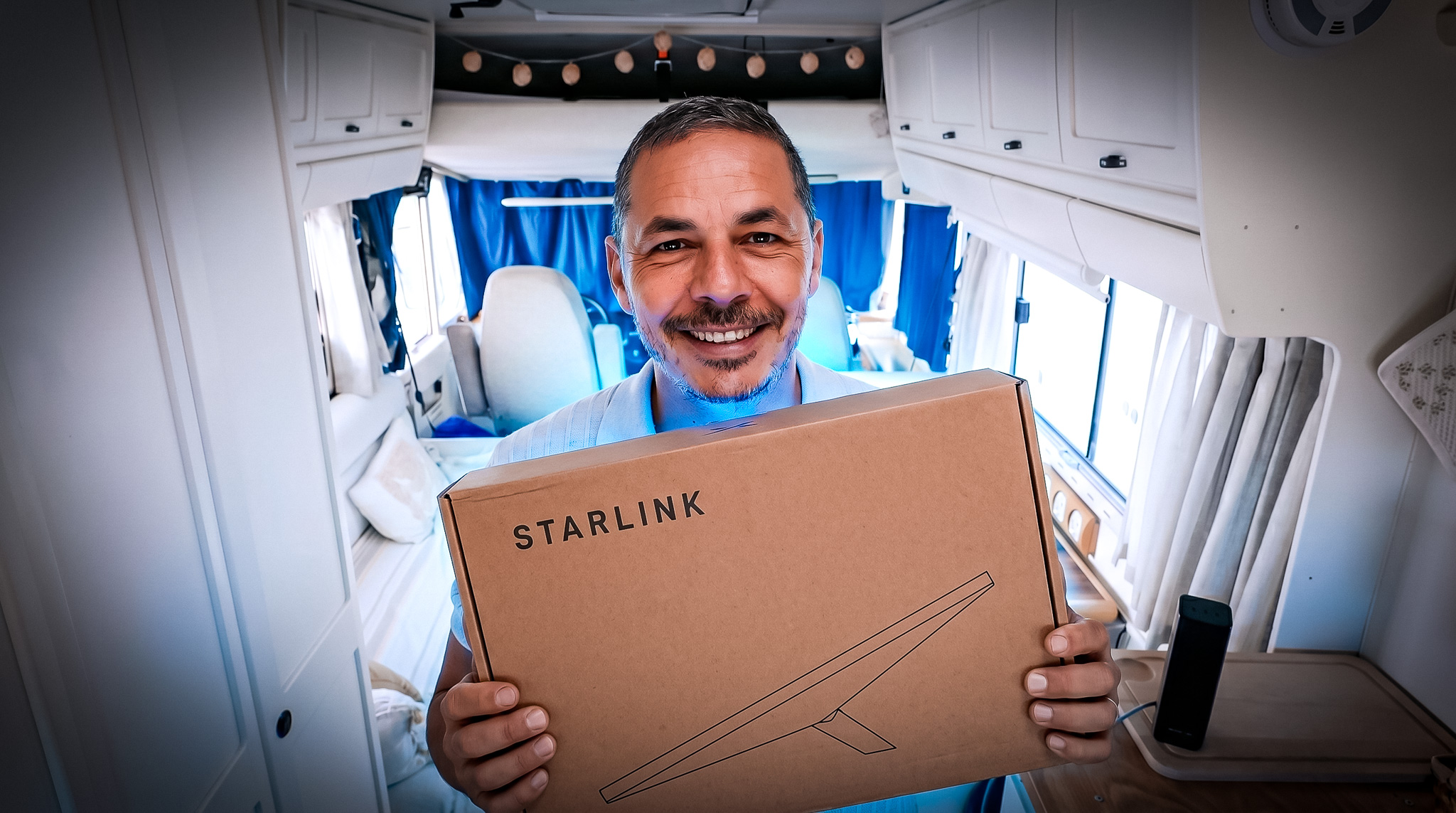
The vanlife has become widely popular in recent years.
And the fact that so many travelers are hitting the road today is no coincidence. Largely thanks to solar energy, which allows for greater autonomy, but also due to the possibility of having a reliable internet connection to work from almost anywhere.
For a long time, 4G and 5G plans with SIM cards were the go-to option for staying connected while traveling. Simple, accessible, and effective in many areas, they have accompanied an entire generation of nomadic travelers.
Then Starlink arrived, with a very enticing promise: to provide internet connectivity practically everywhere on the globe, even in the most isolated places.
But is it really worth it for van life or motorhome living? Is it truly suitable for a nomadic lifestyle? And above all, what about the electric consumption on battery, a crucial point when living on the road?
This is precisely what we will explore in this article, through our complete test of Starlink for motorhomes and vans, with real field experience feedback, its advantages, limitations, and our honest opinion.
Starlink in motorhomes: why this equipment has become essential for our life on the road
During our first years in a motorhome, while we were working on the road, we had nearly 5 SIM card subscriptions with 3 French operators as we explain in this article of the internet guide for RoadTrip, to ensure we didn’t run out of DATA, since unlimited abroad didn’t exist, until Elon showed up.
Forget about dead zones and the hassle of saturated mobile networks
The satellite allows you to access the internet in the most isolated corners. You enjoy a stable connection where 4G is non-existent or completely saturated. This is true in theory, and most of the time, it is indeed the case. If you have a clear sky, it’s still incredible, but if there was really an advantage for us, it’s being able to cross a country’s border without having to worry about ordering an eSIM or going to get a local SIM card from a specialized store as we had to do in Switzerland or the United Kingdom. That’s the real Game Changer!
Starlink Mini or Roam: the guide to choosing the right equipment and plan for your budget
Now that you understand the interest in the system, let’s look at the choice of equipment and the actual cost.
The Starlink Mini at £249: the mobility advantage for small spaces
The Starlink Mini is a small revolution for us. Its purchase price is around £249 currently (sometimes dropping to £199 with the Roam activation discount for new customers). It’s a welcome price drop for nomads.
Its format is compact, it’s true. But not necessarily less than our old Teltonika. It does fit into the limited storage of our motorhome. The antenna is directly integrated into the router, which reduces the number of cables lying around in the cabin.
The installation is ultra-quick. You set it up, plug it in, download the app, and boom, you’re connected in 1 to 3 minutes.
Understanding the Roam 100GB at £50 and Roam Unlimited at £165 offers
Roam 100GB (£50/month)
- 100 GB of data
- Europe coverage
- Ideal for emails, GPS, social media
- No commitment
Roam Unlimited (£165/month)
- Unlimited data
- Higher network priority
- Europe coverage + maritime zones
- No commitment
The monthly rates are without commitment. You can suspend the subscription when you are not traveling.

I'm Xavier
I test gear over months, in the van and day to day, and I say what doesn't work. If that saves you one bad purchase, leave me your address.
Ce que vous souhaitez recevoir :
Actual speeds and installation: what we really measured on the ground in Europe
We have therefore tested the performance in real conditions during our recent outings, and we were able to compare it to our old setup.
Speeds of 50 to 100 Mbps measured in real conditions at the stop.
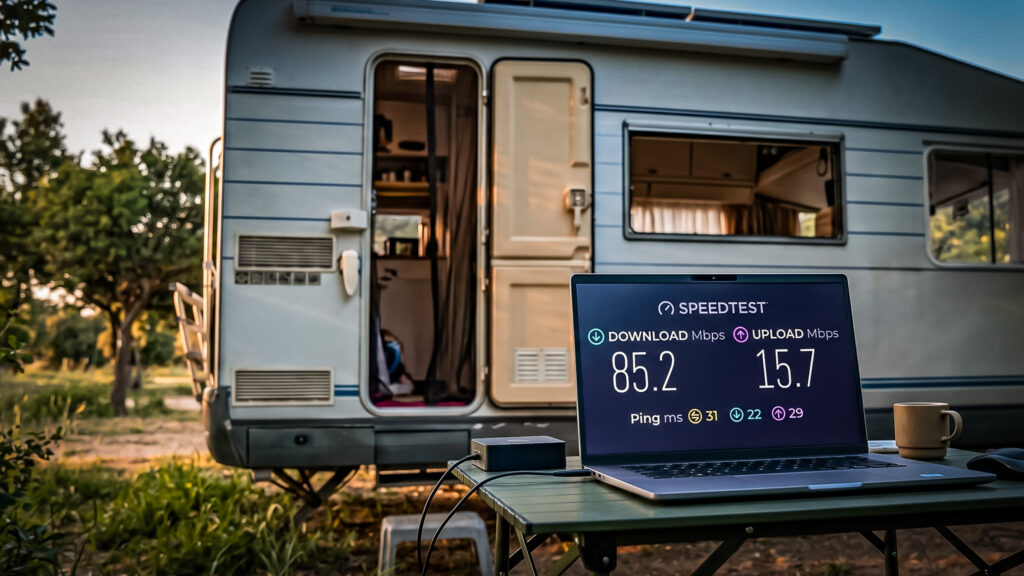
In the countryside, the results are impressive. We easily get between 50 and 100 Mbps. Latency remains stable between 25 and 60 ms.
In dense areas (Mediterranean coast in summer, for example), the signal can drop to between 20 and 50 Mbps. It remains very acceptable.
This is more than enough for smooth video calls. We never experienced any interruptions during our important meetings. Weather has little impact on the signal; even in the rain, it works very well.
Starlink coverage in Europe: our tested spots
Here are the areas where we tested Starlink during our road trips. The quality varies according to the terrain and density of the area.
Map not found.
Mounting your antenna on the roof of the motorhome properly and safely
A clear view of the sky is essential for performance. The Starlink Mini is compact (30 x 26 cm) and weighs only 1.1 kg, making installation easier.
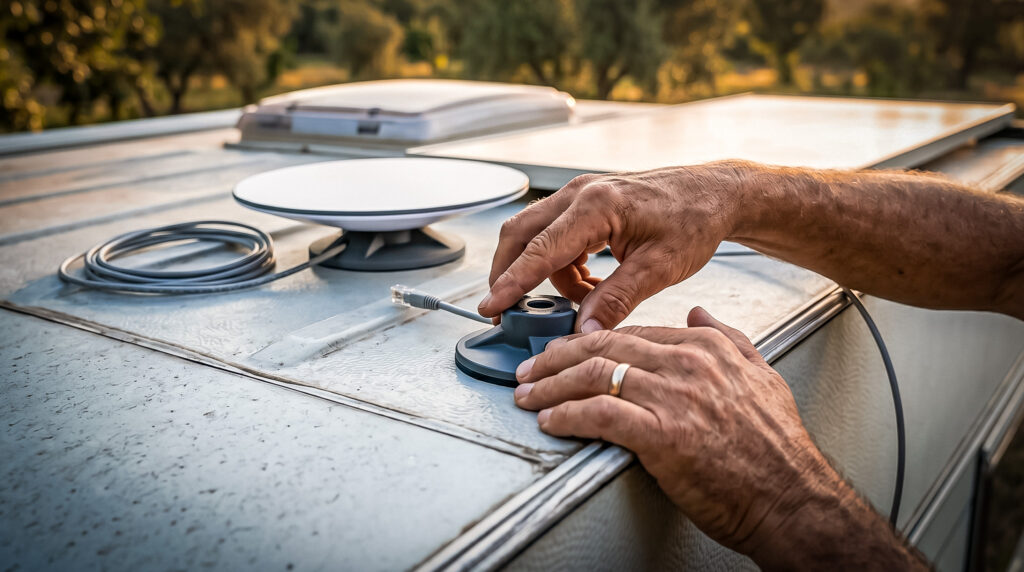
Several mounting options are available:
- Official magnetic mount: the simplest, easily placed and removed from the metal roof
- Permanent mount: aluminum mount with stainless steel screws for a permanent installation
- Suction cup mount: a compromise between the two, suitable for non-metal roofs
Is Starlink faster than mobile phone networks?
That’s an excellent question. And the answer will largely depend on your usage.
When stationary, when the motorhome or van is parked, yes, we can clearly say that Starlink often offers a better connection depending on the areas. In some poorly covered places by 4G or 5G, the comfort is significantly better. For working, making video calls, or sending large files, it’s often more pleasant and stable.
Where the observation is a bit more nuanced is when driving.
In the past, we regularly did live streams on Twitch while driving. And for this type of usage, a continuous connection without micro-disconnections is required. On this point, Starlink posed more problems for us.
Paradoxically, with our old 5G network, we were sometimes able to stream live for over 180 km without any interruptions.
However, we must recognize a real advantage to Starlink: the antenna can be used at home and then moved to the vehicle. This versatility is interesting for those who alternate between home and travel. (Even though, in my case, my current modem does exactly the same thing.)
Energy and security: stay connected without draining your batteries or risking your data
Does the modem work on a 12V battery? Well, no, unless you perform a manipulation that voids the warranty, you’ll need to use a converter, which is a small downside where, once again, my Teltonika works with a cigarette lighter plug and consumes almost nothing (it’s a modem that we put in certain cash withdrawal machines that are connected to the internet, you can imagine how reliable the thing must be!)
How much does Starlink consume in the camper van?
The Starlink Mini model consumes about 30 to 50W in operation. Over an 8-hour usage day, this represents about 240 to 400 Wh.
A portable battery of 1000 Wh (like EcoFlow or Allpowers) can power Starlink for 2 to 3 days. With a 200W solar panel, you can offset continuous consumption in good weather.
Our advice would obviously be to turn off the router at night. It seems simple, but it saves a lot of precious energy for the next morning.
Equipping your van with Starlink gives you a total digital freedom with stable speeds, even in a dead zone. Between the compact Mini format and the flexible Roam plan, secure your data with a VPN and monitor your energy to never lose track. For digital nomads like us, it has become an investment as essential as solar panels.
Frequently Asked Questions about Starlink for Motorhomes and Vans
Does Starlink work while driving?
No, not with the Starlink Mini or the residential kit. The antenna needs to be stable and have an unobstructed view of the sky to connect to the satellites. However, as soon as you park and deploy the antenna, the connection is established in 1 to 3 minutes. The Starlink Roam option allows usage on the move (stopped) anywhere in Europe.
What is the power consumption of Starlink in a camper van?
The Starlink Mini consumes between 30 and 50W in operation. Over an 8-hour usage day, this represents about 240 to 400 Wh. A portable battery of 1000 Wh (like EcoFlow or Allpowers) can therefore power Starlink for 2 to 3 days. With a 200W solar panel, you can offset the continuous consumption in good weather.
Starlink or Holafly eSIM: which one to choose?
The two solutions are complementary. The Holafly eSIM is ideal for short trips (1 to 3 weeks): no equipment, instant activation, unlimited data. Starlink is better suited for long-term nomads who need a stable connection for remote work. For weekends and holidays, Holafly is more than sufficient.
Do you need a special subscription to use Starlink in Europe?
Yes. The standard residential plan only works at your installation address. For mobile use in a camper van, you need to subscribe to the Roam 100GB option (£50/month) or Roam Unlimited (£165/month). The difference: Roam Unlimited offers superior network priority and covers more maritime areas.
Can you use Starlink without a solar panel?
Yes, a portable battery is enough. With a 500 Wh battery, you can run the Starlink Mini for about 10 to 15 hours. Then recharge while driving (12V cigarette lighter socket) or at a camping electric charging station. The solar panel is a real plus for complete autonomy, but not mandatory.
Does Starlink work in forests and valleys?
This is the main weak point. Starlink needs a clear view of the sky (about 100° field of view). In dense forests or in a narrow valley, the signal will be degraded or even nonexistent. In a parking lot in a clearing or on a plateau, no problem. The Starlink app allows you to check for obstructions before setting up.
What speed to expect with Starlink in a motorhome?
In low-congestion rural areas (the majority of vanlife spots), the Starlink Mini offers 50 to 100 Mbps for downloads and 5 to 15 Mbps for uploads, with a latency of 25 to 60 ms. This is more than sufficient for remote work, video conferencing, and 4K streaming. In very busy areas (Mediterranean coast in summer), speeds may drop to 20-50 Mbps.
How to mount the Starlink antenna on the roof of the van?
Several options exist. The official Starlink magnetic mount is the simplest: it attaches to the metal roof and is easily removable. For a permanent installation, an aluminum mounting bracket with suction cups or stainless steel screws works well. The Starlink Mini is compact (30 x 26 cm) and weighs only 1.1 kg, making installation easier. Remember to pass the cable through a waterproof cable entry.
Connected everywhere, and the rest of the trip
Two years of full-time van life, and the Algarve as our base ever since. We still hit the road, by van or otherwise, and we write up what we find along the way. An email when we have something to say, no more.
Ce que vous souhaitez recevoir :