



Well, the dream is this: we drive, the scenery rolls by, and the money transfer comes in while we sip our coffee in front of the ocean. Caro and I finance life on the road with a mix of income streams we’ve tested on the ground since the Hymer (from affiliate marketing to bitcoin mining… yes yes), and I can personally tell you that most travelers we meet are disillusioned within two months. Because financial freedom requires a colossal amount of work upfront, and a strong discipline to avoid running dry between stops (like, really dry, the kind where “we sleep in the rest area because we can’t afford the campsite”).
And let’s be honest, we often spend more time looking for a stable internet connection than enjoying the view (I don’t know why, but in Southern Spain, it’s always a disaster). So here it is, in this article we break down 10 concrete ideas to generate passive income for vanlife and build a resilient financial system tailored to your adventure. No miracle promises, just what we do, and what we’ve seen work for friends we’ve met on the road.
Before you dive in: discover your passive income profile
So before you get lost in the 10 ideas below, do yourself a favor and answer the 6 questions in the quiz just below. In 2 minutes, you’ll have your profile (Investor, Creator, Marketer, or Pragmatic) and 3 concrete actions to get started. That way, you know right away which section to jump into first.
Which passive income vanlife is right for you?
And to get an overview before diving into the details, here are the 10 ideas summarized in a table: how much you need to invest upfront, what you can expect to earn each month, and how truly passive it is (the stars are the ratings from Caro and me, not a theoretical benchmark).
The 10 passive income ideas in vanlife: comparison table
| Idea | Initial investment | Estimated return | Passivity |
|---|---|---|---|
| Cloud mining (BTC) | £100 to several thousand | Variable, depends on BTC price | ★★★★☆ |
| Affiliate marketing | Very low (blog + time) | £50 to £2,000 / month | ★★★☆☆ |
| Van rental | Van purchase price | £500 to £1,500 / week peak | ★★☆☆☆ |
| Ebooks and guides | Time + design | £100 to £500 / month | ★★★★★ |
| Stock photos and YouTube vlogs | Photo / video gear | Highly variable, low at start | ★★☆☆☆ |
| Online courses | Modest (mic, camera) | £500 to £3,000 / month | ★★★★☆ |
| Dropshipping | Ad budget + shop | Unlimited but risky | ★★★☆☆ |
| Buy-to-let real estate | Deposit + mortgage | £200 to £600 cashflow | ★★★★☆ |
| Stocks and dividends | A few hundred £ | 3 to 8% per year | ★★★★★ |
| Asynchronous freelancing | Skills + computer | £20 to £60 / hour | ★☆☆☆☆ |
Passive income in vanlife: between myth and reality in 2026
So before we tackle the ideas in detail, let’s lay the groundwork… because otherwise, we’ll be making up stories. Generating income while traveling relies on a mix of investments (dividends, real estate, cloud mining) and automated digital assets (ebooks, affiliate marketing, courses). Total passivity remains a myth (really, sorry for those who wanted to believe), expect 12 to 18 months of initial effort before it starts looking like something.
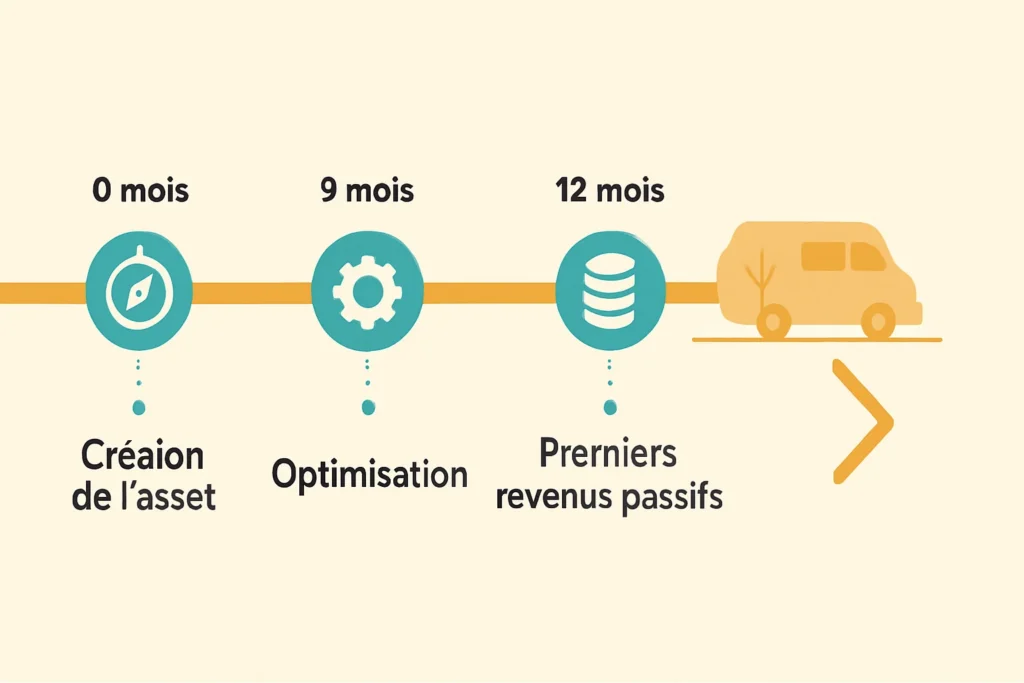
Going from dream to reality mainly requires understanding that money doesn’t fall from the sky without a solid upfront effort. And personally, I wish someone had told me this sooner.
Why 100% passive income is often a mirage
Okay, let’s be clear for a second. Financial freedom requires a colossal amount of work upfront. Nothing is free. Content must be created, an audience must be built, systems must be tested before departure… otherwise, you set off with rose-colored glasses and come back in a panic 3 months later to get a full-time job (I saw two couples do this in 2024, it’s tough).
And forget the promises from social media, I beg you. Dream sellers hide their failures (of course, it sells better to show pictures of a palm tree than an overdrawn bank account). Reality demands discipline, regular technical maintenance, and a bit of patience.
The term “passive” is misleading (I admit, it’s even a bit of false advertising). In reality, it’s about deferred income: you invest massive time today to reap tomorrow. That’s it.
So be realistic, okay? Without initial effort, no money transfer will come in… and believe me, the feeling when you realize this halfway through is not the best travel memory.
To avoid ending up dry in the middle of nowhere (like in a Portuguese village with no accepted credit cards, been there), you need to learn to juggle multiple sources of profit.
The art of building resilient income streams
And there’s the key word: diversify your income sources. Never depend on a single algorithm (an algorithm can get you kicked out overnight, I’ve seen friends lose 80% of their traffic in one night). Seasonality impacts your needs, your mental availability varies with your stages, so you need to plan flexibly.
Personally, Caro and I intelligently combine our income streams. We use stock dividends (the most relaxing thing there is), keep some freelancing gigs for rainy weeks, and let the content run in the background. This duality ensures a necessary psychological safety… because freedom is great, but the anxiety at 2 AM in the van when you don’t know how to make it to the end of the month is draining.
Investment feeds active work, that’s the virtuous circle. Automatic income pays for fuel, active work finances new projects. Boom, it runs by itself (well, after a year and a half of hard work, that is).
Financial resilience is the key to everything. Multiplying small stable streams is better than one big precarious contract, especially when you’re 1000 miles from home.
Bitcoin cloud mining with GoMining
So once we understand that absolute passivity doesn’t exist, we can turn to cool technological tools, like dematerialized mining. GoMining allows you to mine Bitcoin without the hassle of noisy machines (and believe me, in 6m² of van, an ASIC is just not possible, neither for the ears nor for the camping neighbors). Basically, you simply buy computing power via NFTs, and the platform takes care of the rest.
But be careful, it’s a real risk investment, it’s absolutely not a guaranteed income. Profitability directly depends on the Bitcoin price and network difficulty (so if BTC takes a hit, your income follows). However, if the market rises, the gains naturally follow… and then it’s quite pleasant to check the rewards in the morning.
On the budget side, the initial investment ranges from £100 to several thousand pounds. The potential gain remains variable depending on the state of the cryptocurrency market. Personally, the level of passivity deserves 4 out of 5 stars (because zero maintenance is the dream).
Here’s the honest advice from Caro and me: never put in more money than you can afford to lose, really. Use promo codes to optimize your entry onto the platform (it doesn’t change the view but it eases the bank account). In short, be cautious with your capital.

Mining Bitcoin in 2026: Complete Guide for Beginners
With models like the Antminer S23 Hyd already displaying an efficiency of 9.5 J/TH for 2026, mining bitcoin is no longer a bedroom hobby but a real race for technological...
Read more
Gomining referal discount code: Easily mine Bitcoins without hardware
Now we're going to talk about a finance topic that can help you accumulate money while you travel. This isn't yet another solution that will make you rich (unless you...
Read more
Affiliate marketing and content monetization
If crypto gives you cold sweats (legitimate), affiliate marketing allows you to monetize your audience more organically. The principle is simple: you recommend products that you genuinely use in your van, and you earn a commission on each sale generated. It’s perfect for a blog or an engaged Instagram account… as long as you really use what you recommend (otherwise, you lose your credibility in 3 posts; I’ve seen accounts burned like that).
The initial investment level is very low (a blog, a bit of time, that’s all). The potential earnings range from £50 to £2000 per month depending on the audience. The level of passivity is 3 out of 5 stars (you still have to write a bit, you know).
So you need to produce quality content regularly. Links should be integrated naturally (like, not the thing with 14 banners per paragraph; it’s not 2008 anymore). Honesty with your community is the key to success, everything else builds on that.
And be careful not to become a walking billboard (personally, it drives me crazy when I see vanlife accounts recommending everything and anything between two filtered sunrises). Choose partners who share your nomadic values. Trust is lost faster than it is gained; it’s something to keep in mind constantly.
Renting out your van when you’re not using it
Now, this is an idea that many forget: sometimes, your best financial asset is just sitting under your feet when you’re taking a sedentary break at your parents’ place (experienced it, several times). Why let your house on wheels gather dust when it could finance your future fuel fills?
Rent your vehicle on specialized platforms during your downtime. It covers maintenance costs, annual insurance, and sometimes even a bit more. It’s a concrete and local source of income, an excellent way to make the initial investment pay off (which stings, let’s not kid ourselves).
Initial investment level: the price of the van, so… there you go, it’s not nothing. Potential earnings: £500 to £1500 per week in high season. Level of passivity: 2 out of 5 stars. So it’s not money falling from the sky without effort; I’m warning you right away.
You have to manage the check-ins and cleaning (and believe me, there are tenants who return a van to you… yeah, let’s stop there for the details). It’s a semi-active activity that requires good organization. Get specific insurance for rentals; platforms often offer temporary contracts suited for that.
Caro and I really advise filtering tenants well. Your van is your home. Don’t entrust it to just anyone without solid guarantees; a good human contact is essential before handing over the keys (personally, I always do a video call before confirming; it filters a lot).
Renting an RV or mortorhome to Generate Extra Income
Renting out your RV can be a significant source of additional income. This article explores the best platforms for listing your vehicle, the pros and cons of peer-to-peer rentals, and...
Read moreSelling ebooks and digital travel guides
Well, beyond the material, your knowledge of the best routes can also be turned into a digital product. Compile your best spots, your tips, your tested itineraries into a polished PDF. Sell it directly on your site. Once written, the guide sells itself while you’re on the road (the dream, really; it’s the closest thing to real passive income).
Initial investment level: time and a bit of design (or Canva if you’re lazy, like I am sometimes). Potential earnings: £100 to £500 per month depending on the niche and audience. Level of passivity: 5 out of 5 stars. Phew.
It’s the ultimate passive product. It requires no stock or logistics (and that, in a van where every cm³ counts, is precious). Use simple tools to automate delivery after payment; there you go, end of story.
But the content must provide real added value, you know. Don’t recycle what you find for free on Google; be specific about a region or theme (like “30 tested wild camping spots in Galicia with water access”; that sells, “traveling in Europe” does not).
Monetizing photos and YouTube vlogs
And if you prefer images over text, stock photo sites and YouTube offer interesting prospects (on paper). Sell your shots on stock photo sites or monetize your videos through advertising. YouTube requires a loyal audience and a lot of patience… a lot, a lot of patience (personally, we tried, we gave up; you have to be realistic). It’s demanding creative work.
Initial investment level: photo and video equipment (and that adds up quickly). Potential earnings: very variable, often low at the beginning. Level of passivity: 2 out of 5 stars. There you go.
Editing takes a crazy amount of time on the road (and we honestly prefer to drink a beer at sunset than to cut footage). Internet connection is often a major hurdle for uploads, really. It’s a passion that can become profitable… if you’re passionate to begin with.
So don’t count on it to pay your bills immediately; think of it more as a long-term bonus. Consistency is your only ally here (and it’s hard to be consistent when you’re on the road, I can tell you that).

I'm Xavier
I ran my own company for ten years, then we left. I write about what actually pays for this life: the paperwork, the tools, and the real numbers.
Ce que vous souhaitez recevoir :
Transmitting knowledge through online courses
So for those who have technical expertise, online courses are clearly the next level from ebooks. Teach van electrical wiring, SEO, managing an Instagram account, whatever you want… people pay to save time. A well-structured video course sells for a higher price than a PDF; it’s mechanical.
The initial investment level remains modest (a decent microphone, a camera, a hosting platform, and you’re off). The potential earnings range from £500 to £3000 per month depending on your niche. The level of passivity reaches 4 out of 5 stars once launched.
Automating sales is crucial to stay free (otherwise, you become a prisoner of your own business; I’ve seen friends get eaten alive like that). Use simple sales funnels to guide your prospects. Answer students’ questions only once a week; that’s more than enough. It preserves your travel time and energy.
Avoid overpriced courses that stray from reality (they create buzz but damage your long-term reputation). Stay accessible and authentic in your approach. Your expertise must solve a concrete and immediate problem for the buyer; that’s the key to a sustainable business on the road.
Dropshipping or automated e-commerce
Well, selling physical products is also possible without storing boxes under your van bed (thankfully, because the van bed is already filled with poorly folded socks). Create an online store where the supplier ships directly to the customer. You only manage marketing and customer service. It requires excellent advertising skills, really, not just some DIY.
Initial investment level: advertising budget and shop subscription. Potential gain: unlimited but risky. Level of passivity: 3 out of 5 stars (customer service can be time-consuming).
Customer service can become time-consuming (like really time-consuming if you have a product with a defect). Automate as much as possible with template responses. Choose quality products to avoid massive returns, otherwise you’ll spend your evenings in the van managing refunds (absolute anti-dream).
And beware of margins shrinking with advertising costs (Meta and Google are not your friends, they take their cut). It’s a full-time job. Don’t think it’s easy money, personally I find it’s the most stressful of the 10.
Real estate investment as a financial foundation
Well, before hitting the road, securing a tangible asset remains the most solid strategy in our opinion. Buy a small apartment, put it on rental management. The rent pays off the mortgage and sometimes generates a surplus. It’s the foundation of freedom for many nomads we meet (and clearly ours too).
Initial investment level: personal contribution and mortgage (so you need to be bankable before leaving, it requires preparation). Potential gain: £200 to £600 in cash flow. Level of passivity: 4 out of 5 stars.
Delegate management to an agency. You don’t want to manage a water leak from Portugal, believe me… the tenant calling at 11 PM while you’re on the edge of a cliff with no signal is not funny (and it ruins your sunset). It’s a necessary cost for your peace of mind.
Also, plan for a precautionary savings for repairs. Real estate is a long-term game, you need to enter it with that mindset. It’s the ultimate safety net for Caro and me (and it allows us to sleep peacefully during months without extra income).
The stock market and dividends for regular income
If real estate is too heavy to manage (or too expensive to buy today, let’s be honest), the financial markets offer total flexibility. And it’s our favorite.
Invest in dividend stocks or ETFs. You receive a share of the company’s profits every quarter (and when the money hits your account without doing anything… well, personally I find that almost magical). It’s the most passive income form available, there you go. We love this automatic aspect.
Initial investment level: a few hundred pounds to start, it’s accessible. Potential gain: 3 to 8% per year. Level of passivity: 5 out of 5 stars. It’s ideal when you’re constantly on the move and don’t want to check a dashboard every day.
You just need to be patient and not panic during downturns (and believe me, in 2022 we felt the heat, the urge to sell everything was palpable). Reinvest your gains at the beginning to benefit from compound interest. It’s an ant strategy. Time works for you.
And time, precisely, is what turns a small contribution into a snowball. Here’s what £10,000 invested at 5 percent per year (average return of a diversified dividend/ETF portfolio) looks like depending on how long you let it grow:
Compound interest: £10,000 invested at 5% per year
At 30, your starting capital has more than quadrupled, without adding a penny. That’s why we talk about “ants”: it’s slow at first, and then from year 15 the slope takes off.
Use an online broker with low fees (otherwise you give everything to your bank, which is a shame). Educate yourself before clicking buy, really. The stock market is not a casino but a growth tool, that’s how you secure your path. Personally, we’ve been with Degiro since 2021 for the minimal fees, and the referral bonus covers the first trades (perfect when you’re testing your first ETFs without worrying about costs).

Asynchronous freelancing to maintain flexibility
Finally, to complement your passive income (because at the beginning, it won’t be enough, let’s be realistic), on-demand work remains an option.
Offer your services in proofreading, translation, design, development, whatever you know how to do. Work by objectives rather than hours of presence, that’s the key. It allows you to manage your schedule freely, and it’s essential to adapt to unforeseen events (a storm, a change of plans, a meeting… the road shakes you up).
Initial investment level: your skills and a computer. Potential gain: £20 to £60 per hour. Level of passivity: 1 out of 5 stars. Well, it’s not passive, it’s active income, but it pays the bills quickly.
It’s active income, but essential at the beginning, there you go. It finances your future investments. Choose clients who accept flexible deadlines, really. Avoid emergencies that break your freedom of movement (like a client calling you on a Sunday for something “urgent”… no).
And above all, don’t overload yourself with tasks. The goal of vanlife is to enjoy the scenery, not to work more than in a full-time job but with a view. Keep time for the unexpected and discovery. Your well-being comes before revenue, that’s what Caro reminds me when I start to bury myself in work (and personally she is often right).
Successfully setting up your administrative and tax affairs while traveling
Well, generating money is one thing, but knowing how to declare and manage it on the road is another… and it’s often the thing we forget because we’re so focused on departure.
Business registration and legal obligations
So the first step: choose a registered office service for your headquarters. This allows you to centralize your administrative mail without a fixed address (because receiving a registered letter from HMRC in a remote campsite is not ideal). Companies House requires a registered office address for every UK-registered business.
Taxation depends on your primary residence, be careful. Research international tax treaties before making any drastic moves. Don’t neglect the declaration of your income generated from abroad, it’s the kind of thing that catches up with you 3 years later with a tax adjustment (not pretty).
Be really diligent with your invoices. A good accountant remotely is a worthwhile investment, personally I consider it insurance.
Tools and apps to manage your finances
Use online banks to limit currency exchange fees (because paying £3 per ATM withdrawal in Croatia, multiplied by 6 months, adds up). Apps allow you to track your expenses in real-time, which is vital to avoid running dry (and again, the feeling of having £200 in your account 1500 miles away from your friends, let’s avoid that if possible).
Also invest in a good 4G or 5G router, really. A stable connection is your number one work tool. Without internet, your passive income could quickly stop… and your “office by the sea” turns into a freelancer’s nightmare missing deadlines.
Anticipate your dead zones. Download your important documents locally, okay. There you go.
So there you have it, by skillfully mixing affiliate marketing, cloud mining, and digital products, you turn your van into a real profitable office. Don’t wait until you’re broke to diversify your vanlife passive income and secure your administrative tasks (personally, I often think I should have started 2 years earlier, but oh well). Launch your first project today to travel with a free mind tomorrow.
PS: if you’re like us at the start and feel a bit lost with these 10 ideas, start with JUST ONE, the one that excites you the most (or the one the quiz ranked highest for you). The other 9 will come later, that’s it. Safe travels.
FAQ: Passive income in vanlife
Can you really generate 100% passive income while living the vanlife?
Total passive income is often a mirage sold on Instagram. In the real life of a nomad, what is called passive income is actually deferred income. Whether it's for affiliate marketing, selling eBooks, or creating a course, you have to work hard for 12 to 18 months before seeing the first payments come in on their own while you're driving.
The idea is to build an intelligent mix. With us, we combine investments like cloud mining on GoMining with more active freelance missions. This diversity gives you psychological security to enjoy the road without stressing about your bank account.
How to start Bitcoin mining while living in a van?
Classic mining with noisy and energy-hungry machines is impossible in a van. That's where cloud mining comes in. Platforms like GoMining allow you to buy computing power through NFTs, without having to manage physical hardware. No heat, no noise in your 6 m2.
Be careful though: crypto remains volatile. Profitability depends on the Bitcoin price and network difficulty. Our advice: only invest what you can afford to lose and use promo codes to optimize your entry.
How much does a vanlife blog or YouTube channel earn?
Very variable, and often little at the beginning. For affiliate marketing, expect £50 to £2,000 per month depending on your audience and partnerships. YouTube requires even more patience: a minimum of 1,000 subscribers to activate monetization, and it takes 12 to 24 months to achieve significant revenue. Most vanlife creators earn less than £500 per month during the first 2 years.
The advantage: once your audience is established, revenue stabilizes and continues even when you take vacations. Honesty is key: if you lose the trust of your subscribers, you lose your business.
How to rent out your van safely when you're not using it?
On specialized platforms (Yescapa, Indie Campers, Blacksheep), you can earn £500 to £1,500 per week in high season. Enough to cover your annual maintenance costs and more if you rent regularly. It's a semi-active activity: you need to manage the inventory, cleaning, and communications.
Little advice: your van is your home, so filter your tenants well. Make sure you have specific insurance for renting and only give your keys to people you trust. Also, reserve a slot for maintenance between rentals.
What is the average monthly income of a digital nomad?
Very variable depending on the profile. An experienced freelancer (developer, writer, designer) earns £2,500 to £6,000 per month. An established content creator (5 to 6 figures in audience) makes £1,500 to £4,000 per month from affiliate marketing, sponsors, and digital products. A 100% passive investor lives off their dividends or rents, so amounts are highly dependent on the initial capital.
Our advice: aim for a mix of 3 to 5 income sources that each bring you a little. It's more stable than betting everything on a single source.
What are the common scams in passive income?
Beware of anything that promises guaranteed income with no effort. The classics: (1) five-figure training programs with income guarantees (which do not legally exist); (2) crypto Ponzi schemes that promise 30%+ returns; (3) miracle dropshipping sold as passive (in reality, it's a full-time job); (4) 'revolutionary' NFTs without real use cases.
Golden rule: if someone sells you guaranteed income in less than 6 months, it's a scam. Real passive income takes time to build.
Should you quit your permanent job to live in a van?
No, definitely not right now. Our advice: build your alternative income before leaving your job. Aim for at least 6 to 12 months of emergency savings (covering van, health, unexpected expenses) plus 50 to 70% of your monthly needs already covered by your alternative income.
Many vanlifers start by working remotely from their van before transitioning to freelancing. It's more prudent and allows you to test the nomadic life without a leap into financial uncertainty.
Domiciliation and taxation: how to manage while being a nomad?
For your business, you must have a tax address. Three options: (1) a domiciliation company that scans your mail (Welcome, Mailbox France); (2) a domiciliation with a relative; (3) a CCAS if you no longer have a fixed address. It is a legal obligation in France.
For your finances, switch to online banks like N26 or bunq that limit fees abroad. And get help from a remote accountant as soon as your income exceeds a few thousand euros per month: it is a profitable investment that avoids unpleasant surprises with the tax authorities.
We changed our life. Why not you?
We share what pays for all this: creating content, working remotely, the paperwork and the real numbers.
Ce que vous souhaitez recevoir :