Me, who is used to presenting EcoFlow batteries designed for nomadic use, we are radically changing dimensions today. Here, gone are the small setups of vans or camping: with the DELTA Pro Ultra, we discover a crazy energy solution capable of powering an entire house.
So, it’s a true monster that I unveil to you today: a station designed to offer power, autonomy, and comfort, even during the longest outages.
Exterior design of the EcoFlow DELTA Pro Ultra
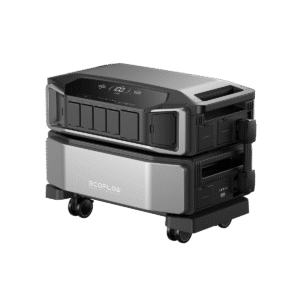
So what does the UFO that is the EcoFlow DELTA Pro Ultra look like? Well, it looks like what many testers have highlighted as: “oh yes, we are no longer in the world of small portable batteries”. Visually, it’s a massive block, but still almost compact despite its size, with a very pronounced industrial look and assembled with blocks that stack on top of each other.
The upper module, for example, is the one that contains the inverter, it immediately catches the eye mainly due to its screen. The latter is truly huge and frankly magnificent, and incredibly bright and readable. Around it, the lines are sharp, a mix of matte black and dark gray that gives an impression of quality, in the manner of this 2025 batch of new ranges that I am aesthetically a fan of. On the front, we find the front sockets perfectly aligned horizontally, which reinforces this very clean, “tidy” aspect, as if everything had been designed to remain discreet as long as nothing is plugged in, and which in my opinion protects the socket from oxidation, and given the price of the product, that’s a good thing. On the front of the X version, there’s a light reminiscent of K2000, for those of you who are older, it’s impressive!
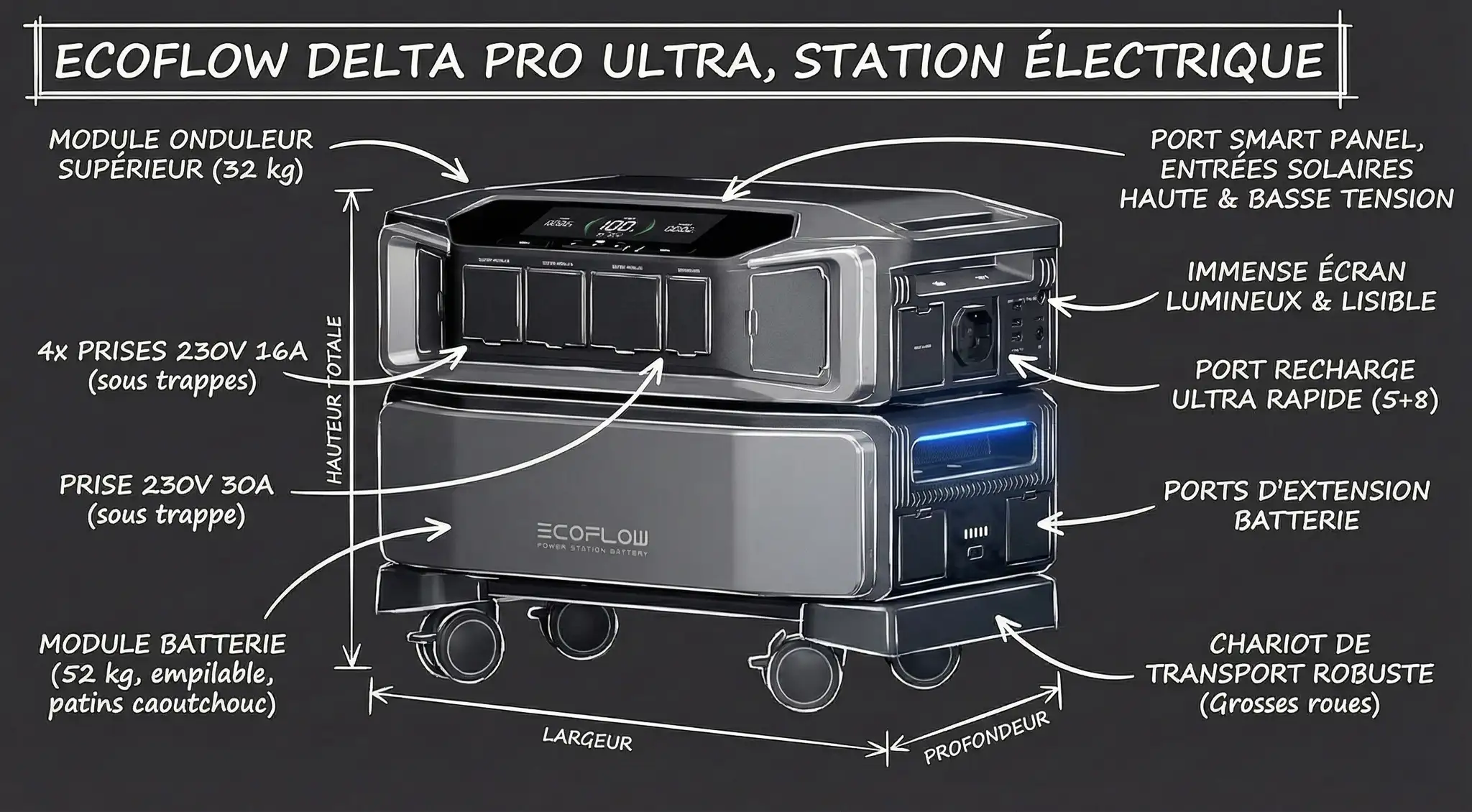
On this front panel of the DELTA Pro Ultra, we find all the sockets: four 230 V 16 A outputs and just to the right, a more imposing 230 V 30 A socket, clearly identifiable. The whole is protected by small magnetic flaps that open and close neatly, immediately giving an impression of serious finishing. The previous generation still offered USB ports on the front, but EcoFlow has removed them here to visually lighten the front and focus on the outputs actually used in a domestic context, as it’s a bit bulky to charge your phone.
On the right side of the inverter module, we then encounter the more “technical” area, the one used for advanced installations: the output intended for the Smart Panel, high voltage solar inputs for residential panels, a low voltage input for portable panels, as well as the famous 5+8 port used for ultra-fast charging. Lower down, the extension ports are also grouped on the side to keep the front clean and clear, making the understanding of the system quite intuitive: everything that is “to be plugged in daily” is at the front, everything related to installation is on the side.
The lower battery, with its satin gray block, is deliberately more understated, almost monolithic, and it “weighs its weight”. And it’s true: visually, it’s massive, dense, compact. Note that small rubber pads underneath immediately inspire confidence: it won’t move an inch once placed. One can easily imagine stacking several modules, each block fitting perfectly into the next: this column design gives a real impression of structure and possible evolution.
Well, you can guess that to move this weight (we’re talking about 32 kilos for the inverter, 52 kilos for the battery, after all….) you will need help, and that’s where we talk about the cart. And “thankfully there are these big wheels”. So, it’s better, we’ll move the product rather than carry it.
Specifications of the EcoFlow DELTA Pro Ultra and Ultra X on paper
On paper, the EcoFlow DELTA Pro Ultra and Ultra X play in a category where very few stations can keep up. They share the same technological base, but each addresses a different level of demand. The Ultra version, already impressive, aims to be a completely autonomous domestic backup solution. The Ultra X, on the other hand, pushes all the sliders to the maximum, with more power, capacity, and integration possibilities for fully electrified homes.
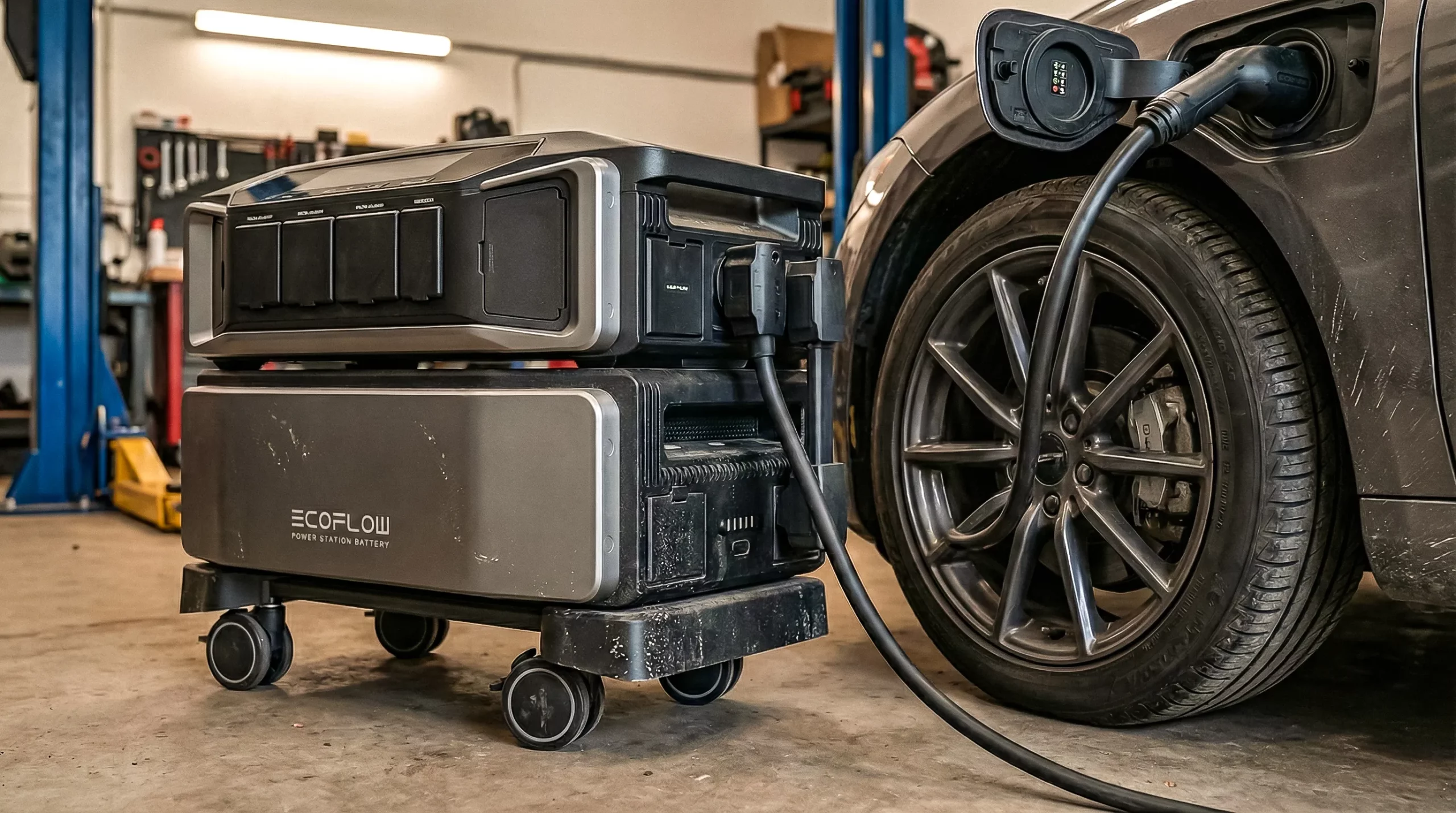
The DELTA Pro Ultra version offers a battery of 6.14 kWh, expandable up to 30 kWh by stacking nearly five modules. Its inverter delivers 6,900 W of power, enough to easily run the most demanding household appliances, while maintaining extremely fast charging thanks to its 6,900 W AC input. On the solar side, it accepts up to 5,600 W of panels, allowing for true autonomous operation for a household, but you will still need to check with your city to see if you are allowed to have a solar electric station in your garden 😅. The batteries use LFP chemistry, with a lifespan of 3,500 cycles, and since it’s for indoor use, it operates quietly under 2,000 W (I find it hard to believe you have a consumption spike above this value).
The DELTA Pro Ultra X, on its side, adopts the same philosophy but in a “complete system” version. Its inverter rises to 12,000 W of continuous power, allowing it this time to power an all-electric home, including heavy loads like a water heater, a well pump, or even central air conditioning. The maximum capacity makes a huge leap, going from 30 kWh to 180 kWh thanks to the ability to stack up to 10 batteries per inverter. The solar input reaches up to 10,000 W, allowing it to harness energy from a true residential photovoltaic installation. The Ultra X is also designed to work in tandem with the Smart Home Panel 3, an intelligent electrical panel capable of managing up to 32 circuits and automatically optimizing energy according to the household’s habits.
How long can a DELTA Pro Ultra serve as backup in a French house
To give a concrete idea, we can base ourselves on the average consumption of a house in France without electric heating according to its size, as estimated by EcoFlow and other industry players. EcoFlow DELTA Pro Ultra and Ultra X as domestic backup means here powering lighting, refrigeration, multimedia, and basic household appliances, while leaving aside pure heating and air conditioning which would explode the autonomy.
These estimates are based on the average consumption ranges of a house without electric heating according to the living area in France, which is approximately 1,800 to 4,500 kWh per year for a house of 80 to 120 m² and 2,500 to 6,000 kWh per year for a house of 150 m² and more (which is between approximately 5 and 16 kWh per day depending on the case). We are here on a reasonable backup usage, without heating or air conditioning powered exclusively by the battery.
| Type of household and size of the house | DELTA Pro Ultra autonomy (from 6.14 to 30 kWh) |
DELTA Pro Ultra X autonomy (from 30 to 180 kWh) |
|---|---|---|
| Couple, house approx. 80 m² (consumption without heating approx. 1,800 to 4,500 kWh/year) |
From 0.5 day to 6 days | From 2.5 days to 36 days |
| Couple with 1 child, house approx. 100 m² (consumption without heating approx. 1,800 to 4,500 kWh/year) |
From 0.5 day to 6 days | From 2.5 days to 36 days |
| Couple with 2 children, house approx. 120 m² (consumption without heating approx. 1,800 to 4,500 kWh/year) |
From 0.5 day to 6 days | From 2.5 days to 36 days |
| Couple with 3 children, house approx. 150 m² (consumption without heating approx. 2,500 to 6,000 kWh/year) |
From 0.5 day to 4.5 days | From 1.8 days to 26 days |
These estimates are based on the average consumption ranges of a house without electric heating according to the living area in France, which is approximately 1,800 to 4,500 kWh per year for a house of 80 to 120 m² and 2,500 to 6,000 kWh per year for a house of 150 m² and more (which is between approximately 5 and 16 kWh per day depending on the case). We are here on a reasonable backup usage, without heating or air conditioning powered exclusively by the battery.

I'm Xavier
I test gear over months, in the van and day to day, and I say what doesn't work. If that saves you one bad purchase, leave me your address.
Ce que vous souhaitez recevoir :
Technical test of the EcoFlow DELTA Pro Ultra
From the first manipulations, the EcoFlow DELTA Pro Ultra immediately gives the feeling of dealing with a machine of another level. We are no longer on a simple portable station that provides backup while traveling: we clearly shift into the realm of systems capable of taking over an entire house without the occupants even noticing (and this shift is truly striking).
Network Switch Test
One of the first tests is to check the ASI switch. Power cut at the panel… and no noticeable interruption. No “click”, no delay, no weakening of devices in use. The system switches to battery in less than 20 ms, and everything continues as if the network had never gone down. Several testers insisted on this point, and the experience fully confirms it: it is impossible to feel the transition.
Power Test
Next comes the question of power: 6,900 W continuously, and this is immediately felt. A fridge, a freezer, a washing machine, a TV, lights, a computer, and even a light oven can operate simultaneously without the EcoFlow showing the slightest sign of weakness. As long as electric heating and heavy resistance devices are set aside, the station handles everything with surprising ease. (It’s hard not to be impressed by this stability.)
Charge Test
Recharging is another moment that leaves an impression. With an AC input that can reach 6,900 W, the battery charges very quickly, even on a setup that doesn’t send the theoretical maximum. In solar mode, the behavior is just as solid: up to 5,600 W of input, which allows during the day to power a household while recharging the battery. For those interested in real autonomy, this solar input range completely changes the game.
Sound Test
On the noise side, the DELTA Pro Ultra remains surprisingly discreet. Under 2,000 W, the ventilation is almost imperceptible: you have to get close to check that the device is indeed running. Above that, the ventilation can be heard, but remains largely acceptable for a system capable of such power. The only point noted by several testers: a slight flicker on some LEDs during transitions or load stabilizations. Nothing problematic, but a notable detail.
Smart Home Panel Compatibility
The integration test via Smart Panel clearly shows the product’s intent. EcoFlow automatically manages circuit priorities, switches to backup as soon as the network goes down, stores excess solar energy, recharges during off-peak hours… everything runs in the background with remarkable fluidity. Once set up, the whole system operates like a true energy interface for the house, without requiring any daily intervention.
Autonomy Compatibility
In terms of autonomy, a module of 6.14 kWh is already sufficient to last several hours or several days depending on usage. By stacking up to 30 kWh, the DELTA Pro Ultra can cover long outages and maintain a very decent level of comfort. As for the Ultra X version, expandable up to 180 kWh, it clearly enters another dimension: that of systems capable of maintaining a house in prolonged autonomy, especially when coupled with a high-performance solar installation.
Overall, these tests confirm what the specifications hinted at: the DELTA Pro Ultra is not an “enhanced portable battery”, but a true domestic power solution. The instant switch, massive continuous power, ultra-fast recharging, modularity, and intelligent management make it a device that completely blurs the line between portable station and high-end residential installation. A system designed for energy security above all, and that fully embraces this role.
The EcoFlow app: a true control center for the DELTA Pro Ultra
The EcoFlow app occupies, as with all other products in the range, a central place in the use of the DELTA Pro Ultra. Upon opening, the station automatically appears in the interface, without complicated setup. The app will give you an overall view of your home system: power consumed, solar energy input, battery temperature, estimated autonomy, as well as the precise status of each module when using multiple batteries; personally, I am a fan of this kind of DATA.
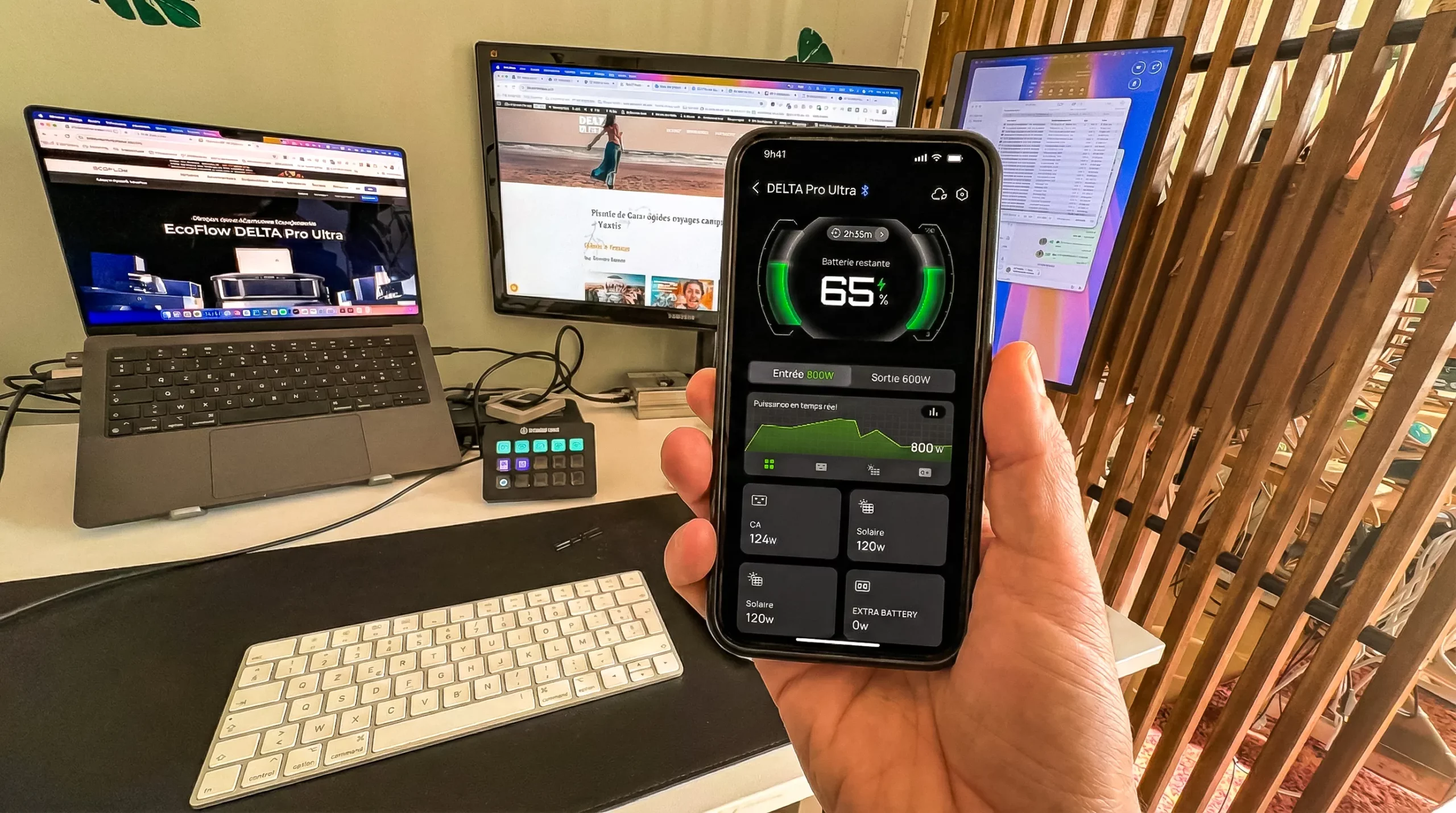
But that’s not all. With a Smart Home Panel, you can choose which circuits in the house are powered, set priorities, or program automatic behaviors based on time, consumption, or weather. Imagine being able to switch entire rooms to battery power with a simple press, and well, the app can do that.
The app also offers different smart modes: Self-Powered to primarily operate on solar energy, Scheduled to schedule charging and discharging during off-peak hours, or even an AI mode (and the term AI is not just there to be trendy, I assure you) that automatically optimizes battery usage based on household habits.
EcoFlow also offers a wall interface called Power Insight, which replicates all the app’s features but in a fixed tablet format, designed as a domestic dashboard. Well, I couldn’t test it, I think having a tablet where the software is installed in app mode would be sufficient for me.
On the odd side of the app, here’s one that also happened to me with my “normal” Delta Pro, and it’s the updates: if the DELTA Pro Ultra powers the Wi-Fi router when an update needs to be installed, it can create a blockage. Why? From what I’ve noticed, during the update, the battery connects to the internet while disabling the output from its ports… but then your modem is not powered… there you go, the snake biting its tail!
Another small point noted: the current inability to disable certain indicator lights directly in the app, a detail that could be improved via a future update.
My opinion and who this battery is for
My opinion on the DELTA Pro Ultra
After studying the EcoFlow DELTA Pro Ultra for quite some time, one thing becomes obvious: we are no longer in the world of classic portable batteries (yes, I know I’m making a revelation here..). We are on a system that approaches not just a domestic installation, but almost (and I say almost, autonomy). And honestly, I think it’s one of the most advanced products EcoFlow has released so far. Several testers spoke of the “top of the top of the top batteries”, and from my side, I find it hard to see how I could go in the opposite direction.
The first thing that struck me is how silent this station is. On my side, I have a Delta Pro under my desk that serves as a luxury inverter; it’s not solicited much, and yet sometimes I can hear it blowing from another room in the house. For the Pro Ultra, some users claim it is “totally silent”, and that was not an exaggeration. Even when charging at several kilowatts, it remains surprisingly discreet. For a solution capable of delivering nearly 7,000 W, it’s just incredible. And honestly, it makes it immediately feasible in homes where a generator would simply be impossible to use because if you have to choose between a device that makes a crazy noise, smells like fuel, and vibrates, compared to a solar generator… the choice is quickly made.
Who is this battery for?
I believe this battery is perfectly suited for those who cannot or do not want to install a generator. Whether for reasons of smell, noise, neighborhood as explained above, or just because it doesn’t fit the environment… the DELTA Pro Ultra does exactly the job of a large generator, but without the drawbacks. Some YouTubers even made a direct comparison: same power, but zero noise, zero fuel, zero maintenance. And for many, that’s a decisive argument. (though we need to see about longevity.)
For those who have a solar installation or want to set one up, this battery also makes a lot of sense. It accepts solar powers that very few stations can handle, and it allows for truly smoothing out household consumption, provided you have a sunlight rate that would keep you safe. Because what could be better in this case than to “transform sunlight into free kilometers” for their electric car (the combination of the two is a banger, it’s almost like having the gas station at home)? With 5,600 W of solar on the Ultra version (and up to 10,000 W on the Ultra X), we really start talking about thoughtful autonomy, not just backup.
However, let’s be honest: this is not a machine made for everyone, yes because “not everyone can afford such equipment”. We are looking at a high budget, designed for households with a real need, not just to charge three phones at a campsite. And indeed, if the goal is simply to power a van, a small secondary house, or a few devices, EcoFlow offers much less expensive solutions that will do the job just fine. Nevertheless, with our promo code, you will save a very significant amount.
In short, the Delta Pro Ultra is not here to look pretty: it is here to do the job, and it does it remarkably well.
Technical specifications
| Capacity | 6,144.00 Wh |
|---|---|
| Net Weight | 32.10 kg (70.77 lb) |
| Dimensions | 690.00 mm (27.17 in) |
| Number of AC Outputs | 5.00 |
| Max AC Output | 6,900.00 W |
| USB-A | 5V-2.4A 12W(×2) Max per port, total 24W |
| USB-C | 5/9/12/15V-3A 20V-5A 100W(×2) Max per port, total 200W |
| DC 12V Output | 12.6V⎓30A, 378W max |
| Solar Charging | 4,000.00 W |
| Display | ✓ |
| Wi-Fi | ✓ |
| Bluetooth | ✓ |
| Warranty | 5.00 an |
| Noise | 30.00 dB |
| Operating Temperature | -20~45 |
| Waterproof Rating | 54.00 % |
| Maximum Expandable Capacity | 30,720.00 Wh |
Our verdict
Benefits
- 6144 Wh usable capacity
- 6900 W AC output
- Expandable with extra batteries
- Solar charging for real off-grid use
- Brand-direct, app and features with no subscription
Disadvantages
- Heavy, meant to stay in place
- A larger investment
A high-capacity unit for serious home backup and self-consumption, best left in place.
EcoFlow DELTA Pro Ultra Power Station promo code
 Out of stock
EcoFlow DELTA Pro Ultra Power Station
CARO5*
*Verified price on 25 August 2026. The final price may vary.
Conclusion, should you buy the EcoFlow DELTA Pro Ultra?
If the goal is to ensure a real domestic backup, reliable, silent, and capable of powering an entire house, then yes, the DELTA Pro Ultra is clearly one of the best solutions on the market. It combines power, responsiveness, and modularity with a quite impressive technical maturity (you can feel that everything has been thought out for real use). This is obviously not a product for everyone, but for households that want serious energy security, an optimized solar installation, or long-term backup, it’s hard to find better today. An exceptional machine for exceptional needs.
Our gear tests, in real conditions
Batteries, solar, conversion, security. What we found after months of real use, and what we would not buy again. An email when we have actually tested something, not before.
Ce que vous souhaitez recevoir :