


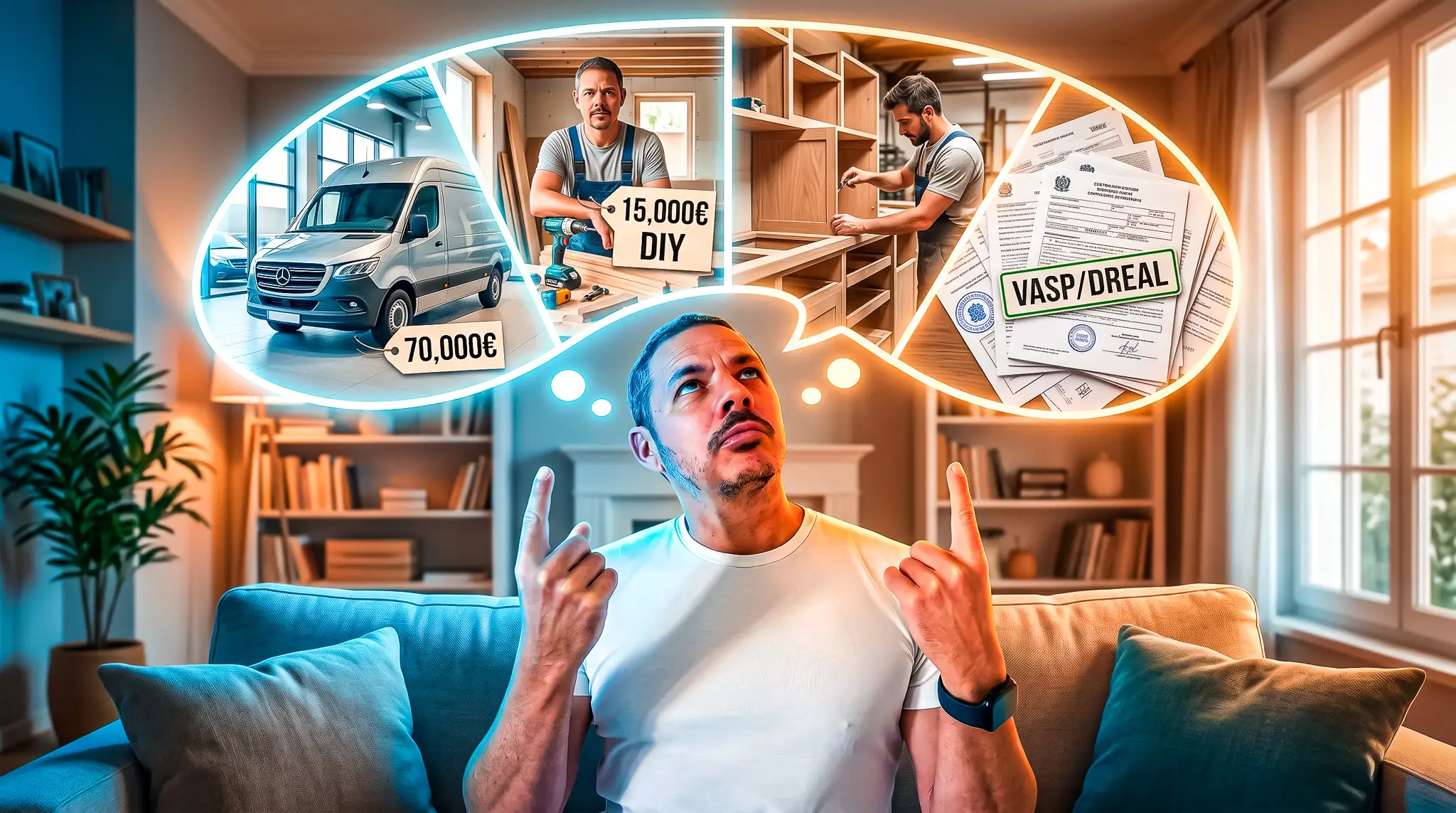
Did you know that a new van costs an average of £70,000 compared to around £15,000 for a complete DIY conversion? Well, yes, that makes a significant difference, and this financial gap can radically influence your way of traveling, as choosing between buying a converted van from a dealer or converting it yourself impacts both your immediate comfort and your DVLA reclassification as a motor caravan. Whether you seek the reassuring guarantee of a manufacturer or the total freedom of custom work, this comparison breaks down the costs and skills needed to ensure that your dream of freedom doesn’t turn into an administrative or financial headache.
Dealer, DIY or craftsman: which option is right for you?
The budget match: how much does your freedom really cost?
After dreaming over landscape photos, it’s time to talk money and compare the two economic models.
The price of a turnkey solution from a dealer
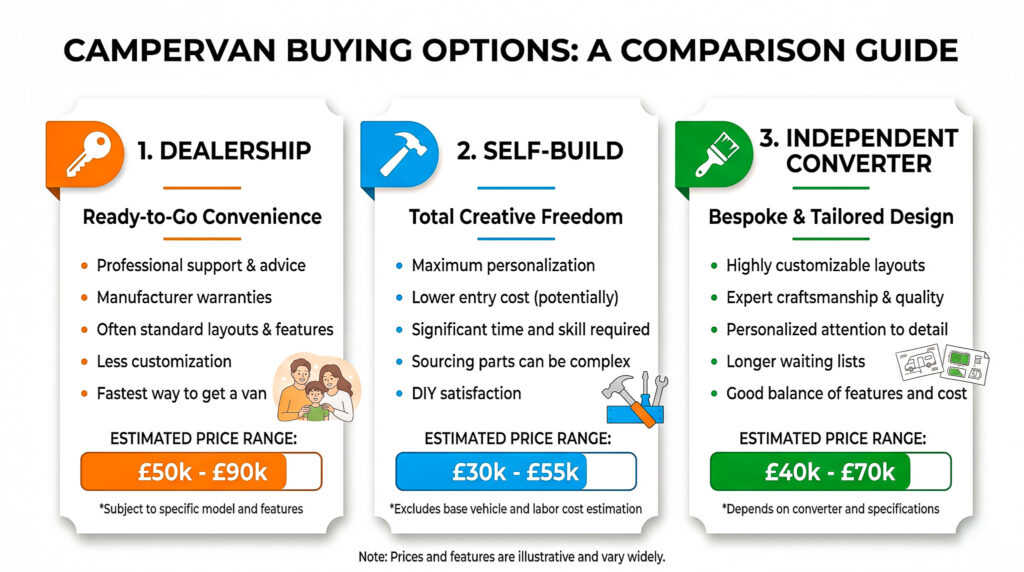
Buying a new vehicle requires a significant investment. Current prices generally range between £50,000 and £90,000. This amount varies depending on the brand and the chosen chassis.
Manufacturer options quickly add to the final bill. A stationary heater or a lithium battery can add thousands of pounds. Each additional piece of equipment can rapidly increase the cost.
Choosing a dealer offers real financial peace of mind. No unexpected costs arise at the start of the project. Everything is included in the initial sale price for total peace of mind.
The real cost of a DIY conversion
Finding a bare chassis is the first step of the project. The second-hand market offers vans between £20,000 and £35,000. The price depends on age and mileage.
Next, you need to estimate the materials and technical equipment. Budget between £10,000 and £30,000 for insulation and furniture. A serious conversion requires quality components.
The hidden expenses that weigh down DIY
Purchasing specific tools is often an overlooked expense. Saws, drills, and measuring tools can be expensive. This budget is significant at the start of the project.
Assembly errors represent a hidden cost that can sometimes be substantial. A botched cut or a ruined panel needs to be replaced. These surprises are common when starting out in self-construction.
Administrative fees for certifications also increase the bill. You must pay for gas and electricity files. These mandatory steps require direct payments to control organizations.
DVLA reclassification: a walk in the park or a maze?
If the budget is approved, the next question is whether you are ready to face the UK administrative paperwork.
The peace of mind of a manufacturer’s certificate
The vehicle leaves the factory already classified as a motor caravan by the DVLA. The buyer has absolutely nothing to do. This is a major advantage for peace of mind.
Total absence of burdensome administrative procedures. No reclassification paperwork to handle yourself. You receive the V5C logbook with the correct classification directly at home.
Immediate compliance with current safety standards. Gas and electricity are already officially certified. The crash tests of the benches are validated by the manufacturer in advance.
The challenge of individual certification
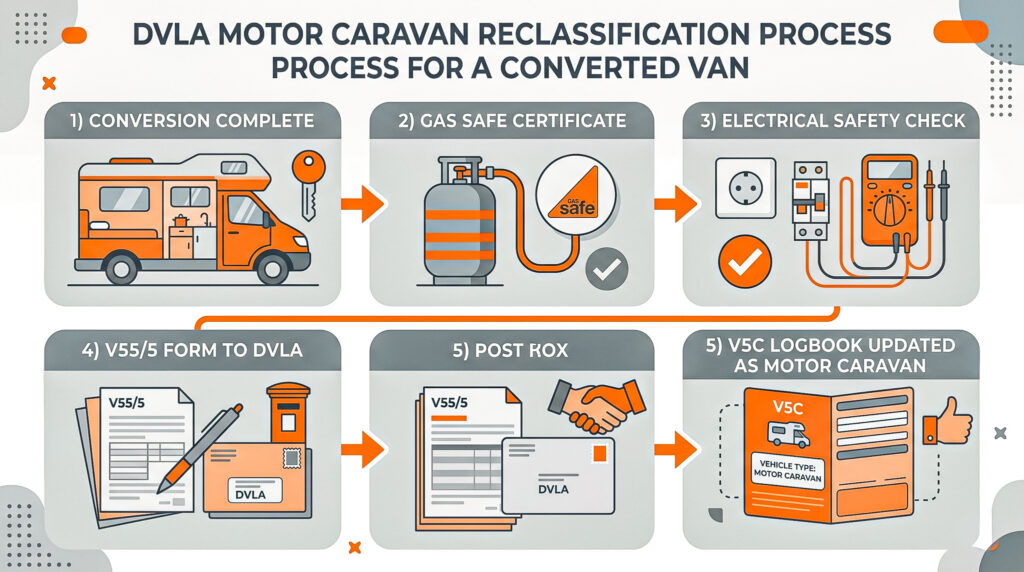
The DVLA reclassification from panel van to motor caravan requires careful preparation. The complexity of meeting all criteria should not be underestimated. It requires patience and absolute diligence.
The DVLA criteria for motor caravan status are specific. You need a fixed bed, cooking facilities, a table, and storage. The conversion must be permanent, not removable.
A gas safety certificate from a Gas Safe registered engineer is strongly recommended. If you have LPG installations, proper certification is essential. This is key to getting your reclassification approved and your insurance valid.
Warranty and after-sales service: who has your back on the road?
Beyond the legal aspect, the question of maintenance and technical failures changes radically depending on your initial choice.
From a dealer
- Manufacturer’s warranty complete (chassis + living area)
- National network of approved garages
- Easier access to standard spare parts
- Quick and certified repairs
In self-construction
- No overall warranty on the conversion
- Each piece of equipment has its own supplier warranty
- You know every screw in your van
- Total autonomy for repairs while traveling
The robustness of manufactured furniture is real. Industrial assemblies are tested to last a long time. They withstand the strong stresses of the road well. Electrical installations are durable, and the fixings are designed to withstand the constant vibrations of the chassis. To learn more about the costs associated with maintenance, check out our complete guide on the maintenance costs of a converted vehicle.

We're Caroline and Xavier
We got most of it wrong before we got it right. We share what actually holds up day to day in a van, and what we wouldn't do again.
Ce que vous souhaitez recevoir :
The time factor: leave tomorrow or sacrifice your weekends?
Once the technique is mastered, one question remains: when do you actually plan to hit the road?
The immediacy of buying from a showroom
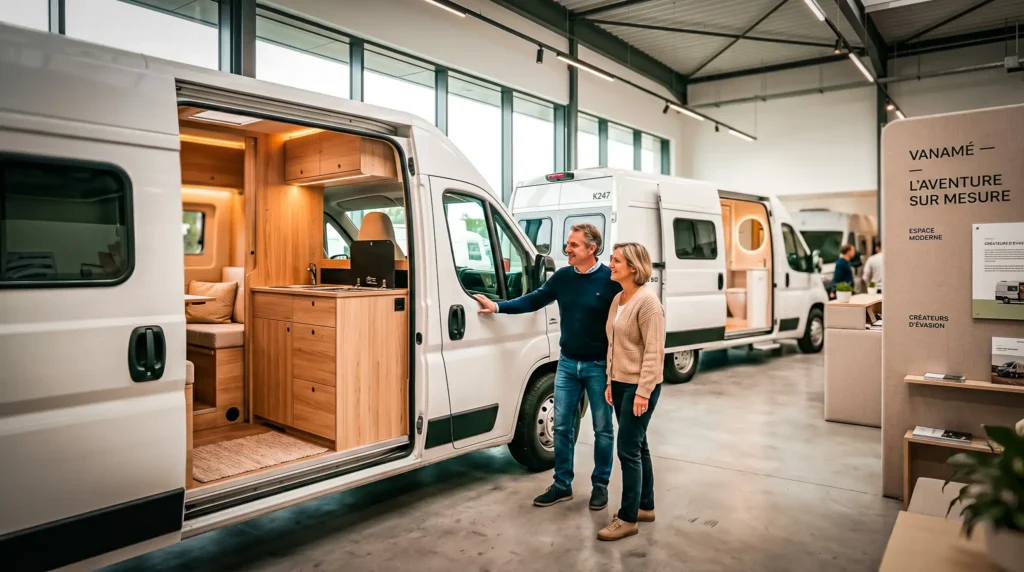
Models in stock offer immediate availability. You can leave with your van almost instantly. This is truly the ideal option for the most impatient travelers. The concept is simple: it’s ready to go. You fill up the tank and finally hit the road.
The months of hard work on a personal project
The conversion requires iron patience. Expect between 3 and 12 months of hard work. It depends on your experience and available free time.
Investing evenings and weekends is massive. The project quickly becomes time-consuming and exhausting. You need to be ready to sacrifice your usual leisure activities for the long term.
Customization or finishes: the dilemma of interior style
The time invested often reflects in the final aesthetics, where professional ergonomics challenge your personal creativity.
The interiors of industrial vans look very similar. The options catalog limits your creative desires. Color choices remain very restricted.
However, experts study ergonomics down to the millimeter. Every nook is optimized by specialized design offices. Usability comfort is guaranteed by years of intensive testing.
You adapt the plan to your actual needs. The bed is placed exactly where you want it. Each storage space is designed for your daily habits.
The choice of materials defines your unique style. Noble wood, reclaimed elements… your interior will look unlike any other on the roads. If you choose this path, check out our guide to designing your van layout with 3D software.
A craftsman offers custom work with professional quality. It’s the perfect blend of originality and technical know-how.
The aesthetic result often surpasses that of an amateur. The details are meticulously crafted with professional tools, and the craftsman handles all the administrative paperwork (including DVLA reclassification).
Material quality and durability
The choice of wood influences overall strength. The plywood of poplar or okoume used by professionals is very durable. The solid wood used in DIY is often heavier.
Weight directly impacts your fuel consumption. An overly heavy layout unnecessarily strains the engine. Manufacturers optimize every kilo to strictly adhere to legal weight limits.
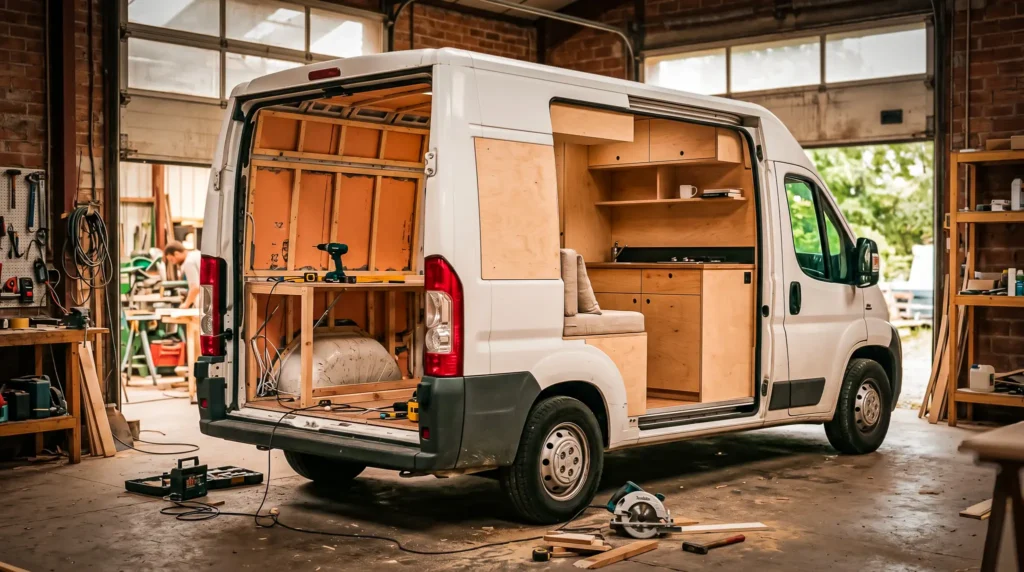
Resale value: protecting your investment
Your aesthetic choices today will directly influence your ability to resell.
A professional layout will depreciate less. The brand offers immediate recognition, the maintenance log reassures buyers, and banks are more willing to lend for a known brand.
A handmade van resells differently. DIY electricity often raises suspicion. You will never recoup your labor costs. Build a solid construction file: photograph each step, especially insulation and cable routing, to reassure the future owner.
Independent converters: the third option
If it seems impossible to choose between the two extremes, know that there is a middle ground often overlooked.
Specialized artisans perform meticulous work. They offer custom solutions with professional quality. An expert can transform your old vehicle into a gem. You save on the base vehicle while taking care of the interior.
In terms of budget, prices range between DIY and dealership. Good workshops are booked months in advance, so you need to anticipate your project very early. You benefit from a ten-year warranty or a compliance guarantee, and the craftsman often handles all the administrative paperwork (including DVLA reclassification).
Comparison: Dealer vs DIY vs Craftsman
| Critere | Dealership | Self-build | Amenageur independant |
|---|---|---|---|
| Budget total | 50 000 - 90 000 EUR | 30 000 - 55 000 EUR | 40 000 - 70 000 EUR |
| Delai | Immediat (si stock) | 3 a 12 mois | 6 a 12 mois |
| Garantie | Constructeur 2-5 ans | Aucune globale | Artisan 1-2 ans |
| Homologation DVLA reclassification | Incluse | A faire soi-meme (DVLA) | Prise en charge |
| Personnalisation | Limitee (catalogue) | Totale | Sur-mesure pro |
| Qualite finition | Industrielle (testee) | Variable (selon competences) | Professionnelle |
| Valeur de revente | Excellente (cote officielle) | Moyenne (si DVLA reclassification) | Bonne |
| Competences requises | Aucune | Bois, electricite, plomberie | Aucune |
| SAV / depannage | Reseau national | Autonomie totale | Contact artisan |
Verdict: which traveler profile matches your choice?
Ultimately, the best choice is not the one that fits your wallet, but the one that aligns with your lifestyle. To help you see more clearly, start by determining which type of vehicle suits your vanlife project.
The comfort and tranquility profile
This choice is for travelers prioritizing safety. If you hate DIY, the dealership is your refuge. A comfortable budget is required, but it’s the choice for stress-free vacations. You turn the key and enjoy.
The passionate and DIY profile
Here, the project is part of the journey. Building your van is an intense human adventure. You learn useful skills for life. If you plan to live in it year-round, do it yourself: you’ll know how to fix everything.
The low-budget and DIY profile
It’s about optimizing every pound. Home layouts allow you to spread out expenses. Access to vanlife at a lower cost, with total financial flexibility: the project evolves according to your income, at your own pace.
Whether you fall for the immediate comfort of a new model or the total freedom to customize your own van, each project is a step towards adventure. Your future office with a view is just waiting for your decision to hit the road!
Frequently asked questions about buying a converted van
How much does a new converted van cost at a dealership in the UK?
The dealership prices start at around £40,000 to £50,000 for entry-level models. For premium vehicles with options (parking heater, lithium battery, solar panel), the bill can rise between £60,000 and £90,000. This price includes the manufacturer's warranty, DVLA reclassification, and a ready-to-drive vehicle.
Is it cheaper to convert your van yourself?
Yes, generally. A used van costs between £20,000 and £35,000, and the conversion between £10,000 and £30,000 depending on the materials chosen. The total is often lower than the price of a new van from a dealership. However, be careful of hidden costs: specific tools, assembly errors, DVLA reclassification fees, and gas/electricity certifications.
Is DVLA reclassification required for a self-converted van?
Yes, it is mandatory in the UK. The DVLA reclassification (Specialized Self-Propelled Vehicle) approval requires an reclassification form with the DVLA, compliance with UK building standards, and gas (Gas Safe) and electrical certifications. Without this approval, your insurance may refuse to cover a claim, the technical inspection may be denied, and resale will be very complicated.
Can you insure a self-converted van?
Yes, but under conditions. Most insurers require DVLA reclassification to cover the living area. Without DVLA reclassification, only the vehicle part is covered, not the conversion. In the event of a claim related to the conversion (gas leak, electrical fire), an unapproved van may have its coverage canceled. Get your van approved before hitting the road.
What is the resale value of a converted van home vs. professional?
A van converted by a recognized manufacturer will depreciate less and sell more easily. Buyers are reassured by the brand, the maintenance log, and the official valuations. A homemade van can also sell well if the work is neat, documented (photos of each step), and especially DVLA reclassification approved. Without approval, expect significant depreciation and months on the listings.
Starting out in a van, and lasting
Two years of full-time van life, and the Algarve as our base ever since. We still hit the road, by van or otherwise, and we write up what we find along the way. An email when we have something to say, no more.
Ce que vous souhaitez recevoir :