


Well, Verona, we’re not going to sell you as a perfect postcard straight out of a catalog, that would be a shame, because this city really comes alive when you experience it for real, with its cobblestones, the heat that hits you all at once, its grand squares, its bridges, and that little very Italian mix between the impressive decor and the life that continues peacefully around it. We arrived there with Édouard at the beginning of a big road trip detour towards Scotland, the kind of diversion we didn’t necessarily see coming at first, and in the end, Verona caught us off guard effortlessly, with an ice cream in hand almost mandatory given the heat, and that rare feeling of stumbling upon a romantic city without being overly sentimental, still lively, beautiful without trying too hard (unlike me when I pretend to understand an Italian city center map at first glance). If you’re looking for a stop in a van or motorhome that combines heritage, food, strolls, and genuine pleasure in wandering, you’ve landed in the right place.
Our city trip to Verona in video
Plan your trip: Italy
Compare rental companies and book at the best price.
Booked on Trip.com — partner link.
Provided by Holafly, our partner.
5% off with code LAPLANETEDECARO
Booked on Holafly — partner link.
Verona, the city of lovers (and much more than Romeo and Juliet)
So, Verona, what is it exactly, apart from the city where everyone immediately thinks of Romeo, Juliet, love letters, and a few well-placed sighs? It’s marketed everywhere as the city of love, and that’s true, but it would still be reductive to sum it up as a balcony that people photograph while gazing up like little love-struck rabbits. It’s primarily an old city in Veneto, situated on the Adige, that river which forms a large loop around the center and immediately gives it a softer relief, with stunning bridges and viewpoints that change throughout the day.
What strikes you in Verona is that the city has stacked centuries without ever erasing them. There’s the Roman heritage, clearly visible with the Arena and the ancient theater, then the great era of the Scaligers, that family of lords who ruled the city in the Middle Ages and left behind its fortresses and Gothic tombs. Then Verona came under the control of the Republic of Venice, which explains the lion of Saint Mark you encounter in the squares, before ending up in the hands of Napoleon and then Austria, until Italian unification. In short, it’s not a frozen museum; it’s a city that has lived, and you can feel that at every corner.
A little parenthesis to set the context of our visit: Verona was our first real Italian stop on a route that was originally supposed to head towards Ukraine, but with what was happening there, we pivoted north to Scotland instead. So we came down from Cannes along the coast to Genoa, then made our way up through central Italy, and Verona was perfectly on the route. Sometimes, the most beautiful stops are the ones you hadn’t really planned.
What to see in Verona: the Arena, the squares, and the bridges
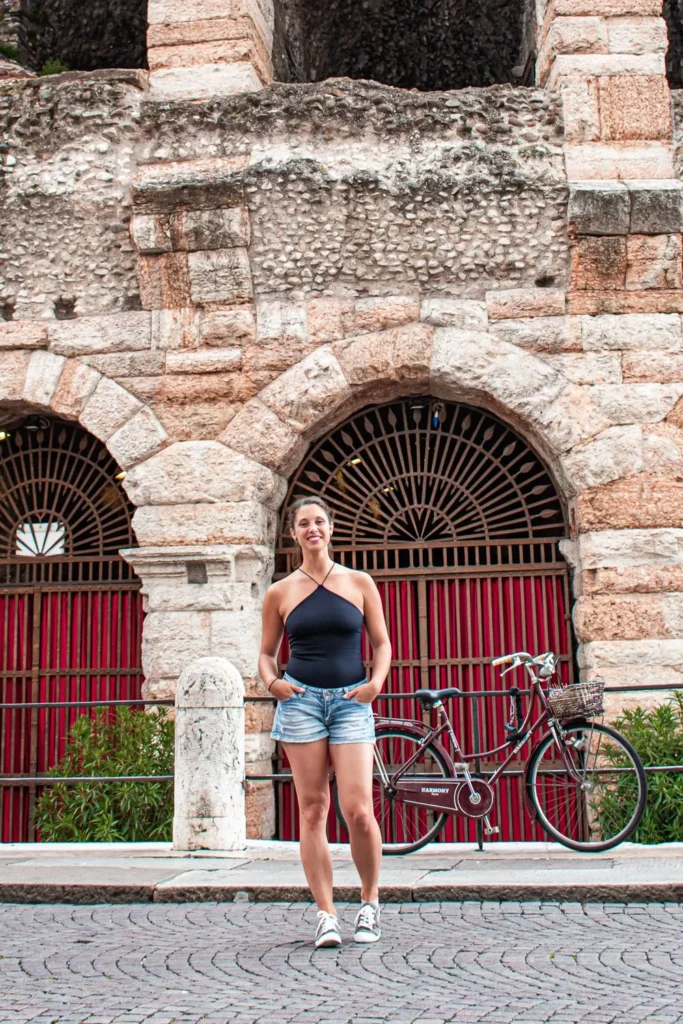
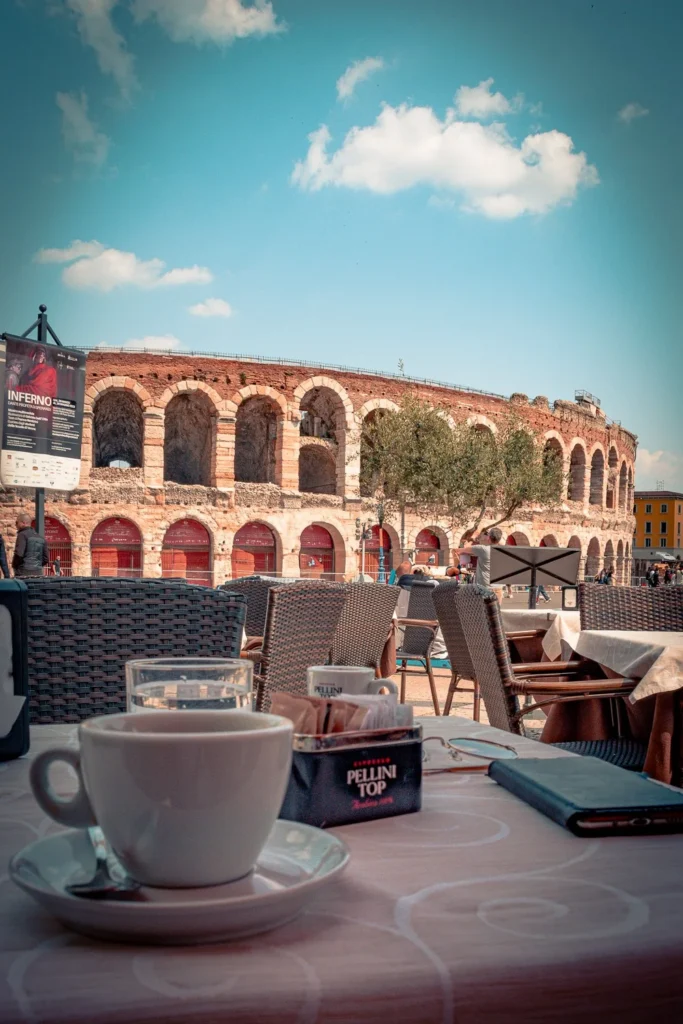
What do we do in Verona, concretely, once we’ve placed Édouard wisely at Porta Palio and avoided the ZTL like almost responsible adults? We started at the Piazza Brà and the Arena, and honestly, the effect is immediate; it’s grand, it’s alive, it’s bustling. The Arena di Verona is nothing less than the third largest Roman amphitheater in Italy after the Colosseum and the one in Capua, built in the first century, capable of hosting around thirty thousand spectators in the days of gladiators. Today, operas and open-air concerts are held there, and on the evening we were there, Zucchero was playing in the arena. Even from the outside, from the square, the sound rose above the stones with that very Italian feeling of listening to something both simple and enormous, without needing to be seated in the pit to grasp what was happening inside.. (a little warning though, the café on the terrace facing the Arena will cost you more than a coffee on the Côte d’Azur, just saying).
As we moved along, we loved Castelvecchio and especially its Ponte Scaligero, which has quite a striking appearance. This fortress was built in the fourteenth century by Cangrande II della Scala, and it served both to protect the city and to provide the Scaligers with a quick escape route to Tyrol in case of trouble. The fortified bridge that extends from it took only three years to build, its main arch rises to nearly forty-eight meters, it was destroyed by the Germans in 1945 and then reconstructed identically with stones retrieved from the Adige, and just that makes you want to linger there longer than for the obligatory photo. It’s the kind of place where you feel the weight of history without a sign shouting at you every two minutes (I know, it’s a terrible transition, but the bridge deserves it)..
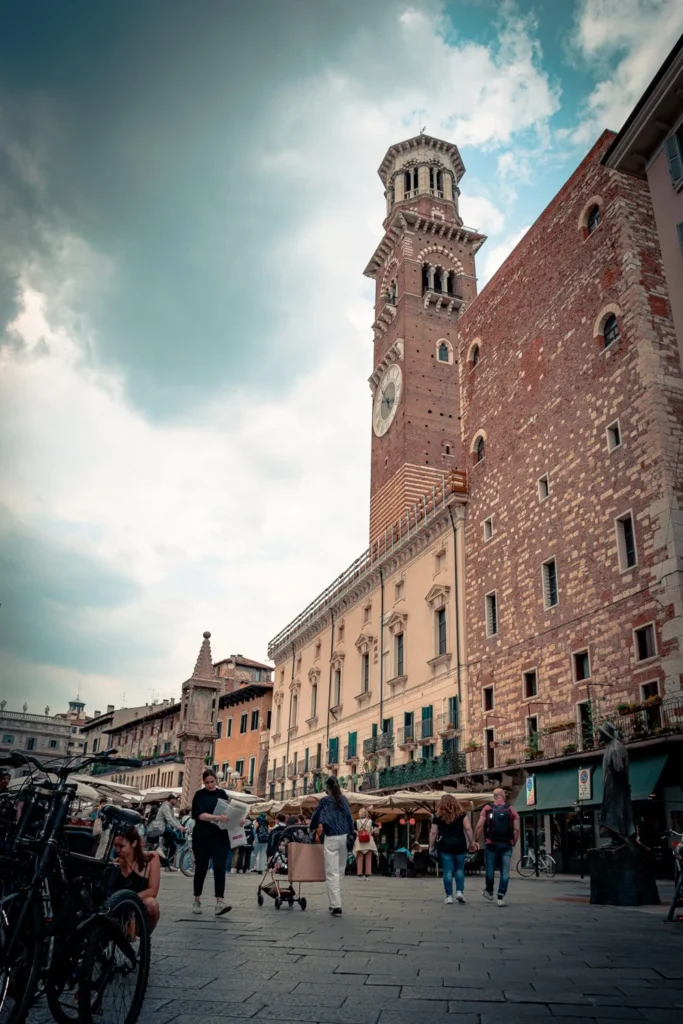
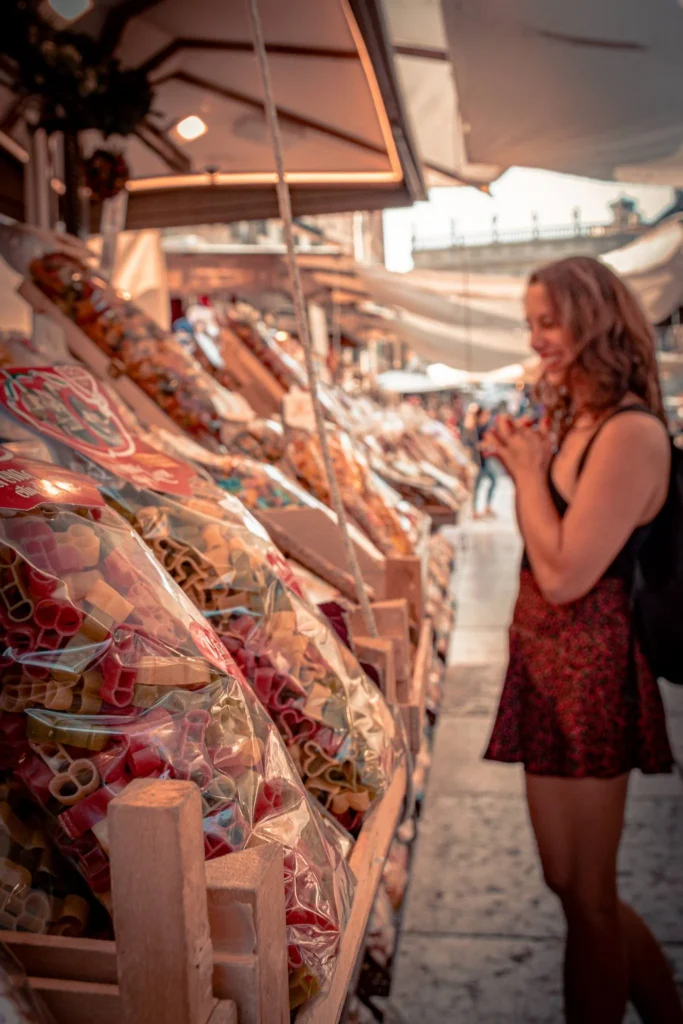
Next, a must-see is the Piazza delle Erbe, the oldest square in Verona, an ancient Roman forum turned herb market, which remains one of the most vibrant squares in the city with its facades, terraces, and some of the oldest Renaissance balconies in the center, along with the Torre dei Lamberti watching over everyone from its eighty-four meters high. So yes, we looked at it from below, very well indeed, because its three hundred sixty-eight steps deserve to be respected with the eyes too, especially when the heat reminds you that wisdom exists. On the stalls, among masks and trinkets, we even spotted pasta shaped like little private parts, wondering ironically whether it really came from Italy or just from the global souvenir market that’s a bit dubious..
Just after, the Piazza dei Signori really appealed to us for its more laid-back, almost nobler atmosphere, with the statue of Dante in the middle that immediately sets a different tone. We stopped there for a spritz as an aperitif, which seems to me a very acceptable way to honor Italian literature, especially since we’re here in Veneto, the very birthplace of the spritz. Right next to it, the Arche Scaligere are worth a visit, these Gothic tombs of the Scaliger family suspended in the air like lace made of stone, and knowing that Dante dedicated the Paradiso to Cangrande della Scala, with whom he lived in exile, adds a bit more depth to the corner, even if, let’s be honest, at that moment we were also thinking about dinner time..
It’s also impossible to miss the Casa di Giulietta, even if for us it turned into a running gag because it was closed.. So the famous Juliet, we mostly approached her from afar, and I was able to deliver my best historical analysis, “mine is better than yours,” which added absolutely nothing to the general knowledge of humanity but made for the joke of the day. For your information, the balcony that people photograph over there was added in the twentieth century for tourist staging, the love story being a fiction by Shakespeare anyway, so it’s good to know before queuing for a crowded courtyard.
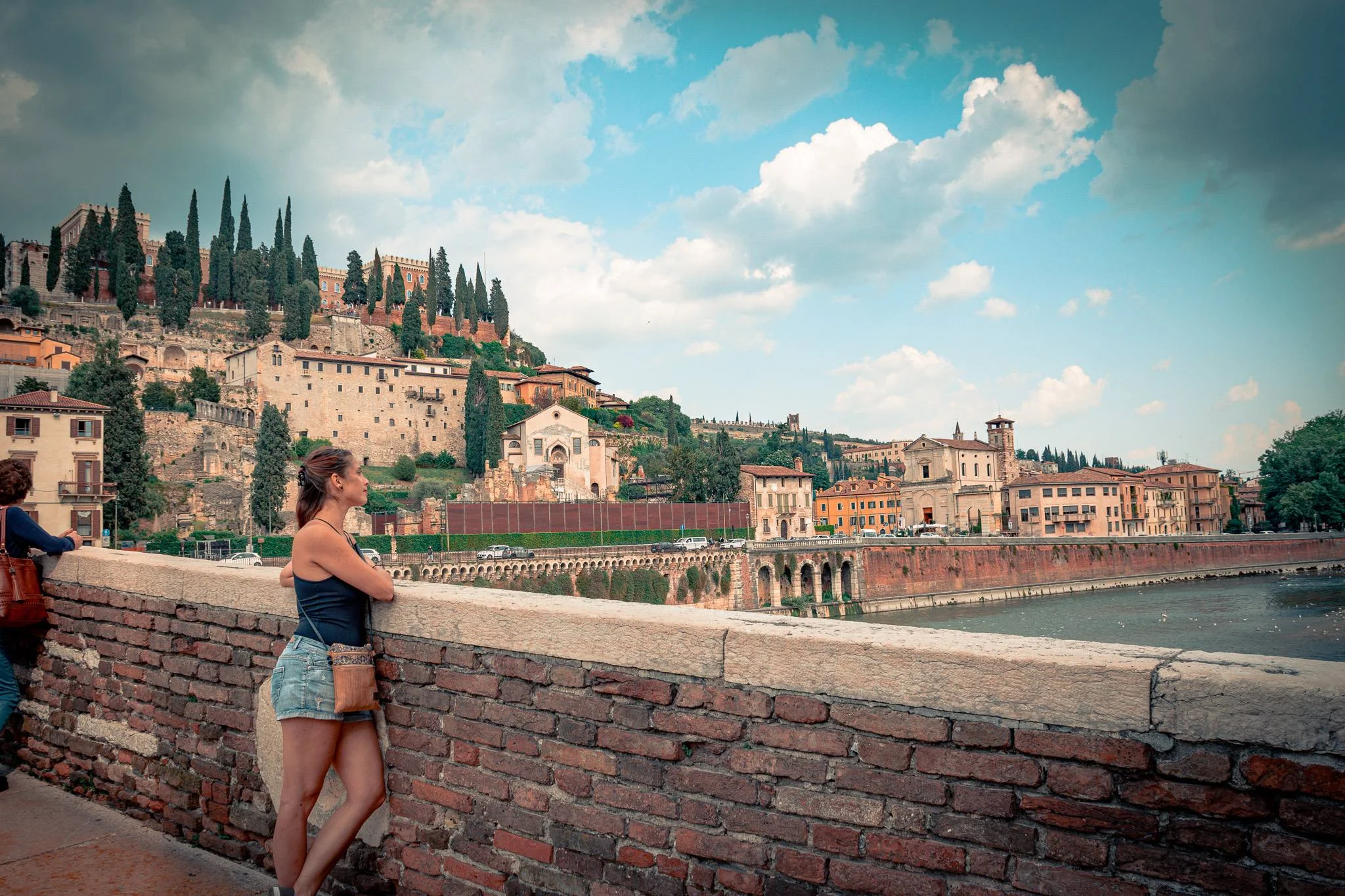
At the end of the day, we headed to Ponte Pietra, a Roman bridge dating back to the first century BC that connects the two banks of the Adige, one of the most beautiful spots in the city for sunset. It was also destroyed in 1945 and then rebuilt with its original stones recovered from the river, and from the bridge, you can see the Teatro Romano high up, an ancient theater even older than the Arena, clinging to the hillside. The light gently falls on the water, the city calms down, and you start to understand why Verona captivates those who take the time to walk without a specific goal.
And then we finished with the climb to Castel San Pietro, on foot of course, because the funicular is great for reasonable people, but we thought we were cool, so up we went the old-fashioned way via the stairs. The viewpoint up there, which occupies the site of an old castle razed by Napoleon and then replaced by an Austrian barracks in the nineteenth century, offers the most beautiful panoramic view of the rooftops, the bridges, the Adige, and the entire historic center. It’s typically the spot where you realize that the city is compact, readable, and full of details, and that you did well to save a bit of energy for the end.
Internet in Italy: check your UK network before you buy anything
Here is the thing nobody puts in the first paragraph of an Italy SIM card guide: whether you need one depends entirely on a decision you made when you last...
Read moreWhere to eat in Verona: cuttlefish polenta and spritz that linger
On the dining side, we finished one of our days at Osteria Sgarzarie, a historic trattoria nestled just steps from Piazza delle Erbe, with a friendly atmosphere and proper Venetian cuisine. I had a cuttlefish served with white polenta, a local specialty, and let me tell you, this dish marked the beginning of a great love for these tentacled creatures, with a stunning visual contrast between the purity of the white polenta and the deep black of the ink. Caroline went for a beef tagliata, thin, super tender, a real delight, and we wrapped it up with a homemade tiramisu that frankly didn’t need to do more to win us over.
If you want to dig a little into the specialties, Verona knows how to host well, and you would be wrong to stick to the easiest classics. Try the polenta, sometimes very rustic, sometimes finer like the cuttlefish ink one, the risotto all’Amarone which has that rich and deep side that you can fully embrace in the evening, the pandoro if you come across a good artisan, and everything that revolves around the drinks you take without too much persuasion, prosecco, spritz, Amarone della Valpolicella… In short, you eat well, you drink well, and you quickly understand why the aperitifs linger here, even when you swore you’d keep it light (yes, of course).
Visiting Verona in 1 day or 2 days: our itineraries
Let’s get practical, because this is often the real question when preparing the trip. Verona can be wrapped up in a big day if you’re ready to walk like a racehorse, but in two days you really take the time to understand the city without coming out with sore legs and a fried brain. Here are the two versions, tested on the ground, with the itinerary we would repeat.
Visiting Verona in 1 day
For an express day, we stick to the essentials and follow a geographical order to save time. In the morning, start from the Porta Palio area, bike or walk to Piazza Brà for the first face-to-face with the Arena, coffee on the terrace and ice cream if the heat kicks in. We then head up to Castelvecchio and its Ponte Scaligero, then we join Piazza delle Erbe and Piazza dei Signori with the statue of Dante. In the afternoon, we pass by Casa di Giulietta, cross Ponte Pietra and climb to Castel San Pietro for the panorama, before heading back down to dine in the center and finishing in front of the illuminated Arena at nightfall. It’s dense, but doable.
Our detailed itinerary, day by day
Day 1, west bank: the amphitheater and the fortress
The Arena, the Castelvecchio and its bridge, sunset over Piazza Brà.
- MorningPiazza Brà & Verona Arena
Departure from the Porta Palio area, first face-to-face with the Roman amphitheater. Coffee on the terrace and ice cream if the heat comes into play.
- AfternoonCastelvecchio + Museum
The Scaliger Fortress and its museum, just before the bridge.
- AfternoonPonte Scaligero
The fortified bridge with a 48 m arch, destroyed in 1945 and rebuilt with stones salvaged from the Adige.
- EveningSunset Piazza Brà
Return to the illuminated Arena, dinner at a trattoria in the city center, then night at Porta Palio.
Day 2, east bank: the squares and the panorama
The great squares, Dante, a Venetian lunch and the view from Castel San Pietro.
- MorningPiazza delle Erbe & Lamberti Tower
The oldest square in the city, the market and the balconies. The 84 m tower can be climbed (368 steps) or viewed from below.
- MorningPiazza dei Signori & Arche Scaligere
The statue of Dante, a spritz, and the Gothic tombs of the Scaliger right next door.
- MiddayLunch Osteria Sgarzarie
Historic trattoria just steps from Piazza delle Erbe: squid ink polenta, tagliata, homemade tiramisu.
- AfternoonPonte Pietra
Roman bridge over the Adige, one of the most beautiful sunset spots, with the Roman Theatre above.
- AfternoonCastel San Pietro
Walking up (or by funicular) for the best panoramic view of the rooftops, bridges, and the entire city center.
And if you have three days, you can add half a day in Sirmione on Lake Garda, a forty-minute drive, a medieval peninsula set in turquoise water, or push on to Mantua or Padua to stay in the Venetian triangle. But that’s another story (and probably another article).

We're Caroline and Xavier
We drive to a place, stay long enough to get it wrong a few times, then write the guide we wish we'd had: parking, timing, what's worth the detour.
Ce que vous souhaitez recevoir :
Sleeping and parking a camper in Verona
On the van logistics side, we parked Édouard at the Porta Palio service area, and it’s clearly the best plan for visiting Verona without a hassle. The area is a five-minute bike ride from the main attractions, relatively quiet at night, inexpensive for the size of the city, and ideally located, with bike paths everywhere to reach the center. We felt the vehicle was secure, we could refill and empty the water, in short, everything you ask for from a service area for one or two nights of urban tourism.
A word about the famous ZTL, the limited traffic zone of the historic center, which is triggered by radar and issues fines without mercy to unauthorized vehicles. The rule is simple: don’t tempt fate with a camper in the center, park at Porta Palio, and switch to bike or walking mode. It’s smarter, it’s more relaxing, and it avoids receiving a nice surprise in the mail a few weeks after the trip.
When to visit Verona?
We passed through in the middle of summer, under a heatwave that fully justified our ice cream consumption (and gave us an excellent excuse). It’s doable, the atmosphere of the opera evenings at the Arena is at its peak this season, but know that the daytime tickets can be steep and that shade is hard-earned. To visit without sweating out all your body water, the spring and early autumn remain the best windows, with milder temperatures and less crowded spots. Here’s an overview of the weather in Verona throughout the year.
Vérone : a glimpse of the weather
5-day forecast
For spontaneous travelers ready to leave tomorrow, here's what to expect this week.
Monthly climate
Between us, we love sunshine and warmth. But not everyone shares our preferences, so here's the climate data to plan according to your wishes.
| Month | Min temp | Max temp | Rain | Weather | Rating |
|---|---|---|---|---|---|
| October | 9°C | 18°C | 68 mm | ☀️ | |
| November | 4°C | 12°C | 102 mm | 🌦️ | |
| December | 3°C | 10°C | 39 mm | ⛅ | |
| January | 0°C | 7°C | 49 mm | ⛅ | |
| February | 4°C | 12°C | 51 mm | 🌤️ | |
| March | 6°C | 16°C | 23 mm | ☀️ | |
| April | 11°C | 22°C | 25 mm | ☀️ | |
| May | 14°C | 24°C | 81 mm | 🌦️ | |
| June | 21°C | 31°C | 77 mm | ☀️ | |
| July | 22°C | 33°C | 51 mm | 🌦️ | |
| August | 23°C | 34°C | 43 mm | ☀️ | |
| September | 17°C | 28°C | 81 mm | 🌦️ |
Budget for visiting Verona
For the budget of a stop in Verona, it’s better to go for an Italian city where you can indulge quite quickly, especially if you add parking, service area, restaurants, survival ice creams, and a well-placed drink on the terrace. In a camper, you balance quite a few things thanks to an area like Porta Palio, which avoids expensive nights and allows you to visit without cumbersome logistics. It’s often on meals and aperitifs that the budget really shifts, depending on your level of love for homemade desserts and spritz that keep coming (for us, let’s just say discipline has never been a cardinal virtue in Italy). Here’s an estimate of prices on-site to help you calibrate your budget.
Quota RapidAPI dépassé (limite par minute/mois). Réessayez plus tard.
Vérone : Places we can tell you about
Here's our selection of places in Vérone: spots we've visited that might be useful to you. Use the list view to discover each address in detail, and export everything to add to Google Maps or your favorite GPS app.
| Place | Address | Download |
|---|---|---|
| Verona Arena | Arena di Verona, Via Dietro Anfiteatro, Città antica, Centro storico, Verona, Veneto, 37121, Italia | |
| Castelvecchio + Museum | Castelvecchio, Via Roma, Cittadella, Centro storico, Verona, Veneto, 37122, Italia | |
| Scaliger Bridge (Castelvecchio) | Ponte Scaligero, Ponte Castelvecchio, Cittadella, Centro storico, Verona, Veneto, 37122, Italia | |
| Lamberti Tower (84m, 368 steps) | Torre dei Lamberti, Cortile del Mercato Vecchio, Città antica, Centro storico, Verona, Veneto, 37121, Italia | |
| Scaliger Tombs | Arche Scaligere, Via Arche Scaligere, Città antica, Centro storico, Verona, Veneto, 37121, Italia | |
| Casa di Giulietta | Casa di Giulietta, Via Cappello, Città antica, Centro storico, Verona, Veneto, 37121, Italia | |
| Ponte Pietra (sunset) | Ponte Pietra, Città antica, Centro storico, Verona, Veneto, 37121, Italia | |
| Roman Theatre | Teatro Romano, Vicolo Botte, Città antica, Centro storico, Verona, Veneto, 37129, Italia |
| Place | Address | Download |
|---|---|---|
| Piazza Brà | Piazza Bra, Cittadella, Centro storico, Verona, Veneto, 37121, Italia | |
| Piazza delle Erbe (market + Madonna) | Piazza delle Erbe, Città antica, Centro storico, Verona, Veneto, Italia | |
| Piazza dei Signori (Dante) | Piazza dei Signori, Città antica, Centro storico, Verona, Veneto, 37121, Italia | |
| Verona (center) | Verona, Veneto, Italia |
| Place | Address | Download |
|---|---|---|
| Castel San Pietro (panorama) | Castel San Pietro, Piazzale Castel San Pietro, Città antica, Centro storico, Verona, Veneto, 37129, Italia |
| Place | Address | Download |
|---|---|---|
| Osteria Sgarzarie (restaurant) | Osteria Sgarzarie, 14a, Corte Sgarzarie, Città antica, Centro storico, Verona, Veneto, 37121, Italia |
| Place | Address | Download |
|---|---|---|
| Service area CC Porta Palio | Porta Palio, Viale Luciano Dal Cero, San Zeno, Centro storico, Verona, Veneto, 37123, Italia |
Visiting Verona: frequently asked questions
Why is Verona known?
Verona is world-renowned as the city of Romeo and Juliet, the lovers imagined by Shakespeare. But it is equally known for its Roman heritage, starting with its Arena, the third largest amphitheater in Italy, where operas and open-air concerts are still held today.
How long does it take to visit Verona?
A big day is enough to see the essentials (Arenas, squares, bridges, Castel San Pietro) by walking a lot. But two days offer a much more pleasant pace, time to sit down, linger in the squares, and enjoy the evenings. With three days, you can add a trip to Sirmione on Lake Garda.
What is the river that flows through Verona?
It is the Adige, the second longest river in Italy after the Po. It forms a large loop around the historic center and is crossed by several bridges, including the famous Ponte Pietra of Roman origin, perfect at sunset.
What are the inhabitants of Verona called?
The inhabitants of Verona are the Veronese (Veronesi in Italian). The city is located in Veneto, in the northeast of Italy, between Milan and Venice.
Where to park a camper van in Verona?
The Porta Palio service area is the best drop-off point: quiet, affordable, secure, with drainage and water refill, and just five minutes by bike from the center. Be careful of the ZTL (limited traffic zone) in the historic center, monitored by radar: leave the vehicle at Porta Palio and reach the center by bike or on foot.
Can you visit Verona on foot?
Yes, the historic center of Verona is compact and can be easily explored on foot. From the Arena to Castel San Pietro, including the squares and bridges, everything is within walking distance. A bike is only useful for connecting the Porta Palio area to the center.
What is the best time to visit Verona?
Spring and the beginning of autumn are the most pleasant windows, with mild temperatures and less crowded places. Summer is very hot but it is the season for open-air operas at the Arenas, a unique experience if you can stand the heatwave.
PS, Édouard was chilling at Porta Palio while we were being cool on foot to Castel San Pietro… and yes, the ice cream upon arrival was non-negotiable, just like the closed Casa di Giulietta, each to their own destiny.
Italy, and the road after
Two years of full-time van life, and the Algarve as our base ever since. We still hit the road, by van or otherwise, and we write up what we find along the way. An email when we have something to say, no more.
Ce que vous souhaitez recevoir :