



Do you want me to tell you when I realised we had made it? Not when signing a big contract, not by looking at the bank account. No. It was the very first morning, just after leaving the French Riviera. We had parked at a France Passion site somewhere in the countryside (a French scheme, much like Brit Stops over here, where you sleep on a local’s land, often a winemaker or a farmer). I took out my little camping table, my folding chair, set the laptop on it, and started working with the sunrise in the tall grass in front of me.
The chair was uncomfortable, the table wobbly, my back already unhappy… and yet. I was there, working like any other morning, except my open space was a sunny field. I had this little rush of we made it. That’s what no one tells you when you’re looking for how to work in vanlife: the hardest part isn’t the technique, it’s maintaining this lifestyle over time. So let’s talk about the real deal, not the postcard version.

Is it possible to work and live in a van? (yes, but not how you think)
Short answer: yes. We lived in a van, we worked, we earned a living, and we even managed to save for the future. So to the question can you live in a camper van and work, I clearly say yes, we did it for several years.
Long answer, and this is where it gets honest: this lifestyle is energy-consuming. Extremely energy-consuming. You combine the work AND all the logistics of nomadic life (finding a spot, filling up with water, emptying waste, managing electricity, driving…). As a result, your productivity takes a hit, it’s mathematical. When I read articles that sell the van as a concentration boost because you’re in nature, it makes me smile softly. Nature, in fact, is your worst enemy when you have a deliverable to submit (I’ll come back to that).
So yes, it’s possible, but not in a lazy way. It’s possible if you come with your job or your source of income already in place. The number of travelers we’ve met on the roads who miscalculated their budget and burned through their savings faster than expected… many had to return home earlier than planned, a bit disheartened. The van does not generate income on its own. It just gives you a (beautiful) framework to do what you already know how to do.
Working in a van: the Instagram dream versus reality
What you are sold on social media, and what we actually experienced working year-round from Édouard.
- The laptop, feet in the sand
- Total freedom, zero constraints
- An office with a view, set up just once
- Digital nomad on the other side of the world
- Calls on the terrace facing the ocean
- The helmet on tight, back aching on the dinette
- Discipline or nothing, facing the demon of nature
- Taking out, packing up, and taking out the equipment every day
- Staying in Europe to avoid delaying my clients
- Meetings locked in the bathroom
Remote work, unfiltered version: discipline or nothing
If I had to summarize remote work in one word, it would be that: discipline. And I’m not joking.
Working remotely requires a good dose of rigor. Now add to that the road, new landscapes, the constant urge to see what’s behind the hill… and you get what I call the demon of nature. This little thing that, at every moment, will try to pull you away from your work. It’s nice out? Let’s go, we’re moving. The spot next door looks better? Let’s go there. Spoiler: if you listen to this demon, you never work.
Our rules, the ones that saved us:
- Maintain a regular routine, with fairly fixed working hours (for me it was every morning, I’ll come back to that).
- Make progress whenever you feel motivated, because the temptation to give up is constant. When you’re in the flow, you push through.
- Prioritize important tasks when you’re fresh, and keep the easy tasks for the low-energy moments (the kind of rainy day when your brain refuses to cooperate).
It sounds simple written like this, but without this framework, the van will eat up your workweek without you realizing it. Geographical freedom comes at the cost of mental discipline. No one bills you for it in advance, but the bill will come.
Before leaving: savings, the safety net, and the trap of we’ll see when we get there
We didn’t leave on a whim. It took us almost 10 years to make this project happen. Not because we’re slow (well, maybe), but because we wanted to have enough funds saved up to leave calmly, without a knot in our stomachs.
My personal setup, for those interested: I had built up a clientele over the years with monthly contracts (I’m more of a web marketing and affiliate profile), to have a minimum cushion. And after COVID, I negotiated with my employer for a part-time fully remote contract, in exchange for a salary reduction. We had to crunch the numbers: how much does it cost to live sedentarily, how much does it cost to live in a van, and therefore what salary sacrifice we could afford. The transition can be hybrid, that’s even what I recommend: keep one foot in security while building the rest.
And that safety net came in handy. When Édouard’s clutch broke twice in two months in Spain (thanks to the garage that rushed the job), we had to live in an AirBnB while the repairs were made. Without savings, this kind of unexpected event means the trip stops. Our rule became: do everything to ensure the trip doesn’t stop because of this kind of problem.
On the how much you need to earn side, I’m not going to give you a magic number, because it depends too much on your lifestyle and your vehicle. But if you want to dig into the real cost of a converted vehicle for the year (fuel, maintenance, food…), the jobs to do in a van and the ideas to generate income, we have dedicated articles on that. Here, the message is just: arrive with a job and savings, not with a dream and an overdraft.

What do you really need to work: connection, energy, a spot to sit
There are two areas where we never compromised, because without them it’s straight back to sedentary life: internet and energy. The rest, we can improvise. Not this.
The connection
We ended up setting up a somewhat serious setup (professional Teltonika router, dome on the roof, several SIM cards from different operators to never be caught without internet). The result is that in several years on the road, the times we found ourselves without internet can be counted on one hand (once lost in Aisne, another time in the middle of the Isle of Skye in Scotland). Caroline was streaming on Twitch while driving without interruption, that says it all. I won’t detail everything here because we have a complete guide dedicated to van connectivity, but remember: to work, aim for multiple operators and a real router, not just your phone’s hotspot. And keep an eye on your data consumption, it goes quickly abroad.
Energy
The original electrical system of a camper van is nice for lighting a nightlight, not for running two computers for eight hours a day. We had to seriously upgrade (tiltable solar panels to capture even in winter, plus portable batteries that we love). If you work from your van, consider that the original electrical system is insufficient, period. It’s a budget, but it’s what allows you to do your job on a rainy day without panicking about your gauge.
The workspace
So here… a great moment of solitude. We worked full days sitting on the benches of the dinette, and personally, I ended up with a sore back after a day. If you have the budget, change your seats or invest in something to support your lower back, your back will thank you in ten years. We discuss this in more detail in our article on the nomadic office in a van.
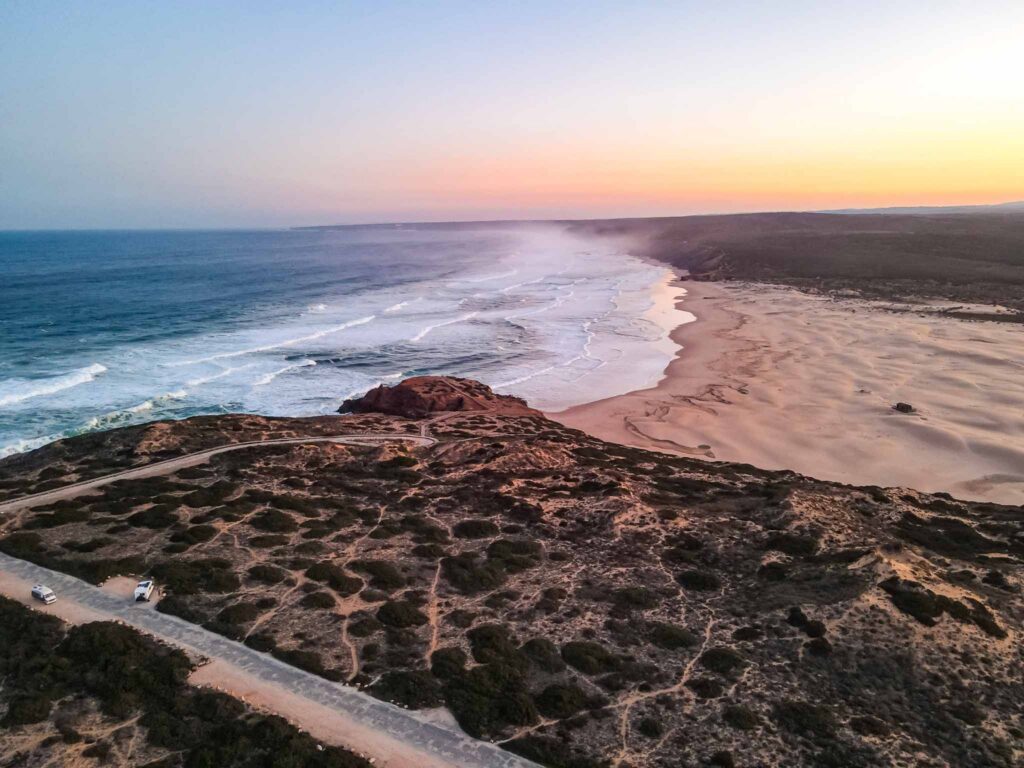
How we organise ourselves as a couple in 6 m2 (the real heart of the matter)
Here’s the part that no one addresses, because to tell it, you have to have lived it. Working alone in a van is a challenge. Together, in 6 meters, it’s a sport.
Our typical day almost organised itself, on a natural shift. Since I had to work every morning for my employer, Caroline took the opportunity to do her Twitch live in the morning, at the same time. While she was talking to her community, I had my headphones on and was working. And we were face to face.
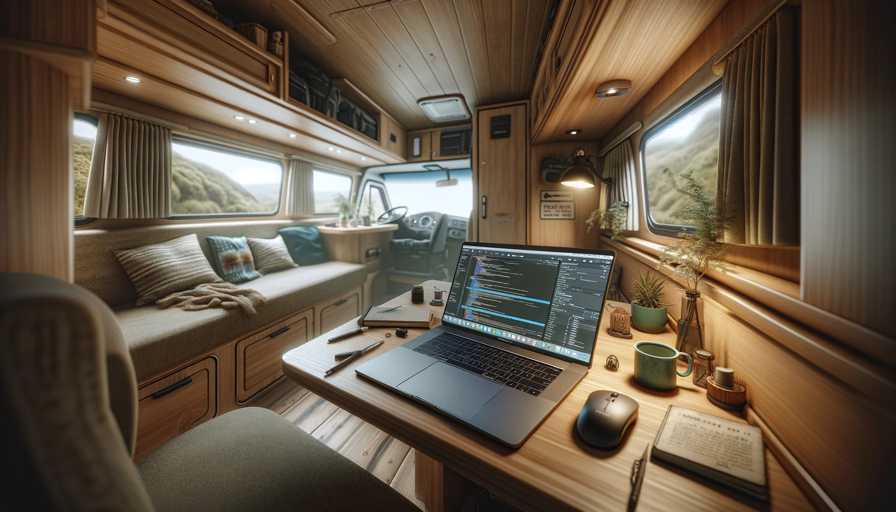
Because you need to visualize the setting: in the Hymer, the dining area consists of two benches facing each other with a table in the middle. Caroline on one side, me on the other. This table is really, really not wide… and yet it became our open space for two. We both took the desk at the same time because it was simply the only place in the van with a table. No your corner, my corner. One workspace for two, and we make do.
And what about client calls while madam is live? I found THE solution, and I’m quite proud of it: I would lock myself in the bathroom, sitting on the toilet. There you go. My corner office, my private meeting room, my space for confidentiality, was Edward’s toilet. I discovered it along the way, out of necessity, and honestly, it changed everything. (By the way, a little loop back to our article on the choice of vehicle: we had installed a toilet plus shower as a non-negotiable comfort. We didn’t know yet that the toilet would mainly become my video call booth.)
The time zone difference, we managed it in advance in a very simple way: we mostly stayed in Europe. With a permanent contract and an employer on the other end of the line, I never ventured more than an hour of time difference, to avoid being completely out of sync with the people I was working with. I know some manage to work from the other side of the planet, but honestly, it’s not my thing: I don’t believe we are ultra-productive like that, and especially I find it can hinder the people on the other side. When you have real clients, you align your geography with your time zone, not the other way around.
And since we’re being candid, my morning ritual? It’s a struggle ritual. When sedentary, you have a designated desk: you sit down, everything is already there. In a van, it was: take out the equipment, reinstall it, put it away in the evening, take it out again the next day, put it away again, take it out… on repeat, every day. Today, when we take the camper van from time to time, I watch myself do it and I sincerely wonder: how did I keep up that pace every day for years? I’m not even sure I could still do it. The freedom of the office-with-a-view is earned through daily setup and takedown that you’ll never see in a story.
Are you cut out for working in vanlife?
Working in vanlife: your questions, our lived answers
Can you really work and live in a van?
Yes, we did it for several years with Caroline, and we even managed to save. But this lifestyle is very energy-consuming: you combine your work and all the nomadic logistics, so your productivity takes a hit. The condition for it to work: arrive with a job or income already in place, not with just a simple dream.
What is the hardest thing about working in a van?
Not the technique: the discipline. It's called the demon of nature, that thing that constantly wants to pull you away from your work to go see the scenery. Without a regular routine and without clear priorities, the van eats up your work week without you realizing it.
What do you need to work from a van?
Two non-negotiable items: internet and energy. For internet, aim for multiple SIM cards from different operators and a proper router, not just the phone's hotspot. For energy, the original electrical system is insufficient to run two computers all day: it needs an upgrade (solar panels, portable batteries).
How to organize yourselves to work in a van?
With us, it settled into a natural shift: I worked in the morning while Caroline did her live. We worked face to face at the little table, the only place with a table. And for calls, I isolated myself in the bathroom. The key: a single shared workspace and staggered moments for noise.
Can you keep your salaried job while working remotely from a van?
Yes. On my side, after COVID, I negotiated with my employer a part-time remote work arrangement in exchange for a salary reduction. It requires a trust contract and calculating in advance the cost of sedentary living vs living in a van. The transition can be hybrid: you keep one foot in security.
What job can you do in a van when starting from scratch?
Everything that can be done remotely: writing, development, design, marketing, network management, support, online training... We have detailed concrete avenues in our article dedicated to digital nomad jobs. The principle: a job that only depends on a computer and an internet connection.
How to manage time zone differences with your clients?
We mostly stayed in Europe, precisely for that. With an employer and clients in the European time zone, I never ventured more than an hour of difference. When you have real contacts, you align your geography with your professional time zone, not the other way around.
Does the internet really hold up for video calls all day?
With a serious setup, yes. Over several years on the road, the times we found ourselves without a connection can be counted on one hand (once in Aisne, another on the Isle of Skye). Caroline even streamed while driving. But that requires several operators and a router, not just a simple phone plan.
Does vanlife decrease productivity?
Honestly, yes. Between daily logistics, distractions, and discomfort, we work less efficiently than with a fixed desk. It can be compensated by discipline and good organization, but we must accept it instead of telling ourselves that we will be more productive in nature.
Do you need an address to declare your income when you are a nomad?
Yes, this is a real issue: in the UK you need a stable correspondence address and you must register as self-employed with HMRC (you will get a UTR and file a yearly Self Assessment). We struggled with the address side at first before sorting it out. We cover the admin and tax side in detail in our vanlife admin and taxes guide.
How much do you need to earn to live in a van?
There is no magic number: it depends on your lifestyle, your vehicle, and your travel pace. We have dedicated articles on the actual costs (fuel, maintenance, food) and income ideas. The right approach: arrive with an income AND a safety net savings.
How to avoid burning through your savings and having to return early?
We met many travelers who had miscalculated their budget and had to return disappointed. The van does not generate income on its own. Our rule: have an online job before leaving and keep an intact safety net for unforeseen events (a breakdown, a slow month), so that nothing stops the journey.

Digital Nomad Jobs: Work While Travelling the World
What if, tomorrow, your office was a café in Tokyo, a beach in Bali, or the back of a van in the Algarve? The digital nomad lifestyle isn’t just a...
Read more
Internet and Vanlife: the guide to being connected almost everywhere
In this article, we explain how we managed to have internet throughout Europe and beyond with our UK mobile subscriptions and the right equipment.
Read more
Passive Income in Vanlife: 10 Ideas to Make Money While Traveling
Well, the dream is this: we drive, the scenery rolls by, and the money transfer comes in while we sip our coffee in front of the ocean. Caro and I...
Read morePS: if one day you call me and hear a weird echo in my voice, don’t look for it. I’m just in a meeting. In the bathroom. And somewhere, that’s the true freedom of working in vanlife.

I'm Xavier
I ran my own company for ten years, then we left. I write about what actually pays for this life: the paperwork, the tools, and the real numbers.
Ce que vous souhaitez recevoir :