



Introduction
So, you’ve found the perfect spot for the night, tucked away from civilization, a place so peaceful you want to stay for days. But when it comes to self-sufficiency, there’s one essential thing: energy. So, how can you give yourself the best chance to stay self-reliant in vanlife?
Why Choose Vanlife and Wild Camping?
 Vanlife and wild camping offer a unique experience of freedom and connection with nature. It’s a way of traveling that allows you to escape the everyday grind and embark on authentic adventures.
Picture yourself waking up each morning to a different view, far from crowded parking lots and packed campsites. That’s the magic of vanlife! You can choose your spot for the night, whether by the sea, in the mountains, or deep in a forest. This freedom of movement is what makes the experience so special.
A Few Rules to Keep Wild Vanlife Alive
But, with freedom comes responsibility. There are a few guidelines to follow when wild camping. For example, always leave the spot cleaner than you found it. (This is the golden rule of responsible vanlifers!) You should also be discreet, respect local wildlife and nature, and avoid staying in one place for too long. Additionally, steer clear of large gatherings. With vanlife’s growing popularity, the best spots are often in high demand, and over time, areas that were once accessible can become off-limits to our little homes on wheels.
Electric self-sufficiency is fantastic for vanlife, but it’s also one of the reasons why our vehicles no longer rely on traditional campsites or service areas as much. And if you’re equipped with a composting toilet, all you really need are places to dump waste and refill water to enjoy the most liberated version of vanlife.
Now that we’ve covered something close to our hearts, let’s dive into how to get that essential energy.
Understanding Your Energy Needs
Before diving into all the options, it’s important to first understand your energy demands. If you’re traveling in a small van and don’t need to work on the road, your needs will likely be pretty low. In this case, there’s no need to complicate things with a complex setup!
There are plenty of clever, battery-powered gadgets that use very little energy. For instance, LED lights that consume less than 2W, and some even come with small solar panels. Convenient, right? For charging your phone over a weekend, a simple power bank might be all you need. It’s compact, affordable, and gets the job done.
Now, if your needs are greater—like powering a laptop to work or running a small fridge—then it’s time to level up. That’s where the different options come into play.
The Generator: Reliable but Bulky
Let’s start with the classic fuel-powered generator. It’s like the noisy, polluting cousin in the family, but it does have its perks. You can rely on it to generate electricity no matter the weather. However, when it comes to being discreet, it falls short. Picture yourself enjoying the peacefulness of nature, and suddenly: VROOM! Your wild camping neighbor fires up their generator. Not so great, right?
The benefits of a generator include its reliability and power. You can run several devices at once. But the downsides are significant:
- It’s noisy—not ideal when you’ve gone out of your way to find a quiet spot.
- It pollutes (not very eco-friendly).
- You need to carry fuel, which is a hassle and can be dangerous, though you might already carry gas for other purposes.
- It’s heavy and takes up a lot of space.
Honestly, unless you absolutely need a lot of power, I’d recommend skipping the generator. There are much nicer, more environmentally-friendly options available.
Fixed Solar Installation: An Investment That Pays Off
Now, let’s talk about a fixed solar installation for your van. This is serious business! You install solar panels on your van’s roof, connect them to batteries, and voilà—you’ve got your own mobile power station.
The benefits are numerous:
- It’s silent (your wild camping neighbor will love you).
- It’s eco-friendly (the sun is free and clean).
- Once set up, it’s a set-and-forget system (no more worrying about it).
The key factor here is system sizing. You need to calculate your energy needs carefully to choose the right size for your panels and batteries. (Pro tip: overestimate your needs a bit—you’ll likely have more devices to charge than you initially think!)
Portable Solar Panels and Mobile Batteries: Flexibility Above All
Finally, we come to my favorite solution: portable solar panels and mobile batteries. It’s the best of both worlds. You can move them around to follow the sun and store them away when you don’t need them.
The main advantage is flexibility. You can use them in your van, but also take them out for a picnic or hike. And if you already have a fixed setup, they can act as a backup when you need extra energy.
The secret to good energy independence in vanlife is the smart combination of different solutions.
What Are the Best Portable Solar Generators for Vanlife?
The best portable solar generators for vanlife, based on our experience, are the EcoFlow Delta 2, Allpowers R1500, and Aferiy P110. These models strike a great balance between weight, performance, and energy capacity—perfect for life on the road, and even for working while traveling.
Before diving into the details, let me tell you that we had the chance to test all three of these models thanks to our partnerships. We really put them to the test in real vanlife conditions, so what we’re sharing here is based on real-world experience!
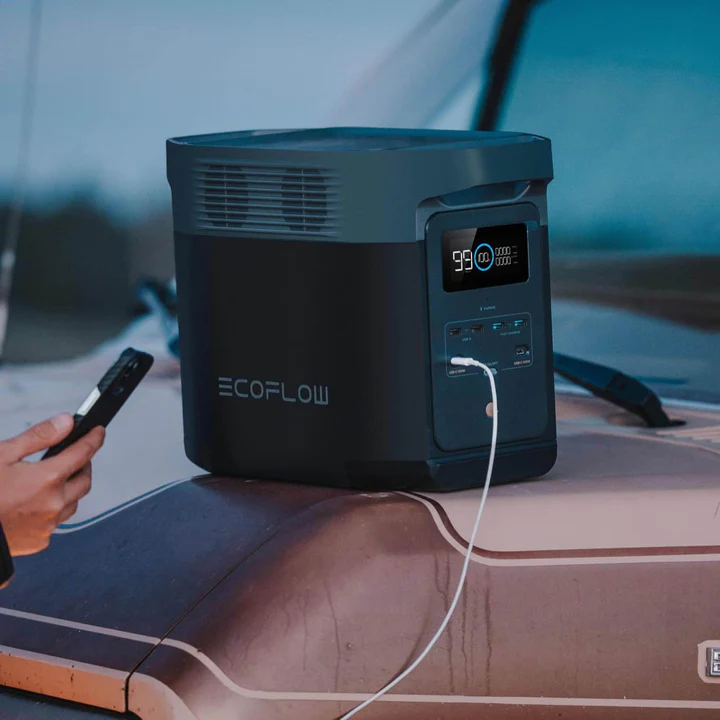 EcoFlow Delta 2: The All-Rounder
The EcoFlow Delta 2 is one of our favorites due to its versatility. With a 1024Wh capacity and 1800W output, it easily handles all your vanlife gadgets. What really blew us away was its fast charging feature—from 0 to 80% in just 50 minutes, which is insane!
In terms of pros, it’s super versatile and has an impressive lifespan (over 3,000 cycles). The downside? It weighs 12kg (26.4 lbs), but honestly, that’s a small price to pay for its performance. And to top it off, EcoFlow offers a 5-year warranty, which is reassuring for a long-term investment.
With our special link, you can get a Delta 2 at a discount!
To complement this gem, we recommend the EcoFlow 160W portable solar panel. It’s lightweight, efficient, and folds up easily for storage in your van.
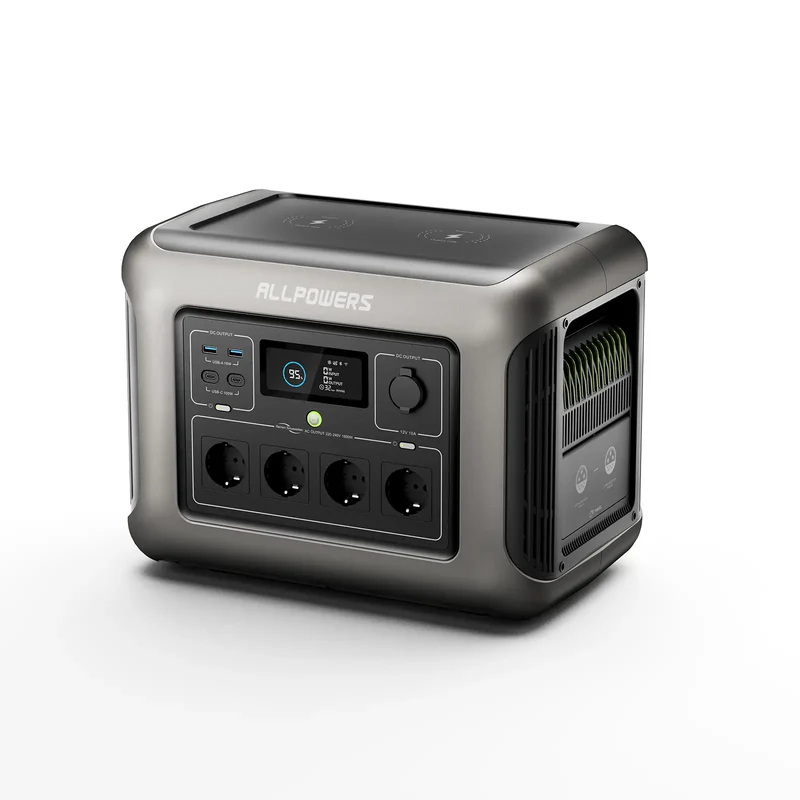
Allpowers R1500: The Powerhouse
Next up is the Allpowers R1500. This is our go-to when we need serious power. With a 1152Wh capacity and 1800W continuous output, it can handle pretty much anything you throw at it.
Its major strength? The LiFePO4 battery, which promises over 3,500 charge cycles. It’s a beast! At 16.7kg (36.8 lbs), it’s a bit heavier, but if you’re not moving your van around constantly, that won’t be an issue. Allpowers also offers a 5-year warranty, showing their confidence in the product.
If you want to grab one, we have a special Allpowers discount code that’ll give you 10% off.
We paired it with the ALLPOWERS SP033 200W polycrystalline portable solar panel, which offers an excellent power-to-weight ratio.
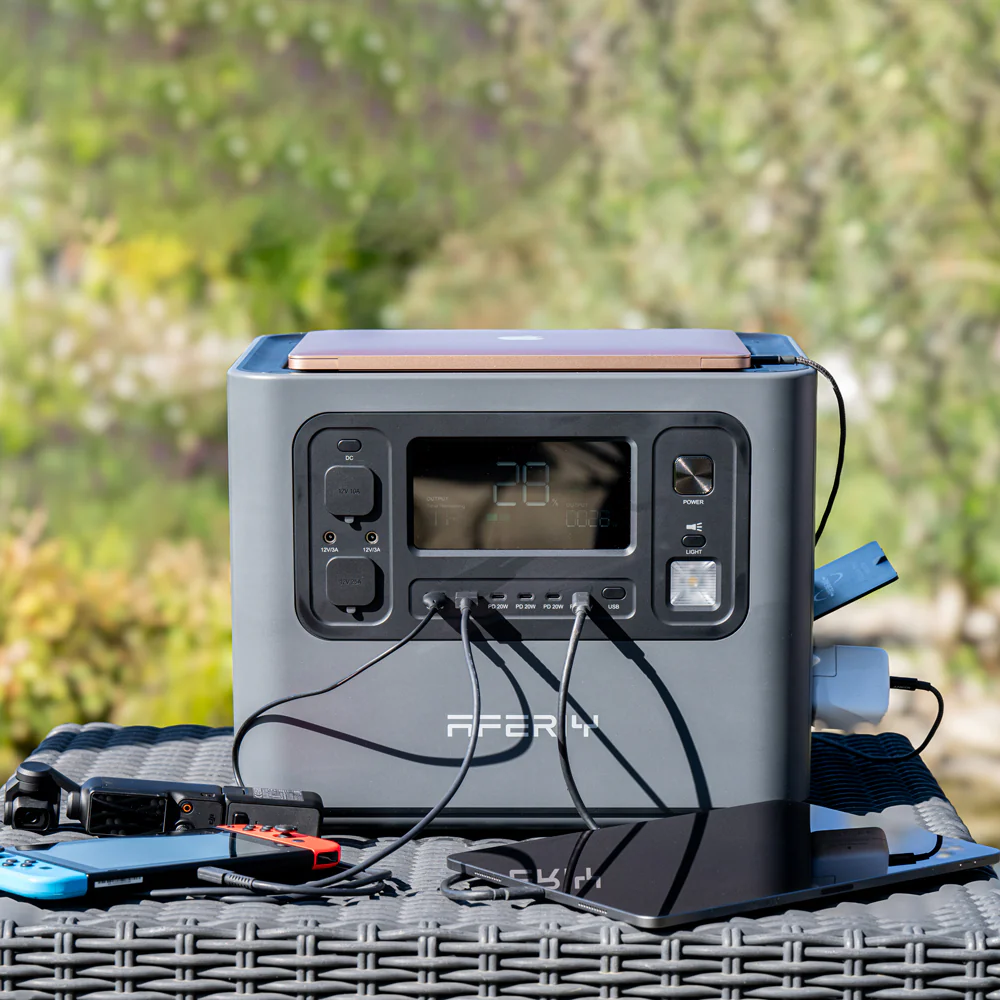
Aferiy P110: The Newcomer That Shines
Finally, we have the Aferiy P110, the latest addition to our lineup, and it really impressed us. With 960Wh capacity and 1200W output, it strikes a great balance for most vanlifers.
What we love is its super intuitive LCD display and rugged design. It’s waterproof (IP54), which is a real plus for vanlife. And the best part? It comes with a 7-year warranty, the longest of the three!
We also have an Aferiy discount code if you decide to go with this model.
To round it out, we recommend the AFERIY AF-S200A1 200W portable solar panel. It’s super efficient, even in cloudy weather.
Remember, choosing the best generator really depends on your vanlife style. Consider your energy needs, how often you’re on the move, and your budget before making your decision!
Personally, if I had to pick, I’d lean toward the Delta 2 for its versatility. But if I needed more power, the Allpowers R1500 would be my choice. And for those looking for the best bang for their buck with an excellent warranty, the Aferiy P110 is unbeatable.
| Features | EcoFlow Delta 2 | Allpowers R1500 | Aferiy P110 |
|---|---|---|---|
| Capacity | 1024Wh | 1152Wh | 960Wh |
| Output Power | 1800W (3300W peak) | 1800W (3000W peak) | 1200W (2400W peak) |
| Battery Type | LiFePO4 | LiFePO4 | LiFePO4 |
| Charge Cycles | 3000+ | 3500+ | 3500+ |
| AC Charging Time | 0-80% in 50 min | 0-80% in 45 min | 0-100% in 2h |
| Weight | 12 kg (26.4 lbs) | 16.7 kg (36.8 lbs) | 15.5 kg (34.2 lbs) |
| Number of USB Ports | 4 (2 USB-A, 2 USB-C) | 4 (2 USB-A, 2 USB-C) | 5 (2 USB-A, 3 USB-C) |
| Number of AC Outlets | 4 | 4 | 2 |
| Other Connectors | 1x car cigarette lighter 12V, 2x DC5521 | 1x car cigarette lighter 12V, 2x DC5521, 1x XT60 | 1x car cigarette lighter 12V, 2x DC5521, 1x XT60 |
| Number of Recharges |
Laptop (60Wh): 17 times Smartphone (12Wh): 85 times USB Fan (5W): 204 hours |
Laptop (60Wh): 19 times Smartphone (12Wh): 96 times USB Fan (5W): 230 hours |
Laptop (60Wh): 16 times Smartphone (12Wh): 80 times USB Fan (5W): 192 hours |
| Estimated Solar Charging Time | 6-7 hours (with 160W panel) | 5-6 hours (with 200W panel) | 5-6 hours (with 200W panel) |
| Warranty | 5 years | 5 years | 7 years |
| Price | Under 1000€ (approx. $1050/£870) | Under 700€ (approx. $735/£610) | Under 650€ (approx. $680/£570) |
How to Optimize Your Energy Use in Vanlife
Having energy in vanlife is great, but knowing how to manage it is even better! Unlike in your apartment, electricity in your van isn’t unlimited, so it’s important to learn how to use it wisely.
Tips to Reduce Your Energy Consumption in Vanlife
Here are a few tips that have really helped me lower my energy usage:
- Always turn off devices you’re not using. It may seem obvious, but it’s easy to forget!
- Use power strips with switches. This way, you can cut off power to several devices at once when you don’t need them.
- Make the most of natural light. Not only is it free, but it also boosts your mood!
Remember, in vanlife, every watt counts. But with a little attention and these simple tricks, you’ll see—it quickly becomes second nature!
And don’t forget: the best energy is the energy you don’t use. Sometimes, switching off all your gadgets and simply enjoying the nature around you—that’s the true beauty of vanlife. (And it doesn’t cost a thing!)

We're Caroline and Xavier
We got most of it wrong before we got it right. We share what actually holds up day to day in a van, and what we wouldn't do again.
Ce que vous souhaitez recevoir :