


Highland : Places we can tell you about
Here's our selection of places in Highland: spots we've visited that might be useful to you. Use the list view to discover each address in detail, and export everything to add to Google Maps or your favorite GPS app.
| Place | Address | Download |
|---|---|---|
| The Granary | Somerled Square, Portree IV51 9EH | |
| Harbour View | 7 Bosville Terrace, Portree IV51 9DG | |
| Scorrybreac Restaurant | 7 Bosville Terrace, Portree IV51 9DG | |
| Cuchullin Restaurant | Somerled Square, Portree IV51 9EH | |
| The Bosville Hotel Restaurant | 9-11 Bosville Terrace, Portree IV51 9DG |
| Place | Address | Download |
|---|---|---|
| Fairy Glen Campground | Uig, Isle of Skye IV51 9XX | |
| Skeabost Bay Spot | Skeabost Bridge, Isle of Skye IV51 9NP | |
| Sligachan Campsite | Sligachan, Isle of Skye IV51 9JZ | |
| Portree Bay Camping | Home Farm Rd, Portree IV51 9LX | |
| Staffin Campsite | Staffin, Isle of Skye IV51 9JX |
| Place | Address | Download |
|---|---|---|
| Skye Museum of Island Life | Kilmuir, Portree IV51 9UE | |
| Aros Centre | Viewfield Rd, Portree IV51 9EU |
| Place | Address | Download |
|---|---|---|
| Portree Harbour | Quay St, Portree IV51 9DE | |
| Old Man of Storr | A87, Portree IV51 9HX | |
| Fairy Glen | Uig, Isle of Skye IV51 9XX | |
| Mealt Falls (Kilt Rock) | A87, Staffin IV51 9JE |
| Place | Address | Download |
|---|---|---|
| Saint-Columba Church | Somerled Square, Portree IV51 9EH |
| Place | Address | Download |
|---|---|---|
| Isle of Skye Distillers | The Gin School, Portree IV51 9EH | |
| Wentworth Souvenir Shop | Wentworth St, Portree IV51 9EJ |
| Place | Address | Download |
|---|---|---|
| BP Portree Gas Station | Dunvegan Rd, Portree IV51 9PZ |
Highland : a glimpse of the weather
5-day forecast
Planning an unexpected departure? Check out the weekly weather before packing your bags.
Monthly climate
Weather-wise, our heart leans towards bright sunshine. That said, you might have different criteria for choosing when to visit.
| Month | Min temp | Max temp | Rain | Weather | Rating |
|---|---|---|---|---|---|
| October | 9°C | 12°C | 246 mm | 🌧️ | |
| November | 5°C | 9°C | 203 mm | 🌧️ | |
| December | 4°C | 8°C | 222 mm | 🌧️ | |
| January | 2°C | 6°C | 135 mm | 🌧️ | |
| February | 3°C | 7°C | 119 mm | 🌧️ | |
| March | 4°C | 10°C | 209 mm | 🌧️ | |
| April | 5°C | 12°C | 152 mm | 🌧️ | |
| May | 7°C | 13°C | 117 mm | 🌧️ | |
| June | 10°C | 16°C | 197 mm | 🌧️ | |
| July | 12°C | 17°C | 110 mm | 🌧️ | |
| August | 11°C | 17°C | 166 mm | 🌧️ | |
| September | 10°C | 15°C | 268 mm | 🌧️ |
Quota RapidAPI dépassé (limite par minute/mois). Réessayez plus tard.
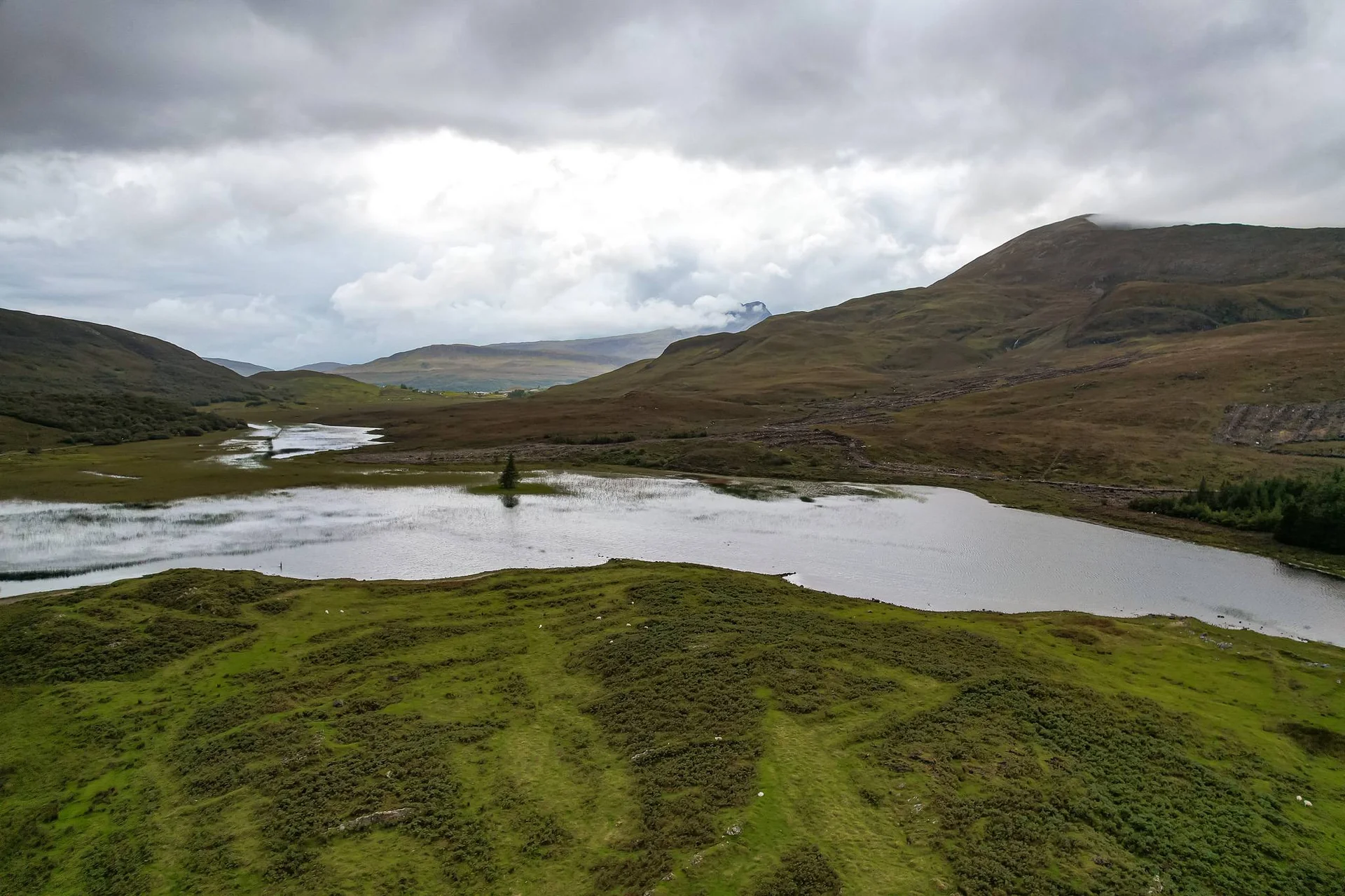
Well, let’s be honest from the start. The Isle of Skye, we had heard about it like everyone else: land of fairies, magical landscapes, mysterious mists, solitary sheep in movie-like settings. Basically, it’s like Lord of the Rings without the extras. We drove for a month through the Highlands before arriving there, and our Skye experience, we will tell you as we lived it, without the polish of an Instagram post.
A little note before we start: what we are going to describe is our experience at a specific moment (August, particularly hot and dry summer, after a month of spots all to ourselves on the NC500 and the north coast). If you go in May or October, you will read a different article. If you hit a rainy year, the Kilt Rock waterfall will have a different effect on you than it did on us. We just prefer to tell you what we saw, rather than copy the brochures.
Skye, for us, after a month in Scotland
We need to set the scene. Before Skye, we had spent thirty days hopping from Ullapool, Lochinver, Achmelvich, Durness, Tongue, the northern NC500, the Cairngorms… Everything we’ve told you in our other articles, in short. And the common denominator of this part of the trip was: we were often all alone. Édouard parked facing an Atlantic beach with two sheep as extras, that’s it. A single-track road with no one on it for 25 miles. A stream at the end of Scotland where we did the dishes. In short… we had gotten used to the deserted Highlands.
So when we switched to Skye in the middle of summer, and found ourselves parking next to 200 other campervans in the Fairy Pools parking lot, the contrast was a bit brutal. Caroline put it straight in the video we shot at the time (and we own it): “The Isle of Skye is often presented as magical, a pristine land where sheep and cows coexist peacefully. However, in summer, it is not at all like that. We were disappointed, especially me who was expecting the magic of getting lost in wonderful and empty settings.”
We don’t hold it against Skye. Honestly. It’s a beautiful island, with landscapes you won’t see anywhere else, completely crazy geology (we’ll get back to that). But it is also a global tourist spot in peak season, and we were no longer in the right mindset for that. It makes perfect sense that there are tourists in August; it’s a holiday period and people go to see beautiful things. It’s just that in our opinion, after four weeks of spots all to ourselves, it broke our rhythm a bit.
If you go off-season, we are sure you will read a completely different article than this one. Caroline confirms it at the end of the video: “I think this place is worth it, but outside of tourist season. However, you shouldn’t be faint-hearted, because we’re talking about autumn, spring, or even winter.” So, tip number 1 of the article. Aim for April-May or September-October.
Plan your trip: United Kingdom
Tours, tickets and day trips in London.
5% off with code PLANETEDECAROT
Booked on Trip.com — partner link.
Compare rental companies and book at the best price.
10% off with code PLANETECAROLOC
Booked on Trip.com — partner link.
Provided by Holafly, our partner.
5% off with code LAPLANETEDECARO
Booked on Holafly — partner link.

We're Caroline and Xavier
We drive to a place, stay long enough to get it wrong a few times, then write the guide we wish we'd had: parking, timing, what's worth the detour.
Ce que vous souhaitez recevoir :
Arriving in Skye by campervan: via the bridge, not by ferry
To enter Skye by van, you have two options. The bridge (Skye Bridge, from Kyle of Lochalsh on the mainland) or the ferry (Mallaig to Armadale). Spoiler: we took the bridge. Édouard, as we’ve explained before, doesn’t have any floats. And honestly, the bridge is free (toll removed in 2004), accessible 24/7, no reservation, no waiting. The ferry is more picturesque but requires advance booking with CalMac, and easily costs £60-90 per campervan. It’s up to you, but on an impromptu road trip, the bridge saves time.
A quick note for those who have already started dreaming about the Applecross valley (which is just before the bridge, on the mainland side): pass your way if you’re in a campervan. The Bealach na Bà pass climbs to 626 meters with 180° turns and 20% gradients. It’s the legendary scenic route of Scotland but is strictly not recommended for long or tall vehicles. We waved from afar as we passed and drove straight to the bridge.
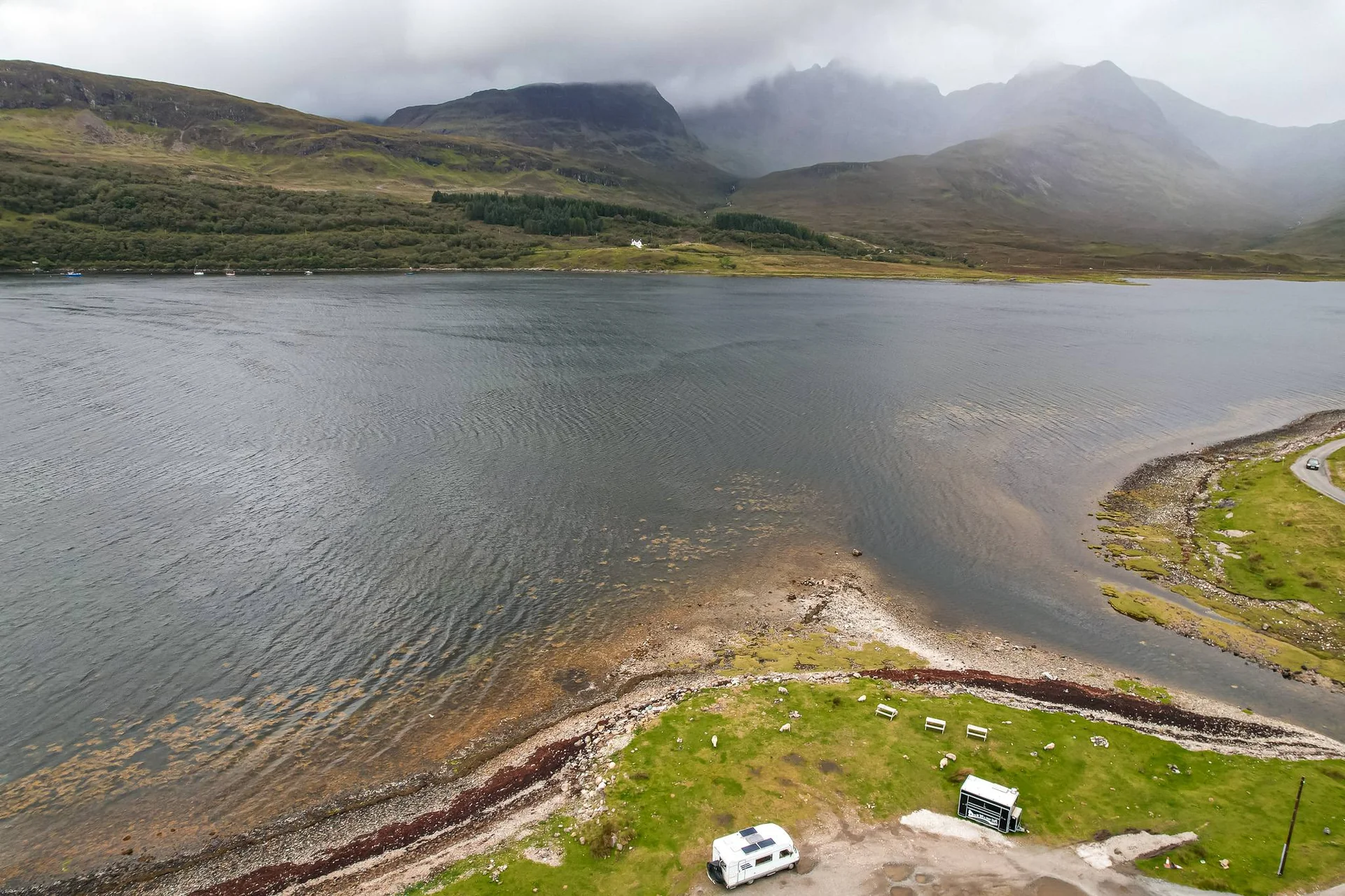
Our arrival in Skye, in our case, was at the end of the day under a threatening sky. Caroline set the tone in the video: “On this summer evening, discovering an island that shows us its mysterious side, almost with a dangerous air. Always narrow and winding roads, surrounded by mountains and lakes.” That was exactly it. The light was starting to fade, the island grew before our eyes, and we were looking for a spot for the night. Except we quickly ran into a problem…
The SIM hassle (and the good Holafly reflex before arriving)

Best UK SIM for a Scotland Road Trip: Highlands, Skye and NC500 Coverage
What internet connection to use during a stay in Scotland? Often questioned by travelers, we explored the various options available in Scotland in this comprehensive article. As always, each solution...
DiscoverBarely arrived in Skye, we faced a major setback: none of our French SIM cards had signal. And we’re not talking about a slow network; we’re talking zero bars, no 4G, no 3G, nothing. We needed a connection (searching for a sleeping spot via Park4Night, GPS, work, social media to update for Caroline’s boat)… in short, it was dead.
Caroline summarized it at the time: “We also needed to find a good internet connection, and that’s very complicated on the Isle of Skye.” We ended up testing a beautiful spot (one of those we had dreamed of upon arrival), zero internet, we had to leave. Further along, another spot, same issue. In the end, we settled for a national roadside, not pretty at all, but with a bit of signal. The lesson: on Skye, the perfect spot is not the prettiest; it’s the one that combines legality, connection, and safety. The beauty of the panorama, you can do without if it prevents you from working the next day.
So, here’s a concrete tip for you: don’t rely on an EU roaming plan. Several options:
- Buy a local UK SIM in Inverness or Edinburgh before arriving. EE and O2 have the best coverage on Skye. Expect to pay £25-30 for 30-50 GB.
- Get a Holafly UK eSIM. It’s our current partner, activates in two minutes from the app, and works for the duration of your stay. Unlimited data, you keep your French number in parallel for calls.
- Trust the WiFi of Portree cafés, but that means you have to go to Portree to work, and thus not be fully immersed in the wild west.

Holafly promo code: LAPLANETEDECARO (-5% discount).
Fairy Pools: beautiful, but not in mid-August
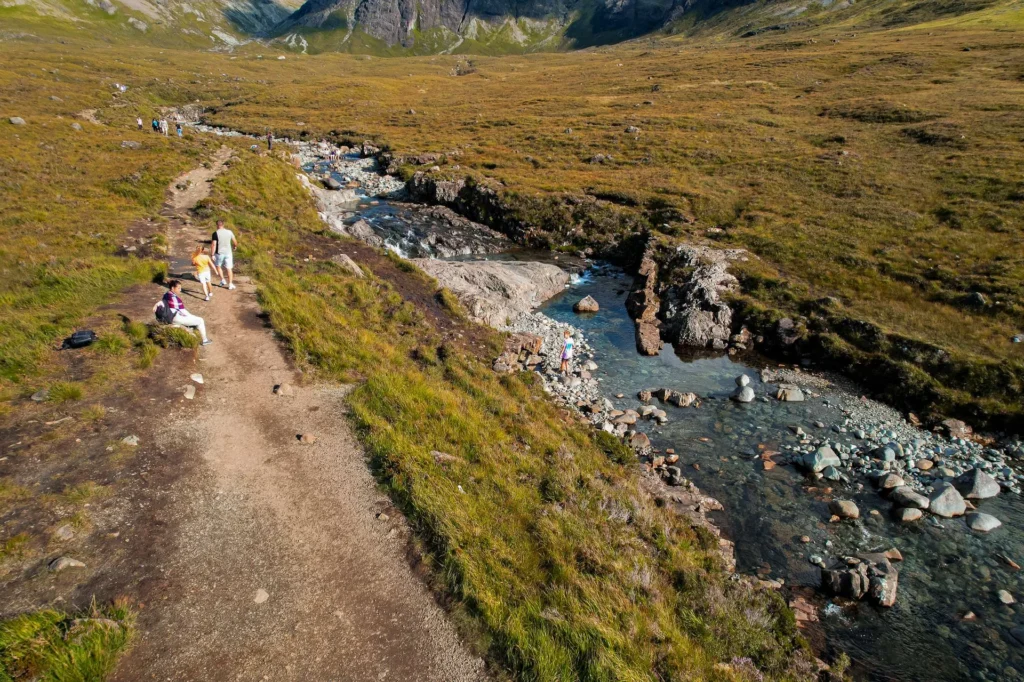
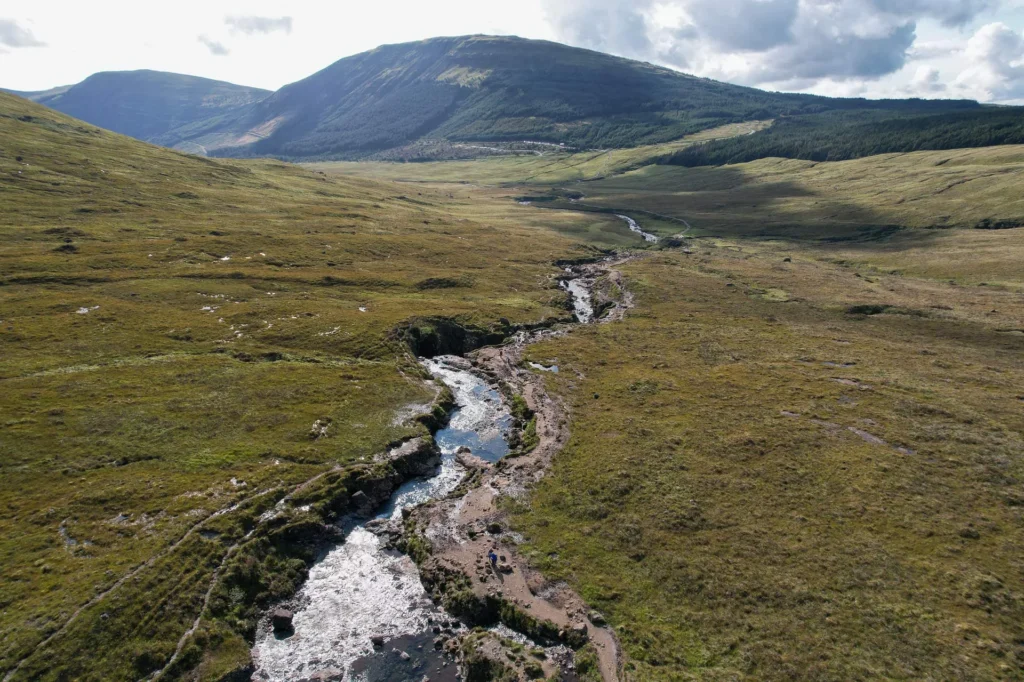
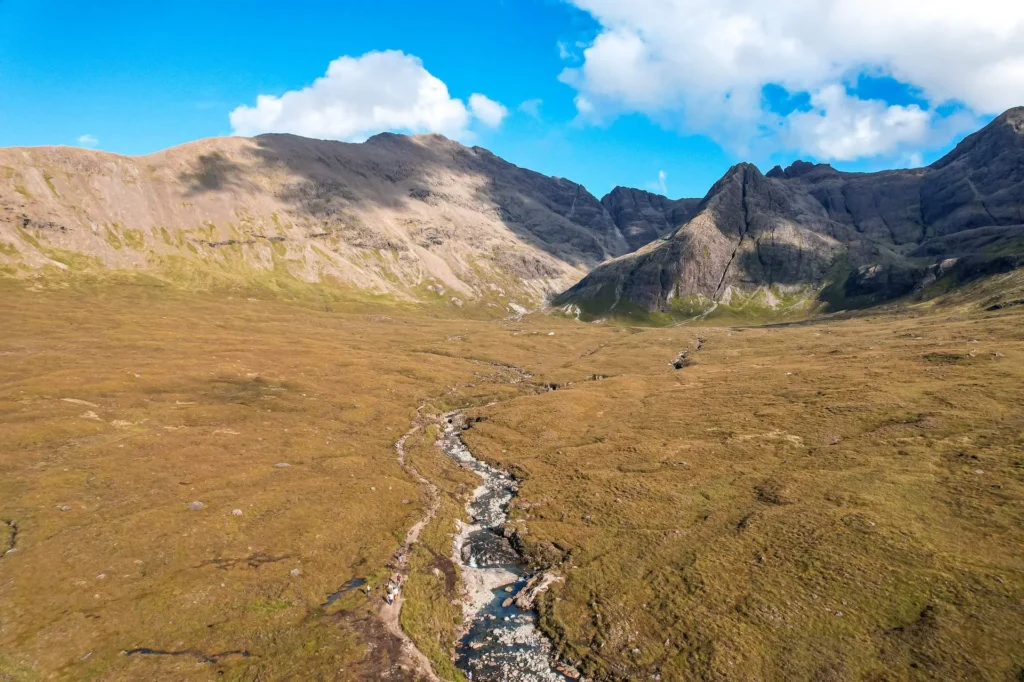
It’s the most famous spot on the island. A succession of natural meltwater pools descending from the Black Cuillin, those sharp black mountains in the southwest of Skye. Crystal clear water, waterfalls, wild mineral landscape, the scene is set. On paper, it’s exactly what we came looking for.
In reality… it was crowded. Caroline arrives on site “excited like a little girl might be when told she’s going to play in a big garden” and struggles to find parking. The path, barely wide enough for two people, is congested. The walk is short (20-30 min from the parking lot), so everyone can go, from families with strollers to groups in flip-flops. And the further you get from the parking lot, the fewer people there are, but the nice spots are spoiled by the mud created by foot traffic.
Caroline shares her conclusion on video: “It’s a mixed place for us in terms of beauty. It’s very beautiful, but I think this place has a flaw that makes it successful: it’s too easily accessible. If you go to the Alps, I think you see places just as beautiful with waterfalls, except you have to hike for 4 hours.”
On that note, she attempted a swim. “Maybe in the hope of transforming into another form of being or receiving magical powers. Aside from knocking me out, I didn’t feel any great change! Very pleasant, but actually, it exhausted me. It had an immense fatigue effect on me.” The water at the Fairy Pools comes directly from the Black Cuillin, it’s at 6-8°C even in the height of summer. Limit it to 5-10 minutes maximum, with a warm towel ready for when you get out. No swimming solo, and not before a long hike afterwards (Caroline was out of commission for the rest of the day).
The passage we want to quote word for word, because it says something honest about tourism today: “We were asking ourselves: should we show you this place? Should we talk about it, share it with you, while telling you that there are too many people? Wouldn’t we be better off not showing it to you? If we want to say that we’d like to preserve these natural places, aren’t they at risk of turning into mere tourist spots?”
We’re showing it to you anyway, because that’s why we do this blog. But we also tell you: arrive before 8 AM or after 5 PM. The tourist buses arrive between 10 AM and 4 PM, it’s mechanical. And walk 30 minutes beyond the first pools, the crowd thins out significantly. Paid parking (around £6 for the day), mandatory payment or you’ll get a fine.
Fairy Glen near Uig: earth pyramids and marketing semicircle
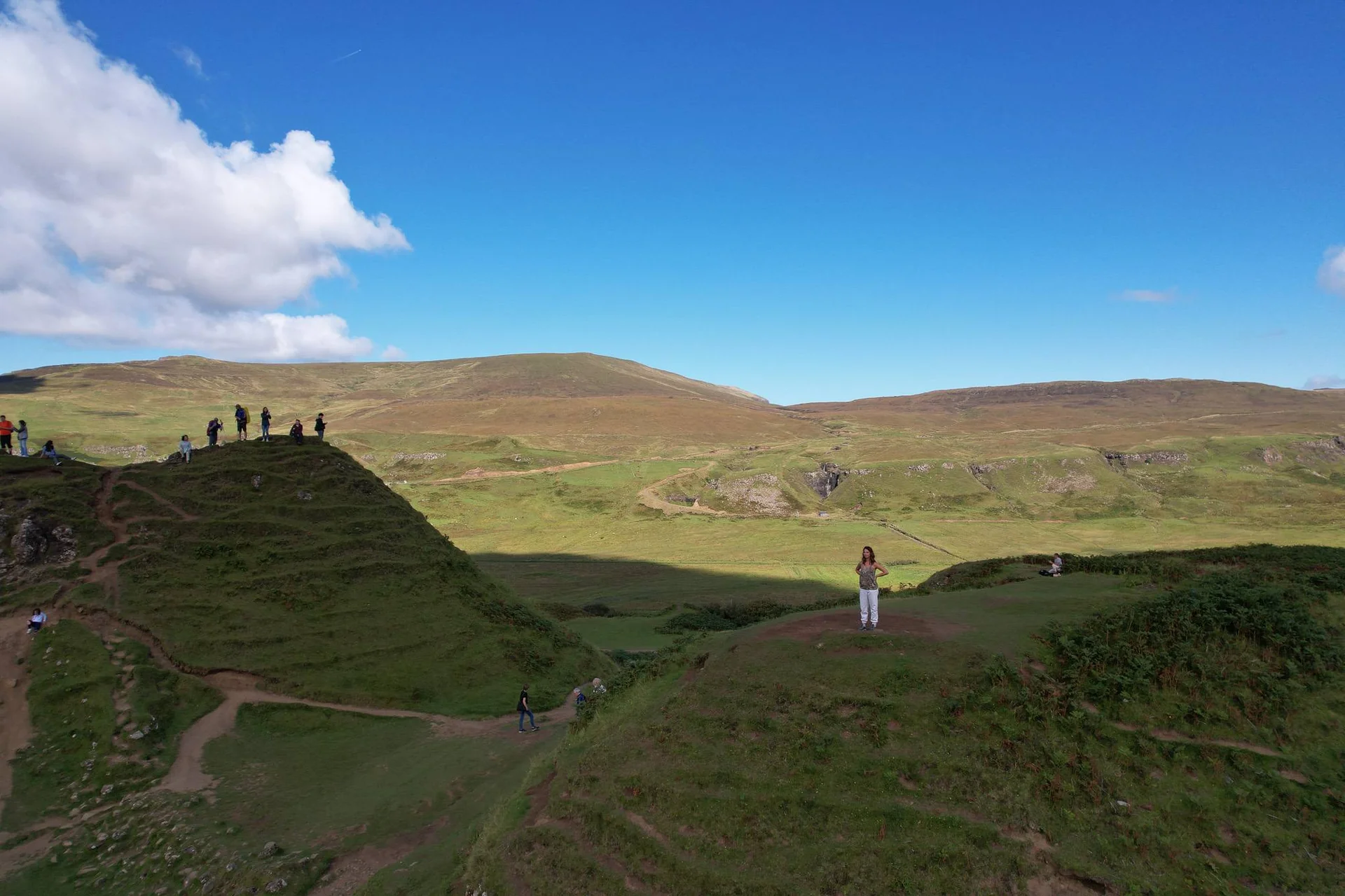
The day after the Fairy Pools, we traveled up the island towards the northwest to Uig, and we made a stop at the Fairy Glen. The Valley of the Fairies. On site, there are small green mounds in pyramid shape rising in the middle of a depression, with ferns everywhere. Caroline arrives amused: “You really feel like you’re in a fairyland. Not really any legends around it, but since nature is surprising, it offers us a spectacle here, it really looks like it was made by fairies.”
Geological spoiler: it’s not the fairies, it’s tectonics. More precisely, an ancient plate slip that sculpted these mounds. I joked in the video: “Actually, it’s people with diggers who came in. They did this, and in the end, the grass grew, right?” Caroline didn’t approve.
Inside the Fairy Glen, there’s a small semicircle of stones laid on the ground, which has become THE Instagram spot in the area. We’ll tell you upfront: it’s not a Celtic legend, it’s a recent tourist construction, fueled by visitors adding their own stones. The authorities of Skye have been asking for a few years now to stop adding more because it creates erosion and damages the vegetation. If you go there, look, take photos, but don’t collect stones to add. Really.
A good point for the Fairy Glen: it’s significantly quieter than the Fairy Pools. We were there at the end of August when the tourist peak passes, and we found a little hidden spot by venturing into the secondary paths. Caroline said: “Listening to the sound of the water flowing was a real little joy.” That sums it up well. Count on 1-1.5 hours on site, modest parking 2 miles from the village of Uig.
Old Man of Storr and Kilt Rock: the last road, and the waterfall that was thirsty
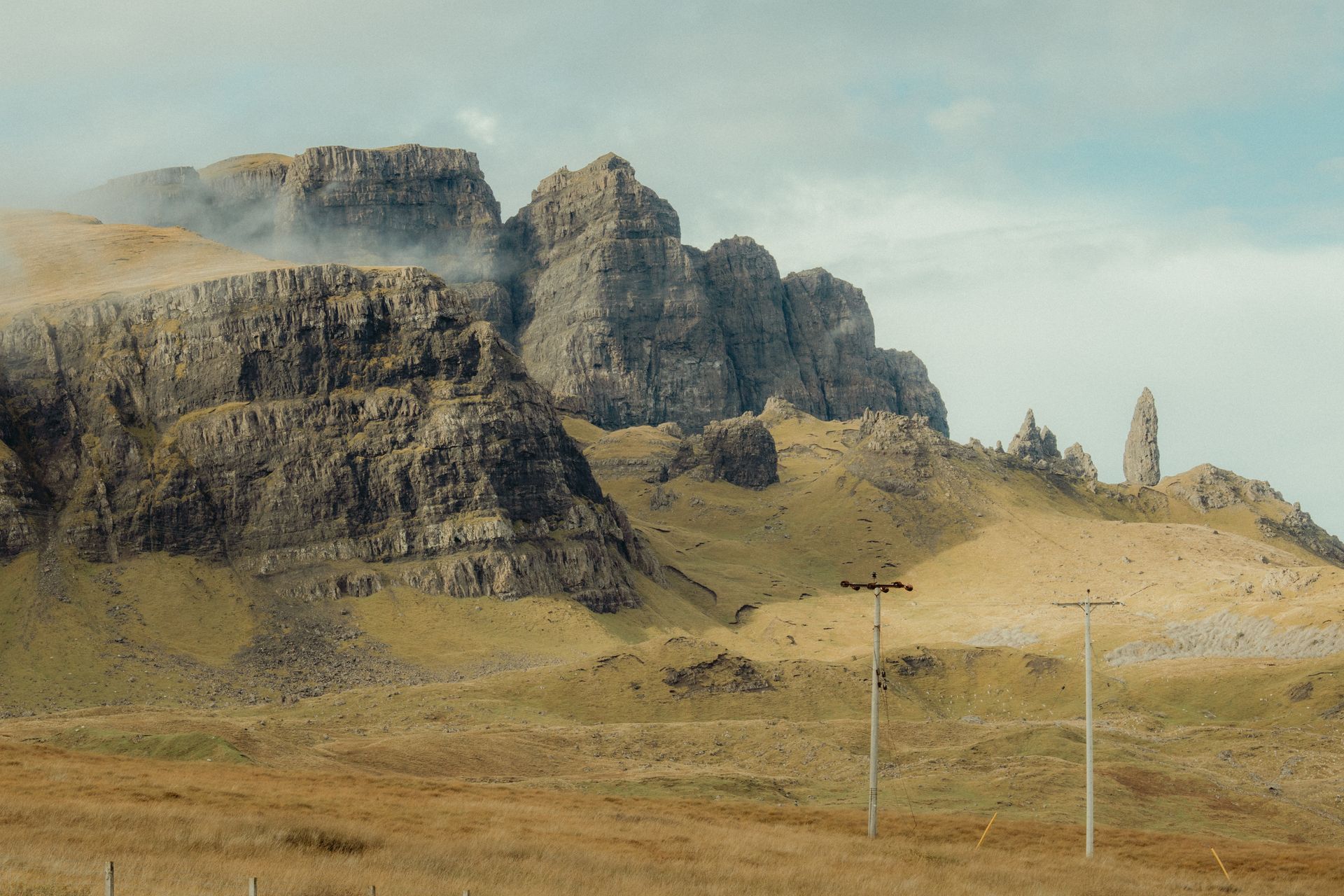
At the end of our stay, we took the A855 which runs along the east coast of Skye, and we passed by the Old Man of Storr. A rocky peak of 719 m that dominates a rocky chaos and the entire Trotternish peninsula. Iconic. It’s probably the most photographed spot in Skye after the Fairy Pools.
We didn’t hike to the summit (2.5 miles round trip, 400 m elevation gain, about 2-2.5 hours, proper shoes recommended). Caroline had a heavy heart, we couldn’t leave: “It’s always the same when you know it’s the end of an adventure. We have a heavy heart, tears in our eyes, not yet realizing everything we were experiencing at that moment.” We looked at it from the road, took our photos from the parking lot, and moved on.
If you go there, however, do the hike. It’s the best way to avoid the crowd in the parking lot that settles for the first viewpoint. And arrive early (before 8 AM) or late (after 5 PM), paid parking £3 for 2 hours.
Further north, a 15-minute drive away, we reached Kilt Rock and the Mealt Falls. A 60 m basalt cliff overlooking the sea, with a waterfall that pours directly into it. Spectacular on paper. Except that that summer, the UK had been declared in drought (the driest July since 1976), and… the waterfall had no water. Caroline summarized in the video, disillusioned: “It’s nice when there’s water, but there’s no water anywhere. It’s true that it loses a bit, it’s beautiful, but it loses a bit of its splendor, thanks to everyone.”
It’s circumstantial. A year of normal rainfall, the waterfall is magnificent, full flow, we’re in the middle of a show. For us, it was a trickle of water timidly falling into the sea. We know that if we return under normal conditions, we’ll see something else, and we’ll change our minds. The basalt cliff remains breathtaking anyway, and the viewing platform allows you to admire the panorama without risk. No hiking, free parking.
A little bonus tip for this northern part of Skye: if you have the time, extend 20 minutes north to reach the Quiraing. It’s an even more spectacular rock formation than Storr, and significantly less crowded because it requires a 4.5 miles loop (4-5 hours). Lunar scenery from an ancient landslide. We didn’t do it, and we regret it.
Portree, the breath: colorful houses, fish and chips, and local gin
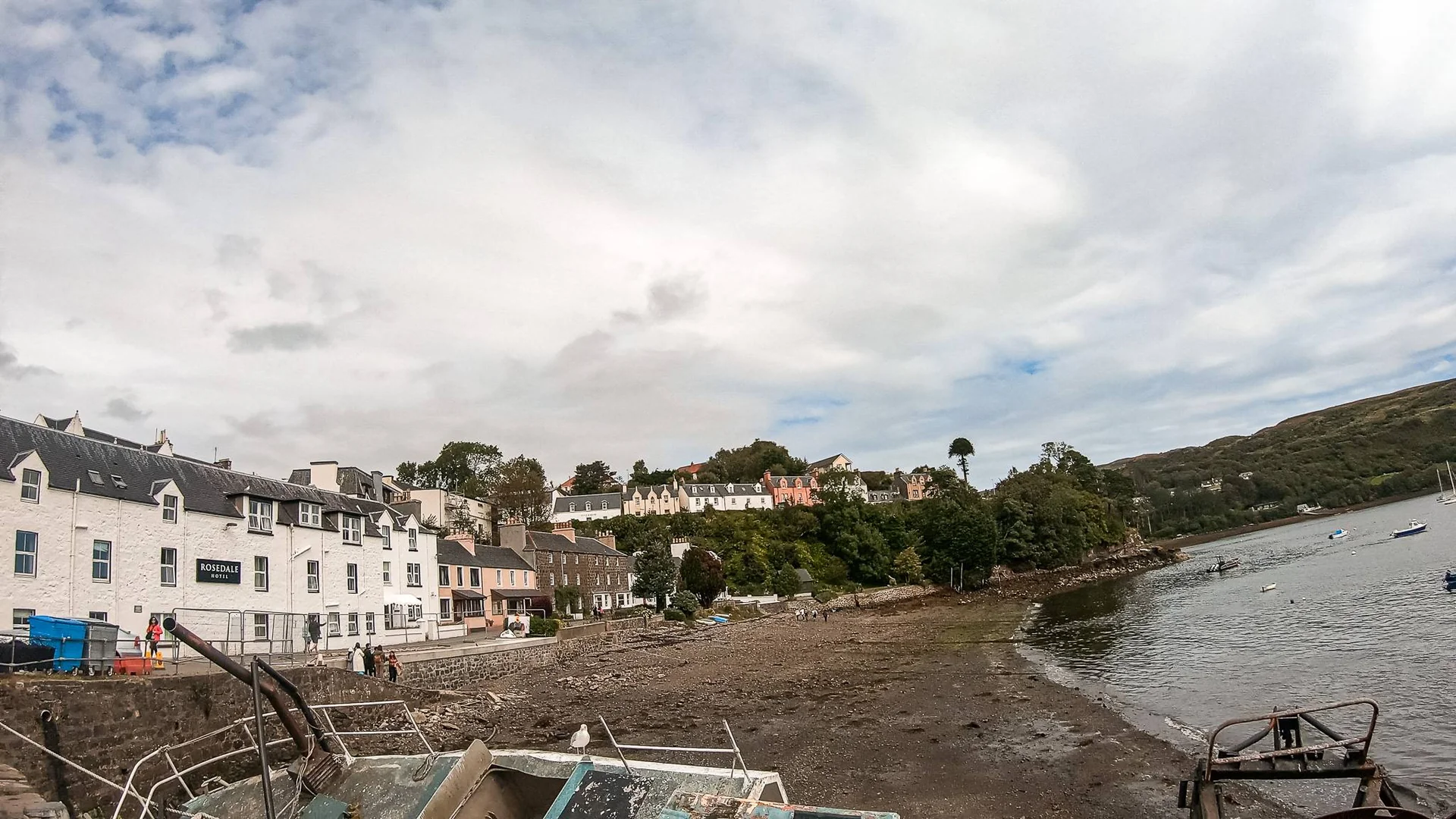
In the midst of all this, there was Portree. And let’s be frank: Portree is the highlight of our Skye stay. It’s the moment when, after the Fairy Pools, we could finally breathe. The capital of the island, with about 2500 inhabitants, located on the east coast. A small fishing port, colorful houses, narrow streets. In short… exactly what we came looking for.
Caroline sets the tone upon arrival: “Portree, which in Gaelic means, in translation, port of the king.” The full name in Scottish Gaelic is Port-an-Rìgh, and legend attributes it to a visit from King James V in 1540 (the origin is probably older, but the story is nice). A cute detail: this small village of 2500 inhabitants presents itself as a capital, and Caroline believed it.
What strikes you in Portree is the row of colorful houses on Quay Street. Pink, blue, green, perfectly aligned along the quay, reflected in the water of the harbor. This is THE iconic photo of Skye. To capture it in the best conditions, aim for late afternoon (the western sun shines directly on them) and photograph from the opposite quay, not directly in front. Caroline summarized: “You feel like this little town just popped out of nowhere, and suddenly, there’s life.”
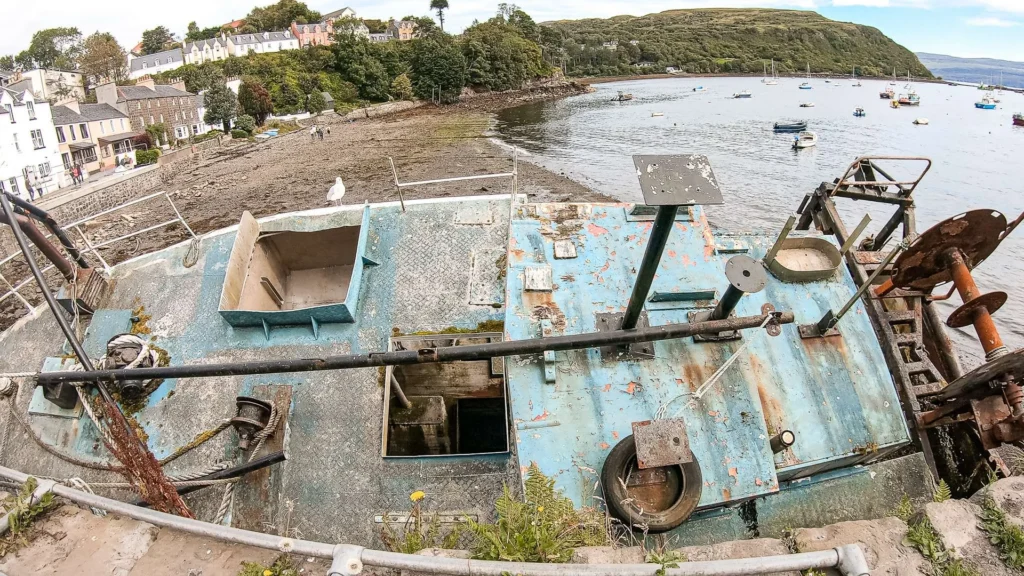
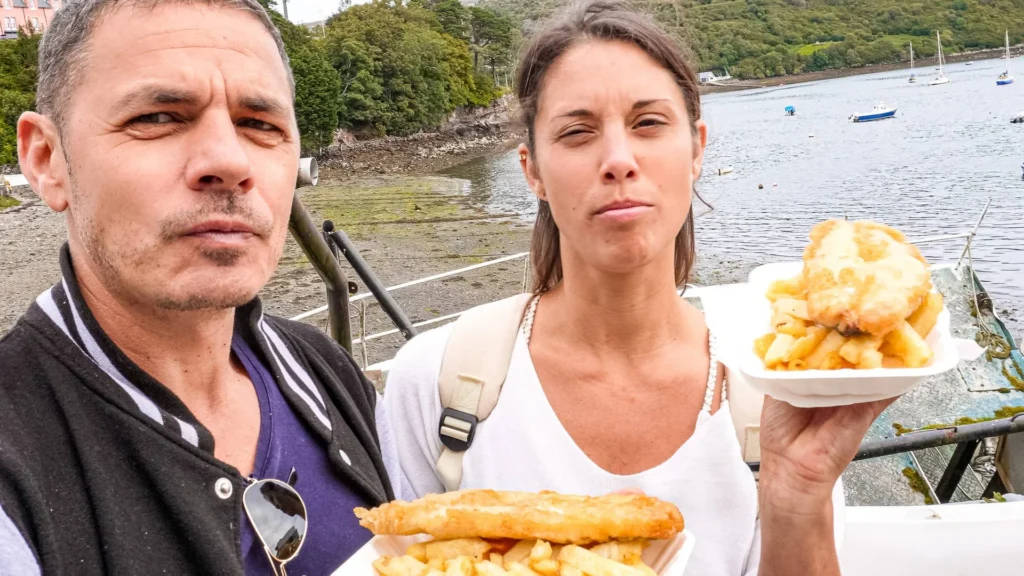
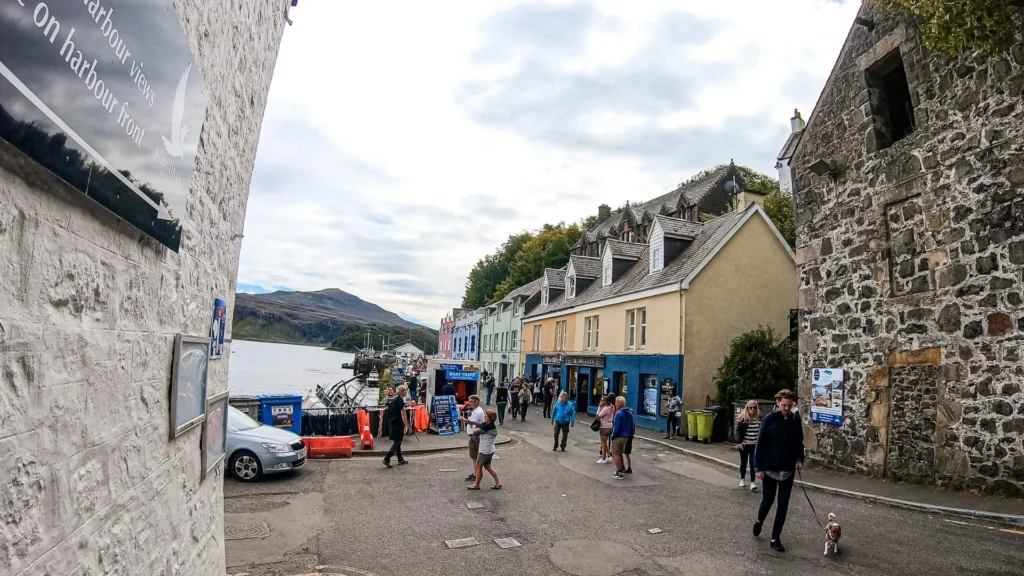
We loved the atmosphere of the port. No yachts, no luxury marina, just small fishing boats with their nets. It smelled like fish, and we felt good. “We’re very much a port town anyway, we don’t like the big stuff with yachts. It’s nice, it smells like fish, it’s cool, it’s compatible with us.” Classic lunch break: fish and chips at the port, fresh from the day. Caroline confirmed: “It’s good.”
A fun anecdote: we didn’t take the vinegar sauce offered as a side. Seeing the massive amount the server poured on the locals’ portions next to us, we hesitated: “He puts it everywhere, on the fries. So, for once, it would have been vinegar on the fish & chips. That’s it. Vinegar chips, enjoy your meal.” Malt vinegar is a solid British tradition, but the local dose would make a French palate weep. Ask for it “on the side” if you want to try it without being overwhelmed.
As for shops, the alleys in the center (Wentworth Street and Bank Street) are full of little souvenir shops with fairy figurines (a nod to the nearby Fairy Pools), small miniature Highland cows, tartan scarves, and scented candles. We indulged in our share of tourist clichés. Caroline confessed: “We’d clear out the whole store.”
And then the heartwarming purchase, which we’ll bring back to Édouard for vanlife evenings in the Hebrides: a bottle of local gin. The Misty Isle Gin from Isle of Skye Distillers, distilled right in Portree. Caroline chose it by chance: “By chance, it won an award this year and is among the best gins in Scotland. We hadn’t bought a real, good one yet, so normally this one should do the trick.” Indeed, it has won several awards at the Scottish Gin Awards. The distillery itself is open for visits (reservation required, The Old Police Station, Portree).
Bonus for whisky lovers who aren’t convinced by gin: the Talisker distillery in Carbost is another big name in Skye spirits. A single malt founded in 1830, with guided tours + tastings. About an hour’s drive from Portree, on the southwest coast.
Discovering Portree on a road trip and in a van: Complete Guide (Isle of Skye)
Set off on an unforgettable journey to Portree, Scotland! Discover its ancient streets, breathtaking landscapes, and delicious local cuisine.
Lire l'article completBoarding in Uig for Harris: the Willy mission begins
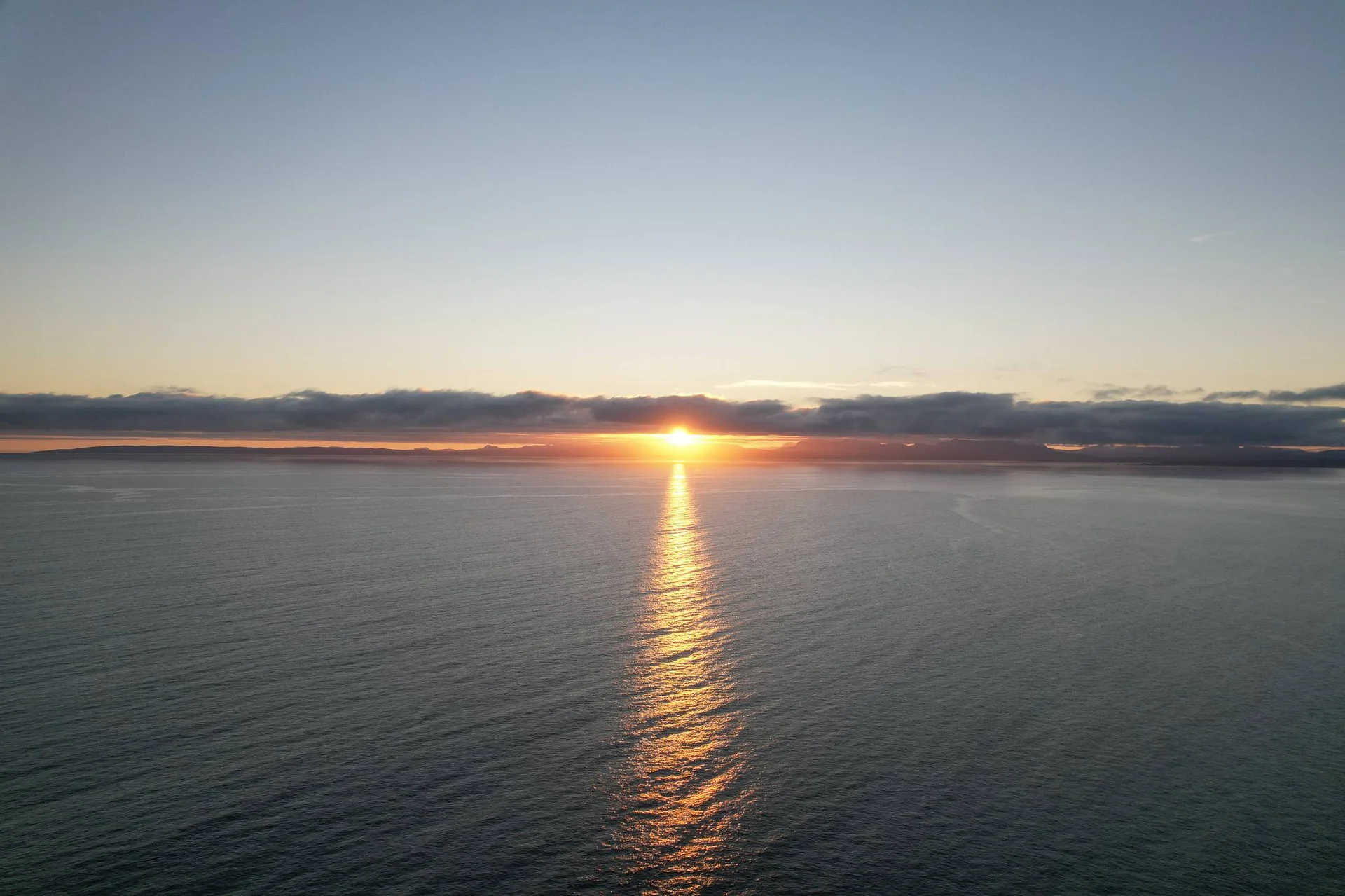
To leave Skye, we headed to Uig, in the northwest of the island. It’s the boarding port for the Outer Hebrides, via the CalMac ferry that connects Uig to Tarbert on the Isle of Harris. Expect about 1 hour and 40 minutes of crossing. Reservation is essential in high season, especially for campervans. Indicative price: £15-30 per passenger, £60-90 for the campervan depending on Édouard’s length.
At the time, we were boarding for Harris with a mission in our pocket. Caroline summarized: “To try to find our dear Willy who’s waiting for us, he doesn’t know yet that he’s waiting for us.” The famous Willy is this painter from the Hebrides that a couple of French regulars had told us about in Lochinver a week earlier, with a bottle of wine to drop off at his place. The Willy mission, for the blog regulars, starts here. For those discovering, we wrote a whole article about the [Isle of Harris](https://www.vantour.net/harris-island-travel-guide/).
Ticket collection at the Uig port counter, simple process (“It was super simple. I confirm, it’s not the most complicated thing we’ve had to do in this life.”), then we waited in the campervan queue. Édouard pretended to think about starting (“Will it restart or not, we don’t know”), but this time he complied. Boarding, gray crossing, and off to Harris. Another story begins.
A small detail that has its charm: while waiting for the ferry, from the quay in Uig, we can already see the “Harris loaves” in the distance. It’s our internal code for talking about the islands that flatten on the horizon like industrial English bread. Caroline named them that, and we never changed it.
Discovering the Isle of Harris on a road trip and in a van: Complete Guide (Outer Hebrides)
Get ready to experience the adventure of a lifetime on an unforgettable road trip to the Isle of Harris in Scotland! Discover the fascinating history, local cuisine, and a multitude...
Lire l'article completMake the most of Skye (better than we did)
Okay, we’ve talked a lot about what held us back. To end on a positive and actionable note, here are our tips if you go there (and you really should).
1. Aim for the low season. April-May or September-October. You’ll experience a different island, and it won’t be the same story as ours. The weather will be more unpredictable (bring waterproof clothing, Webasto heating for the van, dishes protected), but the magic will return.
2. Shift your schedule. At all major spots (Fairy Pools, Old Man of Storr, Kilt Rock, Neist Point), arrive before 8 AM or after 5 PM. Tourist buses run between 10 AM and 4 PM, it’s mechanical. Bonus: at dawn or sunset, the light is five times better for photos.
3. Get off the beaten path. The Quiraing is less crowded than Storr and more spectacular. Neist Point at sunset will offer you one of the most beautiful panoramas of the island if you accept the 30-minute walk from the parking lot and the wind in your face. Dunvegan Castle (seat of the MacLeod clan for 800 years) and its gardens are only half-visited. Talisker and its loch are calm during the week.
4. Prepare your connection BEFORE arriving. Local UK SIM or Holafly eSIM, we’ve detailed that already. Don’t rely on an EU roaming plan. GPS without a network can leave you stranded in the middle of a single track.
5. Anticipate the midges. From June to August, these invisible biting midges can make an end-of-day infernal, especially near lakes and bogs at dusk. Head nets for £15 in any Scottish outdoor shop, DEET-based repellent, and prefer camping spots exposed to the wind (midges hate wind and sun).
6. Be patient with the “No Overnight Camping” network. Local authorities have increased signage since 2019 in tourist areas (Fairy Pools, Old Man of Storr). Wild camping remains legal in Scotland under the Land Reform Act, but please respect local signs. Prefer discreet single tracks, isolated areas, or official campsites.
Sleeping in a van, budget, practical tips
Where to sleep in a campervan. Three main options:
- Official campsites (the simplest, sometimes essential): Glenbrittle Campsite (near Fairy Pools), Torvaig Caravan (near Portree), Sligachan Campsite (island center). Expect to pay £20-30 per night with waste disposal and electricity.
- Discreet wild camping: legally possible in Scotland, but on Skye, avoid areas with “No Overnight Camping” signs. Favor single tracks away from tourist spots.
- Roadside parking (our solution for the first night): not glamorous, but it helps when you need a signal and are exhausted.
Average budget for two in a campervan on Skye. Skye is the most expensive part of the Scottish trip, just a heads up.
- Paid parking: £6 Fairy Pools, £3 Old Man of Storr (2h), £5 Quiraing
- Official camping: £25-30 / night
- Restaurant Portree: £15-25 per dish
- Fish and chips at the port: £12-15
- Distillery tour: £12-25 depending on the tour
- Average total for two: £80-100 / day, groceries included
Practical tip: stock up on groceries in Inverness before arriving. Supermarkets on Skye (Co-op in Portree, Spar in Broadford) have everything, but are on average 10-15% more expensive. The same goes for fuel: Inverness offers the best prices in the area.
How many days. Three full days are enough for a first visit: one day for Fairy Pools + Talisker + southwest coast, one day for Portree + Old Man of Storr + Kilt Rock, one day for Fairy Glen + Quiraing + Neist Point at sunset. With two days, you sacrifice the north. With a week, you can explore Elgol, Coral Beach, Loch Coruisk, and the distilleries.
FAQ Isle of Skye on a road trip
How do you get to the Isle of Skye by campervan?
When is the best time to visit Skye, and how bad are the midges?
What are the must-see stops on Skye?
Where can you sleep in a campervan on Skye?
How many days should you plan for Skye?
How do you get from Skye to Harris and the Outer Hebrides?
Is phone signal good on Skye, and how do you stay connected?
Before Skye: our favorite stops in the Highlands
To recap what we mentioned at the beginning: the three Highland stops that left a mark on us just before arriving in Skye, which set our hearts on solitary spots.
Discovering Ullapool on a road trip and in a van: Complete Guide (NC500 Wester Ross)
Discover our ultimate Road Trip guide to Ullapool in Scotland! Experience a unique blend of exploration, relaxation, and culinary delights. Dive into the fascinating history of this charming town, learn...
Lire l'article complet
Discovering Lochinver on a road trip and in a van: Complete Guide (Sutherland NC500)
Get ready to be captivated by the fascinating history, culinary specialties, and exciting activities of Lochinver in Scotland during your unforgettable road trip. Join us to discover this charming town...
Lire l'article completPS: if you go and find the magic we missed, let us know. We want to believe. And if you encounter the Fairy Pools early in the morning with no one around, take a photo and send it to us; it will help us believe we just had bad luck.
The next route, straight to your inbox
Two years of full-time van life, and the Algarve as our base ever since. We still hit the road, by van or otherwise, and we write up what we find along the way. An email when we have something to say, no more.
Ce que vous souhaitez recevoir :