
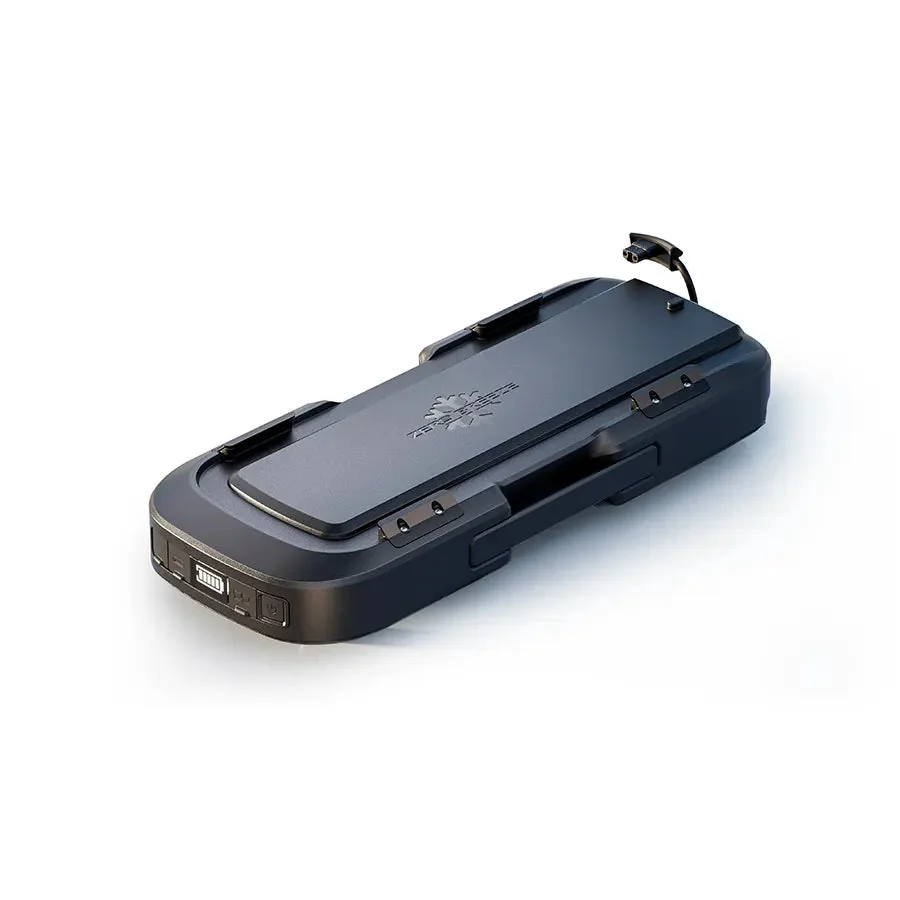
Zero Breeze Mark 3: battery-powered portable air conditioner
VANTOUR**Verified price on 17 October 2026. The final price may vary.
Why use our link and our code?
Video
Description
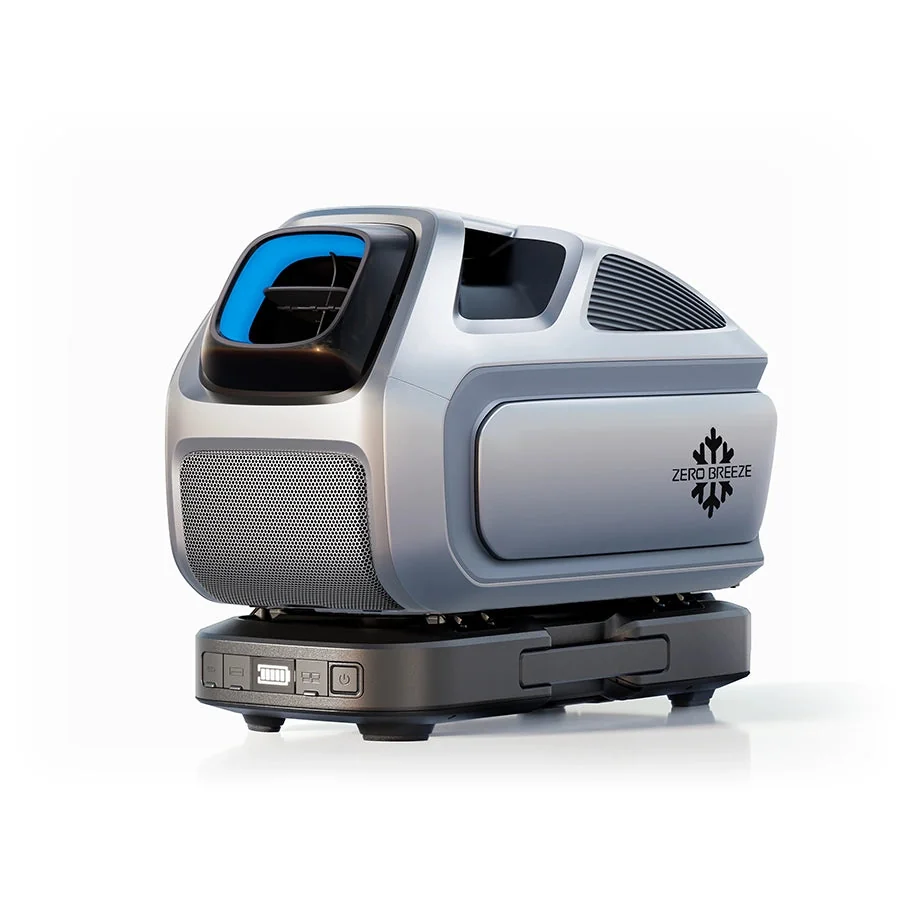
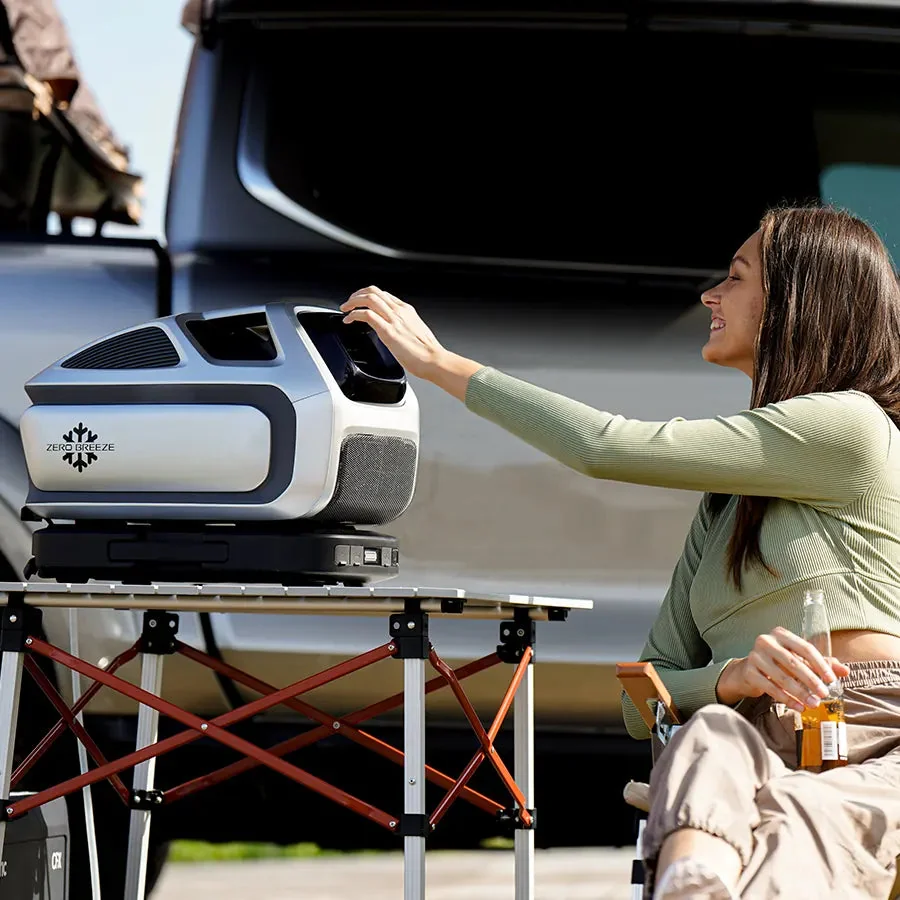
The Zero Breeze Mark 3 is the air conditioner you take everywhere: into the campervan when you hit the road, and into the room at home that has no cooling when you stay put. It cools, it heats, it dehumidifies, and it runs on battery, with no fixed install and no drilling. It is Zero Breeze's current flagship, from the brand that invented the portable AC built for van life.
Let's be honest up front: at this price, this is not the gadget you pull out one week a year for the holidays (a clip-on fan and a shady spot do that job for next to nothing). The Mark 3 earns its keep when you live in your van a good part of the year, or when you have a fixed room with no cooling to handle day to day (a garden office, a loft bedroom) and you want the same unit on hand for the campervan. One machine, two lives: that is where its real value sits.
Who is this portable air conditioner for?
We recommend it first to people who travel a lot, even year round, and for whom every kilo and every cubic centimetre counts. It is also, and this is the angle we like best, one unit for home and van: it cools your non-air-conditioned office in the week, then rides along in the camper at the weekend or for a long trip. Two uses, one investment.
If, on the other hand, you head off once a year for a few days, the price is hard to justify: better to play geography (head north in summer) and run a fan or two. We are well placed to say it, because that is exactly the strategy we used for years with our own campervan.
What to know before buying a portable AC
One honest point that applies to the Mark 3 as much as to every rival: a portable air conditioner does not turn a van into a cold room. In full sun, a van stays a metal box that heats faster than the machine can cool it. The right move is to create a localised bubble of cool air (aim the flow at yourself, partition the sleeping area) rather than trying to cool the whole volume. Claims like "minus 8 degrees in fifteen minutes" are lab figures on a tiny volume; in real life, expect a few degrees gained over an hour, far better in the shade than in the sun.
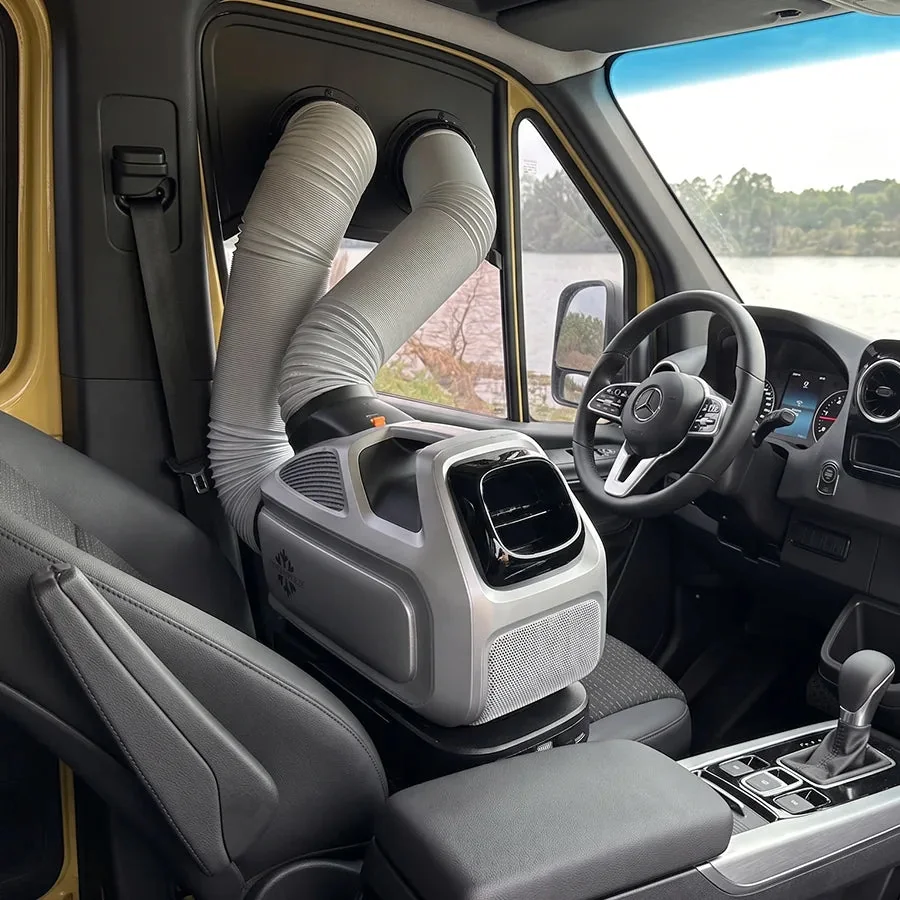
The other make-or-break is exhausting the hot air: if the ducting is not sealed properly at the window, the unit cools on one side what it reheats on the other. We lived this on our EcoFlow Wave 2: the kit was good, the sealing made the difference. The Mark 3 answers with its dual-hose airflow (separate intake and exhaust) and its active drain pump that avoids spilled water when you move it.
Cooling, heating and dehumidifying: one unit all year
The Mark 3 rates 5,280 BTU cooling (1,550 W) and 5,800 BTU heating (1,700 W): it is a genuine reversible AC, not just a fan. In practice it cools a bunk, a tent or a 9 to 14 sq m corner of the living space, and it heats in the shoulder seasons as long as the ambient air stays above roughly ten degrees. It dehumidifies too, which matters as much as the cold when the air is heavy. The refrigerant is R290, cleaner and more efficient than the older gases.
Worth flagging honestly: heating is not exclusive to the Mark 3. Its direct rival, the EcoFlow Wave 3, heats as well, a touch harder even. The real split happens elsewhere, on weight, runtime and ecosystem.
Runtime and stackable batteries
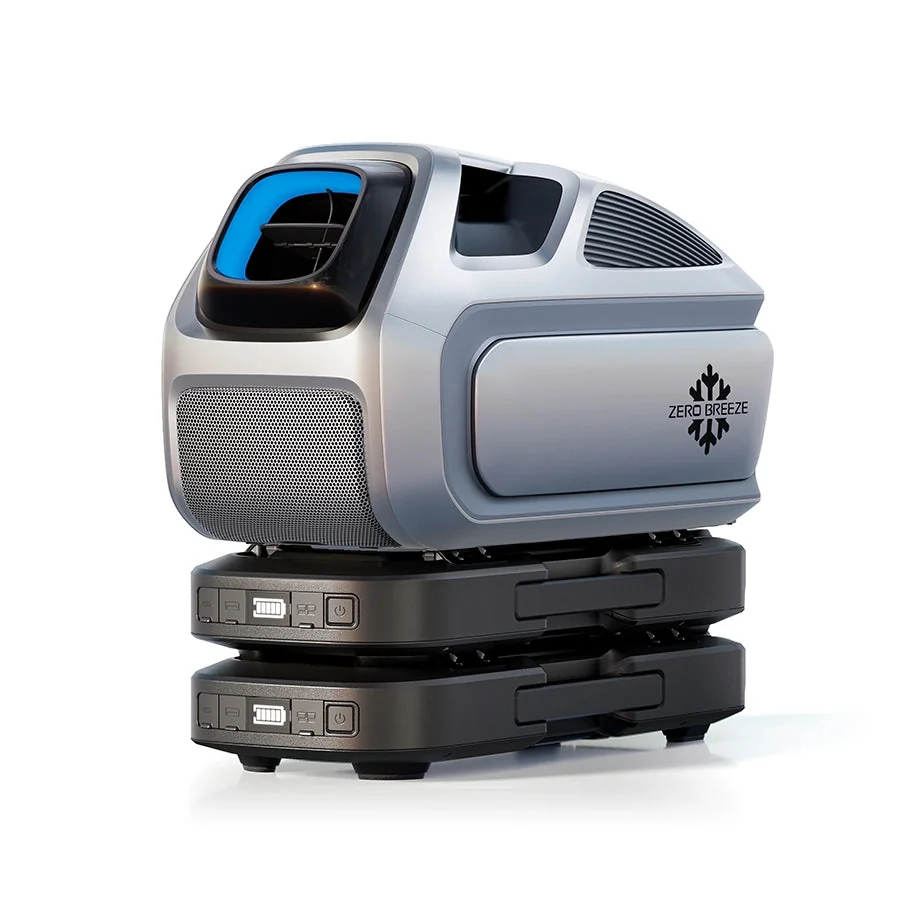
The version we list ships with a dedicated 1,022 Wh battery (21700 lithium-ion cells). Depending on the mode, count two to three hours at full tilt, and far more in the economical night mode. The clever part is stacking the batteries: add a second, a third, and you get through a full night without a second thought. Charging is quick (about two hours from zero to 80 percent) and, crucially, the Mark 3 charges while running, from the mains, the 12V socket or a solar panel up to 500 W.
On the output side, the battery doubles as a small power station: a 12V Anderson port (120 W), USB-C Power Delivery 100 W and USB-A. Enough to run a fridge or top up devices when the AC is off. One field reminder: shade cools the van but cuts the solar charge, the permanent trade-off of nomad life.
Set up in 60 seconds, no drilling
Ten kilos for the unit, the lightest in its class, and it starts in a minute: set it down, plug it in, let it blow. No drilling, no fixed mounting. Zero Breeze offers venting kits for the windows of common vans (Mercedes Sprinter, Ram ProMaster, Ford Transit), plus a universal cut and a tent version. In night mode it drops to 46 dB, clearly quieter than the previous generation.
Zero Breeze Mark 3 or EcoFlow Wave 3?
That is the question we get most. Both are excellent battery-powered portable ACs, and the right pick depends on your need, not on an absolute winner. The Mark 3 is the pure nomad choice: lighter (10 kg against 15), some of the coldest air out there, the lowest draw, and stackable batteries to last several days. The EcoFlow Wave 3 offers a little more BTU, longer runtime and a hardier LiFePO4 battery; it plugs into an EcoFlow Delta station if you already own one, but it is heavier. Already on EcoFlow, we lean Wave 3; after the lightest and most self-sufficient setup, we lean Mark 3.
Our take
Full transparency: we have not had the Mark 3 in our hands (we owned the EcoFlow Wave 2, which is our lived reference point). Our read leans on the real specs and on feedback from creators who tested it in the field, in vans and in tents. What comes out of their trials matches our logic: aim the air at yourself rather than at the whole volume, a real jump in runtime and charging over the previous generation, and a drain pump that changes life when you move the unit. The honest snag that keeps coming up: an app that dislikes going offline and a proprietary battery connector.
For the bigger picture on staying cool in a van, see our guide on van and motorhome ventilation.
Why buy on Vantour?
Because we buy straight from the brand: a 100 percent genuine, official product, stock managed by Zero Breeze, and warranty handled by the maker for the longest term possible. No dodgy third-party reseller, no counterfeits.
On price, to give you a concrete idea:
Technical specifications
| Capacity | 1,022.00 Wh |
|---|---|
| Net Weight | 10.00 kg (22.05 lb) |
| Dimensions | 560 x 260 x 310 |
| Total Output Power | 550.00 W |
| USB-A | QC 3.0 18W |
| USB-C | PD 100W |
| DC 12V Output | Anderson 12V/10A (120W) |
| AC Charging | 500.00 W |
| Solar Charging | 500.00 W |
| Battery Chemistry | Lithium-ion (21700) |
| Wi-Fi | ✓ |
| Application | ✓ |
| Noise | 46.00 dB |
| Operating Temperature | 10 to 40 |
| Waterproof Rating | 4.00 % |
| Cooling Capacity | 1,550.00 W |
| Heating Capacity | 1,700.00 W |
| Rated Cooling Power (AC) | 500.00 W |
| Charging Temperature | -10 to 40 |
Our verdict
Benefits
- Lightest in its class (10 kg), ready to blow in 60 seconds
- Some of the coldest air of any battery portable AC
- Stackable batteries: add runtime to get through the night
- Reversible, it heats too (5,800 BTU) in the shoulder seasons
- R290 refrigerant and active drain pump, built for nomad use
Disadvantages
- High price, justified mainly for regular use (not one week a year)
- Lithium-ion battery, fewer cycles than a LiFePO4
- Proprietary battery connector (no standard XT60)
- In full sun it makes a bubble of cool air, not a fully cooled van
If you live in a van a good part of the year, or want a single unit for home and campervan, the Mark 3 is the lightest and most frugal pick. The occasional holidaymaker will do without it just fine.
Frequently Asked Questions
Can the Zero Breeze Mark 3 cool a whole campervan?
How long does it run on battery?
Does it run on solar or while driving?
Does it heat as well?
Do you have to drill the van to fit it?
Customer reviews
Review
There are no reviews for this product yet.
Additional information
| Option | Price | Availability |
|---|---|---|
| Standard | £1359,00 £1291,05 | In stock |