



If you’re reading this, it’s because you’re torn between the two current references to cool your van: the Zero Breeze Mark 3 and the EcoFlow Wave 3. We’re not going to sell you a fake winner because the truth is, it depends on you. We’ve owned the previous EcoFlow Wave 2, so we know the logic of these machines well, and we’ll tell you which model leans towards which.
In short: which one for whom?
If you want the short version: the Mark 3 is the pure nomadic choice, the lightest and most compact, with stackable batteries that last several days. The Wave 3 is the ecosystem choice, more powerful, with a longer-lasting battery, and it connects to an EcoFlow Delta station if you already have one. Already equipped with EcoFlow, go for the Wave 3. If you’re traveling light and want long autonomy, check out the Mark 3.
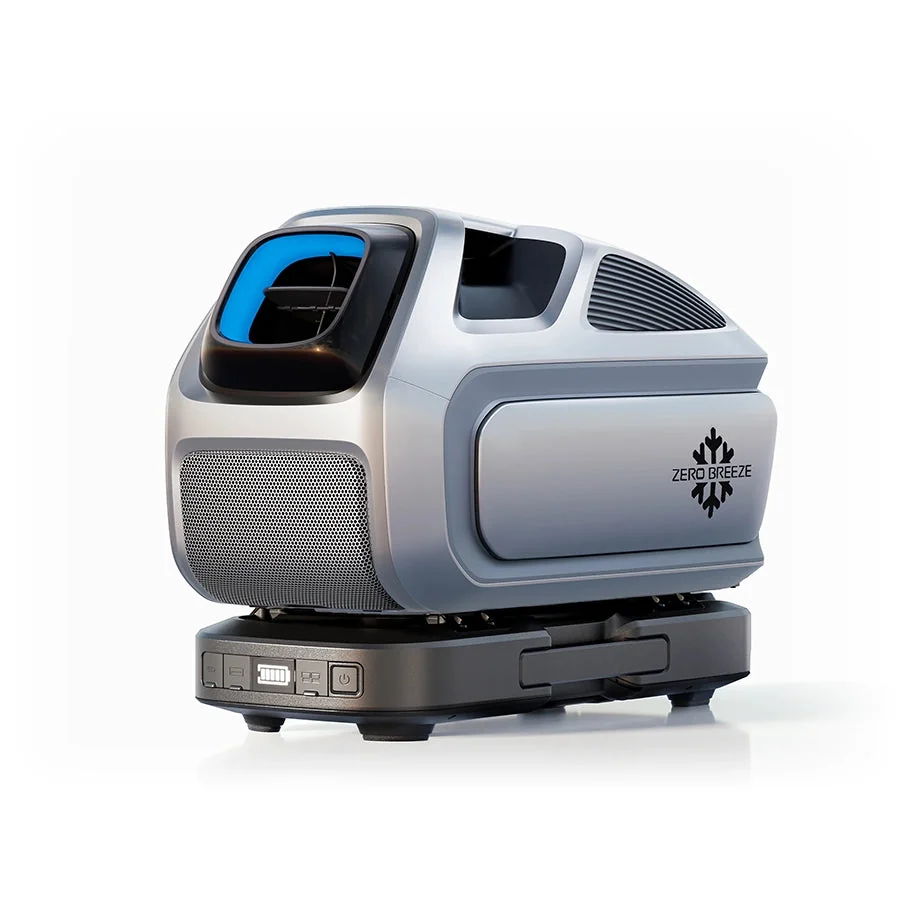
The match at a glance
Comparison of Zero Breeze Mark 3: battery-powered portable air conditioner and EcoFlow Wave 3: portable battery air conditioner and heater

£1359,00
See the product
|

£749,00
See the product
|
|
|---|---|---|
| Capacity | 1,022.00 Wh | - |
| Net Weight | 10.00 kg (22.05 lb) | 15.60 kg (34.39 lb) |
| Dimensions | 560 x 260 x 310 | 519.00 mm (20.43 in) |
| Total Output Power | 550.00 W | - |
| USB-A | QC 3.0 18W | - |
| Application | ✓ | ✓ |
| Noise | 46.00 dB | 58.00 dB |
| Operating Temperature | 10 to 40 | - |
| Waterproof Rating | 4.00 % | 4.00 % |
| Cooling Capacity | 1,550.00 W | 1,800.00 W |
| Heating Capacity | 1,700.00 W | 2,000.00 W |
| Rated Cooling Power (AC) | 500.00 W | 690.00 W |
| Charging Temperature | -10 to 40 | - |
| Refrigerant / Quantity | - | 112.00 g |
| Air Volume | - | 330.00 g |
| Rated Cooling Power (DC) | - | 640.00 W |
| Rated Heating Input Power (AC) | - | 645.00 W |
| Rated Heating Input Power (DC) | - | 606.00 W |

I'm Xavier
I test gear over months, in the van and day to day, and I say what doesn't work. If that saves you one bad purchase, leave me your address.
Ce que vous souhaitez recevoir :
Cold and hot: one blows more, the other colder
On paper, the Wave 3 leads with 6,100 BTU in cooling compared to 5,280 for the Mark 3, and it also heats a bit stronger (6,800 against 5,800 BTU). In practice, testers note an interesting nuance: the Mark 3 blows slightly cooler air at the mouth, while the Wave 3 handles a larger volume. Both are reversible, so heating doesn’t really differentiate them, with just a slight edge for the Wave 3 in relative cold.
A little reminder of honesty valid for both: the “minus 8 degrees in fifteen minutes” are lab numbers. In a real van under the sun, expect a few degrees gained over an hour, aiming for a bubble of cool air rather than cooling the entire space.
Weight and size: the Mark 3’s advantage
This is the most concrete criterion in daily use. The Mark 3 weighs 10 kg for the unit, compared to about 15 kg for the Wave 3, and it is significantly more compact. When you need to take out and store the device every day, or fit it into a van where every centimeter counts, those five kilos and that volume make a real difference. If you travel in a small van or frequently move the air conditioning, the Mark 3 wins this round without debate.
Autonomy and ecosystem: the Wave 3’s advantage
Here, the Wave 3 takes the lead. Its LiFePO4 battery withstands about 4,000 cycles, much more than a standard lithium-ion battery, and importantly, it’s not mandatory: the Wave 3 connects to any EcoFlow Delta station you already own, and it runs on 12V while the engine is running. The Mark 3 responds with its stackable batteries (you can use two or three to last the night, or even days), but within a closed ecosystem. Already with EcoFlow, the Wave 3 is a no-brainer.
Installation and noise: a draw, or almost
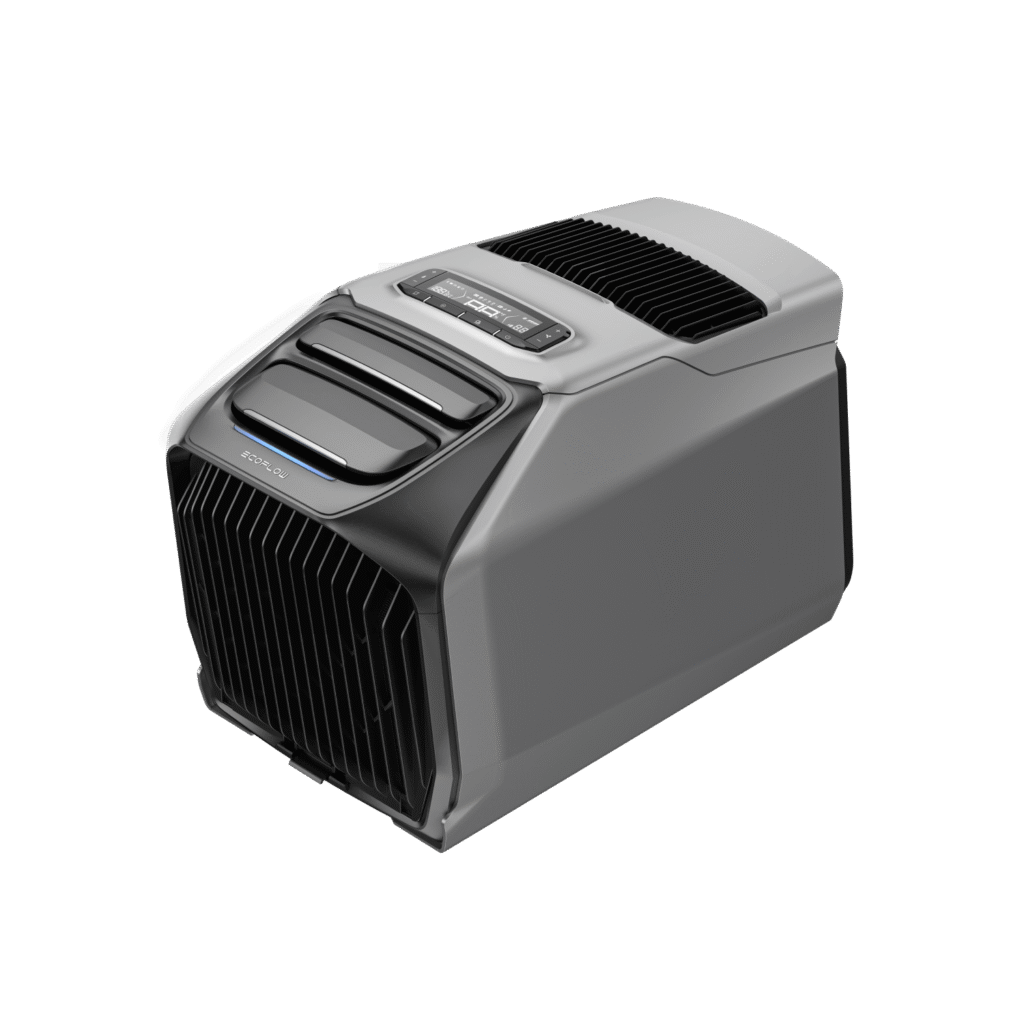
Both install without drilling, with ducts through the window, using ventilation kits for common vans. In terms of silence, they are comparable: about 46 dB for the Mark 3, 47 to 50 dB in eco mode for the Wave 3. The point to watch is the same for both, and we learned this from our Wave 2: properly sealing the hot air exhaust, otherwise the efficiency collapses.
Price: slight advantage to the Wave 3
At comparable configurations, the Wave 3 often comes out a bit cheaper, especially if you already have an EcoFlow station that saves you from buying the battery. The Mark 3, being more premium in format and weight, costs a bit more. Nothing prohibitive either way, it comes down to a few hundred pounds depending on promotions.
Our verdict
There is no loser. The Zero Breeze Mark 3 is made for the nomad who counts every kilo, wants the most compact option, and extendable autonomy through battery stacking. The EcoFlow Wave 3 is made for those already with EcoFlow, wanting more BTU and an ultra-durable battery. We, with our Delta, would lean towards the Wave 3, but we completely understand choosing the Mark 3 for its lightness.
To put all this in context, check out our complete guide on air conditioning in campervans, and find both models in our section on portable air conditioners.
To finalize your decision, here are the two product sheets and our complete air conditioning guide:

Zero Breeze Mark 3: battery-powered portable air conditioner
The Zero Breeze Mark 3 is the air conditioner you take everywhere: into the campervan when you hit the road, and into the room at home that has no cooling...
Discover
EcoFlow Wave 3: portable battery air conditioner and heater
The EcoFlow Wave 3 is the air conditioner that cools, heats and dehumidifies on battery, with no fixed install and no drilling. Successor to the Wave 2 (which we owned...
Discover
Campervan air conditioning: which AC to choose
Roof air conditioning, built-in 230V or battery-powered: the honest guide to choosing the air conditioning for your motorhome or van, including consumption, autonomy, 12V while driving, and reversible heating.
DiscoverZero Breeze Mark 3 vs EcoFlow Wave 3: your questions
Which is quieter?
Can the Wave 3 run on something other than an EcoFlow battery?
Can the Mark 3 batteries power other devices?
Which should I pick if I live in my van year round?
Is there anything cheaper than these two?
Which heats better?
PS: whatever your choice, you’ll have an air conditioner that also serves at home, in the room that the fixed air conditioning never reaches. Maybe that’s the real argument, more than the BTUs.
Our gear tests, in real conditions
Batteries, solar, conversion, security. What we found after months of real use, and what we would not buy again. An email when we have actually tested something, not before.
Ce que vous souhaitez recevoir :