



We’ve spent quite a few summers in our campervan, and for a long time, our “air conditioning” consisted of two USB fans and the common sense to head north when it got really hot. It works, but let’s be honest, there are days when we would have liked to just press a button and get some cool air. So here’s the guide we wish we had read beforehand: the three families of air conditioning for campervans, what they are really worth, and which one to choose based on your travel style.
Can you really air condition a campervan?
Let’s start with the uncomfortable truth, because no one tells you this before you buy: a campervan in full sun is like a tin can. It heats up faster than any machine can cool it down. No air conditioning, even fixed, can turn a van parked in the blazing sun into a cold room.
What works, however, is creating a bubble of cool air in a localized area: you cool down the space where you live or sleep, start early in the morning before it heats up, and find shade whenever possible. Marketing promises like “8 degrees cooler in fifteen minutes” are lab measurements in a very small volume. In a real campervan of 15 to 20 m3, expect to gain a few degrees over an hour, much better in the shade than in the sun. Keep this in mind to avoid disappointment.
The cool air bubble, in reality
Temperature inside the camper van during a hot afternoon, without air conditioning and then with a portable air conditioner directed at the living area. Indicative values, drawn from creator feedback.
- Outside, about 37°
- Van without air conditioning
- Van with portable air conditioner
For reference, in full sun. A portable air conditioner does not turn the cell into a cold room; it creates a cool air bubble around you and gains a few degrees, much more in the shade or when starting early in the morning.
The three families of air conditioning for campervans
There are three main solutions, and they don’t play in the same league or at the same price.
Roof air conditioning (12V or 230V)
This is the fixed air conditioning mounted on the roof, a Dometic or a Truma roof unit. Its main advantage is that it cools the entire vehicle fairly evenly, through one or more vents, without cluttering the inside since it lives on the roof. The classic campervan air conditioning, basically.
The downside is twofold. First, the weight: 25 to 30 kg on top affects handling and dimensions, plus you need to cut a hole in the roof and budget between £1,800 and £2,500 installed. Then there’s the electricity, and that’s where it gets expensive: a roof air conditioning unit easily consumes 400 to 1,000 watts. On battery alone, you’ll last one to two hours on a 100 Ah battery, barely more on 200 Ah of lithium. To run it all night autonomously, you need a very large battery bank, a robust inverter, and properly sized solar panels, in short, a real electrical installation.
So the actual use becomes clear: at a site with 230V, it runs all night without a second thought. When off-grid, the right reflex is to turn it on in the evening upon arrival, to dispel the heat accumulated in the cabin all day and lower the temperature before sleeping. And let’s be honest, on some hot nights, even one night isn’t enough.
Built-in 230V air conditioning (like Truma, Dometic)
Installed under a bench or in a storage compartment, it distributes cold air through ducts throughout the cabin. It’s the most comfortable and discreet, almost like home, and often the quietest of the bunch.
But it’s also the most expensive (£2,000 to £2,300 plus installation) and by far the most power-hungry: it requires strong 230V, so a permanent connection or a large battery bank with an inverter. Without mains power, you can’t really use it. It’s the air conditioning for those who stay put at a site with electricity, much less for the nomad who moves around and lives off their batteries.
Battery-powered portable air conditioning
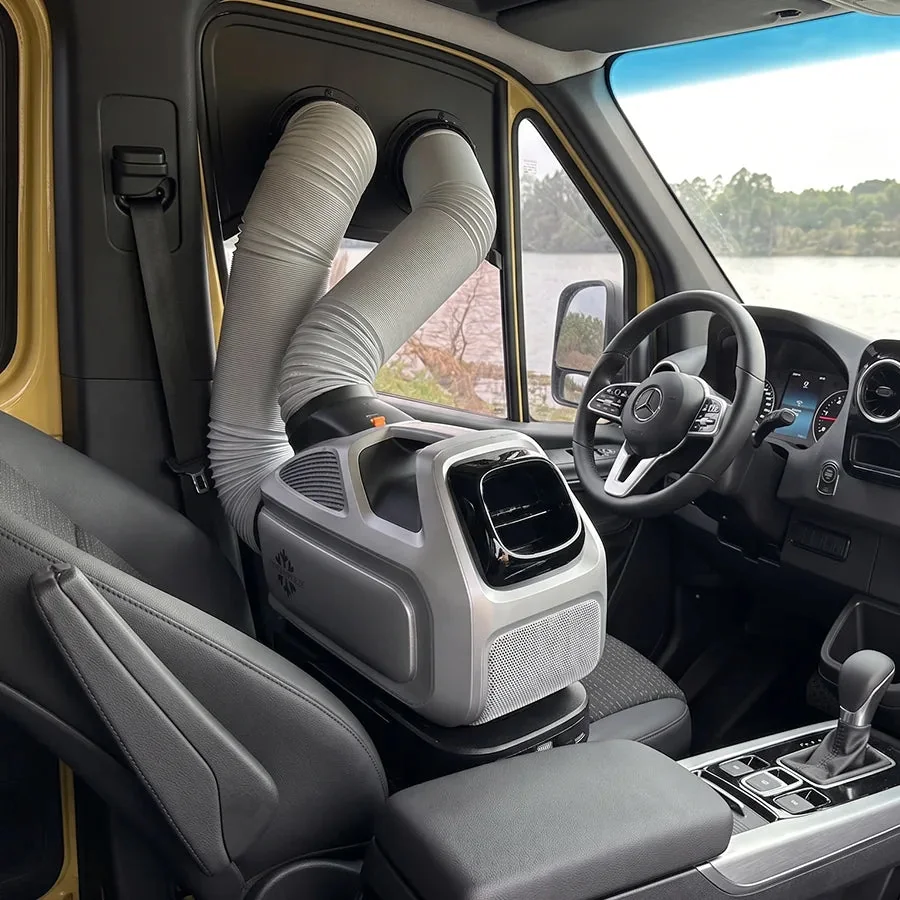
This is the new generation: a standalone unit, placed on the ground, that blows cold air through one vent and expels hot air through a duct to the window. It runs on its own battery, recharges via solar or while driving, installs in a minute without drilling, and most importantly, you can take it out of the van to use at home.
It only cools a bubble around you, not the entire cabin, but in return, it remains much more economical to use: around 100 watts in night mode, enough to last several hours on its own battery without draining the van’s entire battery bank. It’s the solution we prefer for vanlife, and we’ll explain why just after.
| Criteria | Roof air conditioning | Built-in 230V | Battery-powered portable |
|---|---|---|---|
| Cooled area | The entire vehicle | The entire vehicle | A localized bubble |
| Installation | Roof cutout | Fixed installation + 230V | None, in 60 seconds |
| Off-grid autonomy | Limited | Low without a large battery bank | Battery + solar |
| Required electricity | Large installation or 230V | Mandatory 230V mains | Its battery + solar |
| Weight | 25 to 30 kg on top | Heavy, fixed | 10 to 15 kg, portable |
| Indicative budget | £1,800 to £2,500 | £2,000 and up | £900 to £1,600 |
| Home use possible | No | No | Yes |
What each air conditioner consumes
Electric power required in operation, depending on the type of air conditioner. Indicative orders of magnitude: the higher the bar, the more electricity is needed behind it.
For reference, peak power in operation. To compare, a small USB fan draws about ten watts: that's why it runs all night without draining the battery, whereas a rooftop air conditioner can empty a park in one to two hours.
Our choice for vanlife: battery-powered portable air conditioning
For those who drive and seek autonomy, battery-powered portable air conditioning checks the most boxes. No drilling, no installation, a reasonable weight, solar recharging, and this detail that changes everything: it’s the same device as at home. You cool your office or your non-air-conditioned garden shed during the week, and you take it into the cabin on weekends. One investment, two lives.
In this niche, two models stand out: the Zero Breeze Mark 3, the lightest and most compact, and the EcoFlow Wave 3, more powerful and integrated into the EcoFlow ecosystem. We compared them in detail in our comparison of Zero Breeze Mark 3 vs EcoFlow Wave 3, and you can find all the models in our section on portable air conditioners.
Consumption and autonomy: what battery for air conditioning?
This is THE crux of the nomadic lifestyle. A portable air conditioner draws between 300 and 700 W depending on the mode and power. On a dedicated battery of about 1 kWh, this roughly translates to two to three hours at full power, and much more in energy-saving night mode. In other words, a single battery may not last the entire night during a heatwave.
The workaround is to stack batteries (the Mark 3 does this very well) or connect the air conditioning to a large station like the EcoFlow Delta (the strong point of the Wave 3), all recharged by solar during the day. And here comes a tricky dilemma we know well: parking in the shade cools the cabin but cuts off the solar panel recharge. True autonomy is a mix of battery, solar, and a bit of discipline.
October 2026
How long does a battery last?
Approximate autonomy of a portable air conditioner on a single battery of about 1 kWh, depending on the mode. Magnitudes observed on current models.
A single battery does not last the night at full power during a heatwave. To last, we stack batteries or plug the air conditioner into a large power station, all recharged by solar during the day.

I'm Xavier
I test gear over months, in the van and day to day, and I say what doesn't work. If that saves you one bad purchase, leave me your address.
Ce que vous souhaitez recevoir :
Cooling while driving, on 12V
Many are looking for a “cooling while driving” solution. The idea is good: with the engine running, the alternator provides almost free power. Some portable coolers, like the Wave 3, run on 12V from the vehicle and draw almost nothing when the engine is running, so they can operate continuously on the road. Handy for arriving at your destination with a cabin already cool.
When stopped, however, you rely on the battery and solar power. The 12V while driving is a nice bonus, not a standalone autonomy solution.
Heating: most are reversible
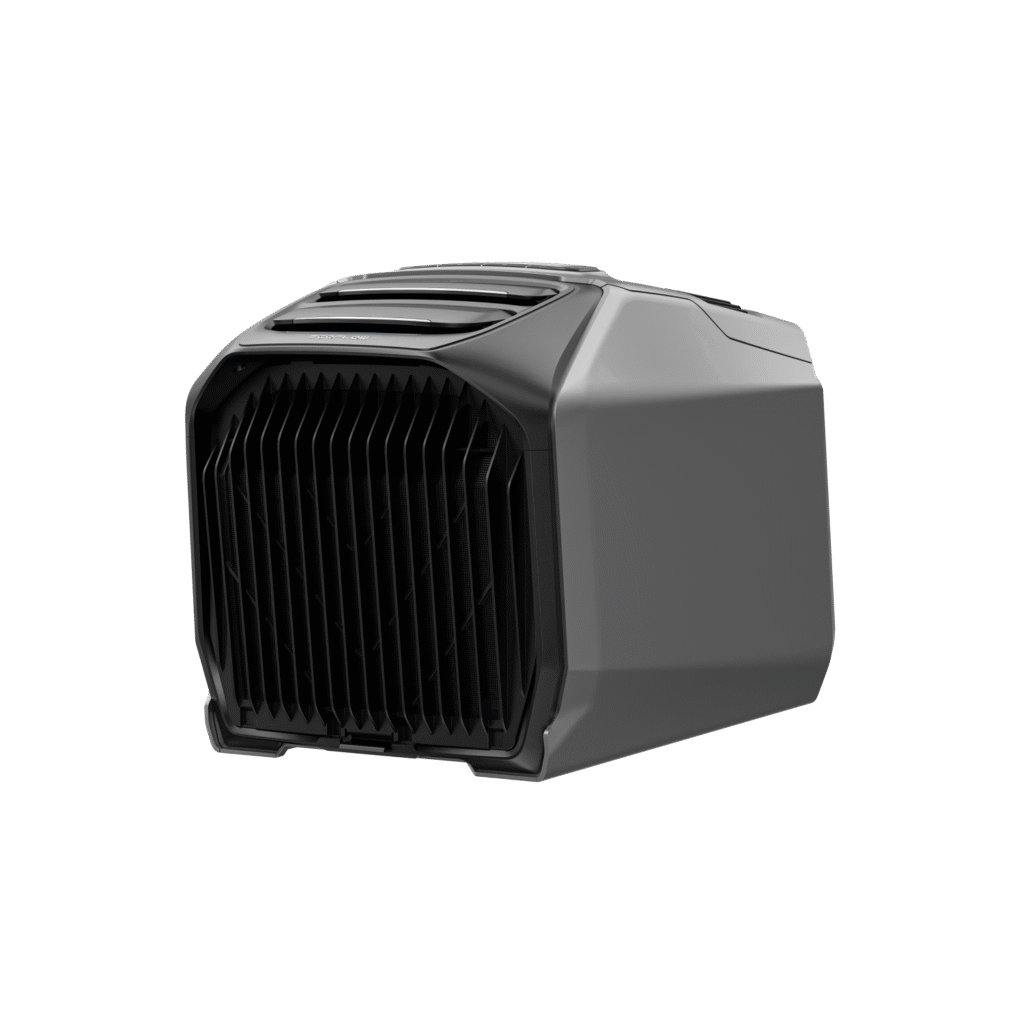
We often forget, but a good portable cooler also heats. The Mark 3 and the Wave 3 are reversible units: they blow warm air in mid-season, as long as the ambient temperature stays above zero to ten degrees depending on the model. For a van used in the shoulder seasons, this is a real plus, one device for summer and for cool autumn mornings.
Be careful though: these are not heaters for extreme cold. Below zero, a gas or diesel heater remains essential. The reversible cooler helps out, but it does not replace winter heating.
Installing a portable cooler without drilling
This is the other big advantage of portable units: installation. You place the device, run the hot air exhaust hose through a slightly open window or a roof vent, and you’re good to go in a minute. Manufacturers offer ventilation kits for common van windows (Sprinter, ProMaster, Transit) or a universal cutout.
The only point to take care of, and we learned this the hard way with our old EcoFlow Wave 2, is the sealing of the exhaust: if hot air enters through the same opening as the hose, the cooler cools one side while heating the other. A good seal around the hose, and the efficiency makes a leap.
And what if we could cool down without a cooler?
A cooler is great, but it doesn’t replace good habits. Even before turning anything on, shade, ventilation, and vehicle orientation do half the work. We detailed everything in our guide to avoiding heat in vanlife and our article on ventilation in vans and campervans. Often, the best cooler is simply choosing where to park wisely.
And if you want to dive deeper into a specific point, we’ve gathered our cooler articles right here, from detailed comparisons to tips for staying cooler without turning anything on:

Zero Breeze Mark 3 vs EcoFlow Wave 3: which portable AC?
Honest comparison of the two battery-powered portable air conditioning units: Zero Breeze Mark 3 vs EcoFlow Wave 3. Cooling, weight, battery life, ecosystem, and price, to choose based on your...
Read more
Zero Breeze Mark 3: our honest review
Our complete and honest review of the Zero Breeze Mark 3: expert analysis and feedback from creators who tested it. Cooling, battery life, stackable batteries, real drawbacks, and comparison with...
Read more
Ecoflow Wave 3: A Blast of Hot and Cold!
Looking for a compact, solar-powered portable battery that can grow with your needs, whether you're off for a weekend escape or living the vanlife full-time? I’ve spent several days testing...
Read more
Refreshing your van or camper, how to avoid heat in Vanlife?
Heat can quickly turn your vanlife adventure into a nightmare. But with the right insulation techniques, thoughtful layout, and a few clever tips, you can keep your van pleasantly cool,...
Read more
Van and motorhome ventilation: how to breathe without ending up with mould
Humidity, condensation, mold, stuffy nights: poor ventilation ruins life in a van. We explain how to ventilate your van or motorhome, summer and winter, without electricity or drilling into the...
Read moreCampervan air conditioning: frequently asked questions
How many BTU do you need to cool a van?
Can you run an AC off a generator?
Is a campervan AC too noisy to sleep with?
Do you have to empty the condensation water?
Can you build a DIY solar air conditioner?
What budget should you plan to cool a campervan?
Can a portable AC also be used at home?
PS: we traveled for a long time without any cooling at all, just by fleeing the heat north in the summer. If you can organize your summers like that, save your money. Otherwise, a good battery-powered portable unit is the best compromise we know.
Our gear tests, in real conditions
Batteries, solar, conversion, security. What we found after months of real use, and what we would not buy again. An email when we have actually tested something, not before.
Ce que vous souhaitez recevoir :