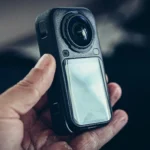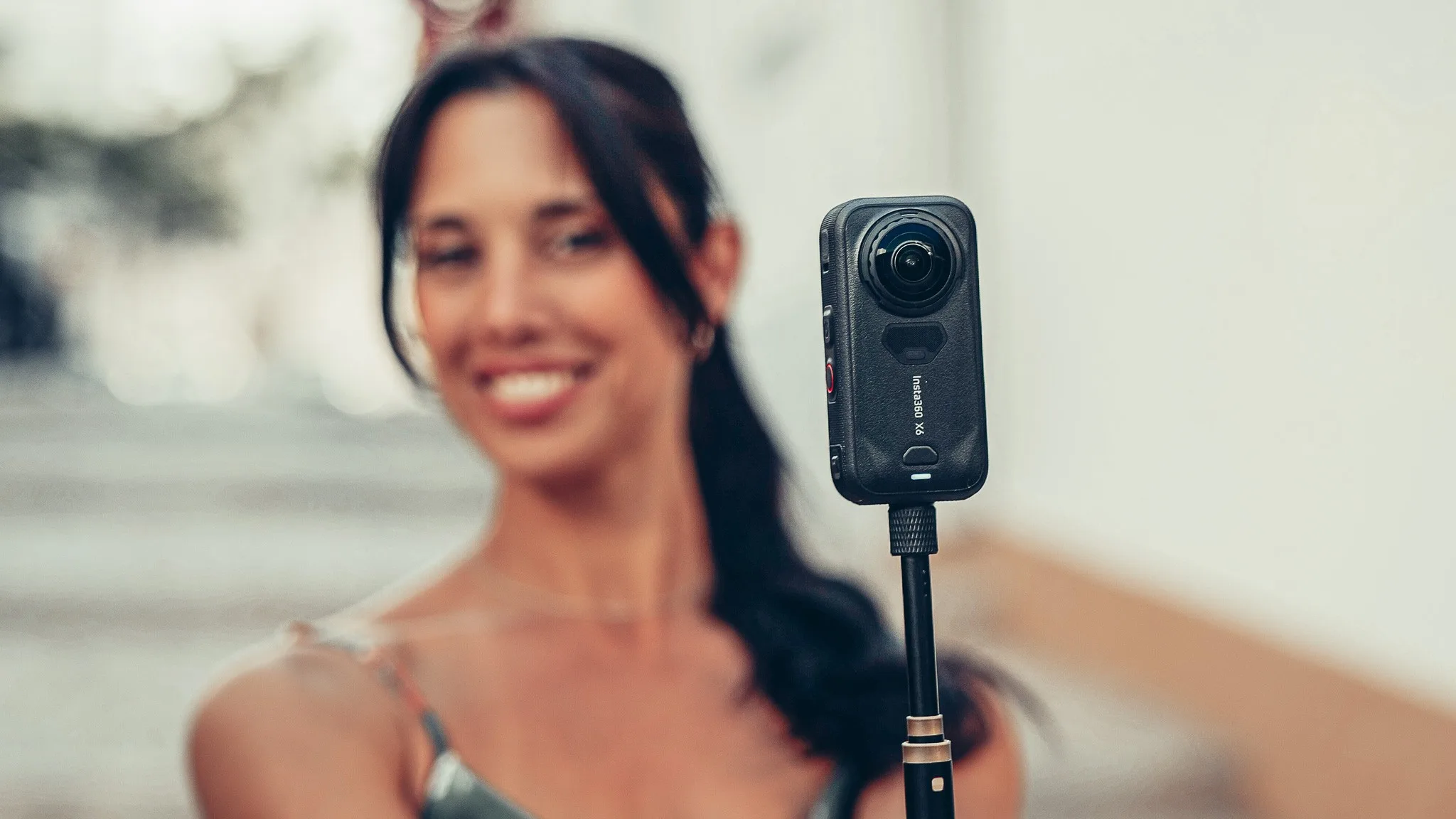
We said no to this camera. When Insta360 offered us the X5 a few months ago, we declined: the bulging rendering, the rounded edges, the characters posed on tiny planets, we find that frankly ugly. Then they came back with the X6, and we accepted without believing it for a second.
It officially launches today. We’ve had it for a week: unboxed, taken to a beach party, and especially taken out on a boat in the caves of Ponta da Piedade, in Lagos. That’s where our opinion changed, and not at all for the reasons we expected.
Here’s what we think after this first week, with what we’ve been able to verify ourselves and what we haven’t tested yet.
Our verdict on Insta360 X6 360 Camera 8K and 3-in-1 Action
Benefits
- Filming without aiming or looking at the screen, framing in post-production
- Dual Sony 1/1.1" sensor equivalent to 1 inch, 8K50 and 14.5 stops
- Battery life that lasts without flinching, 140 minutes announced in 8K30
- 47 GB of internal storage, you can leave without a microSD card
- IP68 20 m and firm hatches: we approach water without thinking about it
- Three cameras in one: 360, auto tracking in flat 4K, single lens 5K60
Disadvantages
- Proprietary software required for viewing and exporting
- What we gain on the field, we lose in post-production
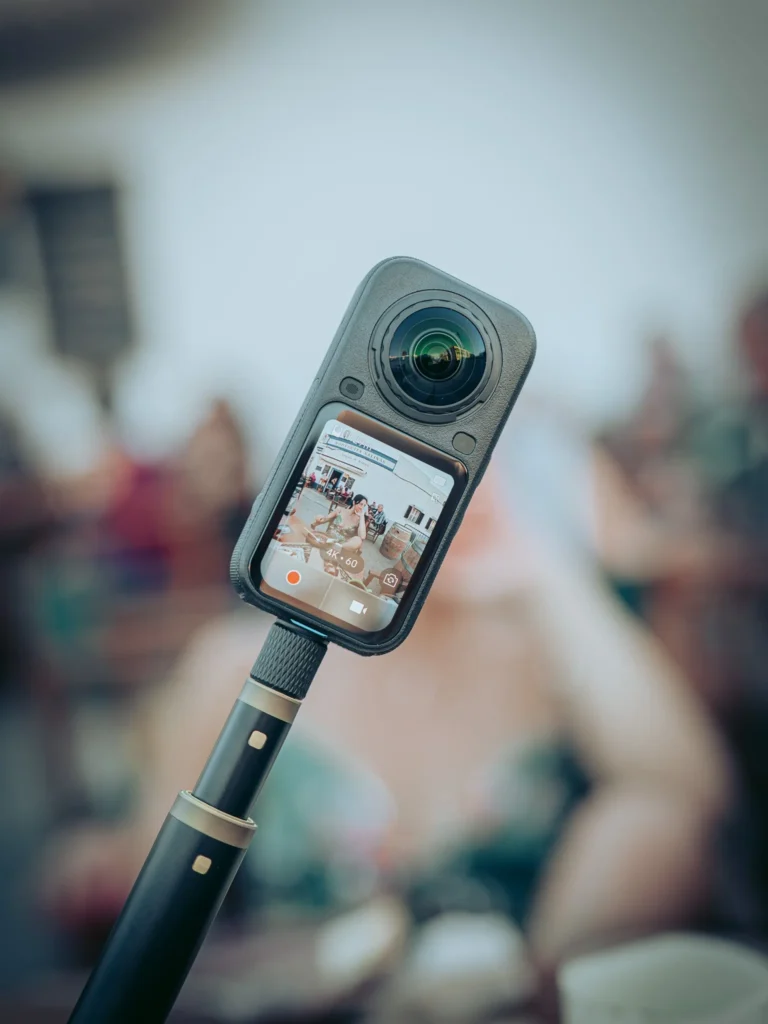
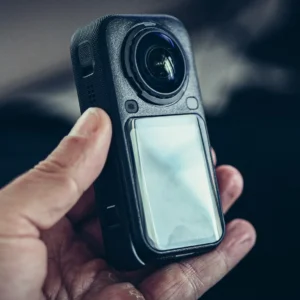
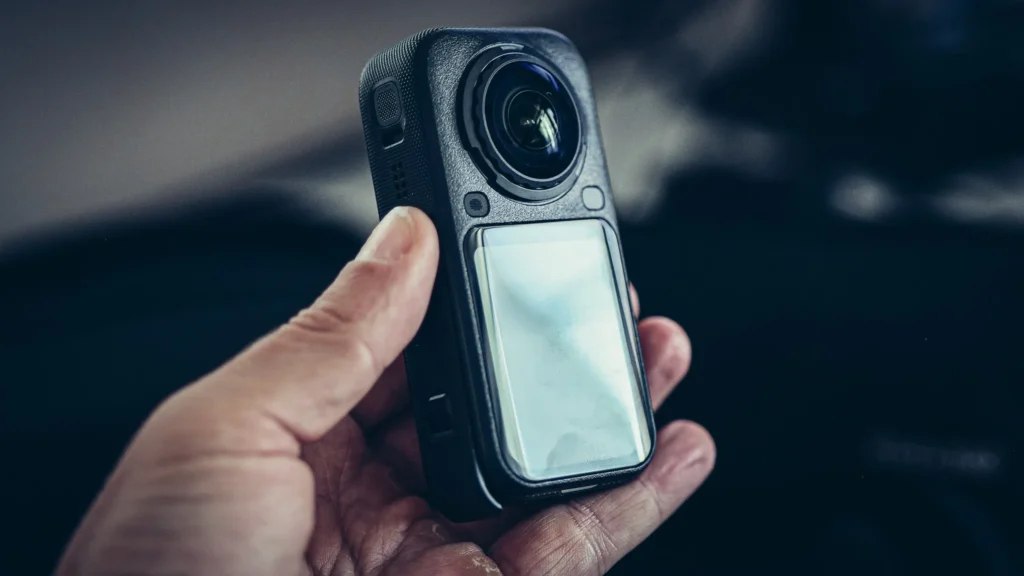
- Bulging and exposed lenses, to be protected (replaceable)
- Automatic AI editing is also coming to the X5
- Very discreet microSD slot, on the side of the battery
For those who want to keep a memory without having to compose it, and for outdoor sports where you want the maximum of shots without touching the camera. The first 360 camera that convinced us while we left skeptical. However, if you are still looking for the best framing and definition, we are not so sure: 360 shifts the framing from shooting to editing, and imposes the software ecosystem of Insta360.
Why we said no to the X5
We need to go back a bit. When Insta360 first contacted us, it was the X5 they offered us. We said no. Not out of vanity: we prefer to work with products that genuinely interest us, otherwise the content suffers and everyone can see it.
And 360 cameras, quite honestly, have never excited us. The blockage wasn’t technical, it was visual. That bulging rendering, those rounded edges, and especially the abuse we see everywhere: the huge character posed on a tiny planet, as if walking on a marble. It wasn’t a question of image quality, it was a question of distortion.
So we directed the collaboration elsewhere, towards the Luna Ultra that we bought ourselves, then towards the GO Ultra. And when Insta360 came back a few months later with the X6, we accepted without the slightest certainty of changing our minds.
Insta360 GO Ultra: our field test of the hands-free POV mini camera
Well, we need to talk about this little pebble. Filming alone, without a tripod, without your hands being busy, keeping your eyes on what you are doing rather than on...
Read alsoWhat’s in the box
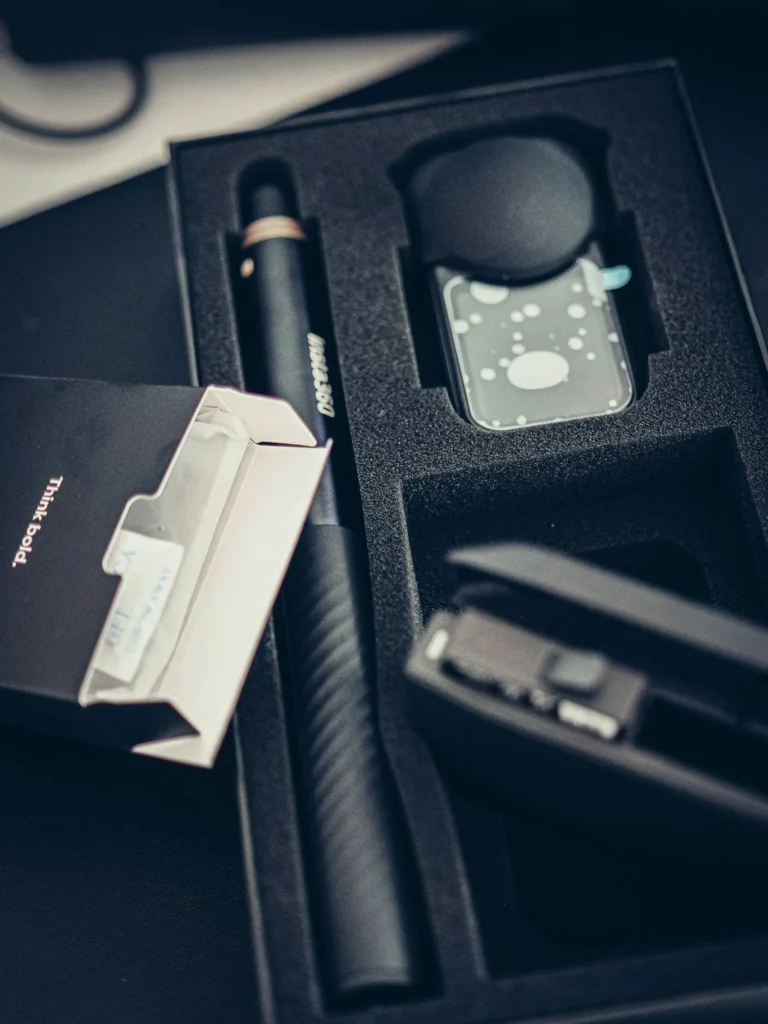
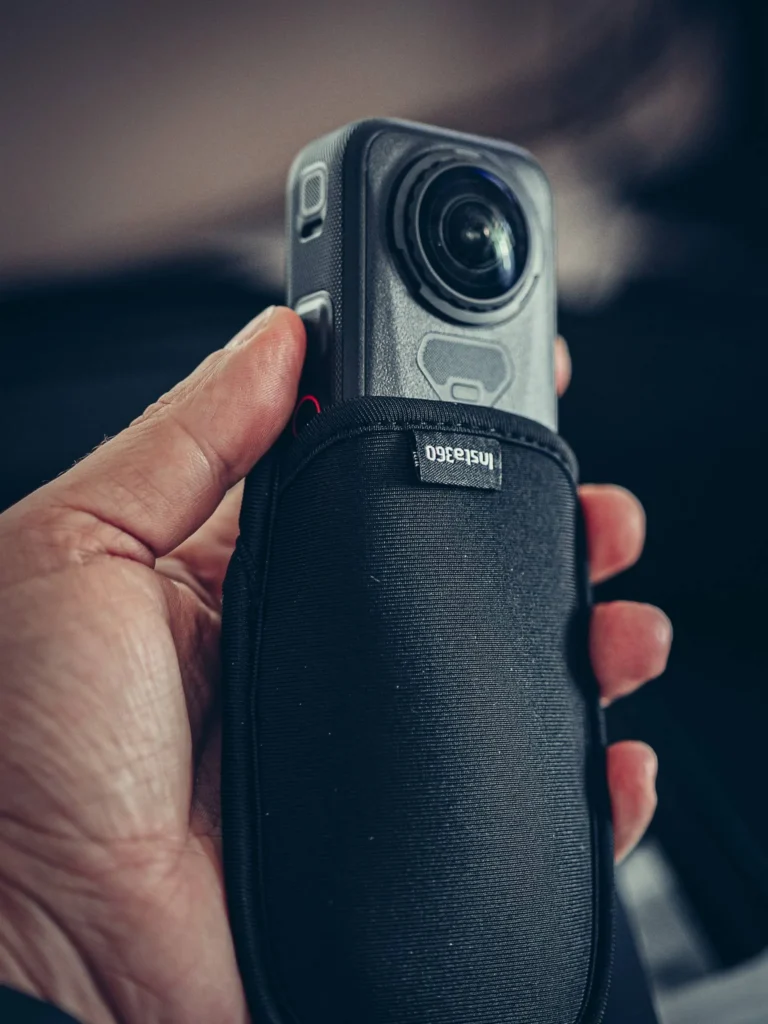
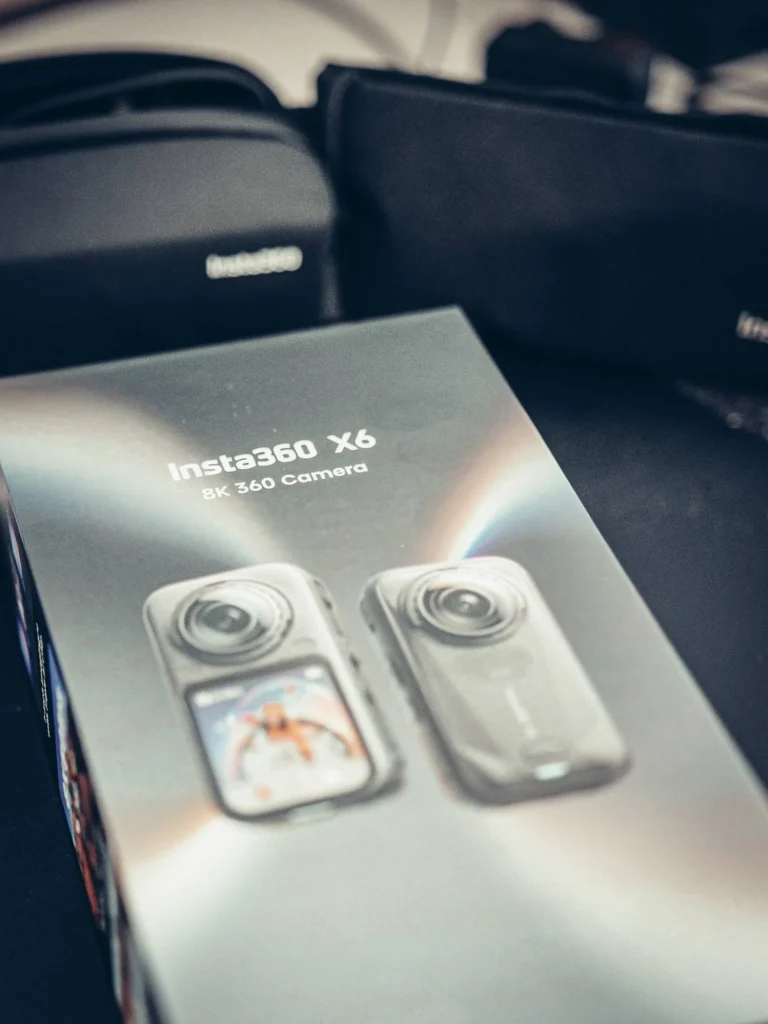
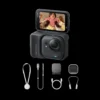
The outer packaging is very nice, but we moved quickly: it’s the inside that interests us. The camera is placed front and center as soon as you open it, with a silicone protection on both lenses. Around it, everything is neatly arranged in a cut foam.
The exact contents of our pack, the most complete of the two:
- The camera, lens protections in place
- A pole that extends up to 114 cm
- A protective case, which itself contains two small pouches
- A microfiber cloth, like the ones used for glasses, to clean the lenses
- A USB-C to USB-C cable for file transfer
- A second battery and its charging case
- The manual, in a small separate box
First surprise, and it’s a pleasant one: the pole is much sturdier than expected. To extend it, you really have to put some effort in. The deployment is firm, not flimsy like most selfie poles. It’s the kind of detail that reassures when you’re going to extend it over water.
One downside, however, and it’s concrete: the provided USB-C cable is quite short. On a laptop sitting on a desk, no problem. On a tower with ports at the back, it won’t work. If you’re transferring your footage from a stationary setup, bring your own cable. This isn’t mentioned on any manufacturer sheet.
The handling: a QR code, and it’s done
We expected the usual process: finding the right app, making mistakes, creating an account, pairing. None of that.
- We turn on the X6. A QR code appears directly on the camera’s screen, to be scanned to download the app.
- Once the app is installed, the camera is automatically detected and the app simply offers to add it.
- We confirm on both sides. It’s done.
The QR code displayed on the screen solves the classic problem of “I have the camera, but I don’t know which of the brand’s apps to download.” It’s silly, it’s clever, and for once it was way too easy.
Here’s our very first power-up, filmed in the streets of Algarve:
What changed in the Lagos caves
At the beginning of August, we visited the Ponta da Piedade caves in Lagos for the first time. By boat, like everyone else. We took the X6 without a specific plan, just to see.
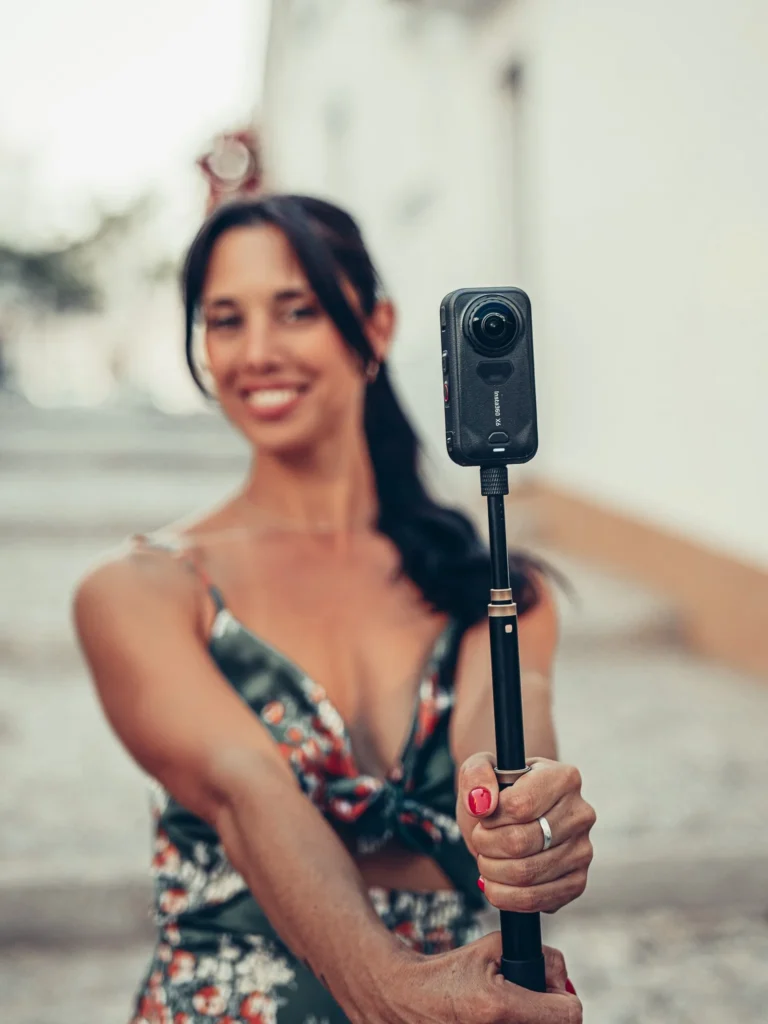
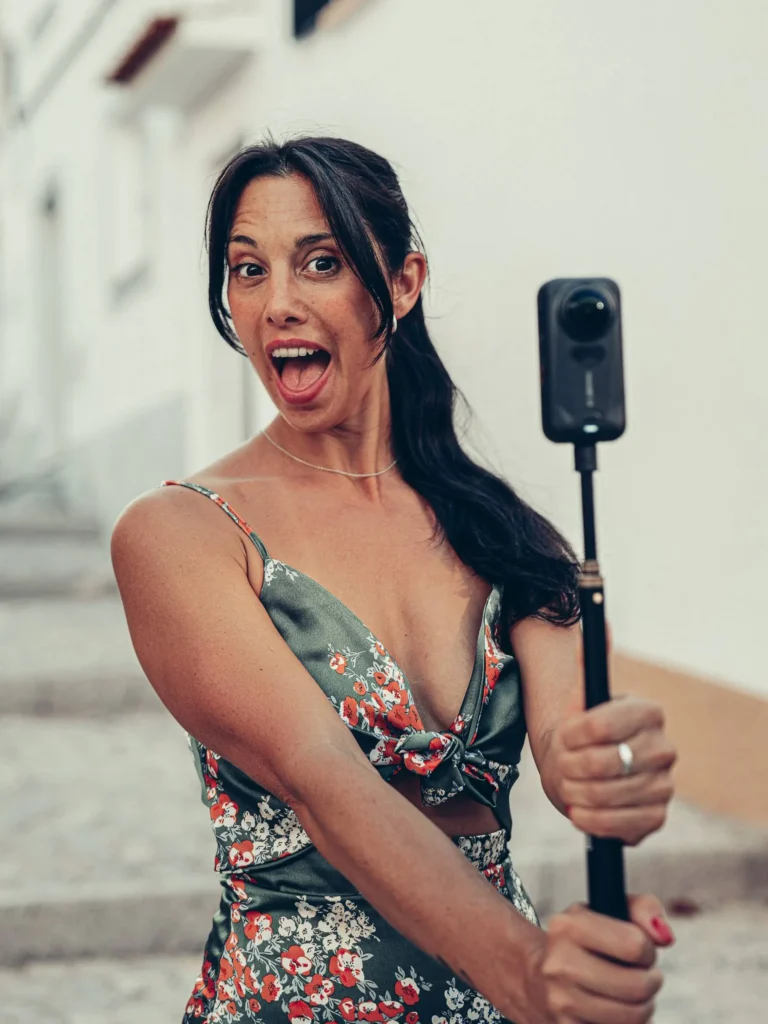
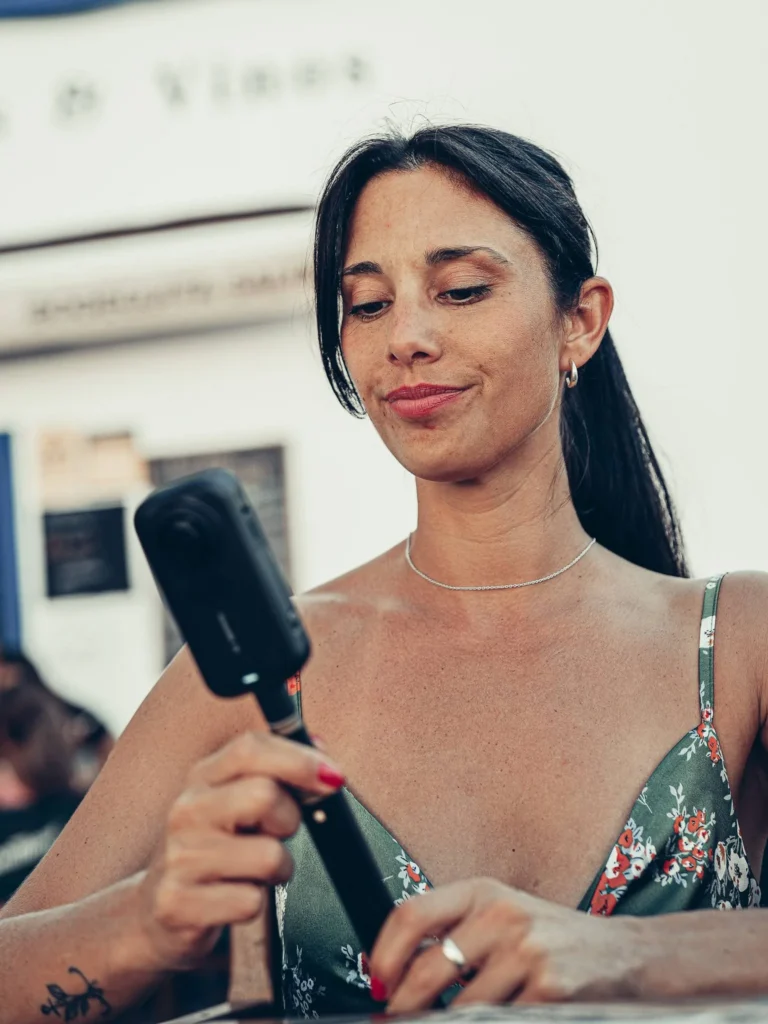
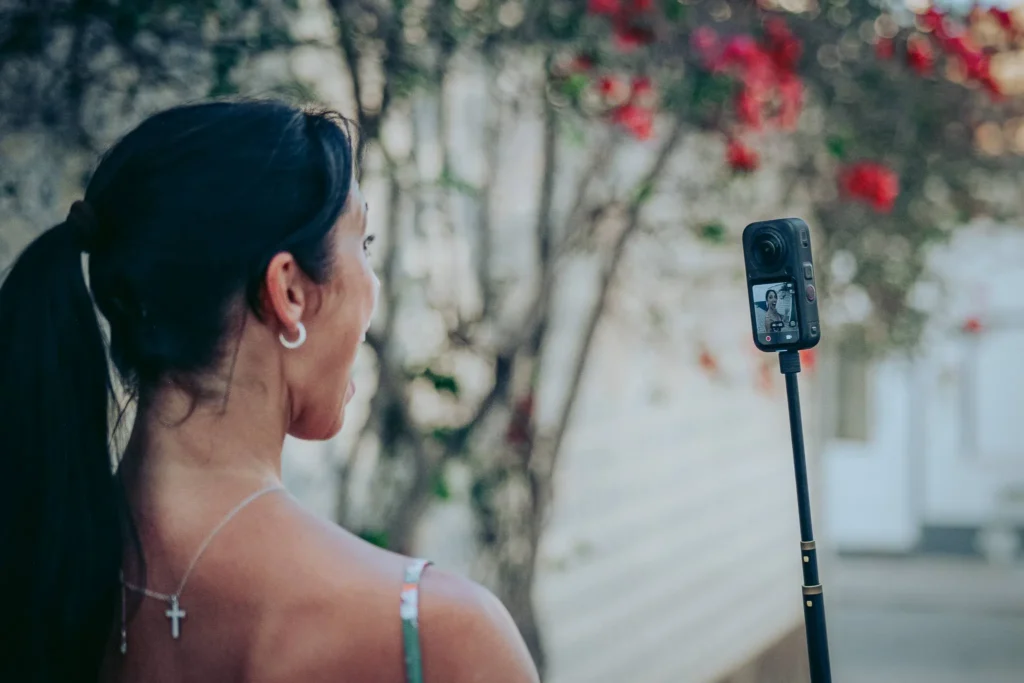
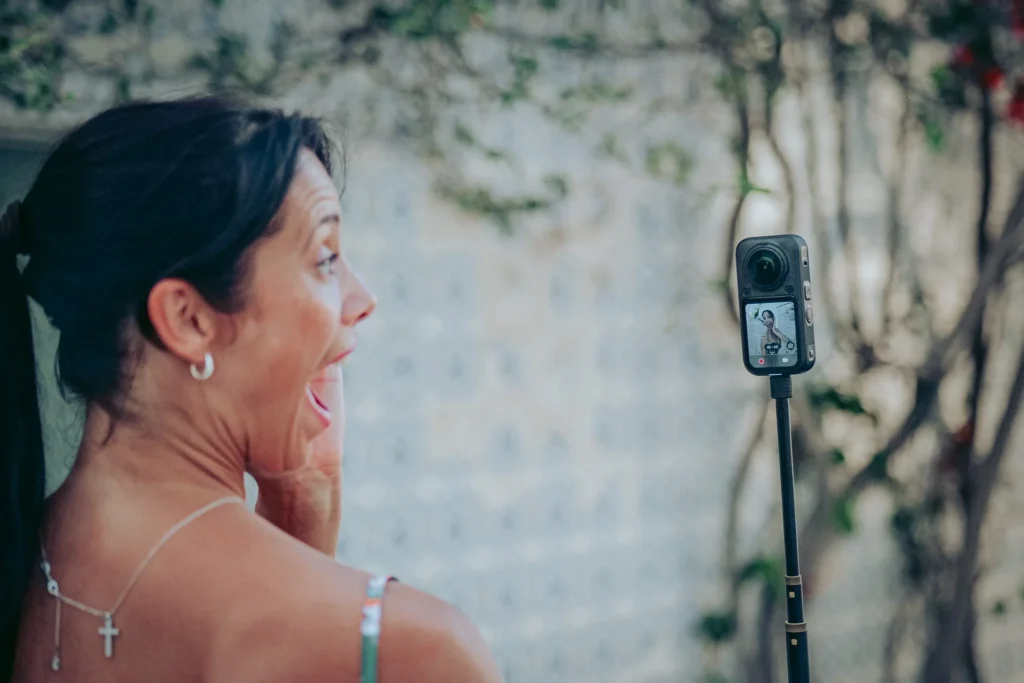
We extended the pole, raised the camera high above the boat, and then we did something we never do when filming: we looked at the scenery. Not the screen, the scenery. The cliffs, the light in the arches, the water. During all this time, the camera was recording by itself and capturing everything.
It’s a sensation we hadn’t experienced before, and that’s when we understood what a 360 camera is really for.
Filming without ever looking at the screen
The real benefit isn’t listed on any spec sheet. Since the camera records in all directions at once, there’s nothing to aim at anymore. No more framing to decide, no more “wait, let me get it right,” no more missed moments because we were looking at a screen instead of looking ahead.
We choose the framing afterward, calmly, in an image that already contains everything that happened around. We’re no longer filming a scene; we’re capturing it entirely and deciding later what to keep.
We had already felt this with the GO Ultra, which we carry on ourselves and forget. With the X6, it’s even more evident, because here we literally miss no angle. The pole completely disappears from the image, giving that overhead view that can only be obtained with a drone.
The sensor, and what really changes compared to the X5
Insta360 developed a dual sensor with Sony, measuring 1/1.1 inches, square-shaped, specifically designed for 360 shooting. The brand claims a rendering equivalent to that of a 1-inch sensor, which is unusual for a camera of this size.
Compared to the X5, the differences claimed by the manufacturer are clear:
- 33% more sensor area (1/1.1″ vs 1/1.28″)
- Twice the size of pixels in 8K, and three times more light captured per pixel
- 14.5 stops of dynamic range, compared to 13.5
- A chip etched in 4 nm supported by two dedicated image processors
In practical terms, this results in 360 video in 8K at 50 frames per second and 360 photos of 120 megapixels. The X6 is also the first 360 camera to natively record in Dolby Vision, with 10 bits across all modes.
Three cameras in one case
This is the central argument of the model, and it’s the one that should reassure those who are put off by 360:
- 360 Mode: the camera captures everything around it, in 8K at 50 frames per second.
- InstaFrame Mode: it locks onto a person, animal, or object, follows it automatically, and directly outputs a flat video in 4K, with no cropping needed afterward.
- Single-lens Mode: it becomes a classic action camera again. 5K at 60 frames per second, 4K at 120 frames per second for slow motion, 170 degrees in ultra-wide angle.
In other words, you can very well live with this camera without ever touching a spherical image. When it’s your first 360, that’s far from a detail.
Battery life, the real surprise
This is what surprised us the most in the field, and it wasn’t what we expected. Our boat ride lasted between thirty and fifty minutes, with the camera on continuously. It didn’t flinch. Looking at the charge afterward, we almost felt like we hadn’t used it.
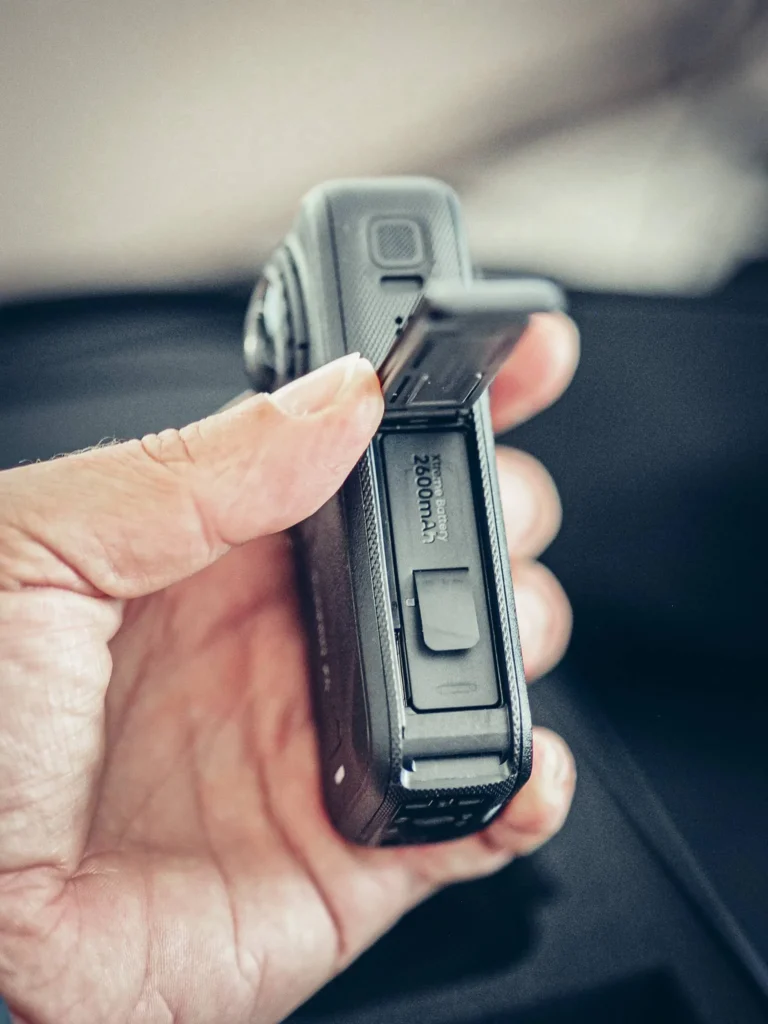
Insta360 claims 140 minutes of continuous 8K with the Xtreme battery of 2600 mAh, which is 51% more than the X5, and a recharge from 0 to 80% in 24 minutes. Our outing isn’t enough to validate these figures, but it doesn’t contradict them either. And since our pack contains two batteries, we feel pretty confident about a full day of shooting.
The microSD card that can’t be found
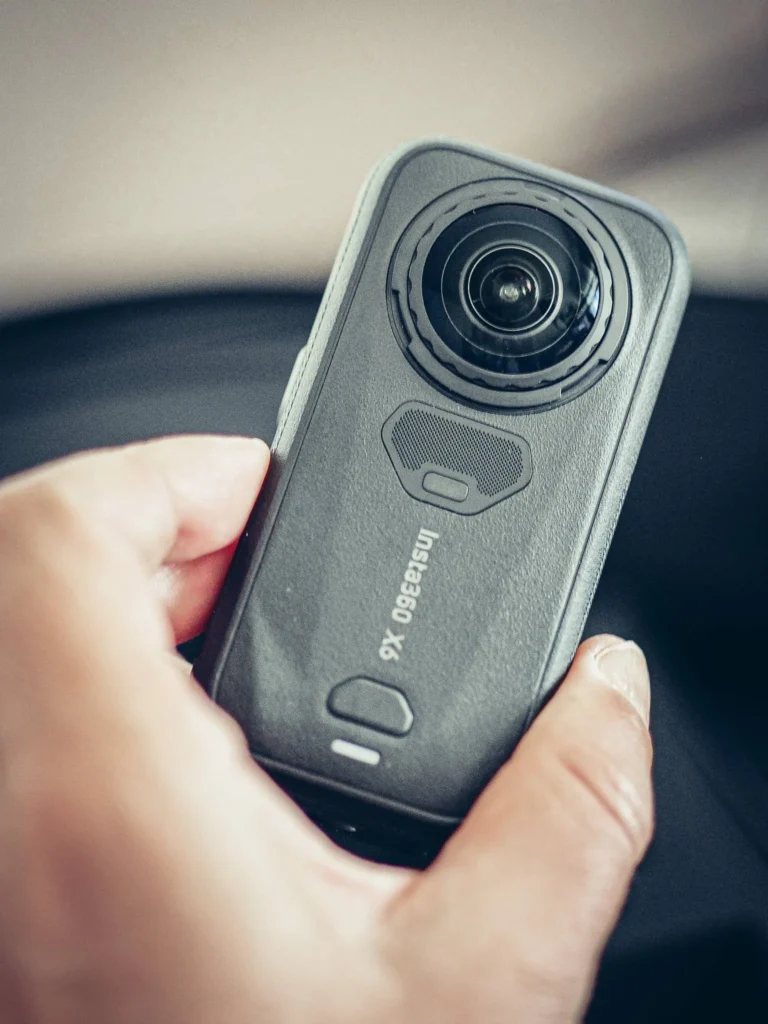
A little service to the future buyer, because we wasted time on this. Upon opening the box, we looked for the memory card slot and couldn’t find it. We even thought for a moment that there wasn’t one.
That said, we haven’t used it yet, because the camera has 47 GB of internal storage. So you can film even if you’ve forgotten your card at home, which happens more often than we admit while traveling.
Near the water without thinking about it
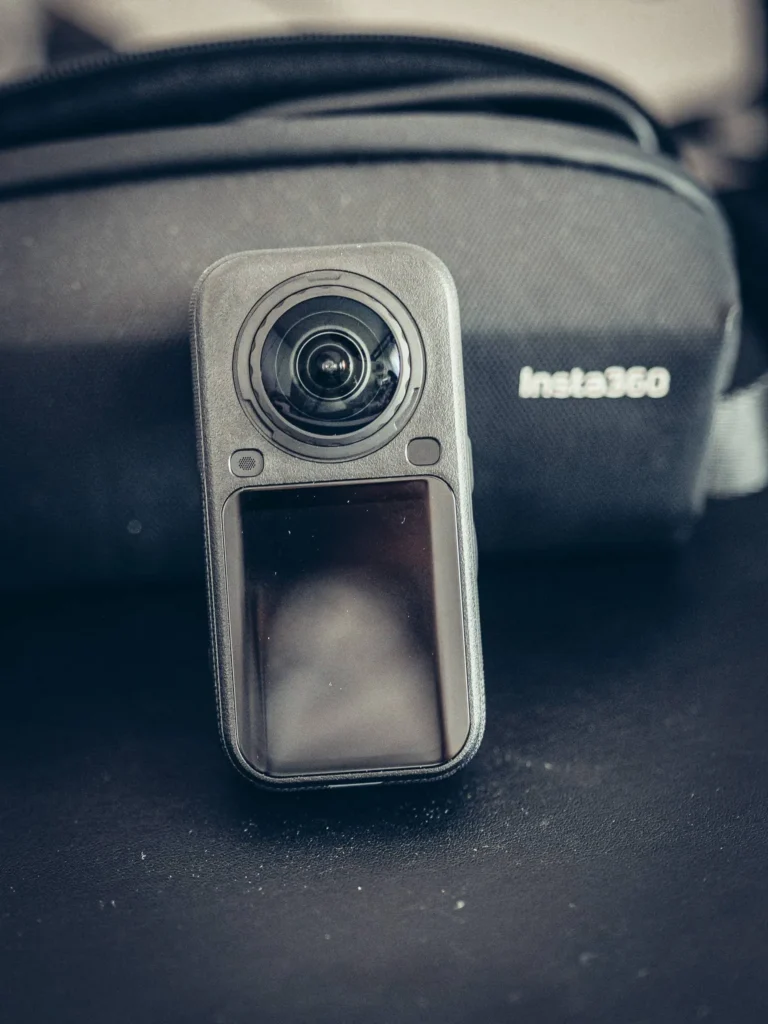
From the moment we opened the box, even before using it, one thing jumped out at us: every opening is seriously protected. The USB port, the battery compartment, everything is closed by firm flaps that require a real gesture. We thought this camera was designed for water sports.
A few days later, on the boat, we verified this intuition without intending to. We brought the camera close to the water for some shots without once thinking it would get wet. That’s the real benefit of waterproofing: it’s not just a number on a spec sheet, it’s the fact that you no longer hesitate.
On paper, it’s rated for IP68 and 20 meters without a case, compared to 15 meters on the X5, and goes down to 60 meters with the diving case. The weak point remains the lenses, which are bulging and exposed: as long as we don’t smash them against the ground, it’s fine. Insta360 doesn’t claim otherwise; the brand has mainly made their replacement less painful, with lenses that are more resistant to wear and 60% cheaper to replace.
Our real reservation, and it’s serious
There is a downside, and it’s important. To view what we’ve filmed, and especially to export it, we have to go through Insta360’s software. A spherical image doesn’t open in just any editing software: it needs to be reprojected, angles chosen, virtual camera movements defined, and then a flat video output. It’s a whole step that didn’t exist before.
We also need to put into perspective a launch argument: the automatic editing by artificial intelligence, presented as the big novelty, is also coming to the X5. So it’s not a reason to choose the X6 over another model in the range.
Who it’s for, and who it’s not for
The first audience is those who want to keep a memory without having to compose it. Not having to think about what shot to take, not having to arbitrate at the precise moment something happens, and being sure not to miss anything. This is not at all the audience we thought of before using it, and yet it’s the broadest.
The second is outdoor sports and anything that gives adrenaline. Wakesurfing, skydiving, skiing, mountain biking: where you want the maximum of shots and the maximum field of view without ever touching the camera, it’s excellent.
On the other hand, we don’t recommend it if:
- You’re systematically looking for the best framing and the best definition. The 360 takes away the decision at shooting to give it back at editing, and honestly, we’re not sure it will suit you.
- You refuse to depend on proprietary software to export your images.
- You hope to save editing time: the 360 adds time, it doesn’t take it away.
- You’re rough with your equipment: the lenses remain the weak point.

I'm Xavier
I test gear over months, in the van and day to day, and I say what doesn't work. If that saves you one bad purchase, leave me your address.
Ce que vous souhaitez recevoir :
X6, X5 or GO Ultra: which one to choose?
£619,00
See the product
|
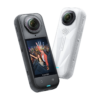
£519,99
See the product
|
£389,00
See the product
|
|
|---|---|---|---|
| Waterproof Rating | IP68, waterproof to 20 m without a case; 60 m with the Invisible Dive Case | 15 m without case | 10 m camera only, Action Pod IPX4 splash-resistant |
| Diagonal Field of View | 170 degrees in ultra wide-angle single-lens mode (5K at 30 fps) | - | up to 156° (wide-angle FPV mode) |
| Connectivity | Wi-Fi 6.0 (100 MB/s), Bluetooth (5 s first pairing, 1 s reconnect), NFC Tap to Connect, USB 3.0 (450 MB/s) | Wi-Fi 802.11a/n/ac, Bluetooth BLE 5.2, USB-C 3.0 | Wi-Fi, Bluetooth, USB-C; works with Insta360 Mic & DJI Mic |
| Storage | 47 GB internal storage plus microSD card | microSD UHS-I V30 or higher | microSD (no internal storage) |
| Audio | 360 wind-resistant mic plus Hidden Engine Mic; smart audio mode; Mic Pro and Mic Air connect over Bluetooth at 48 kHz with no receiver | Wind noise reduction (2 levels), voice enhancement, stereo, 360° audio | Built-in mics + AI noise reduction; third-party mics supported (BT / USB-C) |
| Sensor size | Dual square Sony 1/1.1-inch sensors, 1-inch equivalent output in 360 | Dual 1/1.28" | 1/1.28" (50 MP) |
| Max video resolution | 8K at 50 fps in 360; 5K at 60 fps and 4K at 120 fps single-lens; 4K at 30 fps flat straight out of camera (InstaFrame 2.0) | 8K 360° (7680×3840) at 30fps, single-lens 4K at 60fps | 4K (3840×2160) at 60/30/25/24 fps, 2.7K at 120 fps, 1080p at 240 fps (slow-mo) |
| Photo resolution | 120 MP in 360 photo | 72 MP (11904×5952) | 50 MP |
| Stabilization | FlowState stabilisation plus 360-degree horizon lock | FlowState + 360° Horizon Lock | FlowState (3 levels) + 360° horizon lock |
| Battery life | 140 min at 8K 30 fps (2600 mAh Xtreme battery); fast charge 0 to 80 percent in 24 min | 93 min (8K30), 135 min (5.7K30), up to 208 min endurance mode | 70 min (camera only) / 200 min (with Action Pod); fast charge 0-80% in 12 min |
| Net Weight | - | 0.20 kg (0.44 lb) | 0.05 kg (0.12 lb) |
| Dimensions | - | 46 × 124.5 × 38.2 | 25.6 × 54.4 × 24.8 |
| Application | - | ✓ | ✓ |
| Dynamic range | - | 13.5 stops (PureVideo, Active HDR) | - |
| Colour profiles | - | Vivid, Standard, Flat + I-Log | Multiple colour profiles + log profile (8-bit image) |
| Zoom | - | - | 2x clarity zoom |
Price, packs, and promo code
The X6 comes in two versions. The most complete pack adds a second battery and its charging case, and that’s the one we received. Given what this case does, it’s the one we would choose.
Insta360 X6 360 Camera 8K and 3-in-1 Action promo code
 In stock
Insta360 X6 360 Camera 8K and 3-in-1 Action
VANTOUR*
*Verified price on 10 September 2026. The final price may vary.
Tested first, recommended after
Batteries, solar, conversion, security. What we found after months of real use, and what we would not buy again. An email when we have actually tested something, not before.
Ce que vous souhaitez recevoir :