


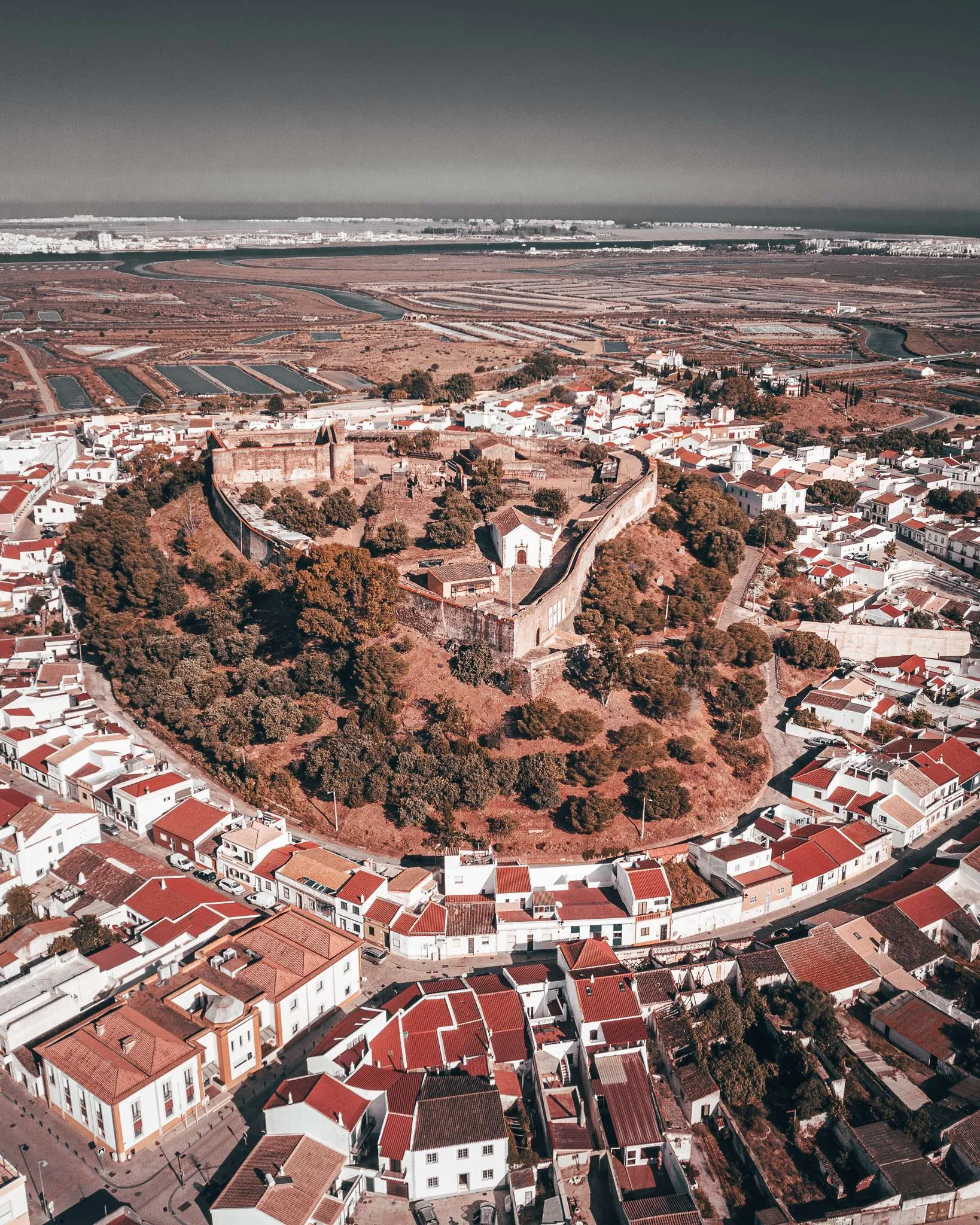
Castro Marim, we used to pass through without stopping. We were driving towards Tavira or Spain, we saw that castle perched on its hill to the right of the road, we thought to ourselves “hey, we should go up one day” (the phrase you say in a van and never actually do)… and we continued, of course.
Wrong, and not just a little. This village of three thousand inhabitants, wedged between the A22, the salt pans, and the Spanish border, is one of the most historically rich places in all of the Algarve (yes, more than Lagos, I stand by it). And one of the least frequented, which is a plus when traveling in a camper van (one May morning, we had the village square almost to ourselves, try doing that in Lagos in August).
Well, this guide is what we would have liked to read before stopping for good: where to park, what to see, what to eat, and especially why this fortified stone (the term is affectionate) has mattered much more than its size suggests.
Castro Marim, the village everyone passes through without stopping
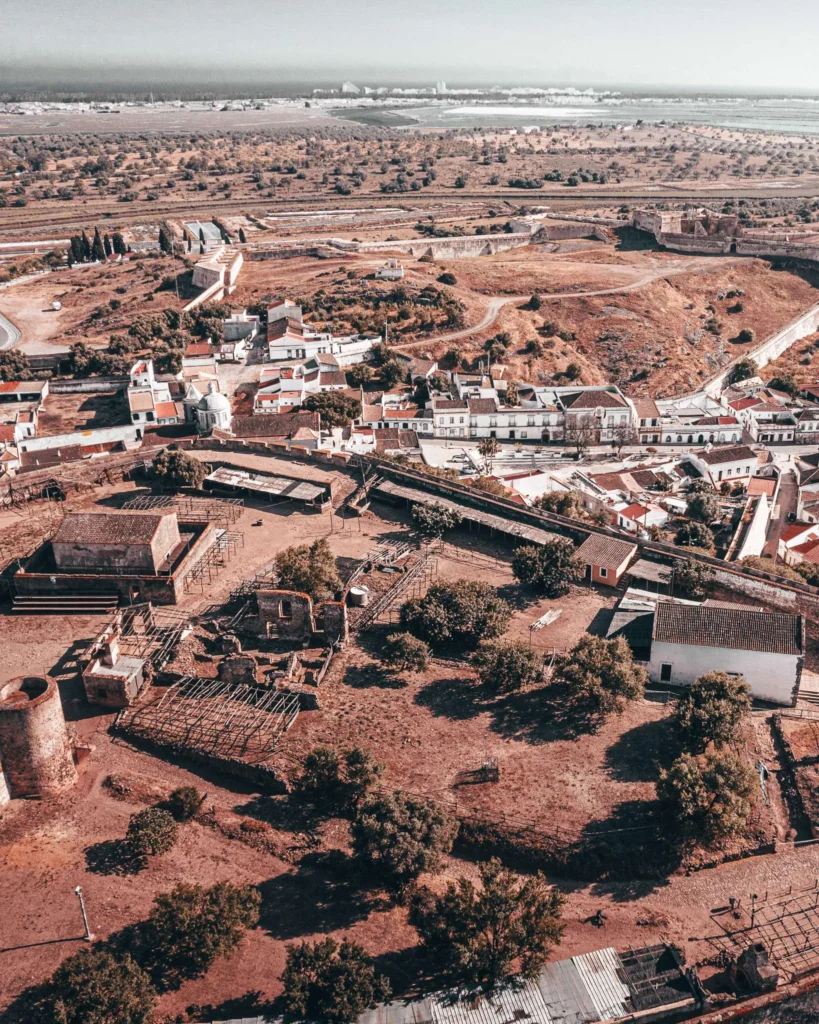
So, let’s set the scene. Castro Marim is situated on a hill about five kilometers from the mouth of the Guadiana (as the crow flies, the road winds a bit more), the river that serves as a natural border between Portugal and Spain in this part of the Algarve. Across the water, it’s Ayamonte (Spain is literally in sight, and at night you can see its lights from the ramparts).
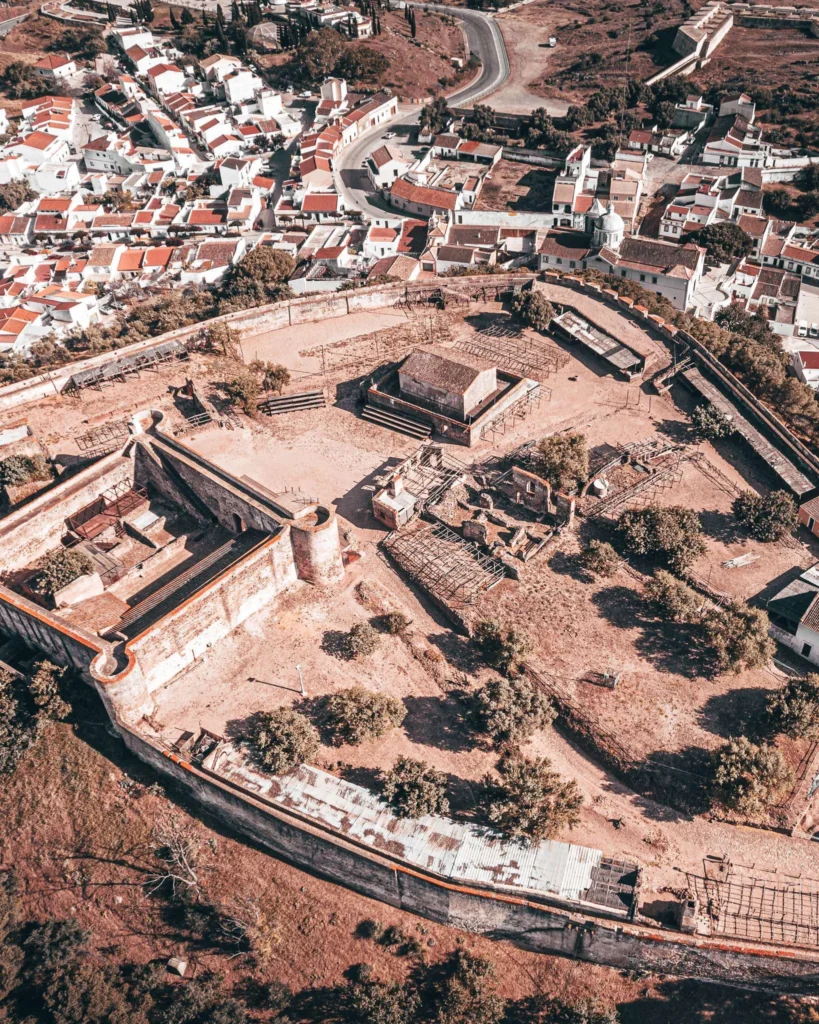
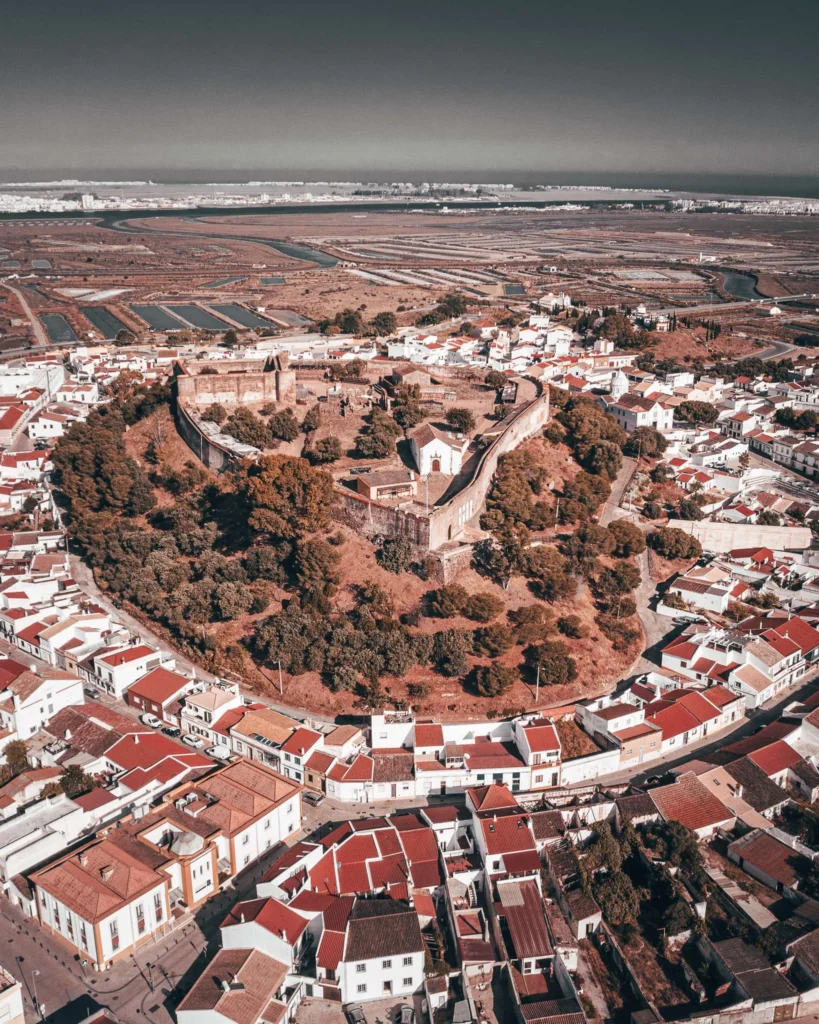
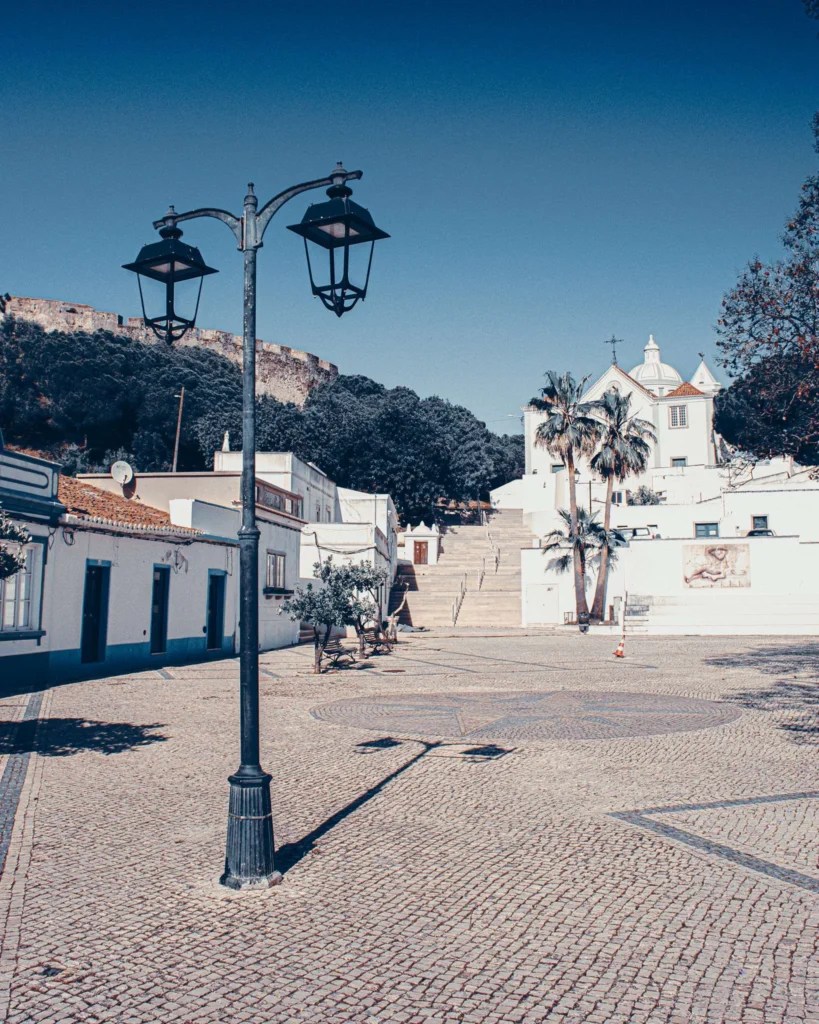
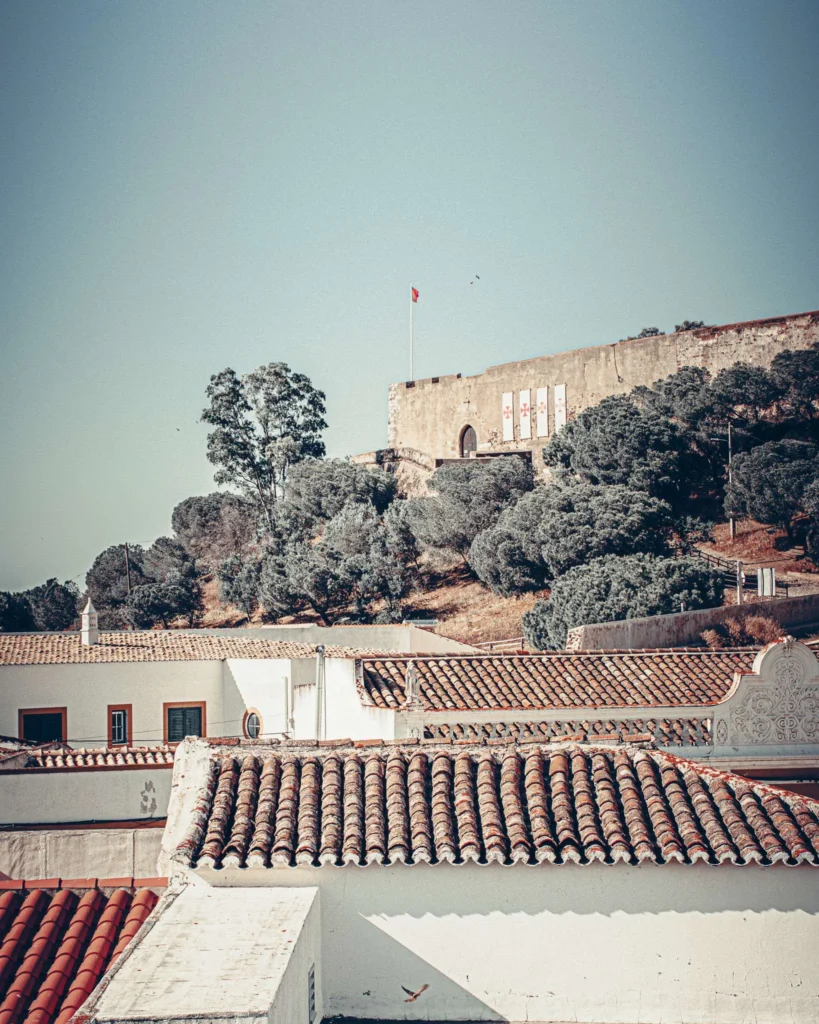
Two fortresses face each other above the village: the medieval castle on one hill, the Forte de São Sebastião on the opposite one. Between the two, white alleys, small squares, a mother church… and that low evening light that makes absolutely everything photogenic (even me, which is saying something).
And all around, what really makes the landscape: the salt pans and the nature reserve, a checkerboard of basins that turns pink and white depending on the season and time (the pink is not a brochure legend, it’s a halophilic bacterium that colors the brine). We will come back to this, because salt here is not a postcard, it’s the village’s economy for twenty-eight centuries… and you can still see it on the shelves today.
What you need to know about its history before going up to the castle
I’ll keep it brief, because we’ve written a whole article on the subject (it’s further down, and it’s much more talkative), but if you go up to the castle without these five markers, you will see old stones instead of seeing a story (and believe me, the difference is huge).
One: the site has been continuously occupied since the end of the Bronze Age, with defensive walls as early as the 8th century BC. The Romans called it Besuris (a name you won’t find on any current signs, unfortunately). The Phoenicians were already navigating the Guadiana up to Alcoutim and Mértola to bring down ore to the port here (the village is therefore much older than the Middle Ages it promotes today).
Two: in 1242, Castro Marim was recaptured from the Moors by D. Paio Peres Correia, master of the Order of Santiago. After that, the region was completely emptied, no one wanted to live on a border (we understand them: at the time there was no bridge, just a potential army across), and the kings had to repopulate it with incentives: Afonso III ordered repopulation in 1272 and granted a foral charter on July 8, 1277, which D. Dinis confirmed and expanded on May 1, 1282.
Three, and this is the part no one tells: on March 14, 1319, the papal bull Ad ea ex quibus cultus augeatur from Pope John XXII created the Order of Christ, heir to the Portuguese Templar assets. Its first seat is the church of Santa Maria do Castelo… here, in this castle. The order would not leave for Tomar until 1357, under D. Pedro I (so yes, before the Convento de Cristo de Tomar, there was this hill in the Algarve, and thirty-eight years, mind you).
Four: on April 10, 1421, D. João I made Castro Marim a couto de homiziados, a sanctuary for convicts (forty places at first, the number is in the charter) where one could commute their sentence to years of border guard… which many preferred to prison. A zone of lawlessness created by royal charter, in short (the exact words are in the document, I am not exaggerating).
Five: after 1656, during the Restoration War, under D. Afonso VI, the bastioned forts of São Sebastião and Santo António were added, because the old castle could no longer withstand artillery (the impressive tower gave way to the bastion that could absorb the impact, a whole change in philosophy). The earthquake of 1755 finished damaging the medieval walls, and everything was classified as a National Monument in 1910 (which, by the way, explains the state of preservation).
Plan your trip to Faro
Tours, tickets and day trips in Faro.
5% off with code PLANETEDECAROT
Booked on Trip.com — partner link.
Compare rental companies and book at the best price.
10% off with code PLANETECAROLOC
Booked on Trip.com — partner link.
Provided by Holafly, our partner.
5% off with code LAPLANETEDECARO
Booked on Holafly — partner link.
The salt of Castro Marim, the other monument of the village
Well. We all look at the castle, and we miss the essential: the real wealth of Castro Marim is what’s down below, in the basins (and it took me several visits to understand this).
The production of sea salt here dates back to the 8th century BC, when the Phoenicians established the fish salting industry on this coast (the 8th century BC, take a second to grasp the distance). The Romans continued, associating salt with fish processing workshops all along the Algarve coast (salt was not a condiment, it was the preservation technology of the time, which completely changes how we view these basins).
And the first written mention of the salt of Castro Marim… is that famous foral from July 8, 1277, the very one that was supposed to repopulate the village: Afonso III reserves for the king the right to all the salt pans. In other words, as soon as we regained the city, we first seized control of the salt (even before taking care of the inhabitants, whom we were desperately trying to bring in). Everything is said.
Today, Sal de Castro Marim and its Flor de Sal are protected by an appellation of origin. The flor de sal, that fine crust harvested by hand from the surface before the coarse salt settles at the bottom, was once called coalho by the ancients… and it wasn’t even sold. It was considered a residue… something to skim off to reach the real product. It now sells for more than everything else (much more, go check the labels), which is a nice lesson in humility for anyone who thinks they know what has value.
Where is Castro Marim and how to get there
A geographical clarification, because we often read the opposite and it annoys me: the Ria Formosa is not in Castro Marim. It is further west, near Faro, Olhão, and Tavira (about an hour’s drive, this is not a minor detail). What borders Castro Marim is the Nature Reserve of Sapal, another wetland, smaller, saltier, and much less frequented.
On the beach side, it’s the municipality that saves you: Praia Verde, Altura, Praia da Alagoa, and Praia do Cabeço are less than a quarter of an hour away by car, with light sand and refreshingly cool Atlantic waters (let’s not kid ourselves, in May we enter in stages). Vila Real de Santo António and its ferry to Spain are five minutes away, and Tavira, our favorite town in the Algarve, is just half an hour away.
- From Lisbon: A2 south then A22 towards Algarve, about 3 hours. Easy road, electronic tolls.
- From Porto: A1 to Lisbon then A2/A22. Count on a full day, it’s not a stopover, it’s a relocation.
- From Faro: N125 or A22, about an hour. The N125 is slower but you see the countryside.
- From Seville: A-49 then A22 after the bridge over the Guadiana. An hour and a half, and the border crossing is hardly noticeable.
- Lisbon to Faro on Intercidades, about 2 hours 30 from Lisboa-Oriente station.
- Faro to Vila Real de Santo António by regional train along the coast, about 1 hour 15.
- Vila Real de Santo António to Castro Marim by bus or taxi: there is no station in Castro Marim, it’s the last kilometer that is tricky.
- Faro (FAO): about 60 km, the logical airport for the Algarve.
- Seville (SVQ): about 155 km, often cheaper, and the road is good.
- Lisbon (LIS): about 300 km, to be booked if you are connecting with the rest of the country.
And the roads in Castro Marim, are they good?
Honestly, yes. The A22 and N125 are wide and well-maintained (which, in the south of Portugal, is not always guaranteed once you leave the main roads), and you can access the village without difficulty with a camper van profile (we passed with our Hymer without ever clenching our cheeks, which is not the case everywhere in Portugal).
The only real point of caution is the climb into the village itself: it narrows quickly near the castle, the streets are narrow, and turning around is complicated. The reflex to have is simple: park at the bottom and walk up (ten minutes, no more). It takes ten minutes and avoids the maneuver in front of six very interested Portuguese retirees (a scenario experienced elsewhere, never twice).
A word about tolls: the A22 operates on electronic tolling, without barriers. If you enter Portugal from Spain, stop at the first registration point to associate your license plate, otherwise the bill catches up with you later, increased (this is the kind of detail you always discover too late, usually when returning).
Climate: When to visit Castro Marim by camper van?
Castro Marim : a glimpse of the weather
5-day forecast
Hesitating about leaving now? Here are the forecasts for the coming days.
Monthly climate
Let's be honest, we prefer beautiful sunny days. But if you enjoy cooler weather or rain, here's everything you need to find your perfect time.
| Month | Min temp | Max temp | Rain | Weather | Rating |
|---|---|---|---|---|---|
| October | 17°C | 25°C | 54 mm | ☀️ | |
| November | 12°C | 19°C | 107 mm | 🌦️ | |
| December | 9°C | 16°C | 119 mm | 🌦️ | |
| January | 9°C | 15°C | 163 mm | 🌧️ | |
| February | 11°C | 17°C | 77 mm | 🌦️ | |
| March | 11°C | 19°C | 77 mm | 🌦️ | |
| April | 13°C | 22°C | 26 mm | ☀️ | |
| May | 15°C | 24°C | 25 mm | ☀️ | |
| June | 19°C | 28°C | 3 mm | ☀️ | |
| July | 20°C | 30°C | 0 mm | ☀️ | |
| August | 20°C | 29°C | 3 mm | ☀️ | |
| September | 20°C | 30°C | 1 mm | ☀️ |
What is the best season to explore Castro Marim?
Our opinion, after having been there in spring and late summer: May and September are the two best months (May has a slight advantage for the light). It’s warm without being oppressive, the light is beautiful on the salt pans, and the village is calm.
July and August are another story. It gets very hot, the inside of the camper van becomes unlivable during the day (we’re talking about thirty-five degrees without effort), and the hill has no shade (the castle is an open oven between 1 PM and 5 PM, you’ve been warned). However, this is when local life is in full swing, with the Nossa Senhora dos Mártires festival in mid-August and especially the Dias Medievais at the end of August.
Winter, finally, should not be ruled out at all… and it’s probably our least followed advice. It rains little, temperatures remain mild, migratory birds are present, and you will have the salt pans all to yourself (literally, you won’t meet anyone). It’s probably even the best time to understand the landscape, without the heat screen.

I'm Xavier
I write up what we learn on the road, from the gear we wear out to the paperwork that lets us live off it. Without dressing it up.
Ce que vous souhaitez recevoir :
The important spots for Van and Camper Van in Castro Marim
All our points marked in Castro Marim are on the map below: the campsite, the service area, the parking at the bottom of the village, the castle, and the mother church. Click on each marker for the address and details, and you can export everything in KML or GPX to send directly to your GPS.
Castro Marim : Places we can tell you about
Here's our selection of places in Castro Marim: spots we've visited that might be useful to you. Use the list view to discover each address in detail, and export everything to add to Google Maps or your favorite GPS app.
| Place | Address | Download |
|---|---|---|
| Camping Revelim de Castro Marim | R. de Santo António 58, Castro Marim, Portugal | |
| Altura Caravan Park | Sítio da, Pedra Arrancada, 8950-432 Altura, Portugal | |
| Camping Monte Gordo | EM511, Monte Gordo, Portugal | |
| Camping Ria Formosa | Tavira, Portugal |
| Place | Address | Download |
|---|---|---|
| Lavandaria do Castelo | N125-6 21 3, 8950-138 Castro Marim, Portugal |
| Place | Address | Download |
|---|---|---|
| Castro Marim Service Area | R. São Gonçalo de Lagos 35, 8950-122 Castro Marim, Portugal | |
| Quinta Lilou | 6G83+JM, Rio Seco, 8950-258 Castro Marim, Portugal |
| Place | Address | Download |
|---|---|---|
| Parking Castro Marim | R. São Gonçalo de Lagos ar, 8950-141 Castro Marim, Portugal | |
| 25 de Abril parking area | R. 25 de Abril 107, 8950-122 Castro Marim, Portugal | |
| Estacionamento do Deserto | Castro Marim, Portugal |
| Place | Address | Download |
|---|---|---|
| Taberna Velho Cavalinho | Castro Marim, Portugal | |
| A Tasca Medieval | Castro Marim, Portugal | |
| Pézinhos n'Areia | Praia Verde, Castro Marim | |
| Restaurante O Infante | Altura, Castro Marim | |
| Encontro d'Amigos | Castro Marim, Portugal |
| Place | Address | Download |
|---|---|---|
| Castro Marim Castle | Castelo, Castro Marim | |
| Matriz Church of Castro Marim | Largo da Igreja, Castro Marim |
Where to sleep in a camper van near Castro Marim
The simplest and most central option is the Revelim de Castro Marim campsite, just steps from the village, with the usual services and walking access to the castle (the real argument is this: you park the vehicle and don’t touch it again). It’s the obvious choice if you come for the town rather than the beach (for us, it was for the town, of course).
If you’re looking for peace and proximity to the sea, you should head towards Altura, near Parque de Caravanas, where you are between countryside and coastline. It’s further from the village but much better located for the beaches (classic arbitration: heritage or sand, rarely both), and the atmosphere is much more “vacation” than “historical visit”.
Where to eat in Castro Marim and what to try
Let’s be clear right away, because I prefer an honest guide to an exhaustive one: we didn’t tour the restaurants of Castro Marim. We ate on the go during the festival, we had coffees in the squares (excellent, and at a price that would make a Parisian cry), but I’m not going to invent an opinion on five tables where I haven’t sat (the old version of this article did that, and that’s precisely what we are correcting today).
What I can tell you is what to order. The caldeirada de peixe, first: the Portuguese fish soup, white fish, tomatoes, onions, herbs, simmered for a long time… the kind of dish you order for two and finish with four. Then the cataplana de marisco, this seafood stew cooked in a bulging copper container that gives its name to the dish (the lid acts as a steam chamber, it’s a utensil inherited from the Arab period, and you can taste it). And the pão de milho, the slightly sweet corn bread, for dipping.
Of course, we are here in the land of salt, so if you should bring back only one thing, it’s a jar of flor de sal de Castro Marim. It weighs nothing, it keeps for years (and it crosses the border without problems, unlike other souvenirs), and it’s infinitely more useful than a magnet (it ends up on everything, including things that didn’t need it). For the rest of Portuguese cuisine, we have detailed polvo à lagareiro, the roasted octopus and sardines grilled the Portuguese way if you want to cook yourself.
The Dias Medievais, the event not to be missed
Once a year, at the end of August, the entire village shifts to the Middle Ages for five days: medieval market on the main street, artisans and large tables within the castle walls, reenactments at the Forte de São Sebastião (the one across, yes), and a family atmosphere that has nothing to do with an outsourced party (the residents do everything).
We went there twice, in 2023 and 2026, and we put everything in a dedicated article: the exact dates, the prices, the tip to avoid paying for entry, what to eat, and the historical background of the place. It’s over here: the medieval festival of Castro Marim, we went twice.
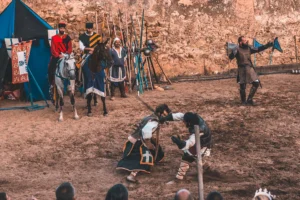
The medieval festival of Castro Marim, we went there twice
I have a coffee mug that comes from a medieval festival. It's three years old, it's a bit wobbly terracotta, and I drink from it almost every morning (Caroline gave...
Read the articleTravel Budget for a Road Trip to Castro Marim
Staying Connected in Portugal: Visitor or Resident?
What internet connection to use during a stay in Portugal? This is a common question we ask ourselves before leaving. Caroline and I, Xavier, have explored the different options available...
DiscoverGood news for the wallet: we are in one of the cheapest areas of the Algarve, because mass tourism stops further west (Albufeira absorbs the bulk of the flow, and all the better for us). The widget below gives the current orders of magnitude on the ground, rather than a figure I would have written once and that would be wrong six months later (which was exactly the case with the previous version of this article, as it happens).
Quota RapidAPI dépassé (limite par minute/mois). Réessayez plus tard.
What budget should you plan for getting around Castro Marim?
Our field rules, on the other hand, do not budge an inch. Eat in the tascas rather than on the seafronts of Altura and Monte Gordo: the value for money is in another league, and so is the cooking. Do your shopping at the municipal market and in the village supermarkets rather than in the tourist zone… the difference over a week pays for a night at a campsite.
The item that surprises newcomers most is fuel and the A22 tolls. Over a week long stay it is often the second biggest budget after food (we underestimated that for a long time, and we now plan our stages taking the toll network into account… which sometimes means twenty minutes more, and ten euros less).
What to do in and around Castro Marim
The village can be visited in half a day if you only do the castle and the lanes (which is what 90 % of visitors do… and it is a shame). In a full day you add the salt pans and a beach (that is the format we recommend, by a long way). Here is what is worth it depending on your mood.
- Castro Marim castle: the ramparts, the tower, the ruins of the alcáçova and the small museum inside the walls. The view takes in the Guadiana, the salt pans and Spain in a single glance.
- The Forte de São Sebastião: the seventeenth century bastioned fort on the hill opposite, never attacked in its whole existence… which is a fairly quiet career for a stronghold.
- The mother church of Nossa Senhora dos Mártires: the patron saint of the village, and a forecourt from which you can clearly see Ayamonte on the other side of the river.
- Vila Real de Santo António: the grid town built in one go in the eighteenth century under the Marquis of Pombal, five minutes away by road. Enlightenment town planning set down at the water’s edge.
- Sapal nature reserve: flat trails through the basins, flamingos, storks and migratory birds. Binoculars advised, hat compulsory.
- Brine and mud bath at Água Mãe: in the heart of the salt marshes, you float in water saturated with salt and coat yourself in mineral mud. Strange, very pleasant, and thoroughly photogenic.
- Sunset over the basins: the moment the water turns pink and the salt heaps turn orange. It is the best photo slot of the day, well ahead of the castle.
- The beaches of the municipality: Praia Verde, Altura, Praia da Alagoa and Praia do Cabeço, the last of these popular with kitesurfers for its steady wind.
- Cycling along the Guadiana: the terrain is gentle between the village, the salt pans and Vila Real, and the views are worth the detour.
- Golf at Castro Marim Golf & Country Club: a rolling course with views over the river and Spain, a few minutes from the village.
- Kitesurfing at Praia do Cabeço: steady wind and a wide beach, with schools on site for gear and lessons.
- Ferry crossing to Spain: from Vila Real de Santo António the boat reaches Ayamonte in a few minutes. Far more pleasant than the bridge, and perfect for a day in Andalusia.
- Dias Medievais: the medieval festival, last week of August, five days. The village’s major event.
- Festival Internacional do Caracol: the snail festival, with Portuguese, Spanish, French and Moroccan recipes. Far more serious than it sounds.
- Festival de Lucía: created in 2016 in tribute to Paco de Lucía, whose mother was born in Monte Francisco, within the municipality. The flamenco connection of Castro Marim is that one, and that one only.
- Festas de Nossa Senhora dos Mártires: the feast of the village’s patron saint, on 15 August, with a procession, music and large crowds.
- Presépio de sal: at Christmas, a nativity scene entirely carved from the salt of the pans. A simple and frankly beautiful idea.
The questions we are asked about Castro Marim
Where can one experience a saline mud bath in Castro Marim?
What makes the flor de sal of Castro Marim special?
Can you see pink flamingos in the Castro Marim nature reserve?
Is there a church with a panoramic view of Spain in Castro Marim?
What was the Forte de São Sebastião used for, opposite the castle?
Can you cross the Guadiana River to go to Spain from Castro Marim?
Is half a day enough to visit Castro Marim?
For the castle, the mother church, and the village's alleys, half a day is more than enough. The site is not large and everything can be done on foot from the bottom of the village.
You should allow a full day if you want to add the salt pans and the nature reserve, which are the other half of the site's interest, or end with one of the beaches in the municipality.
Is it better to base yourself in Castro Marim or Vila Real de Santo António?
Castro Marim if you come for heritage and tranquility: the village is tiny, traffic is almost nonexistent, and you are at the foot of the castle.
Vila Real de Santo António if you want services, shops, the train station, the ferry to Spain, and direct access to the waterfront. The two are only five minutes apart by car, so the choice really depends on the atmosphere you are looking for.
PS: it took us a while to take that exit. Since then we have been back in spring, in summer, by day and by night, and we still have not seen all of the salt pans. Do not do as we did, stop on your very first drive past.
Portugal, we live here
Two years of full-time van life, and the Algarve as our base ever since. We still hit the road, by van or otherwise, and we write up what we find along the way. An email when we have something to say, no more.
Ce que vous souhaitez recevoir :