



We have never paid a clean air charge. Not one, in three years of living full-time in a 1999 motorhome. And that says far more about how we travel than about the vehicle.
This isn’t a boast and it certainly isn’t advice. It’s a consequence: we don’t go into the cities that charge. So rather than write the article you’d expect — how to survive the zones in an old vehicle — I’d rather write the honest one: what it would actually cost us if we did go, and why the question never comes up when you organise your life differently.
No, the zones aren’t quietly going away
Worth starting here, because a lot of owners filed this away when Greater Manchester dropped its scheme.
Manchester is real, and it’s the exception. The government guidance had the references to Greater Manchester removed in February 2025, after the review concluded with a charge-free plan. Everything else stayed put. Seven Clean Air Zones are still running in England — Bath, Birmingham, Bradford, Bristol, Portsmouth, Sheffield and Tyneside — and only the two Class D zones, Birmingham and Bristol, charge private cars at all.
London hasn’t moved either: the ULEZ has covered every borough since 29 August 2023, and nothing has changed in the charge or the boundary since. Scotland, meanwhile, went the other way and completed its rollout: Glasgow, Edinburgh, Dundee and Aberdeen have all been enforcing their Low Emission Zones on every vehicle since mid-2024.
My view of the whole apparatus, since I’m writing about it: I find it largely pointless. It’s another administrative layer, and I’ve yet to see what it changes for the air anybody actually breathes. What I do see is a mechanism for collecting money from the people least able to swap their vehicle. That’s the lens the rest of this article is written through, rather than the usual polite neutrality.
What decides your fate is the Euro standard, not the look of the van
None of this is judged on appearance, mileage or how well the thing is maintained. It follows the Euro emissions standard, which is set by the date of first registration and never changes afterwards.
For a diesel, a first registration between 1997 and 2000 means Euro 2. Euro 3 starts in 2001, Euro 4 in 2006. And the number every British zone asks for is Euro 6, which in practice means a diesel sold from around September 2015. There are fifteen years and four standards between our vehicle and the bar.
Find your vehicle on the timeline, not in a table
A diesel’s standing in every British scheme depends on one thing: its date of first registration. Place yours on the axis, read what London charges above and what Scotland does below.
Ours was registered on 28 April 1999. Do the maths yourself: it lands squarely in the Euro 2 window, and there is no test, no retrofit certificate and no amount of servicing that moves it up. The classification is a date, not a condition. That is the one thing worth understanding before anything else, because everything that follows is just arithmetic on top of it.
The London trap: it starts at 2.5 tonnes, not 3.5
This is the part almost nobody writes about, and it’s the one that would cost us the most.
Everyone knows the ULEZ: £12.50 a day, every London borough, midnight to midnight, diesel needs Euro 6. Annoying but survivable. What gets missed is that London runs a second, older scheme underneath it — the Low Emission Zone — and for motor caravans that one kicks in at 2.5 tonnes gross weight. Not 3.5. A typical 3.5-tonne motorhome is inside it.
So the honest figure for a 1999 motorhome spending a day in London is £112.50, and it isn’t a fine — it’s the legal price of entry. Get it wrong and the penalties are on a different scale again: £180 for the ULEZ, reduced to £90 within fourteen days, and £500 for the LEZ, reduced to £250. Two schemes, two penalty notices, one journey.
Put that next to France, where the same offence is a fixed fine of 68 euros and the zone is, in practice, barely enforced, and you understand why I find the British version more coherent and much more brutal at the same time. It doesn’t pretend. It bills you.
Scotland doesn’t charge you. It bans you.
This is a genuine difference in nature, and it catches people out because the English vocabulary of daily charges doesn’t apply at all.
In Glasgow, Edinburgh, Dundee and Aberdeen there is no daily rate to pay, no ticket to buy, no way to buy your way in. The standard is Euro 6 for a diesel, and if your vehicle doesn’t meet it, driving into the zone is simply an offence. The camera catches the plate and a penalty follows: £60, halved if you pay within fourteen days, and doubled on every repeat — £120, £240, £480, where it caps for a car or light van. It drops back to £60 only after ninety clean days.
That doubling is the detail worth carrying. One mistake is an annoyance. Four mistakes on the same trip, because you didn’t realise the zone covered the street your campsite was on, is £900 of penalties.
What actually happened to us, which is nothing
Here’s my only real field evidence, and it’s French rather than British, so take it for exactly what it’s worth.
We drove straight through Grenoble — one of the two strictest low emission zones in France, already targeting vehicles far newer than ours — and I only realised we’d been inside it once we were well down the road. Absolutely nothing happened. No check, no notice, no letter in the months that followed.
I’m not telling you that to suggest you chance it, and I’d be careful about transplanting it here: French enforcement rests heavily on signage and good faith, whereas British enforcement rests on automatic number plate recognition. The Scottish penalty doubles precisely because the camera never misses twice. A system that bans on paper and rarely checks produces people who comply out of civic duty and people who pass through unaware. I was in the second group without choosing to be. In Britain I’d simply have received the bill.
Why we don’t go there, and what that says about the problem
The real reason we’ve never had trouble isn’t a trick. It’s a choice about how we travel, and it predates every one of these zones.

Big cities in a motorhome are, honestly, miserable. The traffic is miserable, the parking is worse, and I can’t see why I’d go and wedge five and a half metres of 1999 Hymer into a city centre that lectures me on the way in. Britain is quite big enough — it has more coastline, more moorland and more decent villages than we could work through in a decade — and none of that is inside a charging zone.
Where it turns political is what the zones produce for the towns that run them. If they turn away people like us, who arrive with time and with money to spend in local shops, they’ll manage without our money. That isn’t a threat; I have no weight whatsoever. It’s an observation about town centres that sort their visitors at the entrance and then wonder why they empty out.
Pollution, and the nuance that doesn’t flatter me
I know the obvious objection, and it’s a fair one: a 1999 motorhome pollutes, so of course it doesn’t belong in a city.
On the substance we’ve done the sums elsewhere and I stand by them: living in a van year-round pollutes less than being sedentary. We heat nine square metres rather than a house, we use very little water, we make a good share of our electricity from solar, and our annual mileage doesn’t exceed that of a commuter living in the suburbs. The full calculation is in our carbon footprint after three years of vanlife, so I won’t replay it here.
But there’s a nuance I can’t leave out without giving myself the good role. Today we are sedentary and we have a motorhome. We have a home in Portugal and we take the vehicle out to travel. In that specific configuration I honestly think we pollute more, not less. The virtuous-vanlifer argument holds when the van replaces the house. It collapses when it’s added to it.

Eco-friendly camper van: our carbon footprint after 3 years of vanlife
This study is a first draft (August 2023). It will be refined and updated based on new elements we will have at our disposal, in order to remain as honest...
Read more
The End of RVs and Vanlife Due to Oil?
In this article, we will explore whether it is legal to live year-round in a campervan or other converted vehicle. What does the law say? What parameters should be taken...
Read more
I'm Xavier
I write up what we learn on the road, from the gear we wear out to the paperwork that lets us live off it. Without dressing it up.
Ce que vous souhaitez recevoir :
The historic exemption, and the border that runs through it
This is the way out that almost nobody mentions, and in Britain it comes with a twist worth knowing about.
In England, both London schemes exempt vehicles built before 1 January 1973, and vehicles over forty years old that have been registered with the DVLA in the historic vehicle tax class. That last part matters more than the age: the exemption is attached to the tax class, not the birthday, and you have to apply for it. The rolling rule moves each spring — a vehicle built before 1 January 1986 could go into the historic class from 1 April 2026, and so on, one year at a time.
Age alone opens nothing. The tax class does.
In England the exemption is attached to the DVLA historic vehicle tax class, and it has to be applied for. Scotland works on a different threshold entirely.
Now the twist. Scotland sets its bar at thirty years, not forty, and it doesn’t require registration: a vehicle at least thirty years old, out of production and kept substantially in original condition is exempt from the Scottish LEZs automatically. Which produces a genuinely odd outcome for us. Our motorhome should clear the Scottish threshold around 2029 — the same year it becomes a véhicule de collection in France — while it wouldn’t reach the English historic class until roughly 2040. Eleven years apart, same vehicle, same island.
Is that a plan? Not yet. We’re in the middle of re-registering the vehicle in Portugal, and I genuinely don’t know whether the equivalent status there covers motor caravans. The historic-interest classification exists, with similar criteria and certification by a handful of recognised bodies, but I haven’t found a clear answer on eligibility and I’m not going to invent a procedure I haven’t been through. If it exists, I want it, and I’ll write about it when I know.
What I’d check before buying an old motorhome today
What a diesel motorhome faces in each British scheme, by registration date
Nothing here is judged on condition or mileage. It follows the Euro standard, which is fixed by the date of first registration and never changes.
| First registration | Euro standard | London ULEZ | London LEZ (2.5–3.5 t) | Scottish LEZs |
|---|---|---|---|---|
| Before 1997 | Euro 1 and earlier | £12.50/day | £100/day | Banned |
| 1997 to 2000 | Euro 2 | £12.50/day | £100/day | Banned |
| 2001 to 2005 | Euro 3 | £12.50/day | Compliant on particulates | Banned |
| 2006 to 2015 | Euro 4 and 5 | £12.50/day | Compliant | Banned |
| From late 2015 | Euro 6 | Compliant | Compliant | Allowed |
If you’re about to buy something from the nineties or early two-thousands, there’s one check that costs nothing and that hardly anyone does: look at the date of first registration on the V5C, work out the Euro standard, and run the plate through the official checkers before you sign. Not after.
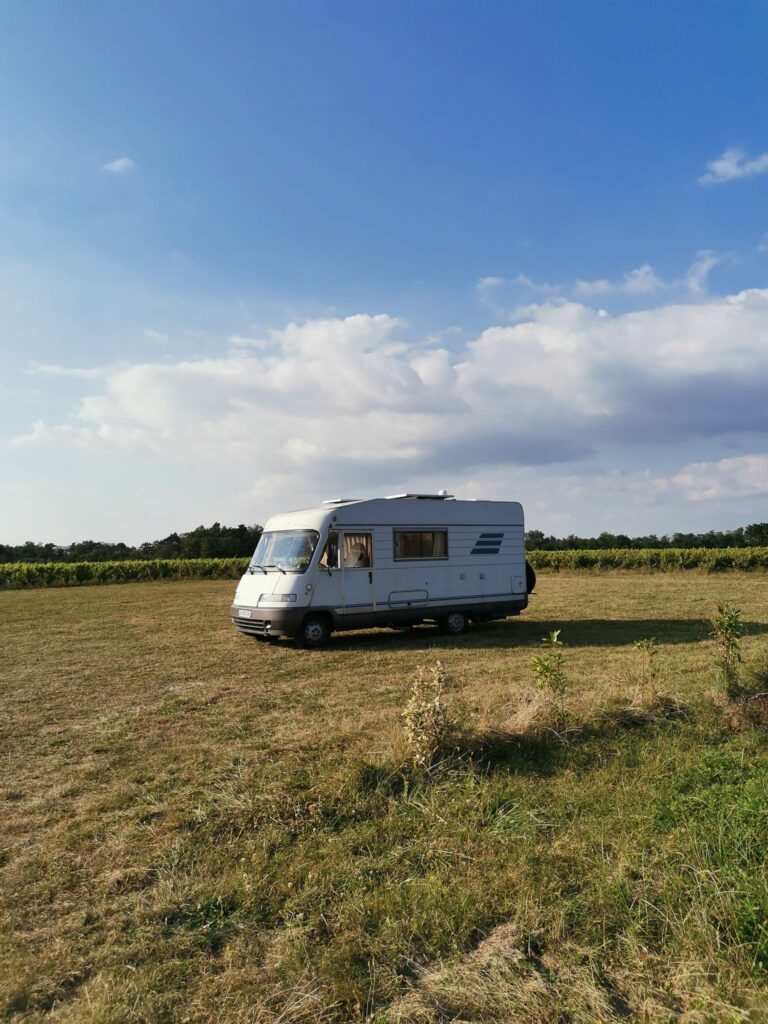
Not because it should stop you. A Euro 2 motorhome is still an excellent buy if you travel the way we do, and ours suits us perfectly. But because it changes what you’ll do with it: the weekend in the city, the trip to see friends in Birmingham, the drive across Glasgow to reach the west coast. Knowing that going in is a completely different thing from discovering it in a penalty notice.
The rest of what we’d look at is in our piece on choosing a vehicle for vanlife, and the emissions question now has its place in there. As for whether any of these zones will still exist by 2029, when the thirty-year threshold comes round for us, I have no idea. Given how the last three years have gone, nobody does.

What type of vehicle to choose for vanlife?
Discover the complete guide to choosing the ideal battery for your motorhome - tailored to your lifestyle and budget!
Read moreOld motorhomes and clean air zones: the questions we get asked
Do I need to buy a sticker to drive in a British clean air zone?
No. There is no sticker anywhere in the UK, and that is the single biggest difference with France, Germany or Austria. Every British scheme works on automatic number plate recognition: a camera reads the plate, a database looks up the Euro standard, and either nothing happens or a charge falls due. There is nothing to order, nothing to display on the windscreen, and nothing to forget.
Does my foreign-registered motorhome escape the charges?
No. Non-UK vehicles are covered exactly like British ones, and TfL asks foreign owners to register their vehicle so the database can read the correct emissions standard. A plate the system cannot identify is treated as non-compliant, which is the worst of both worlds. Register the vehicle before the trip rather than after the penalty notice.
Why would my motorhome pay twice in London on the same day?
Because London runs two overlapping schemes. The ULEZ asks for Euro 6 on a diesel and charges £12.50 a day. The older LEZ applies to motor caravans from 2.5 tonnes gross weight, asks only for Euro 3 on particulates, and charges £100 a day below that. TfL is explicit that paying one does not exempt you from the other, so a Euro 2 motorhome of 3.5 tonnes owes £112.50 for a single day inside Greater London.
What happens if I simply do not pay?
A penalty charge notice. For the ULEZ it is £180, halved to £90 if you pay within fourteen days. For the LEZ on a light vehicle it is £500, halved to £250. They are issued independently, so one journey through London in a non-compliant motorhome can generate both.
Is Scotland the same as England?
No, and the difference is one of nature rather than degree. The Low Emission Zones in Glasgow, Edinburgh, Dundee and Aberdeen are bans, not charges: there is no daily rate you can pay to enter. A non-compliant vehicle caught by camera gets a £60 penalty, halved if paid within fourteen days and doubled on every repeat up to £480 for a car or light van. It only falls back to £60 after ninety days without a further breach.
Which Clean Air Zones still charge a private motorhome?
Seven zones remain in England — Bath, Birmingham, Bradford, Bristol, Portsmouth, Sheffield and Tyneside — but only the two Class D zones charge private vehicles: Birmingham at £8 a day and Bristol at £9. Greater Manchester dropped its charging scheme in February 2025. In the Class C zones the answer often depends on what your V5C says the vehicle is, so run the plate through the official government checker instead of assuming.
Does a good MOT improve my vehicle’s standing?
No, and it is a stubborn confusion. The MOT reports the condition of the vehicle on the day. The Euro standard is set by the type approval at first registration and never moves. A perfectly maintained Euro 2 engine is still a Euro 2 engine, and no amount of servicing will change what the camera looks up.
Does driving straight through without stopping count?
Yes. The charge is triggered by being inside the zone, not by parking in it. Crossing Greater London on the way somewhere else is a chargeable day, and the ULEZ runs midnight to midnight, so an overnight crossing counts as two.
Will the historic exemption get me out of this?
Eventually, and later than most people expect. In England the exemption attaches to the DVLA historic vehicle tax class, which you have to apply for, and it rolls forward one build year each 1 April on a forty-year threshold. Scotland uses a thirty-year rule with no registration at all. For a vehicle built in 1999 that means roughly 2029 in Scotland and around 2040 in England — eleven years apart for the same van.
Our road notes, by email
Two years of full-time van life, and the Algarve as our base ever since. We still hit the road, by van or otherwise, and we write up what we find along the way. An email when we have something to say, no more.
Ce que vous souhaitez recevoir :