



Introduction
Look at them, they give ecology lessons while polluting with their motorhome
We read this comment under every video. And for a long time, we were content to respond, “it’s more complicated than that.” Today, after more than 3 years of full-time vanlife, we are putting the figures on the table. Diesel consumption, carbon footprint, water, electricity, heating: we compare our life in a green motorhome (or at least, we try to make it as ecological as possible) to our former sedentary life in a 40m2 apartment on the French Riviera.
Spoiler: the results surprised us as well. And we also give you all the practical solutions to reduce your carbon footprint in a van or motorhome.
In this article, we will not cast stones at anyone, we will compare various aspects of a lifestyle between the national average and our former lifestyle to the current one, with concrete figures.
Let’s put things into context: we are not talking about a lifestyle where we are on a RoadTrip for 2 months, with a home where we live most of the year, but rather a year-round life in a motorhome (except when it is being serviced).
Complete carbon footprint: vanlife vs sedentary life
To understand if an eco-friendly van is a myth or a reality, we need to compare item by item. When we lived in an apartment, our consumption was invisible, drowned in the bills. In a van, every liter of water and every watt counts. We scrutinized our statements, our bills, and the official data to build this comparison as honestly as possible.
Figures item by item
Here is our annual estimate in kg of CO2 per person, based on our actual readings and national averages:
| Category | Sedentary life (kg CO2/yr) | Vanlife (kg CO2/yr) | Savings |
|---|---|---|---|
| Transport | 2,900 | 3,600 | +24% |
| Heating + AC | 1,200 | 120 | -90% |
| Hot water + sanitary | 400 | 30 | -92% |
| Electricity | 600 | 20 | -97% |
| Food | 2,400 | 1,800 | -25% |
| TOTAL | 7,500 | 5,570 | -26% |
Our carbon footprint after 3 years
The most striking thing is what we noticed when temporarily returning to sedentary life at the end of 2023. In just a few months, all our sobriety reflexes eroded. The electrical consumption with heating in winter was almost equivalent in one day to what we consumed in 2 weeks in the van. Comfort calls for energy expenditure, it’s a fact.
In vanlife, you are frugal by design: small space, limited resources, no excess. It’s not a constraint, it’s a lifestyle that teaches you to consume just what you need.
And therein lies the paradox: we are criticized for our diesel engine, but no one congratulates us for our water consumption reduced by 7, our nearly zero electricity, or our heating reduced by 10. It’s the whole that needs to be looked at, not just the exhaust pipe.
The pollution from the engine
Let’s start with the argument in favor of those who attack us: the pollution from the engine, thus the motorhome itself. On this, we can only agree, a running diesel engine pollutes more than an electric engine. But we must take several parameters into account.
The construction of the vehicle
Do you know how many kilometers it takes for an electric vehicle to be less polluting than a thermal car? Between 26,000 and 85,000 km. We often forget that the creation of the vehicle itself is polluting. It will take 150,000 km for an electric vehicle to have impacts 29% to 65% lower than those of a conventional vehicle. After 300,000 km, the impacts are 55% to 80% lower. (source)
If we relate this to replacing a thermal car with another supposedly less polluting thermal car: assuming a new family car emits 40 grams less CO2 per kilometer than the old one, it would need to drive around 300,000 km to offset the excess CO2 required for the replacement. Changing cars will only be good for the manufacturer, not for the planet. (source)
What we explain here is that we often forget the construction and deconstruction of a vehicle. Our motorhome is 22 years old, its construction has long been amortized, it has 200,000 km, and it can still run double that. Few cars reach that level, right?
The number of miles per year
What is the average annual mileage per car in the UK? Around 7,100 miles (11,400 km) according to the Department for Transport National Travel Survey.
How many miles did we drive in 1 year? About 12,500 miles (20,000 km). We drove roughly 75% more than the UK average, but keep in mind: this replaces ALL our transport needs AND our housing (we have no home to heat or light). And there are two of us in the vehicle at all times, which halves the emissions per person to around 6,250 miles each.
Actual diesel consumption of a motorhome
This is the question everyone is asking, and it’s normal: how much does a diesel motorhome really consume? Don’t rely on manufacturers’ brochures, they are often too optimistic. In real life, with a full water tank, all your equipment, and the weight of the setup, the numbers rise quickly. Here’s what we actually observe:
- Converted van (type Fiat Ducato L2H2): 8-10 L/100 km
- Camper van / profile: 10-12 L/100 km
- Capucine (large wind resistance): 12-15 L/100 km
- Heavy integrated (+3.5T): 13-16 L/100 km
In terms of CO2 emissions, a diesel motorhome emits on average 250 to 350g of CO2 per km (compared to 100-150g for a car). But when considering the overall lifestyle (housing + heating + water + electricity), the balance shifts. That’s the nuance.
From a motorization perspective, the motorhome is therefore more polluting… but the kilometers traveled allow for huge heating savings, which you will understand just below.
Heating and air conditioning
It’s one of the most significant expense categories for a household and one of the most polluting. When we lived in our 40m2 north-facing apartment on the French Riviera, it was already a significant expense in winter (and yet it’s a small area in a warm region). In winter, we had to heavily rely on heating, and in summer, the air conditioning was running at full capacity. We had average bills of 100 euros per month (during the lockdown, they rose to 130 euros per month).
Two factors have led to our heating consumption being reduced by 10:
- We now heat a space of 10m2: it heats up very quickly. Imagine living with two people in a 10m2 room, the warmth of your bodies already heats the space. The Energy Jean will say that the insulation of a motorhome is not the same as that of a house. They are right, except our house moves, which brings us to the second point.
- Winter in the sun and summer in the cool: while UK drivers average around 7,100 miles per year for daily commuting and errands, we use them like migratory birds to reach warm regions in winter and cool ones in summer. We oscillate between 20 and 30 degrees in the motorhome throughout the year. Winter in southern Spain or Portugal is far milder than a British winter, and in summer we head to Scotland or Scandinavia to avoid the heat.
Thanks to these two tips, we rarely need to heat. Our heating bill has been reduced by 10.
What eco-friendly heating for a motorhome?
For the days when heating is still necessary, here’s a comparison of the solutions:
Diesel heating (air pulse)
-
- Draws from the tank
- Total autonomy
- Consumes 0.1 to 0.5 L/h
- Noise and smell
Gas heating
-
-
- Cleaner combustion
- Silent
- Problem with bottles abroad
- Additional weight
-
Heat pump
-
-
-
- Very efficient (COP 3-4)
- Zero direct emissions
- Requires large electrical installation
- Difficult to maintain on solar alone in winter
-
-
Reinforced insulation (the best solution)
-
-
-
-
- Sprayed cork, sheep wool, multi-layered
- Reduces the need for heating
- One-time investment
- Effective in summer and winter
-
-
-
Is our engine still a problem?

We're Caroline and Xavier
We got most of it wrong before we got it right. We share what actually holds up day to day in a van, and what we wouldn't do again.
Ce que vous souhaitez recevoir :
Water
Surely the aspect that shocked us the most during our research. In a motorhome, you are limited in your water consumption. Our tank holds 120L for toilets, dishes, and showers, of which 15 liters are heated by gas. We also have a jerrycan of 15L for drinking water. With this supply, we can last an average of 3 days. Of course, we could use more water, but that would require us to find dumping stations more frequently, and that’s a hassle (because yes, people in converted vehicles do not dump their wastewater in nature; there are designated places for wastewater disposal).
We use a total of 135L of water in 3 days for 2 people.
What is the average DAILY water consumption per person in the UK? Around 136 litres per day (Ofwat, Water Resources 2024-2025).
The two of us consume as much water in 4 days as one average UK person uses in a single day.
Per individual, we use about 20 litres per day:
-
-
-
-
-
- An average UK person uses as much in 1 day as someone with our lifestyle uses in 1 week.
- An average UK person uses as much in 2 months as someone with our lifestyle uses in 1 year.
- An average UK person uses as much in 1 year as someone with our lifestyle uses in nearly 7 years.
-
-
-
-
And is our engine still a problem?
Electricity
Just like heating, electricity is a very important energy category and therefore very polluting. On our side, we opted for solar panels and a battery. We are therefore 99% self-sufficient in electricity. Upon purchase, our battery uses rare and polluting materials; we are talking about our equipment here, and the EcoFlow Delta Mini battery. The goal is ultimately to recycle all this grey energy in our future installations.
To learn everything about the subject, we wrote a complete guide on electricity in wild vanlife.
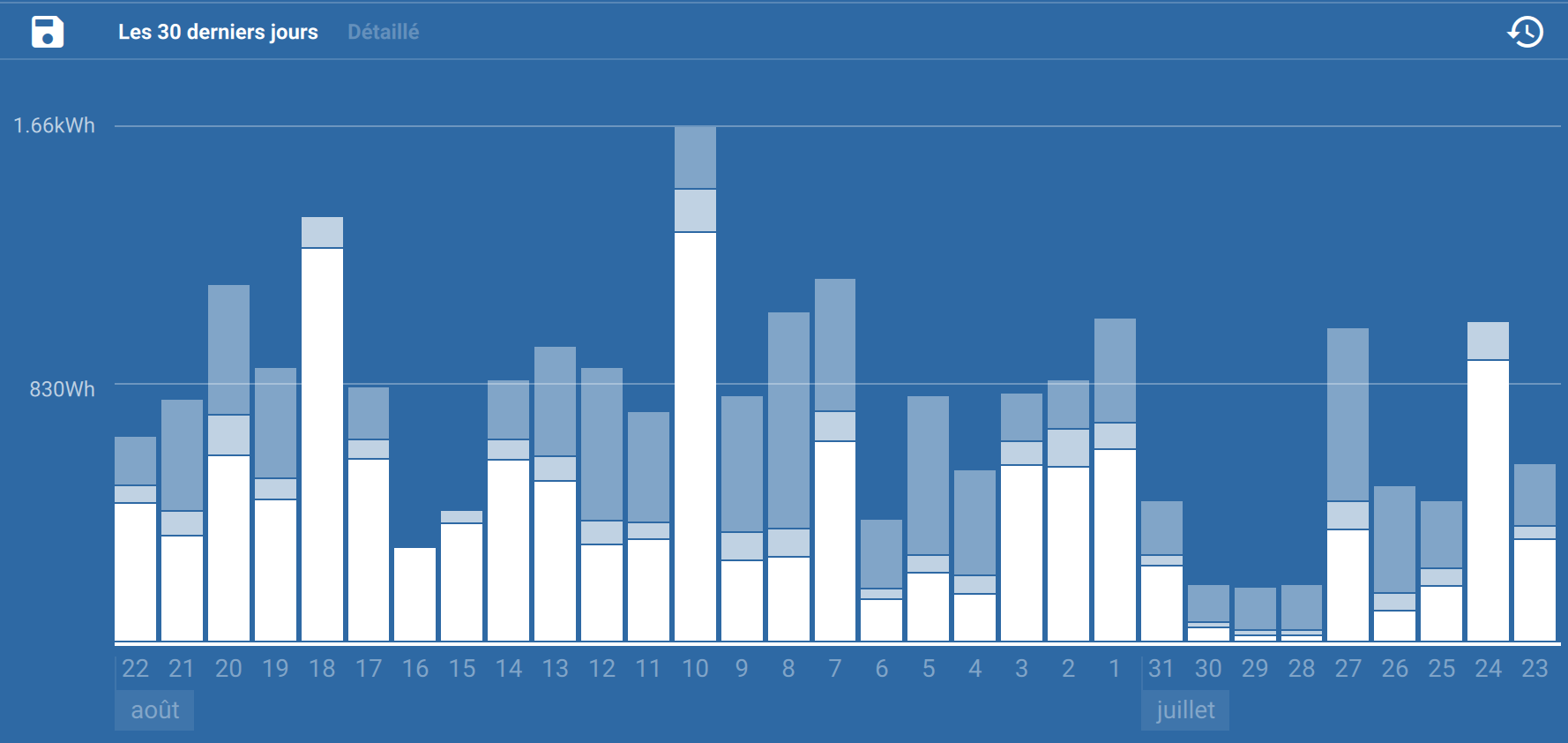
What is our daily electricity consumption? Over 30 days (from July 23 to August 22, 2022), our average was 830 Wh per day, or 0.83 kWh (see visual on the side).
What is the average daily electricity consumption in a UK household? According to Ofgem, the typical UK household uses about 7,400 Wh per day (7.4 kWh).
Does our motor still pollute as much?
How to make your campervan eco-friendly
Beyond our report, here are the concrete solutions to reduce your footprint in a van or campervan. Some we have applied from the start, others we discovered along the way.
Solar panels and energy autonomy
Installing solar panels is the number one investment for an eco-friendly campervan. With 200 to 400W of panels and a 100-200 Ah lithium battery, you can cover your daily needs without a generator. Pair this with low-energy LED bulbs and you drastically reduce your fossil energy needs.
Specifically, here’s what it looks like in numbers:
-
-
-
-
-
- 200W of panels: sufficient for 2 people in summer (lighting, charging phone/laptop, water pump)
- 300-400W: total comfort, even in mid-season, with a small compressor fridge
- 100 Ah lithium battery: 2-3 days of autonomy without sunlight
- 200 Ah lithium battery: 4-5 days of autonomy, ideal for Nordic winters
-
-
-
-
This has been our setup for 3 years and we wouldn’t go back for anything in the world. The initial investment (between £800 and £2000 depending on the configuration) pays off in 1 to 2 years if you avoid electrified campsites.
Dry toilets and water management
Forget the blue chemical products that pollute groundwater. Switching to dry toilets changes the game: zero water used for toilets and zero chemical discharge into nature. It’s also a huge gain in freedom: you no longer need to look for a specific dumping station every 2-3 days.
For dishes and showers, use biodegradable products and Marseille soap. It’s essential to avoid discharging pollutants when you dump. And for drinking water, a good gravity filter or a ceramic filter saves you from buying plastic bottles.
Responsible eating
Even though we love a good red meat, animal products account for 15% of environmental pollution related to human activities. (source)
You only need to live in a campervan to realize that animal products and this kind of fridge don’t mix well. A campervan fridge is not always on, so we avoid buying animal products. Our meat consumption has drastically decreased, and our CO2 impact related to this sector as well. We eat it at restaurants, and when it is produced responsibly.
Eco-driving and sobriety
Driving at 55-60 mph instead of 70 mph can reduce your fuel consumption by 15 to 20%. It’s also a safety issue with a 3.5-ton vehicle. But sobriety goes beyond driving:
-
-
-
-
-
- Buy useful and vital: with 3 cupboards and 10m2, you don’t buy clothes impulsively. No space = no overconsumption.
- Reduce digital consumption: we watch our entertainment in 240p or even 144p on YouTube (and not in HD which consumes 10 times more, or in 4K which consumes 20 times more). An average user consumes in 1 hour of video as much data as we do in 15 hours.
- Favor local products: markets, producers, short circuits. By traveling slowly, we discover local riches.
-
-
-
-
In vanlife, you feed your brain so much with experiences that you don’t need to feed it with material goods. QED.
Conclusion: yes, vanlife can be eco-friendly
You see, we may pollute more than before with our campervan engine, but we have still reduced our carbon footprint by about 25% with this lifestyle. Of course, we are not perfect and we can still improve.
But when tackling a lifestyle, it’s good to take it in its entirety, and not just judge the vehicle’s emissions. An eco-friendly campervan does exist: it’s a state of mind, a sum of small gestures, and a sobriety that naturally imposes itself when you live in 10m2.
Frequently asked questions about eco-friendly campervans
Does a motorhome pollute more than a car?
Looking purely at emissions per mile, yes: a diesel motorhome emits 250 to 350g of CO2/km compared to 100 to 150g for a car. But this comparison is misleading if you only look at the journey. A motorhome is also your home, your kitchen, and your bedroom. Compared to a classic trip (car + hotel + restaurant), the carbon footprint of a motorhome is 50 to 65% lower for a group of 2 to 4 people. It's the sobriety of the onboard living space that makes all the difference.
Can you live in a van without a generator?
Absolutely, and we actually recommend it. With a well-sized battery bank (100 to 200 Ah lithium) and enough solar panels (200 to 400W), you can cover all your electrical needs: lighting, charging laptops and phones, water pump, and a small compressor fridge. This has been our setup for 3 years, and we have never needed a noisy, polluting generator. The key is to match your consumption to your production.
Are dry toilets mandatory for eco-friendly vanlife?
Not legally mandatory, but they make a huge environmental difference. Zero water used, zero chemicals discharged into nature. The alternatives (chemical cassette with blue fluid, SOG system) consume water and chemicals that end up at dump stations. Dry toilets use sawdust or coconut fibre, and the composting process is natural. They are also simpler to manage daily: no need to hunt for a specific chemical dump point.
How long do solar panels last on a van?
A quality solar panel retains 80% of its power after 20 to 25 years in fixed use. On a vehicle, road vibrations and weather conditions can slightly reduce this lifespan. In practice, expect 15 to 20 years of real-world use, making them one of the most durable pieces of equipment in your conversion. It's a solid long-term investment for both your wallet and your carbon footprint.
Van life day to day, unfiltered
Two years of full-time van life, and the Algarve as our base ever since. We still hit the road, by van or otherwise, and we write up what we find along the way. An email when we have something to say, no more.
Ce que vous souhaitez recevoir :