


Why Wick deserves a stop on the NC500
Well, let’s be honest: if you look at Wick on the map before leaving, you probably think “small town on the east coast, 2 hours north of Inverness, it can wait.” Well, we were wrong too, and thankfully we were. Wick turned out to be one of the most memorable stops on our Scottish road trip, both for its history (the most active herring fishing port in Europe in the 19th century, no less) and for what we experienced there.
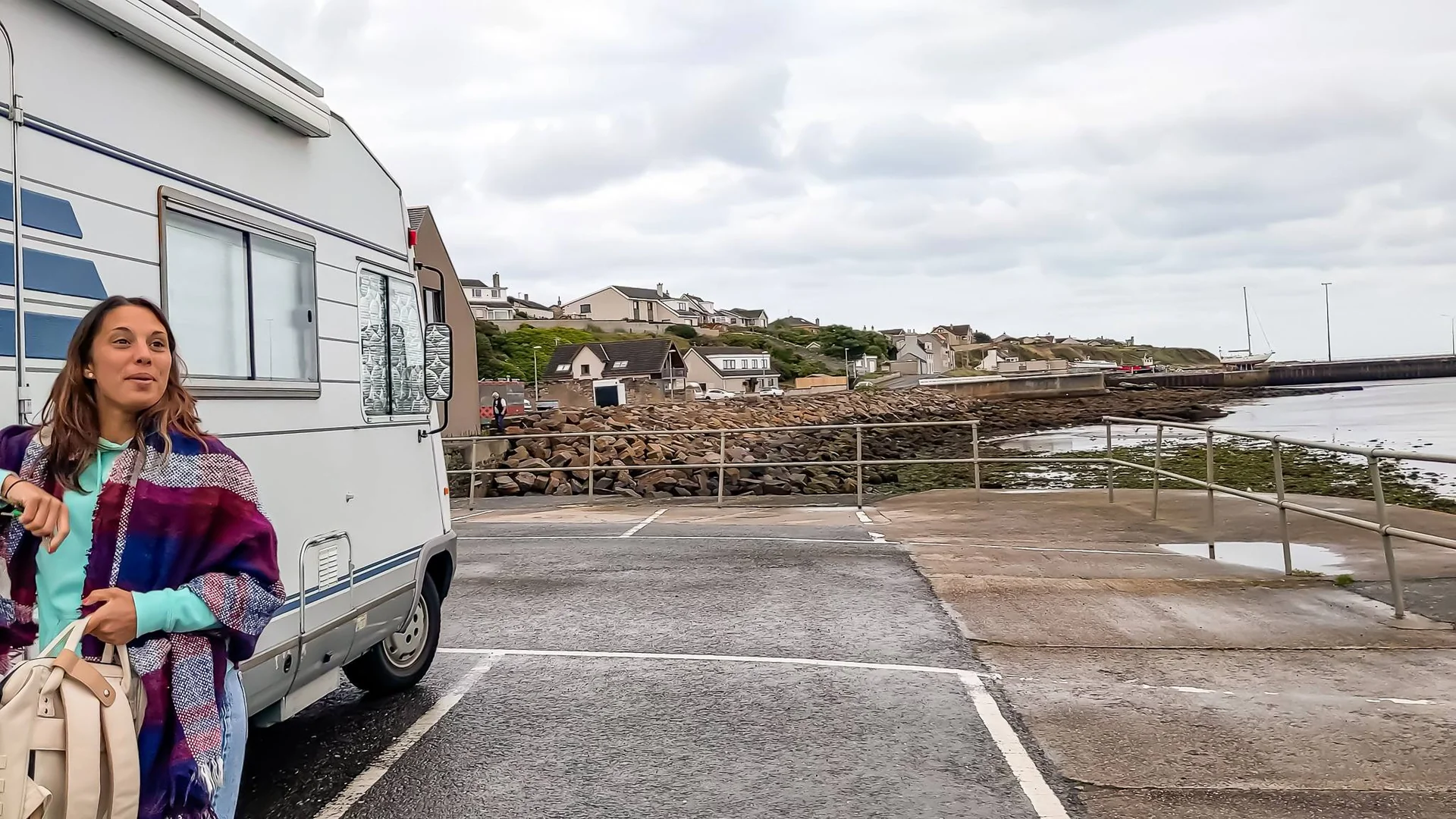
In practical terms, we arrived after a series of misadventures. The drone crashed into Loch Ness with all our best footage of the Cairngorms National Park inside. A detour to Inverness to buy a replacement, at +30% due to the euro/pound exchange rate (that dampens the spirits). Resuming the NC500 heading north, in the drizzle, with the mist sticking to the windshield. And then, upon arriving in Wick, miracle: the blue sky finally, the first real sunshine in several days. It’s August 16th. It’s Stephen’s birthday (shoutout to Stephen, happy birthday!). We park Édouard, our Hymer, in a parking lot by the harbor. And there, we breathe.

Plan your trip: United Kingdom
Tours, tickets and day trips in London.
5% off with code PLANETEDECAROT
Booked on Trip.com — partner link.
Compare rental companies and book at the best price.
10% off with code PLANETECAROLOC
Booked on Trip.com — partner link.
Provided by Holafly, our partner.
5% off with code LAPLANETEDECARO
Booked on Holafly — partner link.
Wick in brief: Vikings, herring, and the administrative capital of Caithness
A bit of context because otherwise, we miss the soul of the place. Wick is the former administrative capital of the Caithness district, this area in the far northeast of mainland Scotland that owes its identity to the Vikings (the name *Wick* comes from the Old Norse *vík*, meaning “bay,” and Caithness was called *Gallaibh* in Gaelic, “the land of strangers,” referring to the Norse who settled there in the 9th century).
In the 19th century, Wick experienced its golden age thanks to the herring industry: it was then the most active herring fishing port in Europe, with a fleet of over 1,100 boats bringing in tons of fish each season. To accommodate the fishermen and organize the industry, British engineer Thomas Telford designed a grid-like neighborhood south of the river: Pulteneytown, which is still visited today on foot. World War II marked the end of this era, but the urban and cultural legacy remains very much alive.
Our experience in Wick: from lost drone to French restaurant by the harbor
Well, let’s talk about what makes a stop unforgettable. For us, in Wick, it was a completely unexpected culinary encounter.
The French restaurant Au Bord de l’Eau
Barely parked in the harbor parking lot, we look up and there, just behind us, the sign: Au Bord de l’Eau, French restaurant. Caroline and I exchange glances. It’s been a month and a half since we had French food. Decision made in two seconds: we’re going.
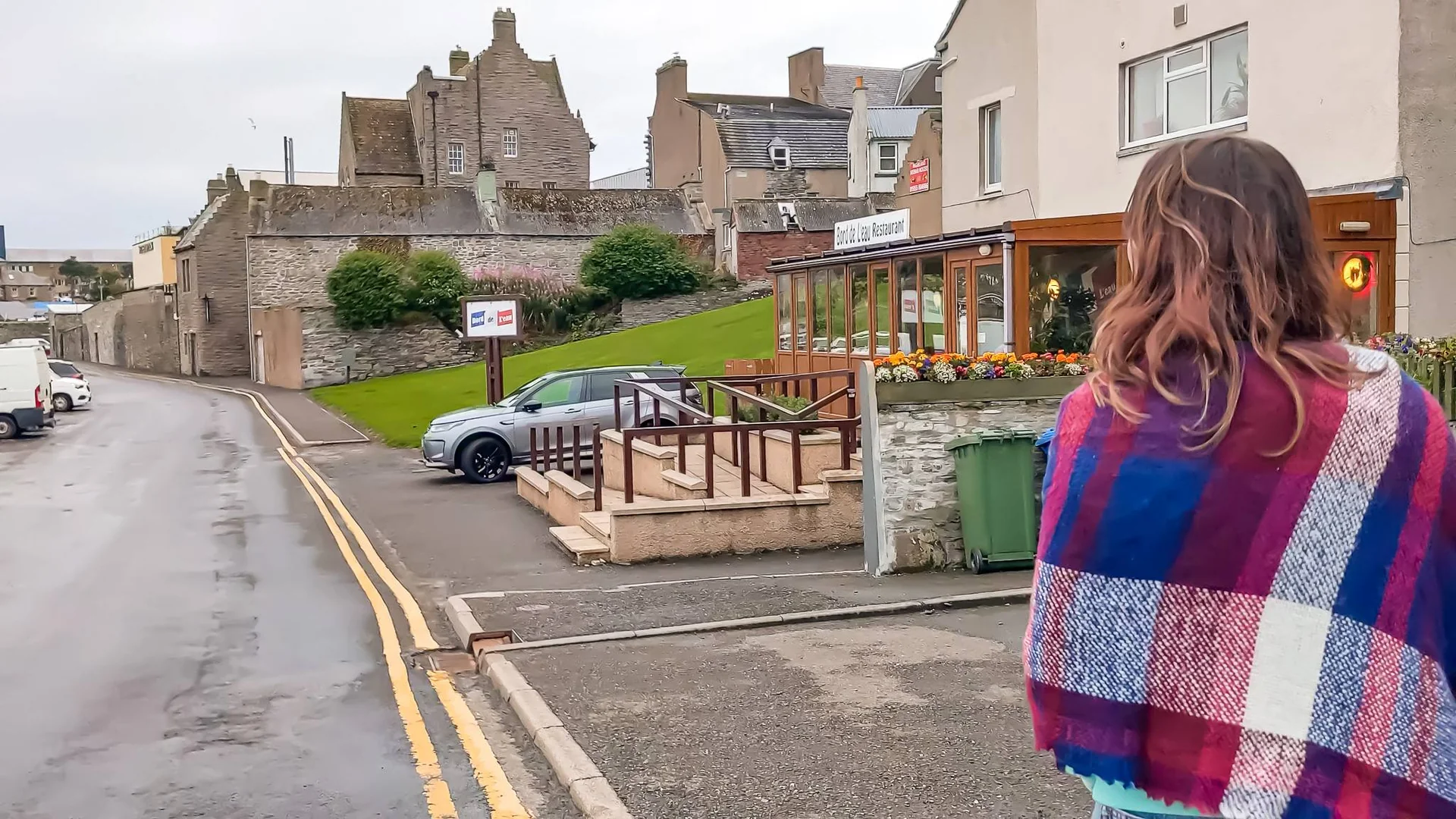
The interior is a true love letter to France. Photos of Paris adorn the walls (Eiffel Tower, Parisian streets, bistro scenes), colorful graphic nods, a postcard-like ambiance. And in the middle of it all: the owner walking between the tables in a real white chef’s outfit, complete with a toque. We smiled. It’s sincere, it’s touching, and clearly very appreciated by the locals who filled all the tables that night.
And the success is real: we hear customers (British on a road trip, locals) loudly telling the chef as he passes, “it’s wonderful,” “exceptional once again,” “bravo.” Guaranteed rave reviews. We understand in two minutes: this is probably the only real French restaurant for miles around, and the local community that has fallen for the concept returns regularly.
Pheasant supreme + classic chicken supreme
Xavier orders the pheasant supreme with mushroom sauce. Caroline orders the classic chicken supreme with steamed vegetables (broccoli, carrots, sugar snap peas). As sides, there’s potato gratin and nicely golden fries.
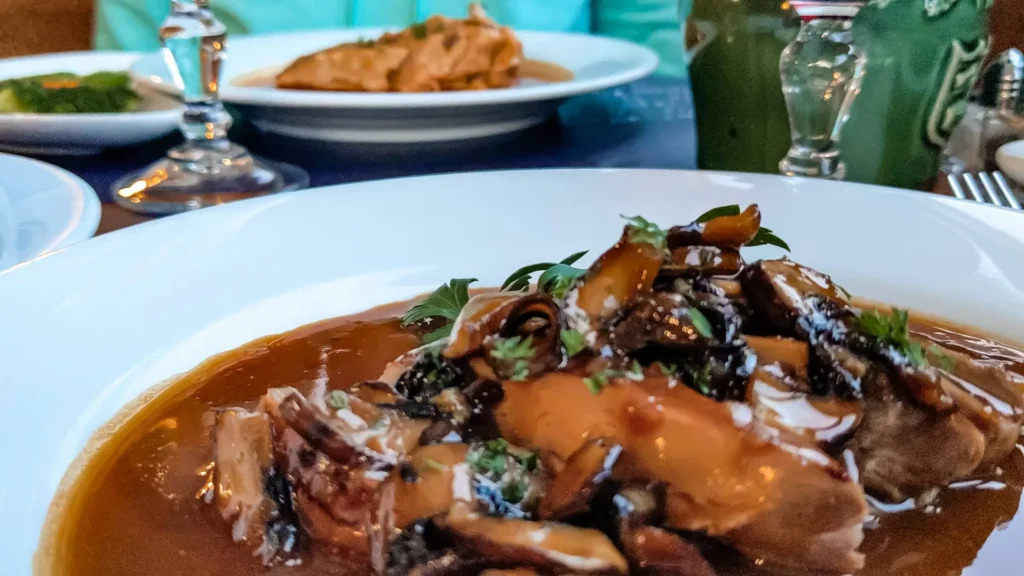
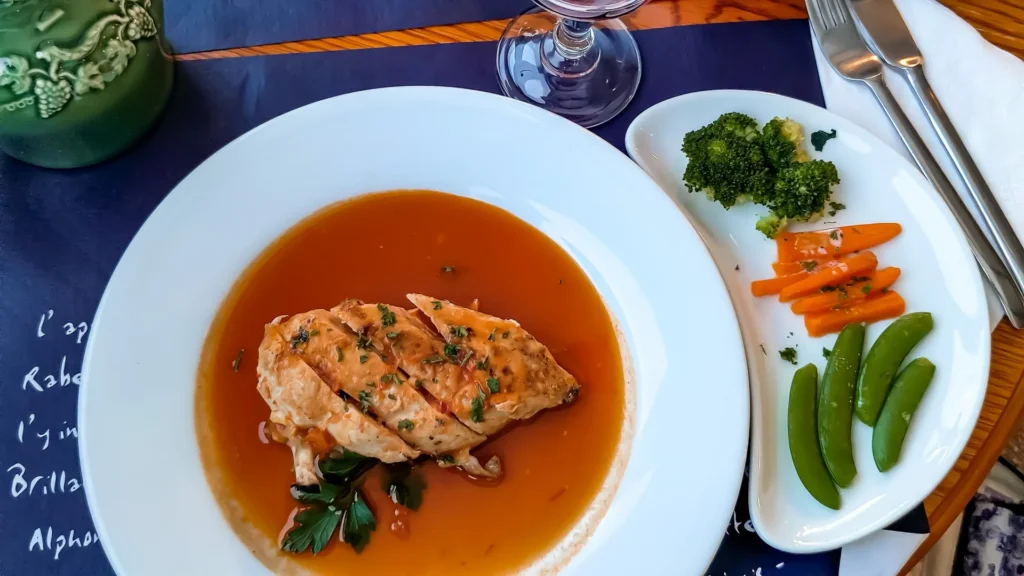
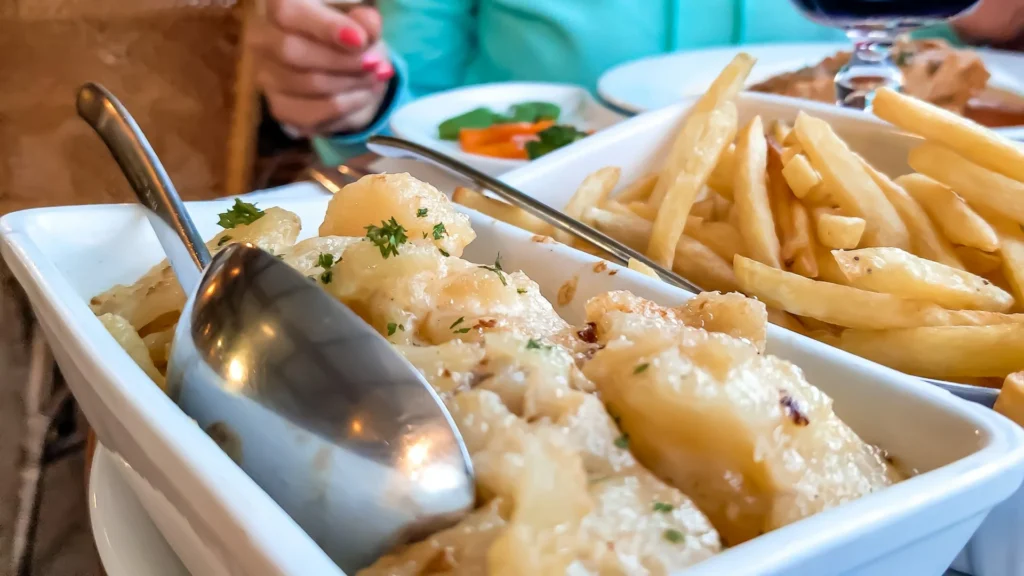
Honest verdict: we won’t be as raving as the locals, but it was good. A decent, comforting meal that did its job after six weeks of pasta and tomatoes in the van. What we remember most is the context: the Parisian ambiance in the heart of Caithness, the chef in uniform, the blue sky finally returned after days of drizzle. A true human pause.
The night in the parking lot facing the harbor (and the story of the Indian restaurant)
After dinner, we head back to the van parked just across. Funny anecdote: in the same parking lot, across from our French restaurant, there’s an Indian restaurant. We had hesitated to go there instead of the French one. Luckily we chose the French, because before or after our outing, we saw the police escorting people out of the Indian restaurant. We’ll never know exactly what was going on (a routine check, a dispute, something else), but at that moment, the conclusion was obvious: “we made the right choice.”
The morning facing the harbor entrance
The next morning, a pleasant surprise: we wake up facing the entrance of Wick harbor, overlooking the North Sea. A narrow entry (typical of Scottish fishing ports), boats gently leaving with the tide, seagulls crying, the horizon clear after the grayness of the past few days. Caroline goes out to take some photos at dawn. I stay in Édouard with a coffee. It’s the moment that calms everything after the emotions of the day before (lost drone, +30% of the Inverness drone, NC500 under the drizzle).
What to see and do in Wick (the 5 essential attractions)
Old Pulteney Distillery (The Maritime Malt)
The next morning, we head to the Old Pulteney distillery, a 5-minute walk from the harbor. A little anecdote to set the stage: we called the night before to propose a small report and share their work on social media that afternoon (based on what we had already done in the Douro Valley in Portugal, another video in our archives). A pressure-free request, “according to your availability.” Positive response, appointment set. This opened the door to a more personal visit “with euphoric vapors” than the standard tourist tour.
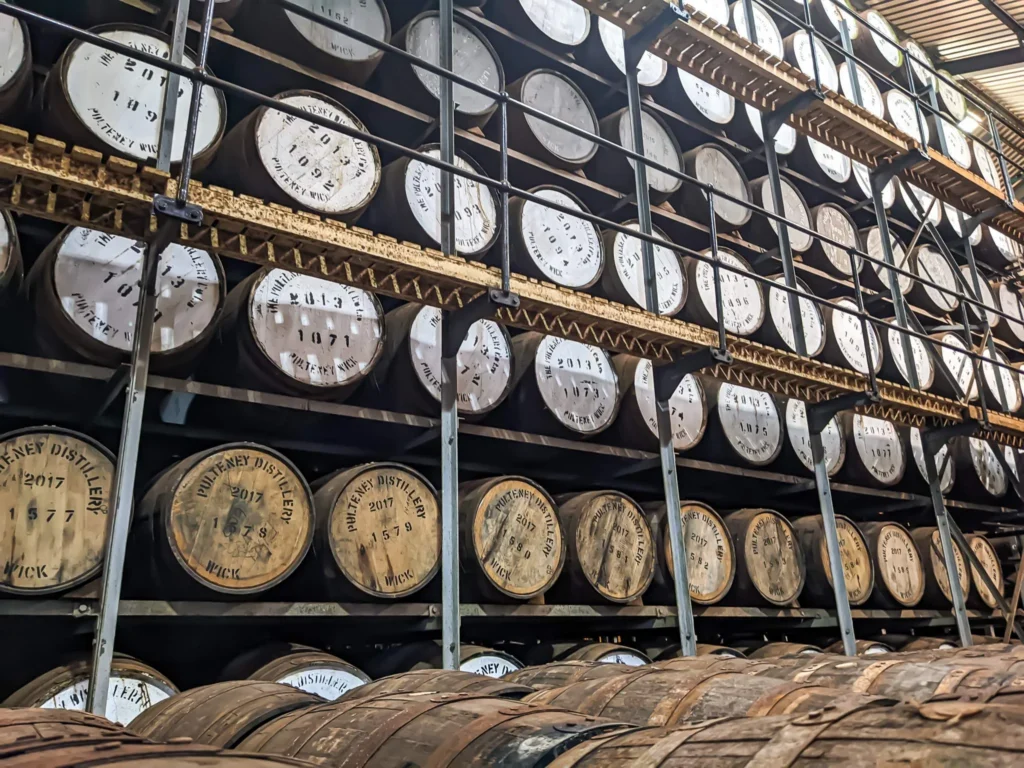
Founded in 1826, Old Pulteney is one of the northernmost distilleries in mainland Scotland, nicknamed “The Maritime Malt“: its oak casks are exposed to the invigorating sea air throughout the maturation, giving the single malt a characteristic taste, distinctive briny notes that are not found elsewhere. In concrete terms, the whisky “captures the taste of the sea.” The other signature of the house: the water comes from a pure source of a nearby freshwater lake, which facilitates brewing and fermentation.


The 5-step manufacturing process
Our guide walked us through the entire production chain, which takes place on the same site (the buildings adjacent to the harbor have become visitable in recent decades). Here are the 5 steps in order:
- Milling. A mill transforms barley into grist. A numerical reference given during the visit: one ton of crushed barley yields about 420 liters of spirit at the end of the chain. The amount of barley stored on-site is substantial.
- Brewing. The grist goes into a 15,700-liter mash tun, where the grain is mixed and then gradually heated to extract maximum sugar. This is the step that prepares the wort.
- Fermentation. The mash goes into stainless steel washbacks, where it is mixed with dry yeast at a constant temperature of 17°C for 60 hours. This is where sugar is transformed into alcohol.
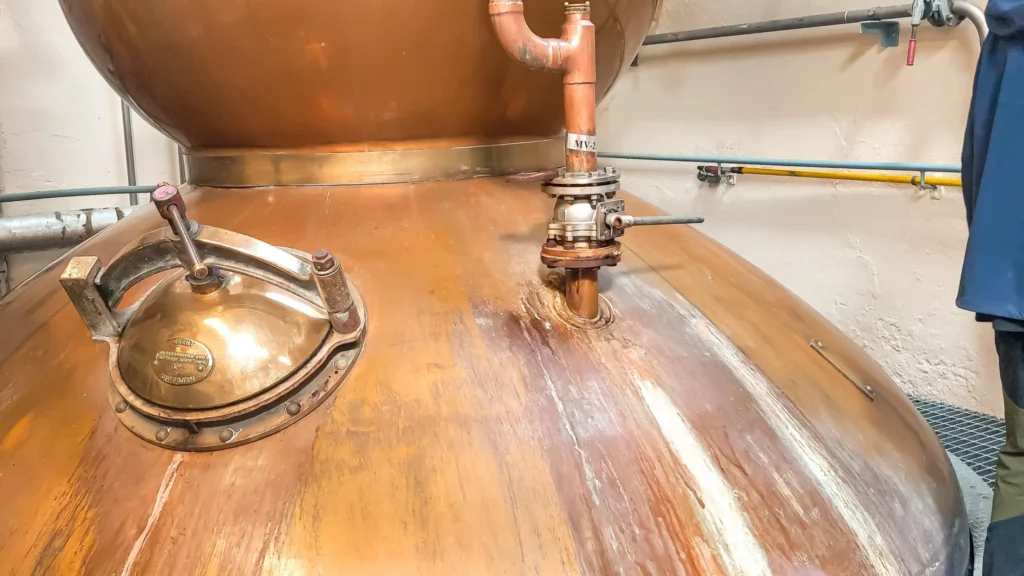
- Distillation. The liquid then passes through two elegant copper stills, characteristic of Old Pulteney, which contribute to the distinctive character of the whisky (the shape of the still really influences the purity and aromatic profile of the product).
- Maturation. And the final magic: the oak casks are stored near the harbor, where the sea air, saline humidity, and low temperatures work on the final product for 10, 12, 18, 21, or 25 years depending on the references. This is the step that defines the “maritime” character of the single malt.
Honest verdict from our tasting: the result is simply delicious. The 12 Years Old in particular, which we tasted at the end of the visit, has this fruity roundness + very distinctive saline notes that perfectly match the setting we are in. Caroline brought back a bottle, which we enjoyed that evening at the bivouac a bit further north (but that’s another story we tell in our John o’Groats article).
How to book and how much it costs
Classic tour The Maritime Malt: 1.5 hours of visit + tasting of the Harbour and the 12 Years Old, Glencairn glass included. Price around 15 to 25 £ per person. Premium Tour: addition of a 25-year-old and two exclusive single casks, around 50 to 60 £. Booking recommended in high season via the official site oldpulteney.com. Tours in English only, but accessible with a school level (the guides speak slowly and illustrate a lot).
Ebenezer Place: the shortest street in the world
A short curiosity (in the literal sense) but a must-see: Ebenezer Place, officially the shortest street in the world according to the Guinness World Records since 2006. It measures exactly 2 meters 06. One entrance door: that of number 1, which is actually the entrance to a restaurant of the MacKays Hotel. The street was officially named in 1887 by Alexander Sinclair, the owner at the time.
In concrete terms, you can get there in two minutes from the harbor. You take the symbolic photo in front of the plaque, and you leave with a good anecdote for your friends. Caroline loved it (yes, it’s very small, yes, it’s silly, and that’s exactly why it’s great).
Wick Heritage Centre (herring museum)
To really understand where the soul of Wick comes from, head to the Wick Heritage Centre, the local museum run by volunteers from the Wick Society. It’s very well documented, much more than one would expect from a municipal museum. You can discover the Johnston photographic collection (over 40,000 images tracing local life and the herring industry since 1863), reconstructions of period interiors, fishing tools, and the entire history of the local fishing dynasty.
Plan for 1.5 to 2 hours of visit to fully enjoy, price around 5 £ per adult. Open from April to October mainly, check seasonal hours on-site.
Pulteneytown: the neighborhood designed by Thomas Telford
To explore on foot after the museum: Pulteneytown, the southern neighborhood of Wick that Thomas Telford designed in a grid pattern in the early 19th century to house the workers of the fishing port. Remarkable architecture, peaceful residential atmosphere, several well-preserved typical cottages. Plan for 1 hour of a leisurely stroll.
Anecdote to situate the character: Thomas Telford (1757-1834) is the most famous civil engineer in the UK of the time. He also designed a good part of the roads in the Highlands, bridges (Menai Suspension Bridge in Wales), and Scottish canals (Caledonian Canal). Seeing one of his fully preserved neighborhoods in Wick is a real chance.
Castle of Old Wick
0.5 miles south of Wick via an easy coastal path (30 minutes on foot), the ruins of the Castle of Old Wick are among the oldest castles in Scotland, dating back to the 12th century. Only a residual tower remains perched on a rocky promontory, but the atmosphere is striking when the wind blows. Free access, spectacular view of the North Sea, perfect for a quiet late afternoon.

Best UK SIM for a Scotland Road Trip: Highlands, Skye and NC500 Coverage
What internet connection to use during a stay in Scotland? Often questioned by travelers, we explored the various options available in Scotland in this comprehensive article. As always, each solution...
DiscoverSpots and excursions in Caithness from Wick
Wick is a perfect base to explore the entire Caithness district. Here are the five classic excursions we did or spotted:
Castle Sinclair Girnigoe (Noss Head, 3 miles north)
Located 3 miles north of Wick, at Noss Head, the spectacular ruins of Castle Sinclair Girnigoe: two merged castles built between the 15th and 17th centuries, perched on a rocky promontory that plunges into the North Sea. Once the fortress of the Sinclairs, Earls of Caithness, the site has a rich history (family dramas, battles, abandonment in the 18th century). The Clan Sinclair Trust works to preserve the ruins from marine erosion. Free parking at Noss Head + a 10-minute trail to reach the castle.
Whaligoe Steps (9.5 miles south)
Located 15 minutes by car south of Wick, on the A99, one of the most impressive spots in Caithness: the Whaligoe Steps, 337 steps carved into the cliff that descend to a natural harbor once used by herring fishermen to unload their catches directly from their boats. Easy descent, strenuous ascent (each at their own pace). A magical site, an iconic photo of Caithness, a must-do.
Grey Cairns of Camster (8.5 miles southwest)
Located 8.5 miles southwest of Wick, in the heart of moorland, the Grey Cairns of Camster: two funerary cairns neolithic over 5,000 years old, among the best-preserved stone monuments in Scotland. You literally enter the burial chambers (crawling), an almost mystical experience. Free access, free parking. For ancient history enthusiasts, this is a must.
John o’Groats (20 minutes north)
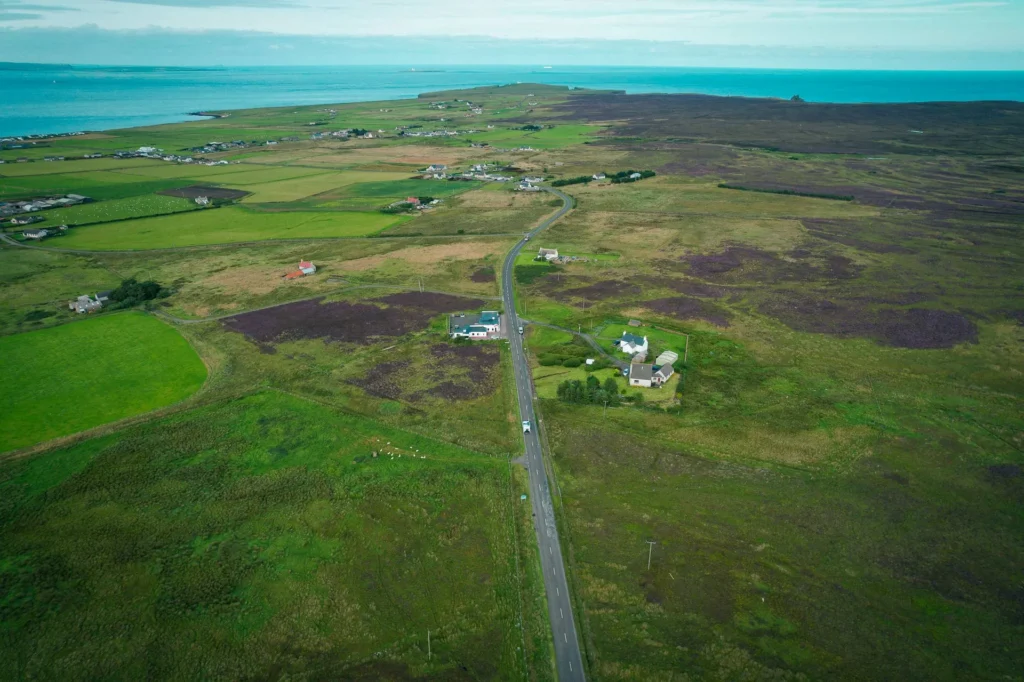
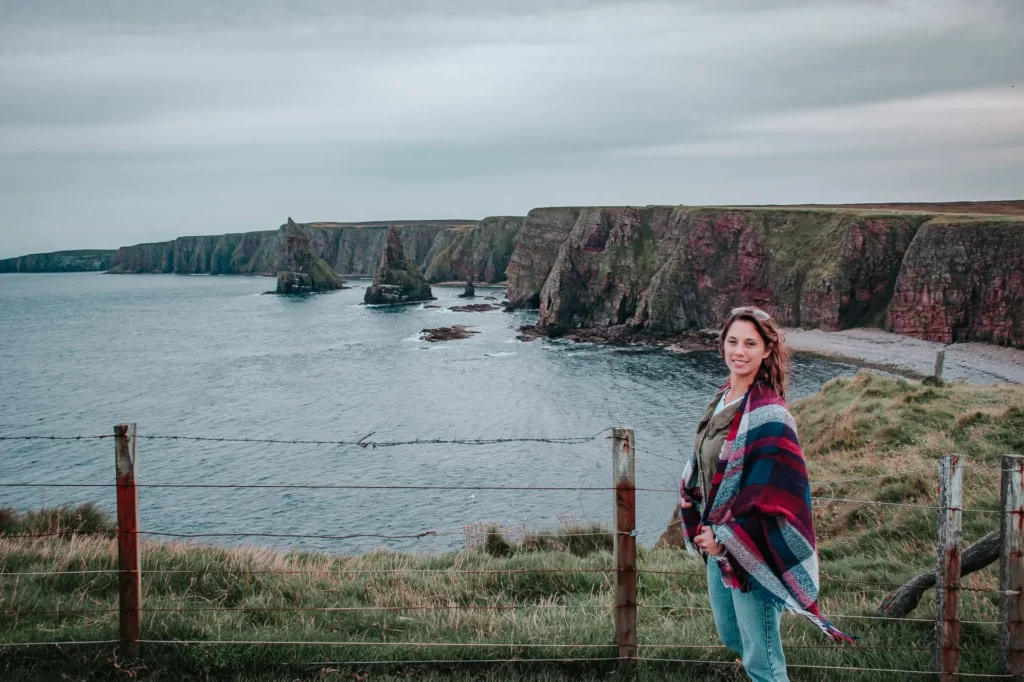
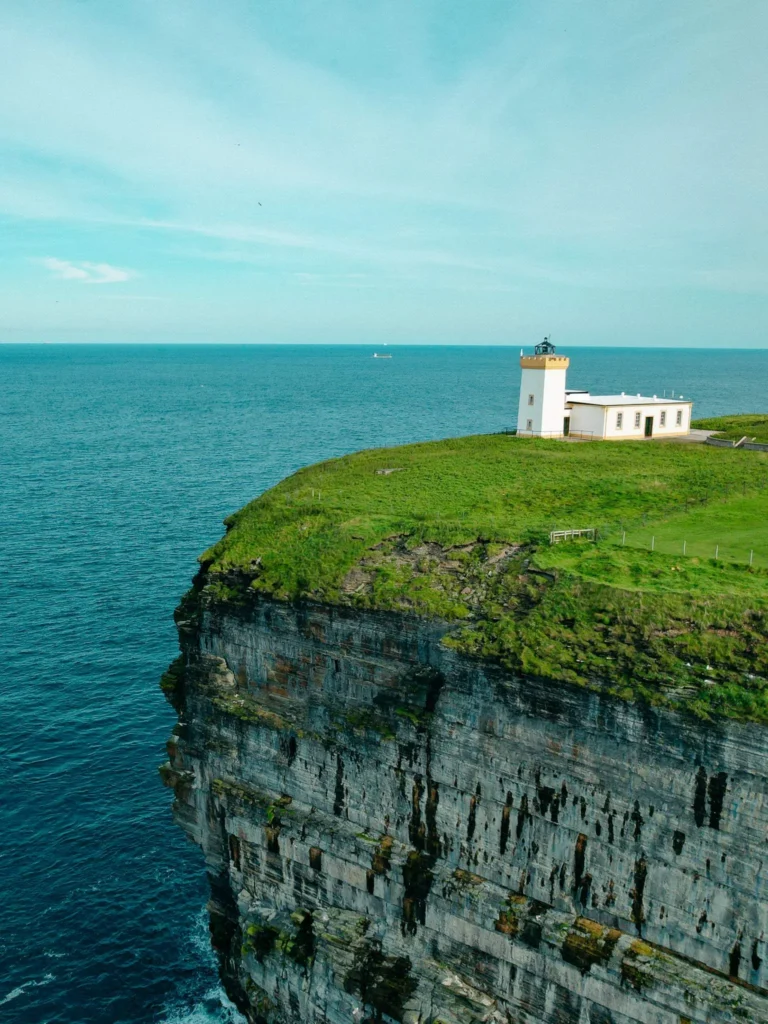
Located 20 minutes by car north of Wick, the famous John o’Groats, iconic northern point of mainland Britain (even though the true northernmost point is Dunnet Head, further west). A must-take photo in front of the “John o’Groats” sign, view of the Orkney Islands on a clear day, stroll to the white lighthouse on the cliffs, sheep everywhere. A bit touristy but still a reference stop on the NC500 road trip.
Sinclair’s Bay and Reiss Beach
Between Wick and John o’Groats, don’t miss Sinclair’s Bay, a large bay of golden sand flanked by two 16th-century castles (Castle Sinclair Girnigoe to the south, Keiss Castle to the north). The main beach, Reiss Beach, is vast, clean, and almost deserted. Excellent sunset walk, especially in summer when the golden light lingers until 10 PM.
The interactive map: all our POIs in Wick and around
To visualize all the spots we’ve just mentioned (restaurants, distilleries, castles, beaches, van parking), our interactive map below. Click on each marker for details.
Wick : Places we can tell you about
Here's our selection of places in Wick: spots we've visited that might be useful to you. Use the list view to discover each address in detail, and export everything to add to Google Maps or your favorite GPS app.
| Place | Address | Download |
|---|---|---|
| At the Water's Edge (French restaurant) | 58.442509, -3.0893765 |
| Place | Address | Download |
|---|---|---|
| Old Pulteney Distillery | 58.4344362, -3.0846985 |
| Place | Address | Download |
|---|---|---|
| Ebenezer Place (the shortest street in the world) | 58.4411701, -3.094157 | |
| Castle of Old Wick | 58.4232537, -3.0815025 | |
| Grey Cairns of Camster | 58.3784453, -3.2656785 | |
| Castle Sinclair Girnigoe | 58.4881, -3.056 |
| Place | Address | Download |
|---|---|---|
| Wick Heritage Centre | 58.4396632, -3.0884026 |
| Place | Address | Download |
|---|---|---|
| Pulteneytown (Telford area) | 58.4371195, -3.0879987 | |
| John o'Groats | 58.6373009, -3.0689679 |
| Place | Address | Download |
|---|---|---|
| Whaligoe Steps | 58.3456843, -3.1613421 |
| Place | Address | Download |
|---|---|---|
| Wick Caravan Site | Riverside Dr, Wick KW1 5SP, Royaume-Uni |
| Place | Address | Download |
|---|---|---|
| Sinclair's Bay (Reiss Beach) | 58.4858, -3.1043 |
Where to sleep in Wick in a van or motorhome
Several options depending on your style:
Wick Caravan Site (Riverside Drive): official caravan park with full services (water, waste disposal, electricity, restrooms, laundry). About £20-30 per night depending on chosen services. 5 minutes walk from the center.
Wick River Campsite: simpler option by the river, perfect for light vans.
Camping Southerndown: seaside camping with views of the northern islands (Orkney on clear days). Very quiet, ideal in summer.
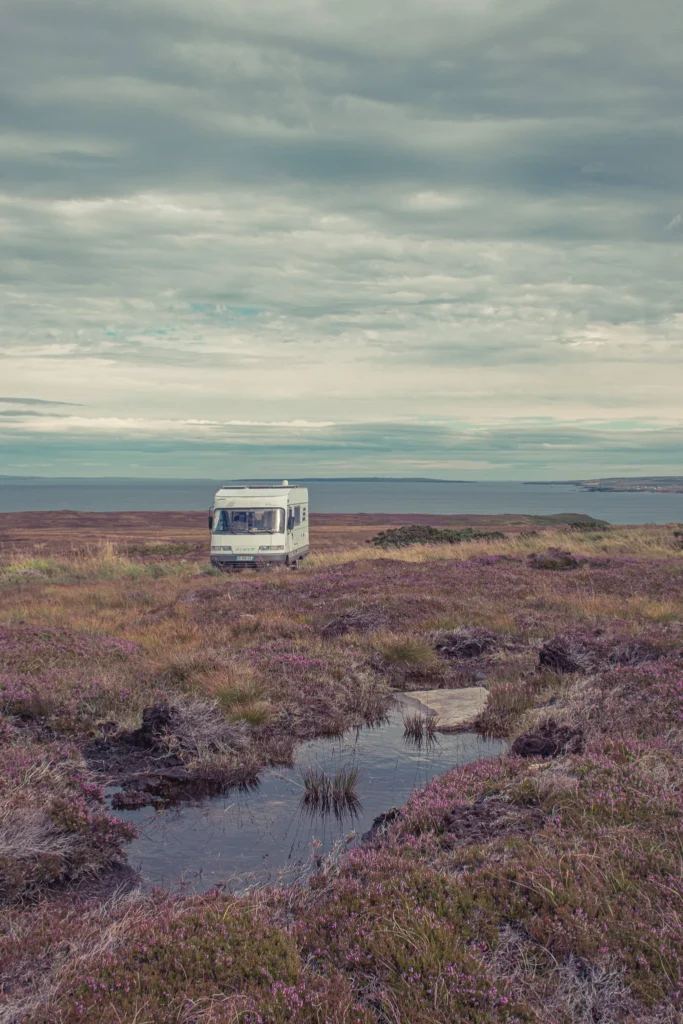
Harbor-side parking (our choice for one night): convenient for a single night, check the signage on-site and the Park4Night app.
To avoid: wild camping in the Caithness moorland. Locals quickly report to rangers/police, and ecological sensitivity is high.
MacKays Hotel: the historic hotel in the city center (and the one that hosts the shortest street in the world!). Rooms around £100 to £150 per night depending on the season.
Bower Pods: camping pods (wooden cabins), an unusual option if you want to get out of the van for a night. Around £80 to £120 per night.
Mey House (nearby, to the north): higher-end guesthouse for those wanting a “manor” atmosphere.
What budget to plan for Wick on a road trip
Quota RapidAPI dépassé (limite par minute/mois). Réessayez plus tard.
To situate concretely:
- Pub meal / fish and chips: £10-15 per person;
- Restaurant meal (By the Water, Mackays): £25-40 per person with a drink;
- Wick Heritage Centre: £5 per adult;
- Old Pulteney tour: £15-25 for a classic tour, £50-60 for a Premium Tour;
- Castle Sinclair Girnigoe / Whaligoe Steps / Castle of Old Wick: free, open access;
- Grey Cairns of Camster: free;
- Motorhome parking: £20-30 at Wick Caravan Site with services, £0-5 for occasional parking.
Plan for £60 to £90 per day for two in vanlife in Wick (meals + one paid visit + camping with services), to be adjusted according to your choices.
What climate and season to visit Wick
Wick : a glimpse of the weather
5-day forecast
For those who love last-minute adventures, here's what the weather has in store.
Monthly climate
Personally, we always choose warm and dry periods. But everyone has their ideal weather! Here's the info to make your choice.
| Month | Min temp | Max temp | Rain | Weather | Rating |
|---|---|---|---|---|---|
| October | 8°C | 12°C | 152 mm | 🌧️ | |
| November | 4°C | 8°C | 101 mm | 🌧️ | |
| December | 5°C | 8°C | 60 mm | 🌦️ | |
| January | 2°C | 5°C | 113 mm | 🌧️ | |
| February | 2°C | 6°C | 85 mm | 🌧️ | |
| March | 3°C | 10°C | 71 mm | 🌧️ | |
| April | 4°C | 10°C | 85 mm | 🌧️ | |
| May | 6°C | 13°C | 112 mm | 🌧️ | |
| June | 10°C | 16°C | 135 mm | 🌧️ | |
| July | 11°C | 16°C | 91 mm | 🌧️ | |
| August | 11°C | 16°C | 140 mm | 🌧️ | |
| September | 10°C | 15°C | 143 mm | 🌧️ |
For the season: June to August are the most stable months in terms of weather (temperatures 13-18°C, long days with sunset after 10 PM, North Sea still cool). September offers beautiful autumn colors with fewer crowds. May and October are possible if you accept more wind and shorter days. Avoid November to March (strong winds, possibility of snow, many shops closed).
Practical tips for Wick on a road trip and vanlife
FAQ Wick on a road trip
Why Wick deserves a stop on the NC500?
What are the must-see attractions in Wick?
What is Ebenezer Place, the shortest street in the world?
How to visit the Old Pulteney distillery?
Where to sleep in Wick in a camper van or van?
How many days should you plan to visit Wick and Caithness?
What excursions are nearby Wick?
Do you need a visa or authorization to visit the United Kingdom?
To go further on the Scottish road trip

Discovering Ballater on a road trip and in a van: Complete Guide
Prepare your RoadTrip to Ballater with our complete guide. History, climate, budget, where to sleep, we cover everything so you can make the most of your trip to Ballater.
Read more

Discovering Edinburgh by road trip and van: Complete Guide
Discover Edinburgh in this travel guide for everyone, perfect for van road trip enthusiasts. Explore the history, budget, where to sleep, where to park, where to eat, and what to...
Read moreOur PS that adds nothing
At the end of the Old Pulteney tour, the guide asked us if we had any questions. Caroline said, “yes, have you also visited the shortest street in the world?”. The guide, with a smirk: “every day on my way to work, yes.” We asked him why the name Ebenezer. He shrugged, “I don’t know, it’s the owner’s choice.” There you go. Huge respect for local honesty.

We're Caroline and Xavier
We drive to a place, stay long enough to get it wrong a few times, then write the guide we wish we'd had: parking, timing, what's worth the detour.
Ce que vous souhaitez recevoir :