Our review of Church of the Holy Rude
Benefits
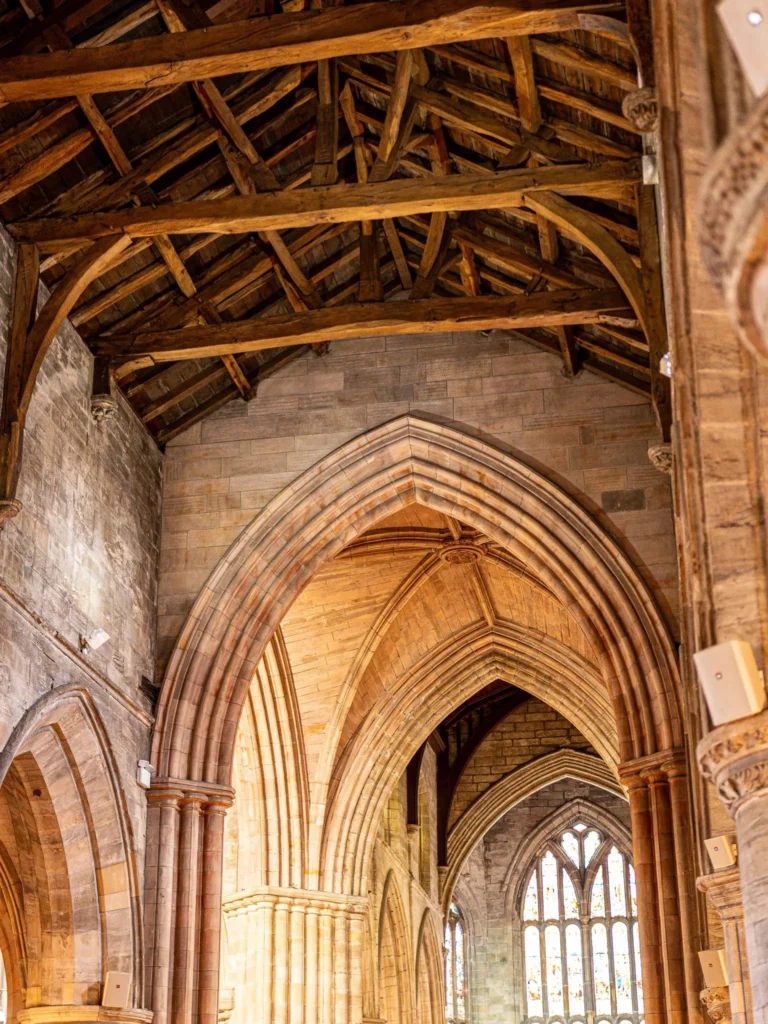
- One of the few medieval timber roofs still standing in Scotland
- The old kirkyard behind it, exactly the Scottish graveyard you picture
- The view from Ladies' Rock, right at the back, and it costs nothing
- Literally on the way up to the castle, no detour at all
Disadvantages
- You pay to go inside, and the outside gives nothing away
- Open to visitors only from late March to early November
- Plenty of foot traffic in the graveyard, hard to have it to yourself
Who is this place for?
- Anyone heading up to the castle who wants a real stop on the way
- Lovers of medieval architecture and old stone
- Photographers, for the kirkyard with the castle behind it
The outside promises nothing. The inside and the kirkyard are well worth the stop on the climb up to the castle.
We came up to Stirling to see a church. We ended up spending most of the day in its kirkyard, and we are not going to apologise for it.
The Church of the Holy Rude stands on St John Street, in the upper part of the old town, just short of the castle. You cannot miss it: coming up from the centre, between the moss-covered walls and the black lantern streetlamps, it is the big stone building that blocks the view. We had spotted it from below without knowing what it was. We went in a little out of curiosity, a little because it was on the way, and with no idea at all of what was waiting inside.
Spoiler: it is the kind of place you enter for five minutes and leave forty minutes later, with a stiff neck.
First things first, it is not a cathedral
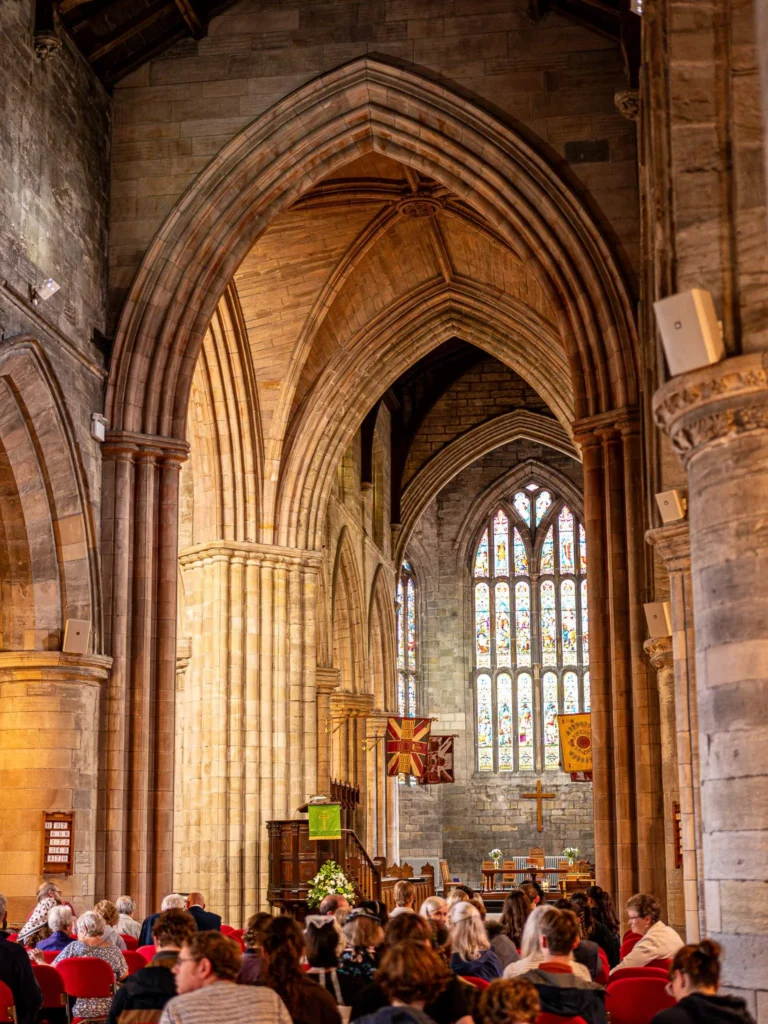
We are clearing this up straight away, because we wondered about it on site and because almost everyone who sees the building from a distance assumes the same thing. The Holy Rude is not a cathedral. It is the parish church of Stirling, plainly and simply. A parish founded in 1129 under David I, and still working today: on the day of our visit, the nave was full.
The name is worth a moment, and it is a better story in English than in French. Rude here has nothing to do with rudeness. It is the Scots form of rood, the Cross. Church of the Holy Rude therefore means the church of the Holy Cross. An altar dedicated to the Holy Rude was founded here by Robert II, and the name ended up sticking to the whole building. A detail that changes everything when you are trying to work out what you are actually looking at.
The building you see today is not the one from 1129. In 1405, a fire tore through a good part of Stirling’s old town, church included. It was rebuilt afterwards: the nave from 1414, the choir begun in 1507, the tower brought up to its present height around 1530. If you want the full picture of the town and the climb to the castle, we cover it in our Stirling campervan road trip guide.
The inside, and the ceiling we did not see coming
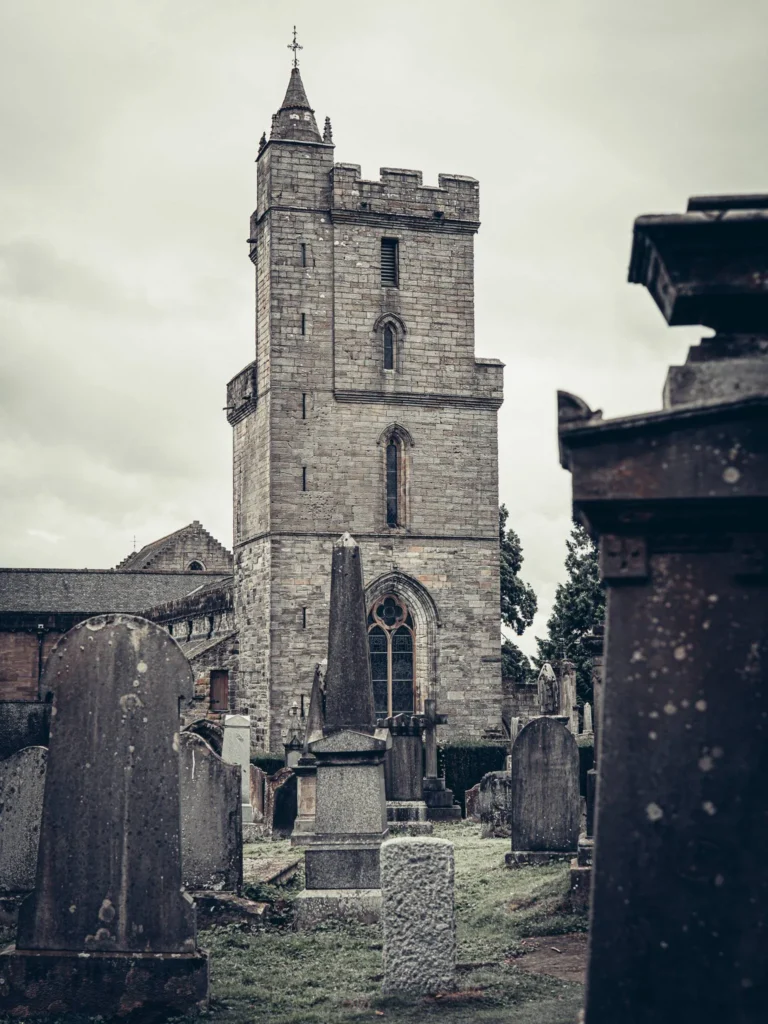
Here is the real subject. From the outside, the Holy Rude is handsome but austere: grey stone, a crenellated square tower, a graveyard wrapped around it. Nothing prepares you for what is inside. You push the door, look up, and there it is, an open timber ceiling, bare beams and trusses, sitting above the stone arcades. An atmosphere with nothing at all to do with what the facade suggested.
And here comes the small pride of the traveller who does the reading afterwards. That feeling of “this ceiling is not ordinary” turns out to be entirely justified. The RCAHMS inventory, the reference survey of Scotland’s built heritage, describes a roof of nine main trusses and states plainly that it is one of the few medieval timber roofs still surviving in Scotland. It went up shortly after 1450. Scotland’s Churches Trust says exactly the same. This is not handsome restoration joinery: it is fifteenth-century wood still holding the roof up.
One clarification, because we have read it several times and it does not quite hold. Some sources present this roof as “the oldest surviving hammerbeam roof in Scotland”. The RCAHMS survey describes trusses with tie beams, king posts and struts, which is not a hammerbeam roof. The rarity is real, the label is not. We would rather give you the sourced version.
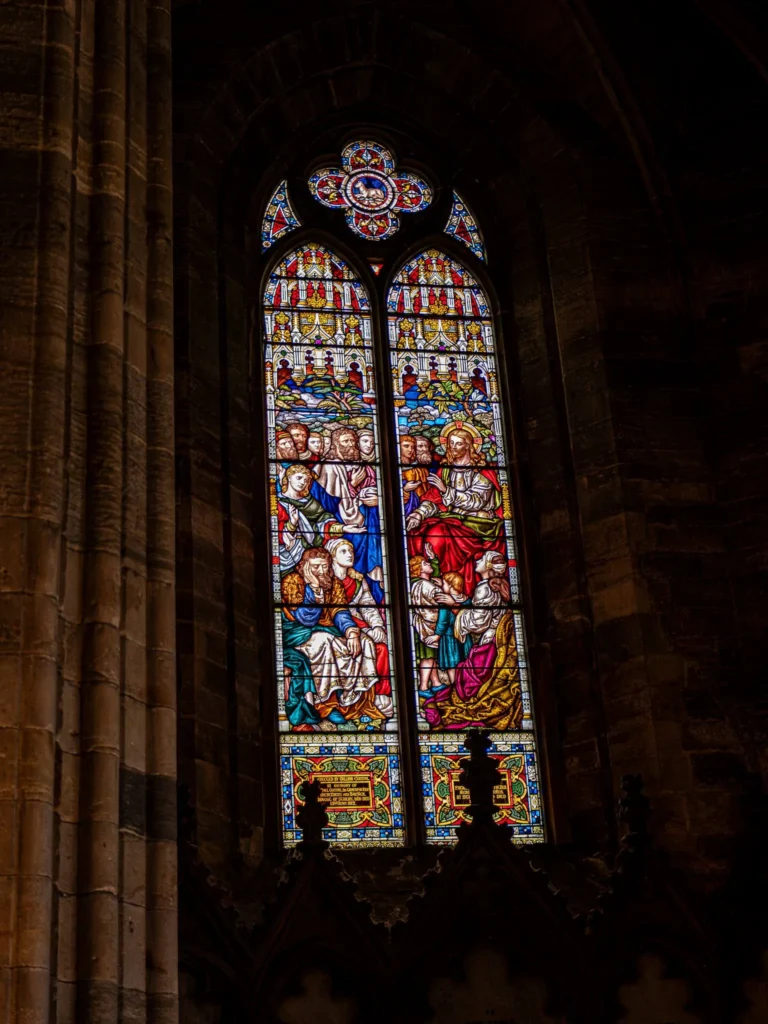
The rest follows: the stained glass, deeply colourful, cutting through the gloom, and the run of tall arcades that give the nave a height you would not expect in a parish church. Honestly, that is the moment the visit shifted from “oh, a church” to “right, we are staying”.
A thirteen-month-old baby crowned King of Scots, right here
On 29 July 1567, Mary, Queen of Scots had just been forced to abdicate. Her son, the future James VI, was thirteen months old. He was crowned King of Scots in this church, with the sermon preached by John Knox, the great figure of the Scottish Reformation. The same James VI who became James I of England in 1603 and brought the two crowns together. We had walked in off the street out of curiosity, and we were standing on the spot where that happened.
Now, the line that circulates everywhere and that we are not going to repeat: “the Holy Rude is, with Westminster Abbey, one of only two churches in the United Kingdom to have hosted a coronation and still be in use”. That is wrong, or at best incomplete. There are three, not two: Westminster Abbey, Gloucester Cathedral (coronation of Henry III in 1216), and the Holy Rude. The parish’s own website states the careful, accurate version: the only surviving church in Scotland to have hosted a coronation and still be in use. That is quite enough on its own. There is no need to add to it.
The wall that split the church in two for almost three centuries
This one we did not see coming either. In 1656, after a falling-out between Stirling’s minister James Guthrie and a colleague, a wall was built straight across the church, separating the nave from the choir. Two buildings, two congregations, under one roof, each on their own side of the partition. Guthrie was eventually executed for treason in Edinburgh in 1661.
The wall stood until 1935. Almost three hundred years. The two halves were reunited, and the building was then restored between 1936 and 1940 by the architect James Miller. Walking today from one end of the nave to the other without meeting an obstacle, you would not suspect for a second that you are making a gesture that was impossible for ten generations.
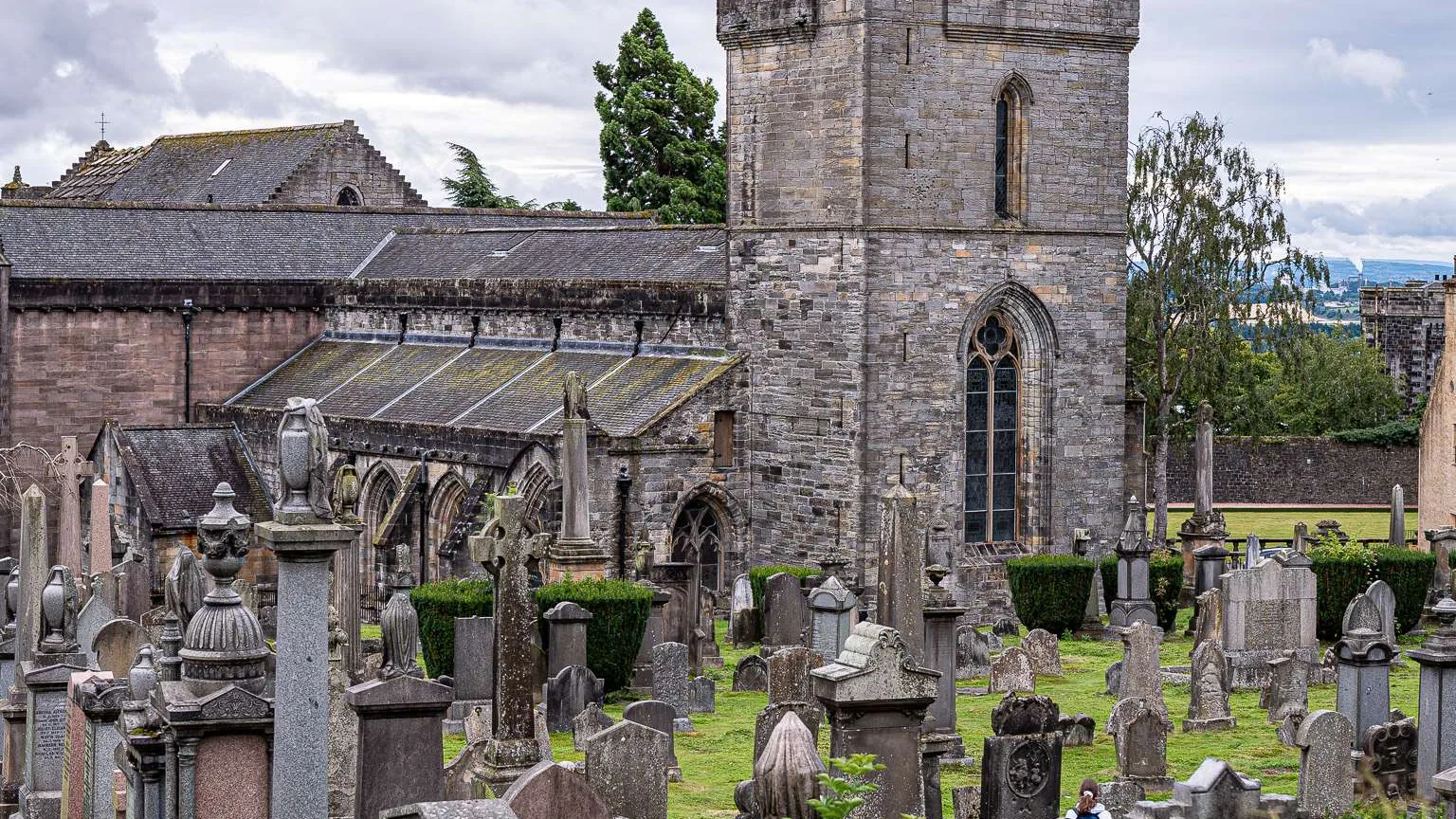
One more thing to look at, outside this time: the masonry of the tower is visibly pitted with small impact marks, with a clear cluster low on one face. You can see it well in our photos. Local belief puts it down to firing from the castle, in particular during the siege of 1651 by Cromwell’s troops. Honestly, we are going to stay cautious here. The RCAHMS does record the pitting, but concludes that this explanation “can hardly be accepted as a full explanation”. The marks are certainly there. Their origin is still argued over.
Behind the church, the grass has won
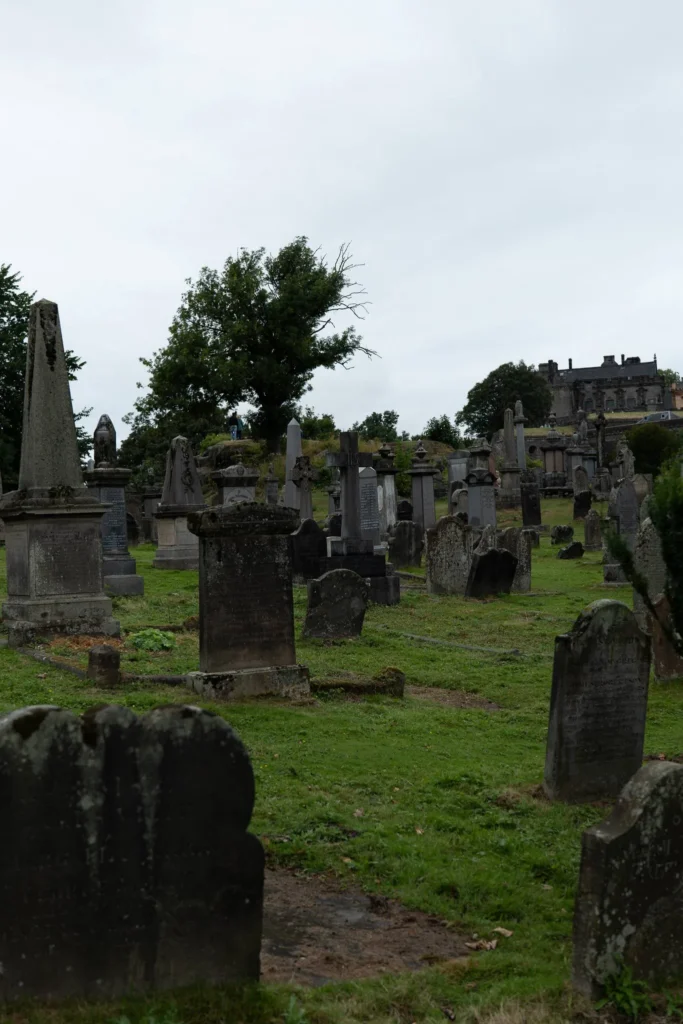
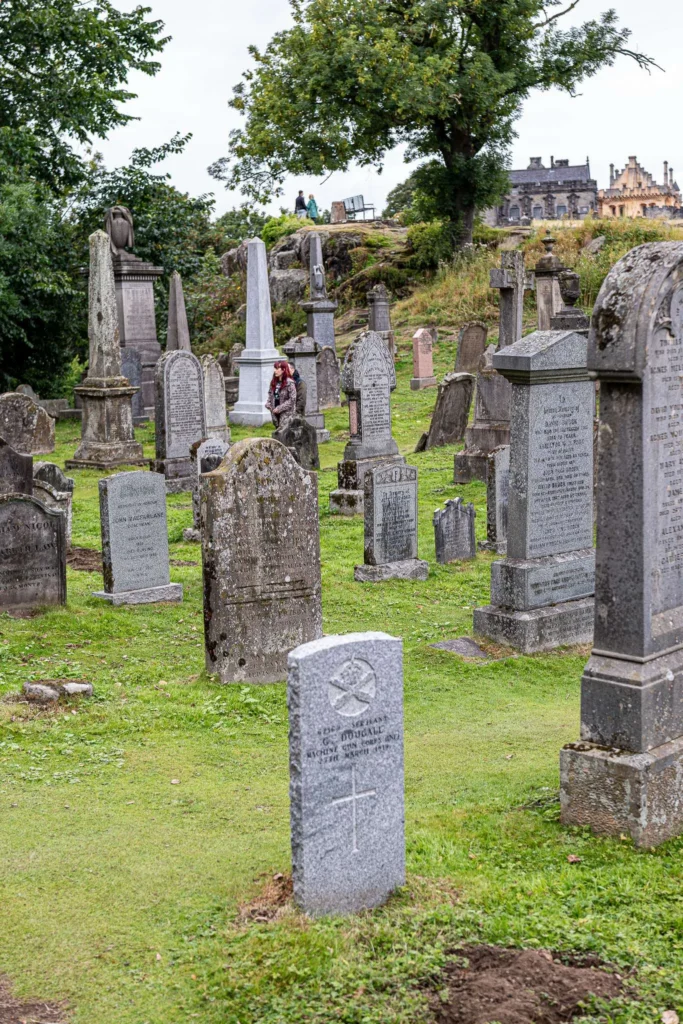
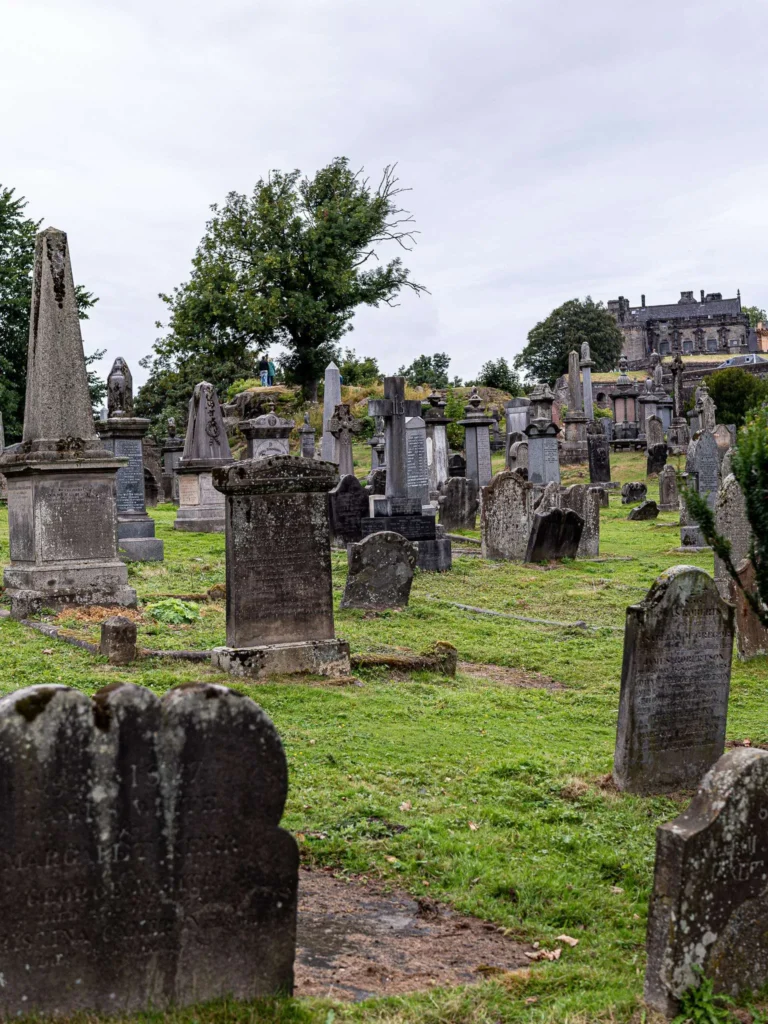
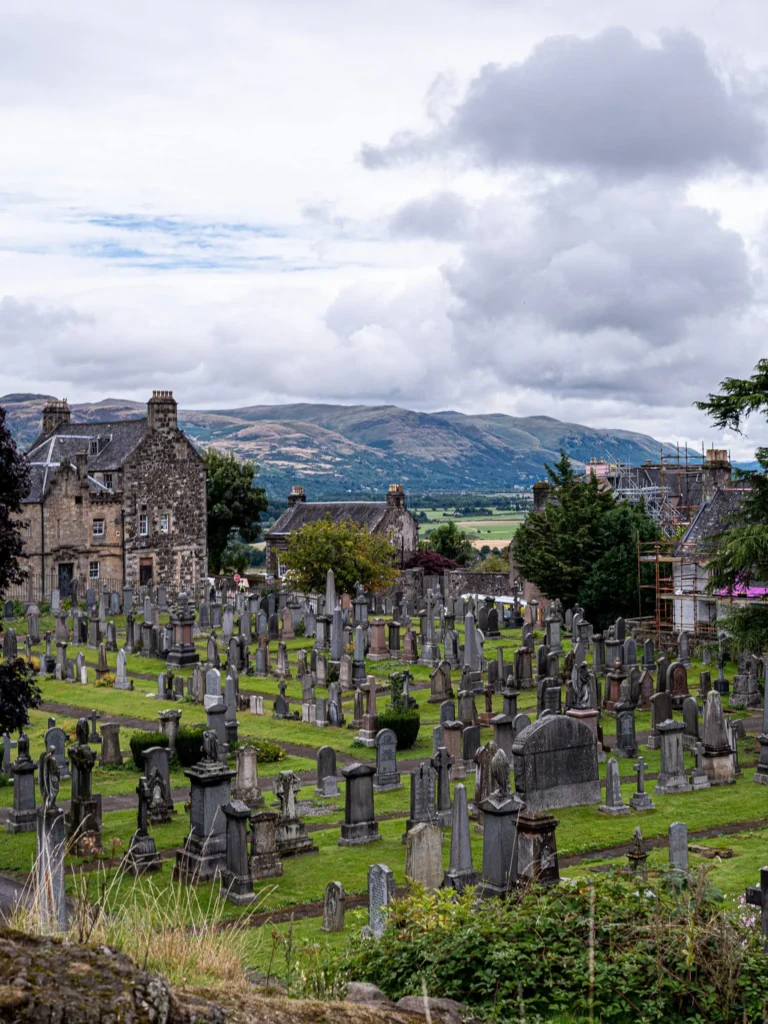
And so, the graveyard. That is where we spent the most time, and that is where Stirling surprised us most. A Scottish kirkyard looks nothing like the cemeteries we know in France, or in Portugal where we live: no raked gravel paths, no straight alignments, no polished plaques. Here the grass rules. It grows around the graves, up against the stones, sometimes right over them. Everything seems to be quietly returning to the landscape. If you grew up with English churchyards, you will be on familiar ground here. We were not.
The big carved slabs lean, wear their lichen and tilt towards one another. Some have gone over completely. And in the background, above the stones, Stirling Castle sits over the whole scene. It takes about three seconds to understand why this graveyard ends up in so many photographs: it is exactly the image you carry of an old Scottish kirkyard, except that you are standing inside it.
What we liked is that these are not anonymous graves. You can read the trades, the lives. One stone pays tribute to John MacFarlane, coachman. Another, plain and white, is a Commonwealth war grave: Serjeant G. Dougall, Machine Gun Corps, 27 March 1919. Serjeant with a J, carved the way the army still spelled it then, and a death months after the armistice. You walk along a grassy path and come upon that, between two landscape photos.
The dates we read on the stones, and the ones that have gone
This is the moment the place becomes concrete. We stopped to read the inscriptions one by one, and came across several nineteenth-century dates, 1829, 1849, and at least one stone carrying 1728. These are not graves that merely look old: you read the date, do the arithmetic, and realise you have almost three centuries in front of you.
For scale, local sources put the oldest still-legible stone in the kirkyard at 1579. In other words, what we were reading was nowhere near the record here. And plenty of other stones will never say anything again: Scottish sandstone erodes fast in this damp, the lettering fades, and some slabs have gone completely mute. We will not know who lies underneath, or from when.
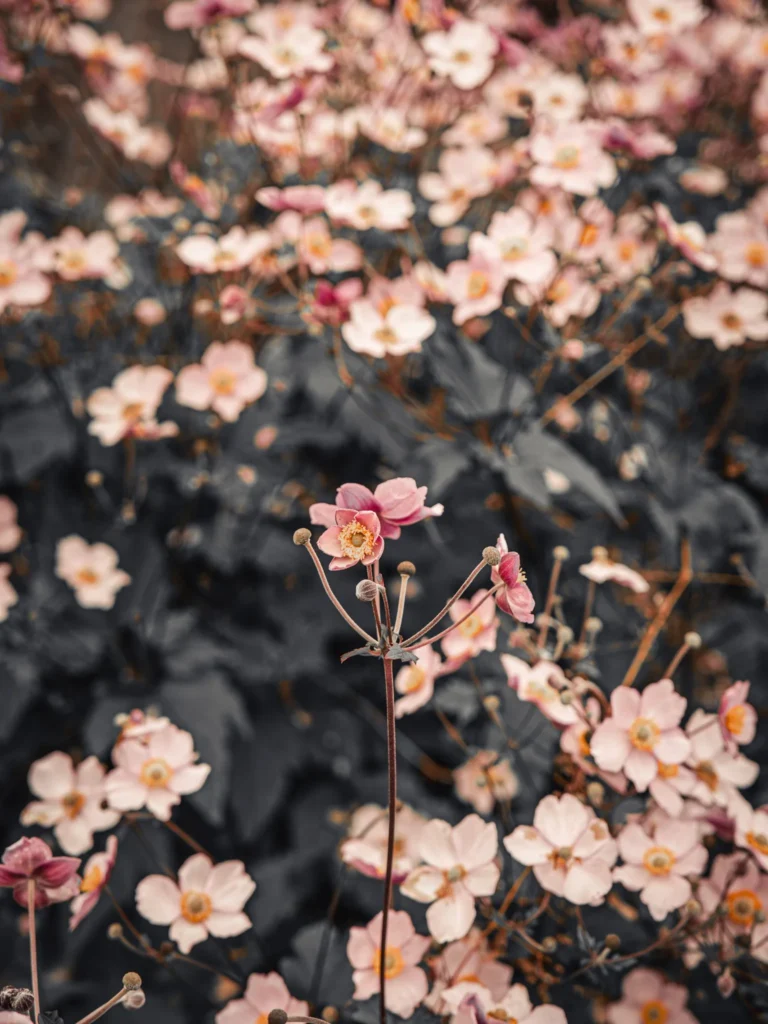
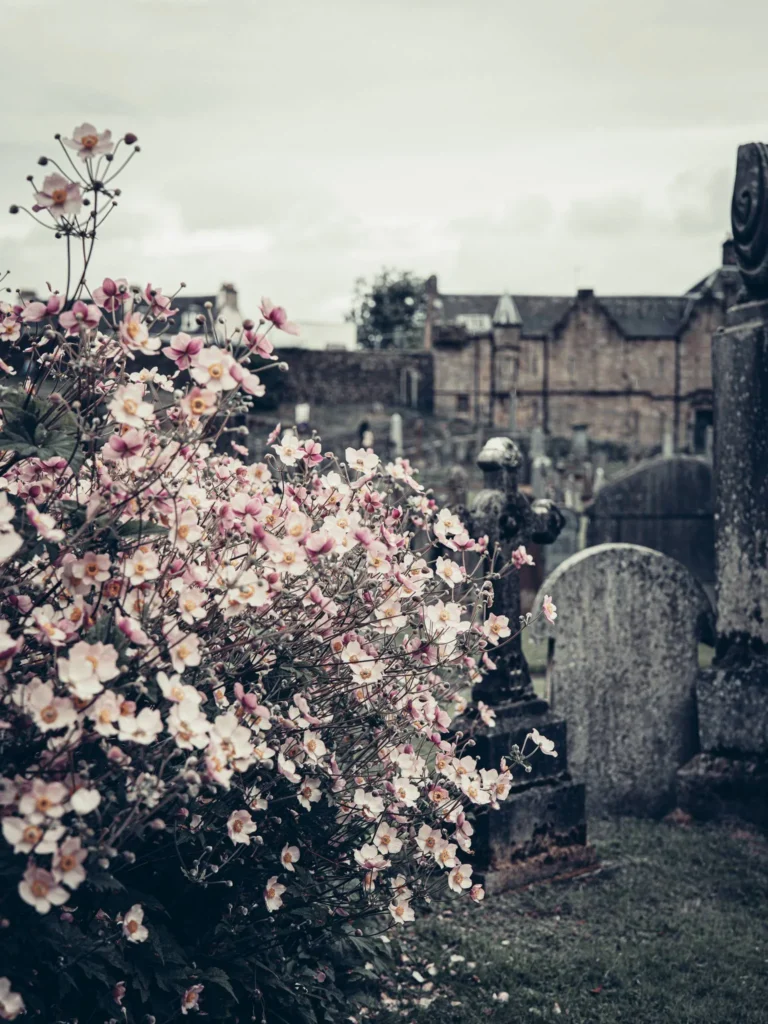
One detail that pleasantly contradicts the mood: in the middle of all this, clumps of Japanese anemones in full flower, pink and white, growing freely against the stones. A Scottish kirkyard in August is not grey. It is green, and in places it is in bloom.
There are two burial grounds here, in fact
A distinction that occupied us for a while, because on site you do not grasp it straight away. What we call “the Holy Rude graveyard” is really two adjoining burial grounds. The old kirkyard, the one pressed against the church, where the grass has genuinely won. And below it, a wide spread of orderly rows with laid-out paths: that is not the same place.
The lower one is the Valley Cemetery, opened in 1857-58 because the church kirkyard had become so full that old graves were being disturbed to dig new ones. It was deliberately laid out as an ornamental garden, in the Victorian gardenesque style, with its monuments, its Star Pyramid and its Martyrs’ Monument. Together the two are now known as the Old Town Cemetery. Which explains why, in the space of a few strides, you go from romantic chaos to Victorian order.

The real advice: go to the bench right at the back
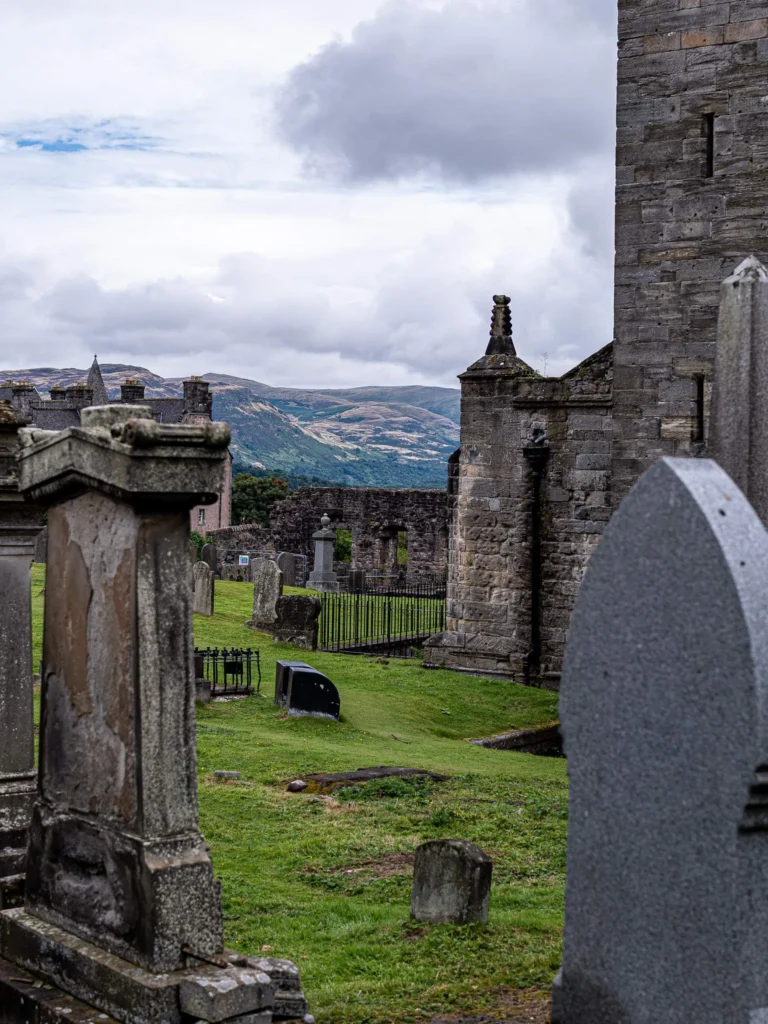
If you take only one thing from this page, take this. Do not just cut across the first rows of graves towards the castle. Keep going, climb, get right to the far end of the graveyard. There is a rocky mound up there with a small bench on top, and a view over the valley and the Ochil Hills that is worth the climb on its own.
And we found out afterwards that we had not invented it. The mound has a name: it is Ladies’ Rock. It was the vantage point from which the ladies of the court watched the tournaments held in the valley below, between the church and the castle. We climbed it because it was steep and we wanted to see further. Five centuries earlier, they climbed it for exactly the same reason.
Then there is the irony of the place, which we noticed while adding to it. It is hard to claim the dead rest in peace here, given the number of people crossing, stopping, framing and taking photographs. Ourselves included, obviously. Some of the residents must end up, entirely against their will, in a truly unreasonable number of Instagram photos.
And then Xavier summed it up his own way, standing in front of the view: “I reckon there are people who would be willing to die just to come and spend eternity in this graveyard. No, really: to lose their life, for the chance to spend eternity up here.”


Who this is for
- Anyone heading up to the castle: it is literally on the way, between the old town and the entrance to the site. Zero detour, and it breaks the climb in two.
- Anyone who likes old stone: a medieval timber roof still in place in Scotland is not something you run into every day.
- Photographers: the kirkyard in grey weather, castle in the background, is a ready-made backdrop.
- Rather less so if you are travelling with impatient kids, or if you only have an hour in Stirling. In that case, at least do the graveyard. It is free.
And while you are in Stirling
The Holy Rude sits on the same climb as the Settle Inn, the pub that claims to be the oldest in Stirling. It is a few hundred metres back down towards St Mary’s Wynd, and it is exactly the right order: the stones first, the pint afterwards.
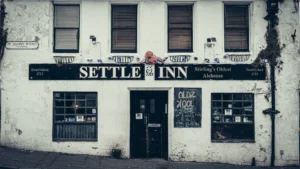
Settle Inn, Stirling’s oldest pub (and the ten seconds we spent wondering what we were doing there)
We walked into this pub wondering whether we were allowed to be there. We walked out being kissed on both cheeks. In between: one hour, two beers, and the kind...
Read moreAnd if you are staying the night, we spent two nights at the Allan Park, at the bottom of the old town, in a listed Georgian building. Eight rooms, and a team we have not forgotten.
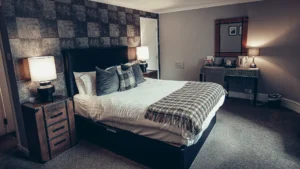
The Allan Park Hotel, the pub-hotel in Stirling where we finally had a proper night.
Our opinion on the Allan Park Hotel, a Georgian gem from 1818 right in the center of Stirling that also serves as a pub and restaurant. Eight rooms, a golden...
Read moreThe rest of the stop, the climb by Spittal Street and St John Street, the old jail, the castle, and what we made of the town coming back four years later, is in our complete Stirling guide.
Practical information
The Church of the Holy Rude: your questions before you head up
Holy Rude or Holyrood: are they the same thing?
It is the same name, and it is exactly the confusion we nearly made ourselves. Rude and rood are two spellings of the same old word for the Cross. The two foundations are near-twins too, both the work of the same king, David I: Holyrood Abbey in Edinburgh in 1128, the Church of the Holy Rude in Stirling in 1129. One year apart. They are two completely separate places, though, around thirty-five miles from one another. Holyrood today means the palace and the Scottish Parliament in Edinburgh. The Holy Rude is the parish church of Stirling.
How long should we allow?
Allow an hour to an hour and a quarter to do it properly. The inside of the church alone took us about forty minutes at our own pace, and the guided tours run 30 to 40 minutes. Then add 20 to 30 minutes for the kirkyard and the climb up to Ladies' Rock, which is the part we very nearly skipped. If you are going straight on to the castle afterwards, be generous: the Holy Rude is the kind of stop that quietly eats a schedule.
Do we need to book, and how do we pay?
No booking is needed for an individual visit, and you pay at the door. All the major cards are taken, with no minimum spend, and cash is fine too. Online booking is mainly there for groups and tour operators. Worth knowing if you are visiting with someone who does not read English: short visitor guides are available at the desk in 88 languages.
Can we visit on a Sunday morning?
No, and it catches people out. On Sundays, visitor access only starts at 12.30pm, because the morning belongs to worship. This is a working parish before it is a visitor attraction. We came by on a Sunday in August and the nave was full, which honestly gives a very different picture of the place than an empty church you cross in silence. One more thing: the Castleview Park and Ride shuttle does not run on Sundays.
And in winter, between November and March?
The church closes to visitors outside its season, which runs from late March to early November. So no timber roof, no stained glass and no choir if you pass through Stirling in January. The kirkyard, on the other hand, stays open all year round and free, and that is already a good half of what makes the place. The parish also keeps holding its Sunday services.
Do we have to pay for the kirkyard too?
No. The ticket only covers the inside of the church. The graveyard, the old kirkyard and the tidier lower part alike, plus Ladies' Rock with its bench and its view over the valley, are all free to walk into. That is our advice to anyone with only an hour in Stirling, or travelling as a group on a tight budget: at the very least do the kirkyard. It costs nothing, and it is where the change of scene is.
Is it accessible with a wheelchair or a pushchair?
Inside the church, yes. The visitor route is level, there are a few steps but ramps are in place. The kirkyard is another matter: it is grass, it slopes, the paths through the old part are uneven, and the climb up to Ladies' Rock is on a dirt track. Doable with an all-terrain buggy and some determination, difficult in a wheelchair.
Where do we park for the Holy Rude?
There is no car park at the church, and that is the weak point of this part of town. There is limited on-street parking nearby, on Spittal Street, St John Street, Broad Street and St Mary's Wynd, and further down on Baker Street and along Upper Castle Hill north of the castle. It fills up fast in summer. The calmest option is still the Castleview Park and Ride, which drops you at the Old Town Jail, two minutes' walk from the entrance. Careful though, it only runs on weekdays. In any case, Stirling's old town is very walkable from the centre.
Are there toilets, a cafe, wifi?
No toilets in the church itself, and the staff will point you to the nearest ones. No cafe on site either, but refreshments are served at Cowane's Hospital, the building directly opposite. There is free wifi, and you can ask at the desk for the password, a small shop selling locally made souvenirs, and dogs on a lead are welcome.
PS: we came up to see a castle. We took a very long time to get there, because we stopped at a church we had not planned on, then in its kirkyard, then on a rock at the back of the kirkyard. That is exactly how our best days go, and exactly why we hardly plan anything any more.