Our review of University of Glasgow
Benefits
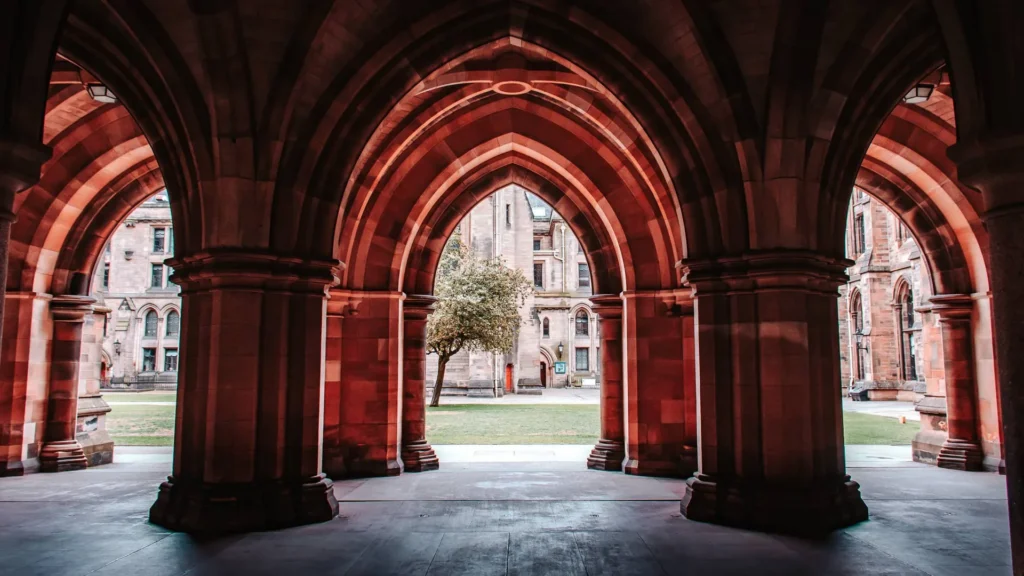
- The vaulted passage of the Cloisters, and the Scottish light shifting under it all day
- Free access to the grounds, and the Hunterian Museum free on campus
- Ten minutes on foot from the West End, right beside Kelvingrove Park
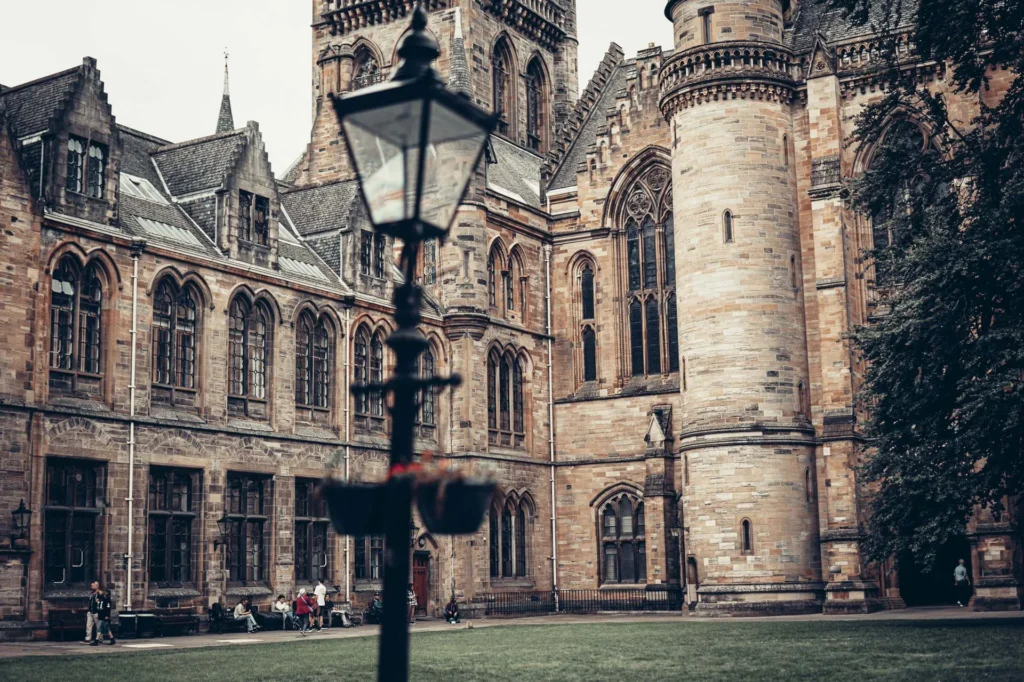
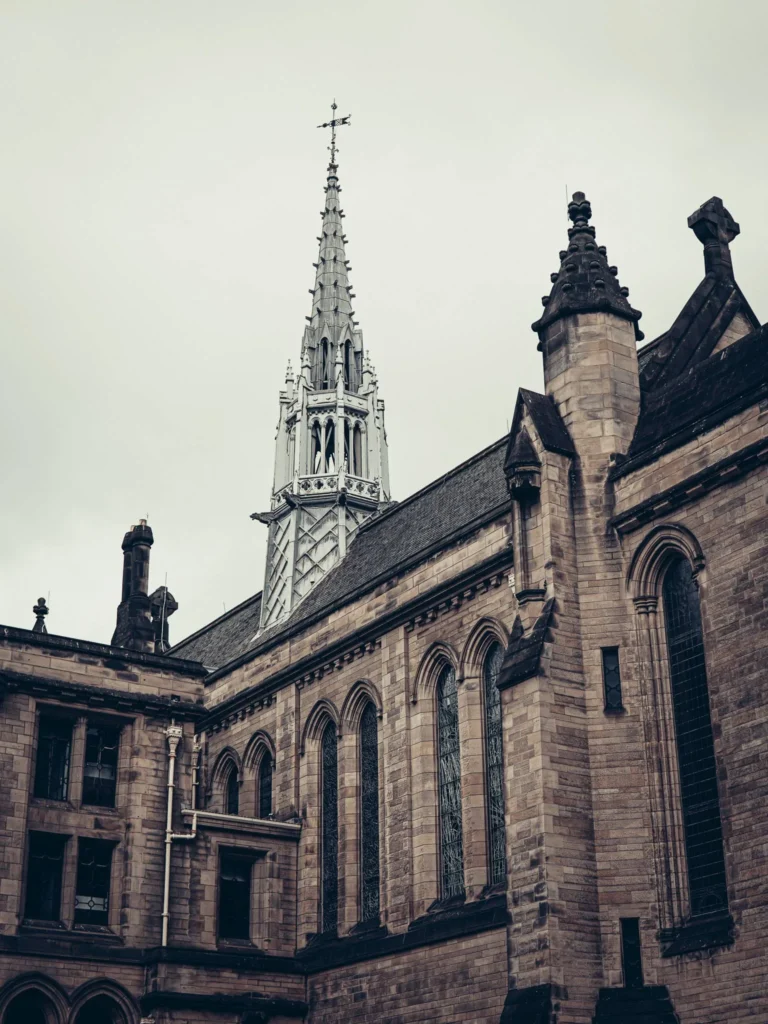
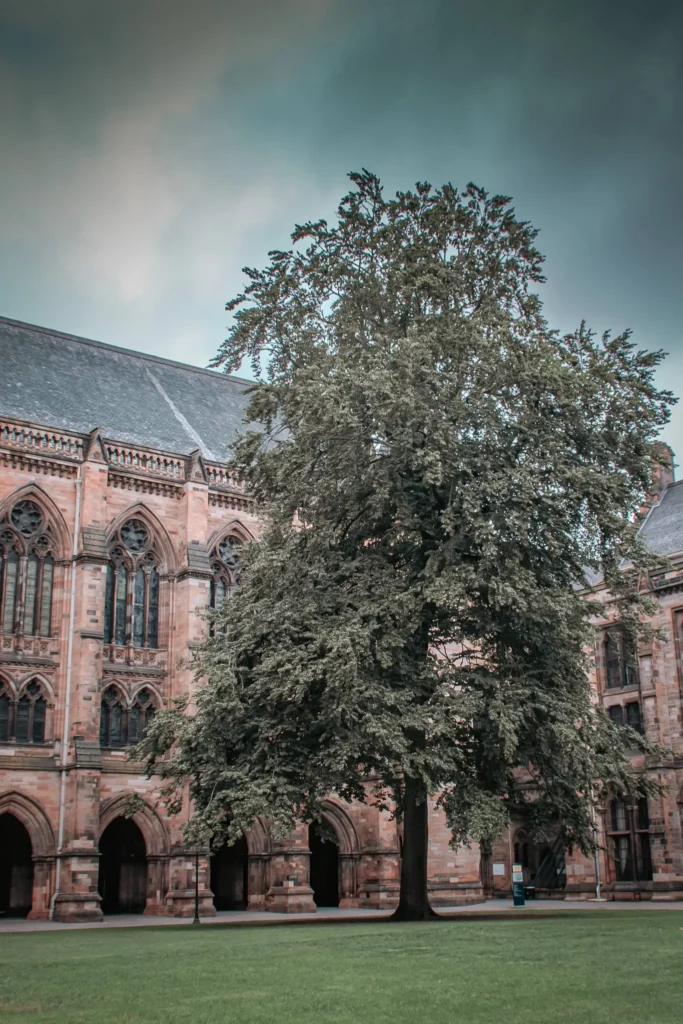
- Massive neo-Gothic architecture, spectacular even under grey skies
Disadvantages
- The visit is essentially outdoors, with no marked route and no rooms to walk through
- An hour on site is enough, it will not fill a day on its own
Who is this place for?
- Anyone who likes neo-Gothic architecture and old stone
- Visitors with one day in Glasgow who want a single big heritage stop
- Photographers and filmmakers, for the light under the arches
The heritage stop not to miss if you only have a day in Glasgow, and the best place in the West End to film Scottish light.
Under the arches the light switches on and off every fifteen seconds. It is the Glasgow weather holding the switch, and we just stood there, doing nothing but watching the rays go past.
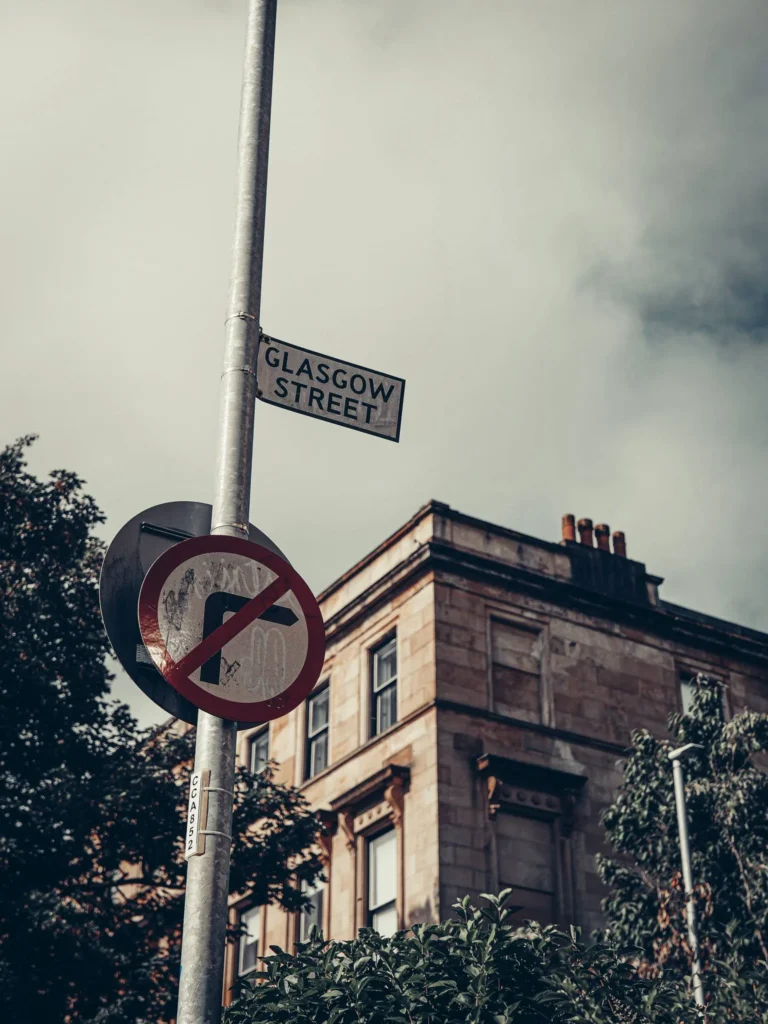
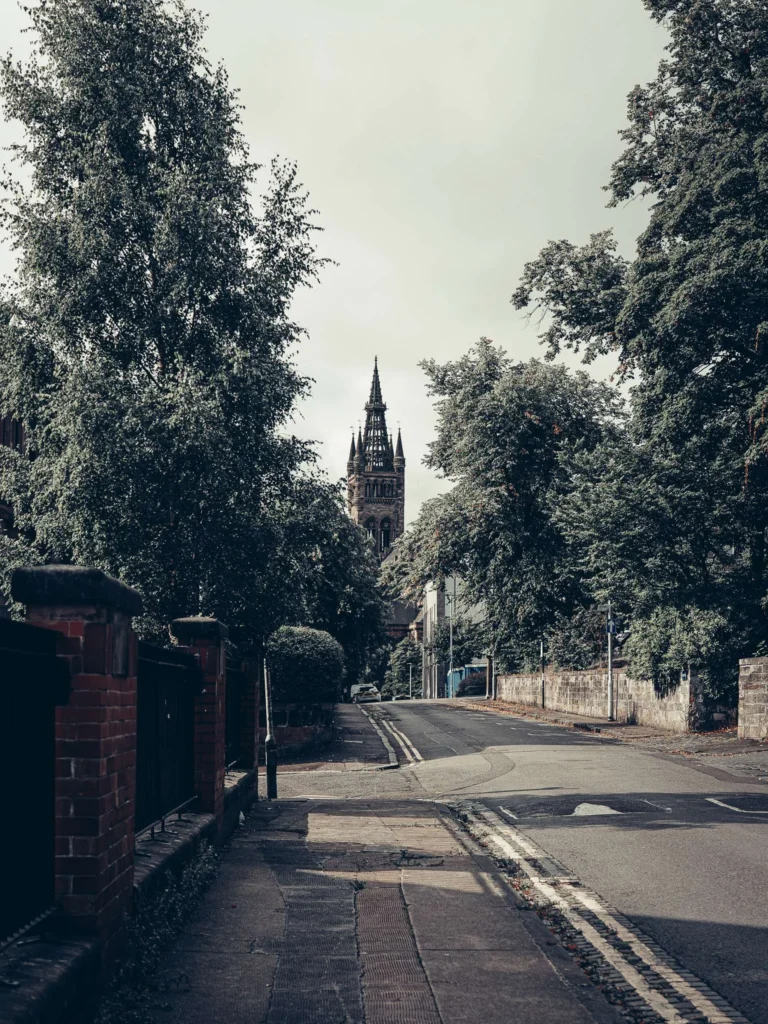
Right, back to the beginning, because I always start at the end. We left the hotel ten minutes early, unhurried, with no particular plan. That is the West End for you: you walk up a street of slightly grey sandstone, lined with trees, bay windows everywhere, you look up at the far end and there is a tower rising above the trees that very clearly reads as a cathedral. Except it is not. It is a university.
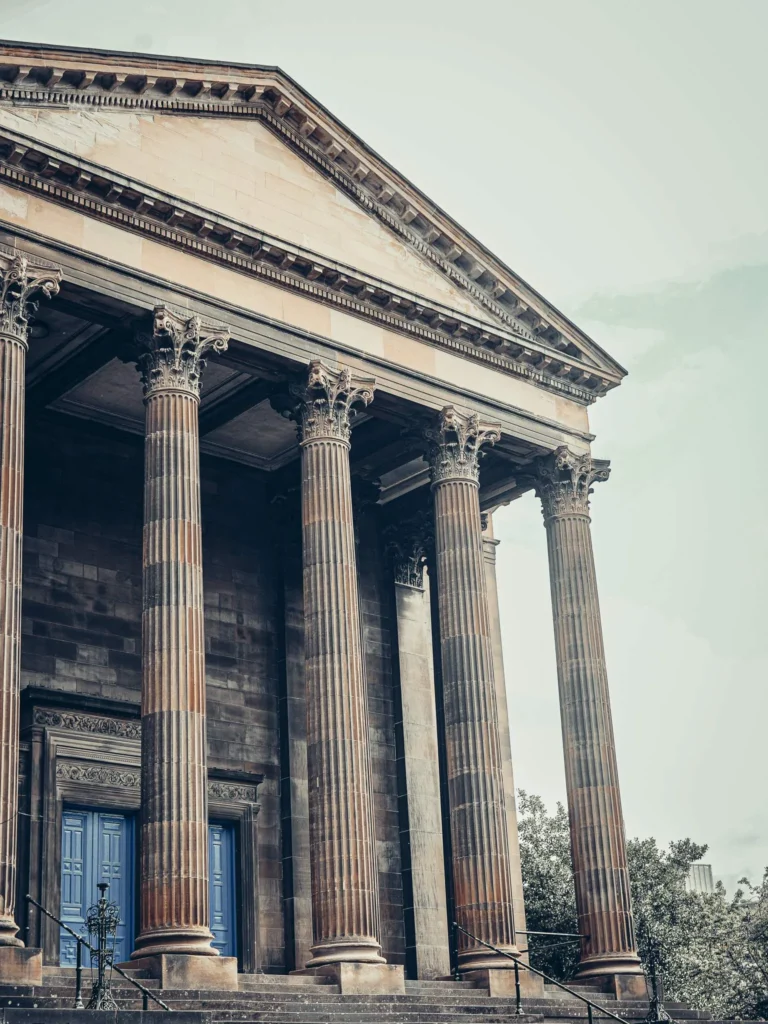
A university that takes up all the space, straight away
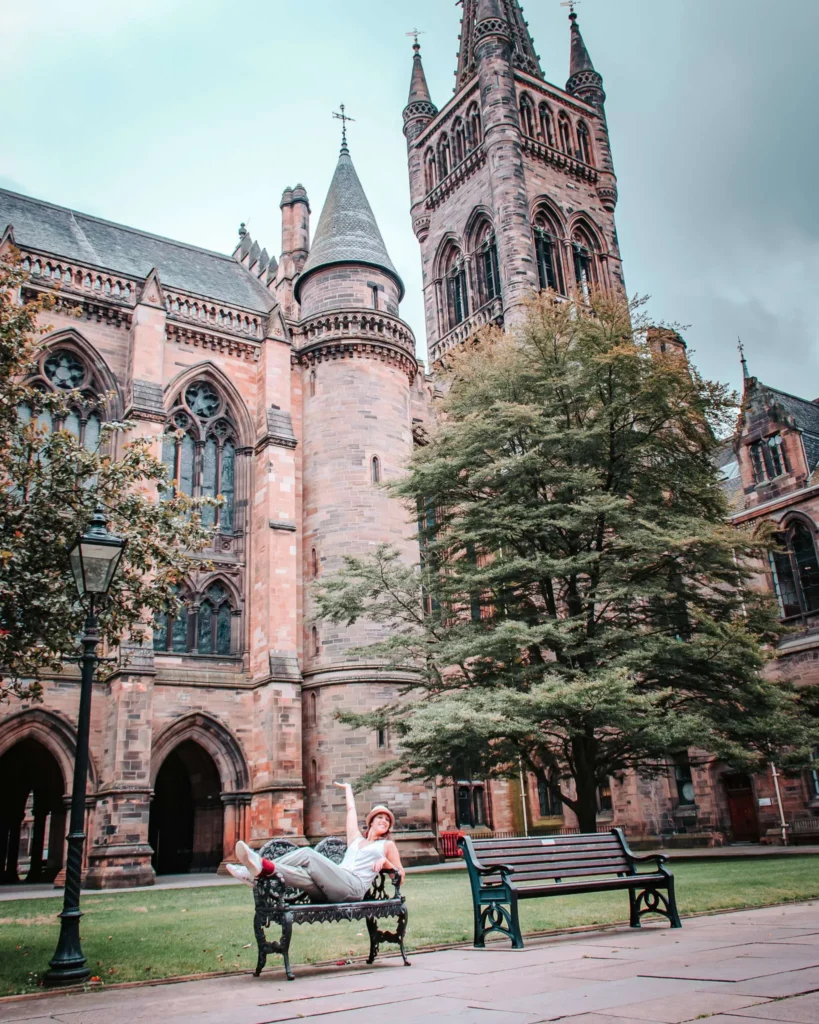
What hits you on arrival, before the architecture even, is the sheer size. This is not a handsome old building sitting at the end of a lawn, these are facades that seem to run on forever, cut stone stacked to a height that has you taking three steps back to try to fit it in frame (spoiler: it does not fit, I tried a good ten times). And that is where it lands on you, what people were able to build back then, with no cranes and no anything.
What I felt walking up was that we were standing in front of a serious university. Not the local uni, something that matters to the city and probably well beyond it. I am telling you this as I felt it, having done no reading at the time, purely from the presence of the campus, which puts the idea in your head inside thirty seconds. It was founded in 1451, and honestly, you feel it before you know it.
And for once the hunch held up. The university was created on 7 January 1451 by a papal bull from Pope Nicholas V, obtained by Bishop William Turnbull at the request of King James II of Scotland. That makes it the fourth oldest university in the English-speaking world, behind Oxford, Cambridge and St Andrews, and one of Scotland’s four ancient universities. So no, it was not just a tourist being impressed by big stones.
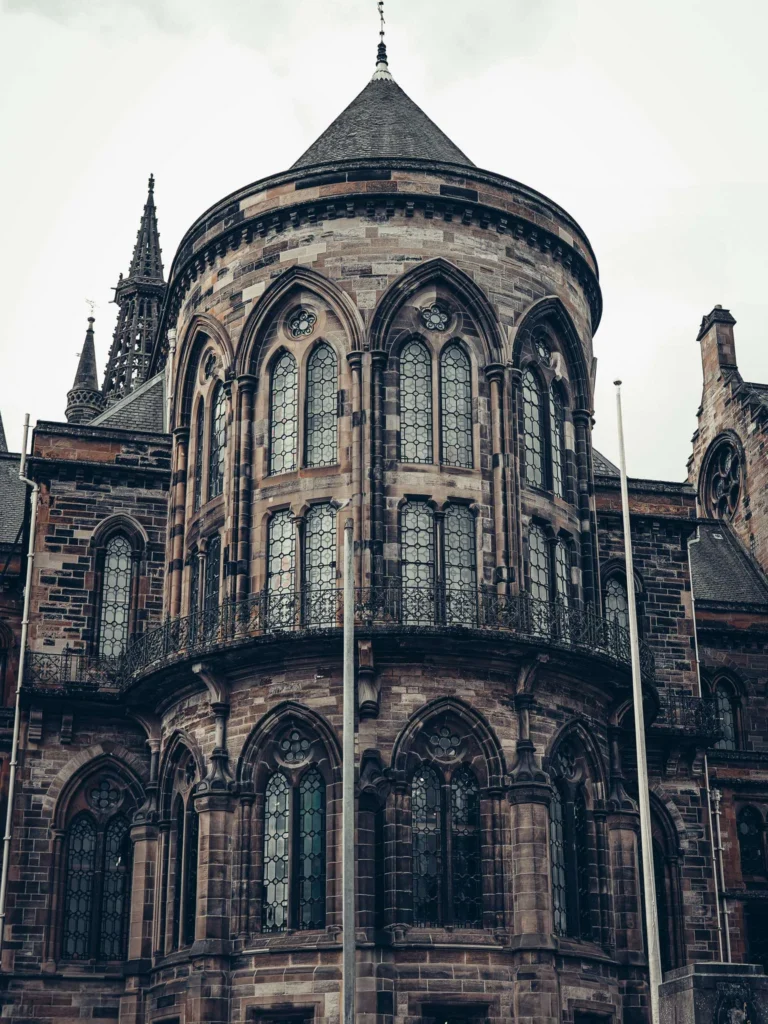
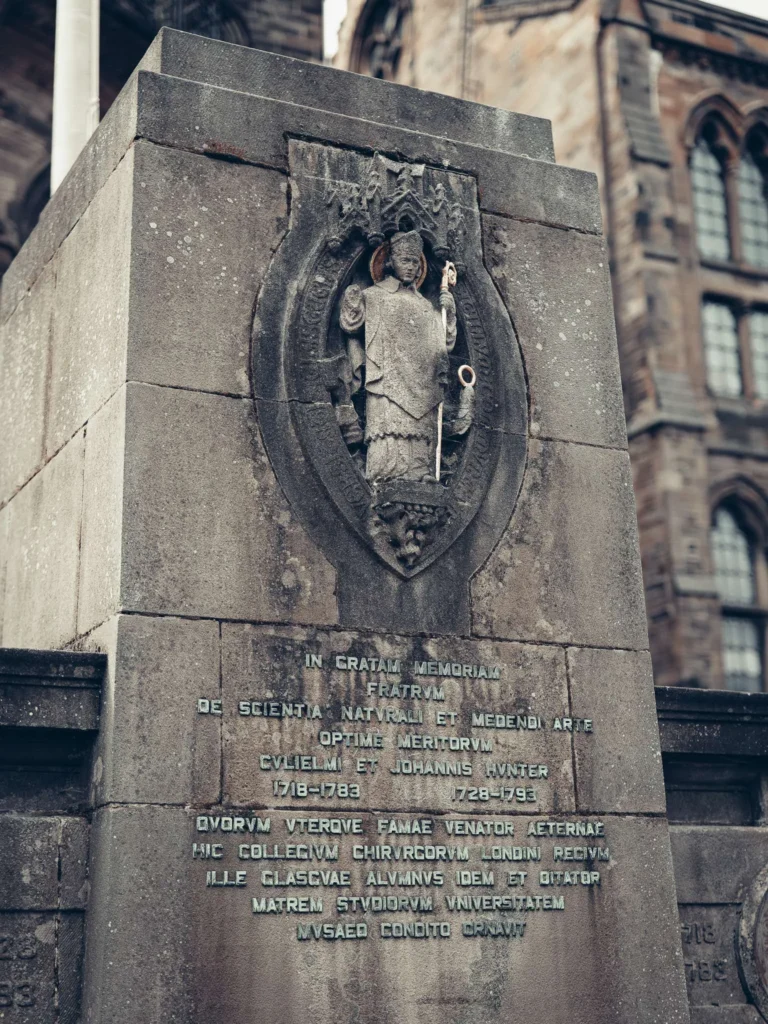
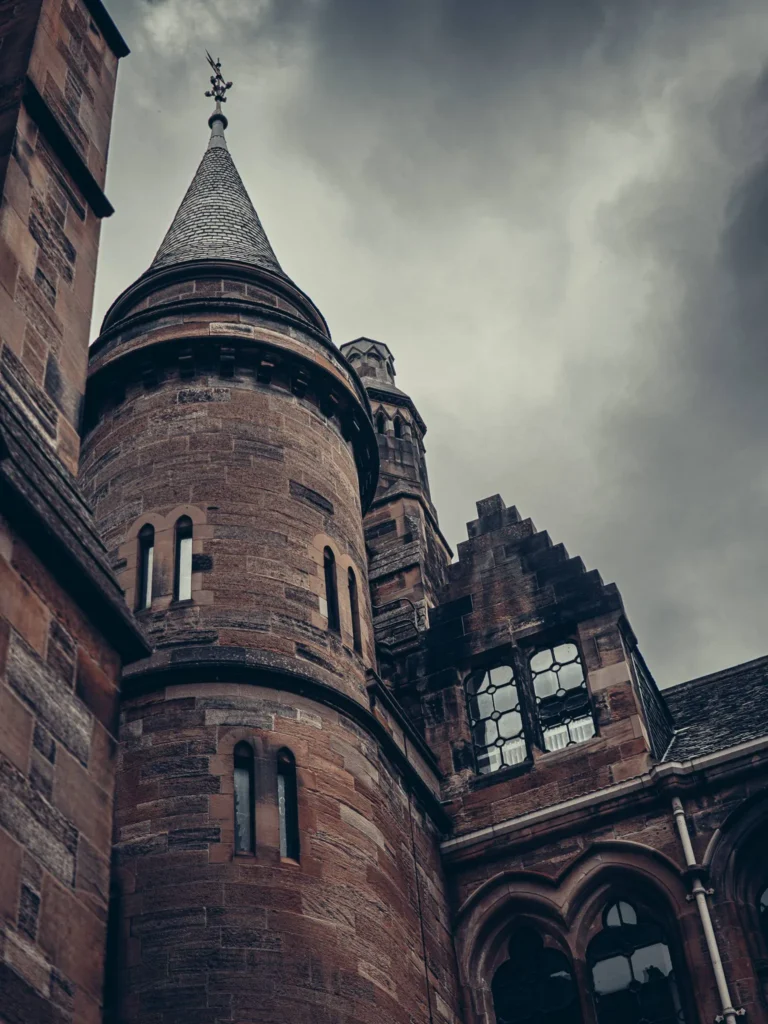
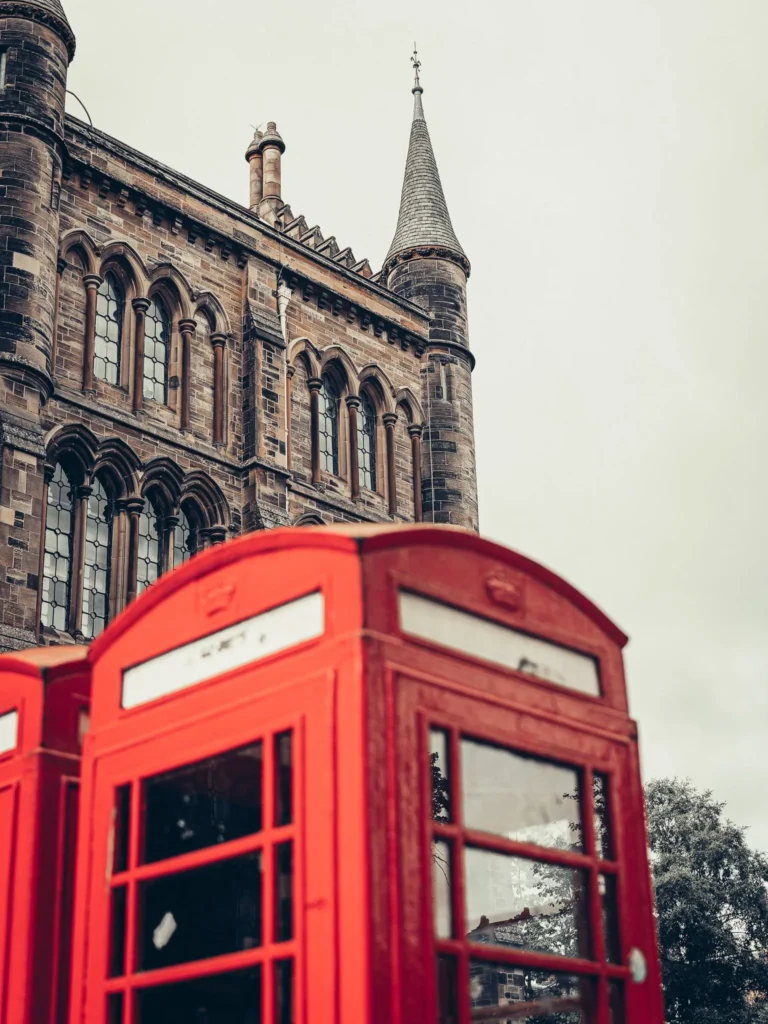
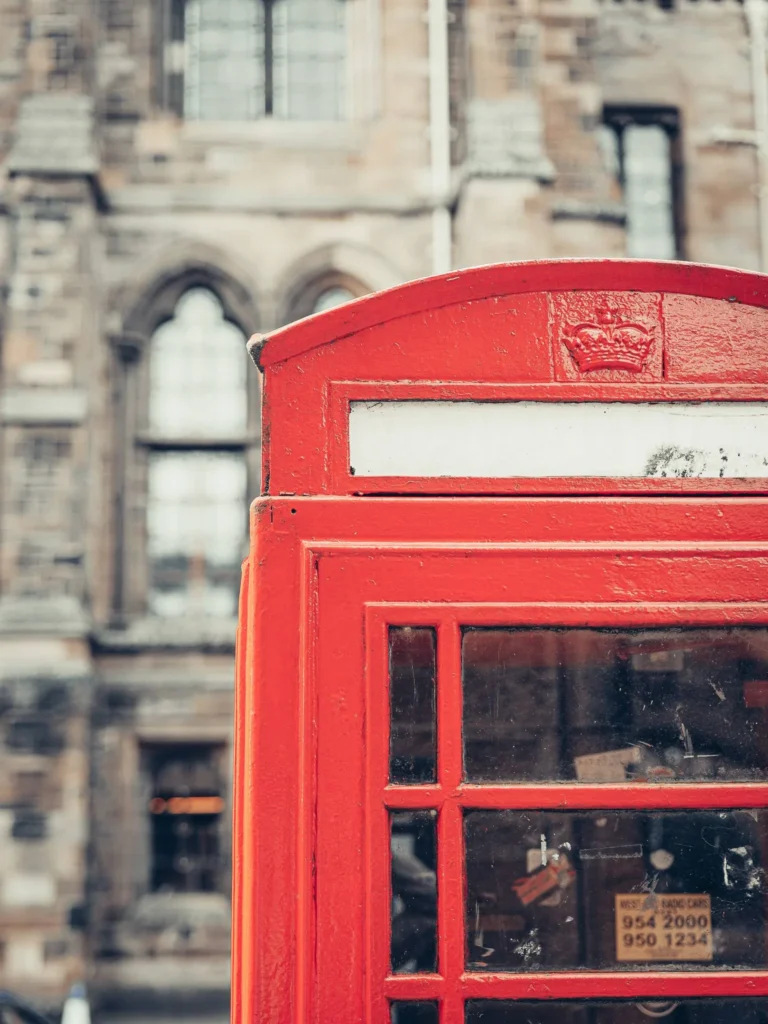
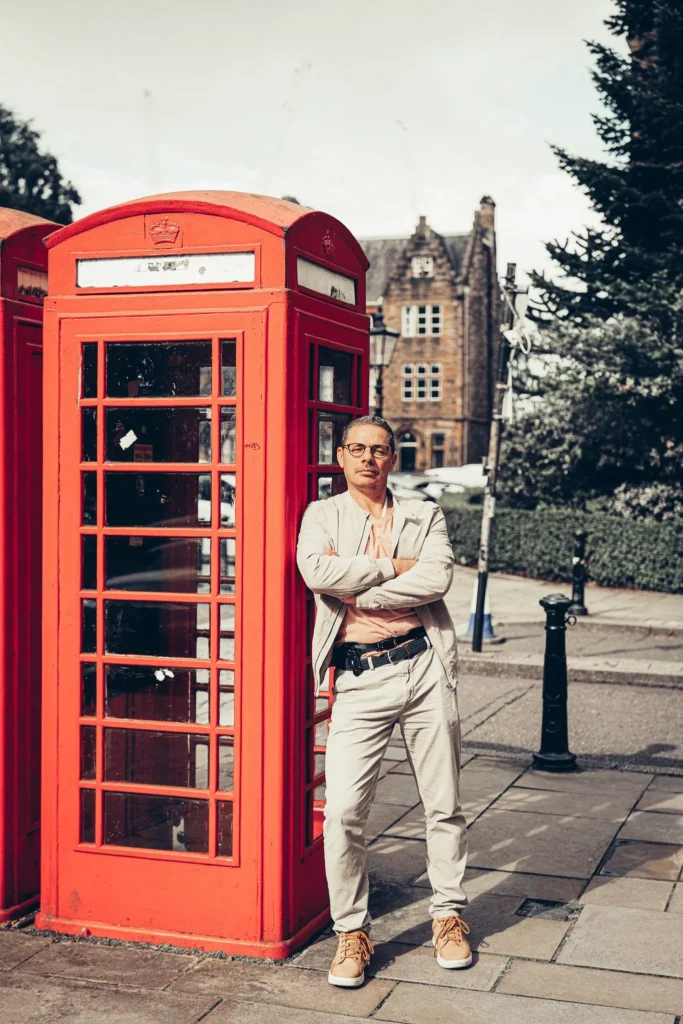
The red phone boxes in front of the facade (we could not resist)
Yes, it is the absolute cliche, we know. There is a row of red phone boxes right in front of the facade and of course we stopped, and of course the camera came out, and of course we took the photo. Caroline first, me next, one at a time, neo-Gothic tower behind and the face of someone who just happened to be passing (nobody is fooled, me least of all).
What is funny is that the red of those boxes is about the only bright colour in the whole scene. Everything else is stone, grey, pale brown, heavy sky. We had come up from Portugal with our eyes used to whitewashed houses and coloured bands round the windows, and here every bit of colour reads ten times louder than it would anywhere else.

Somewhere between the cathedral and the university
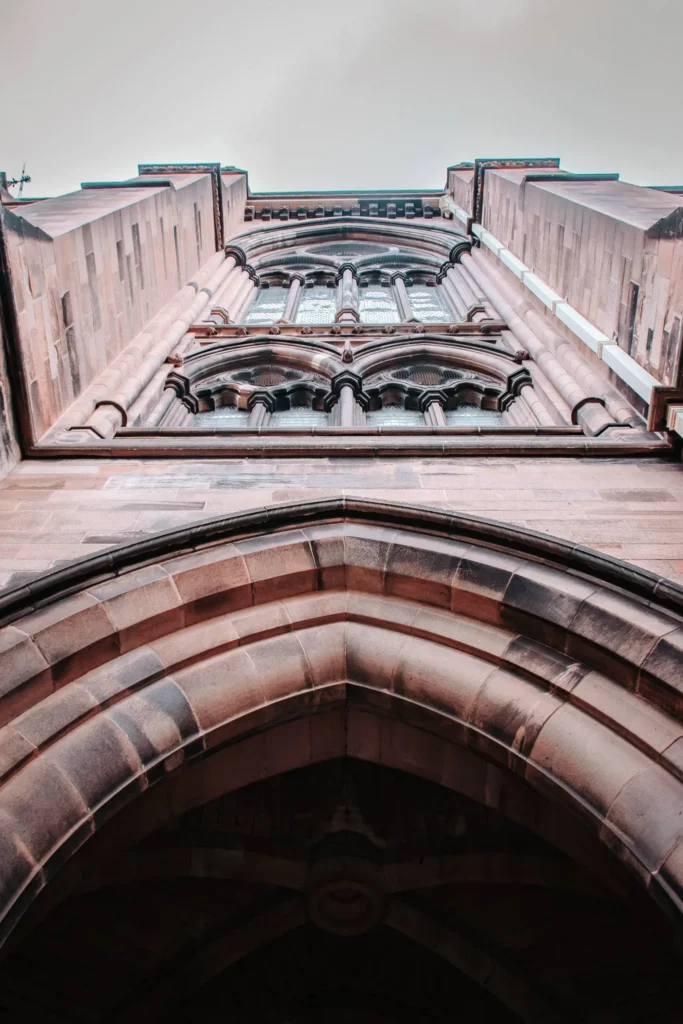
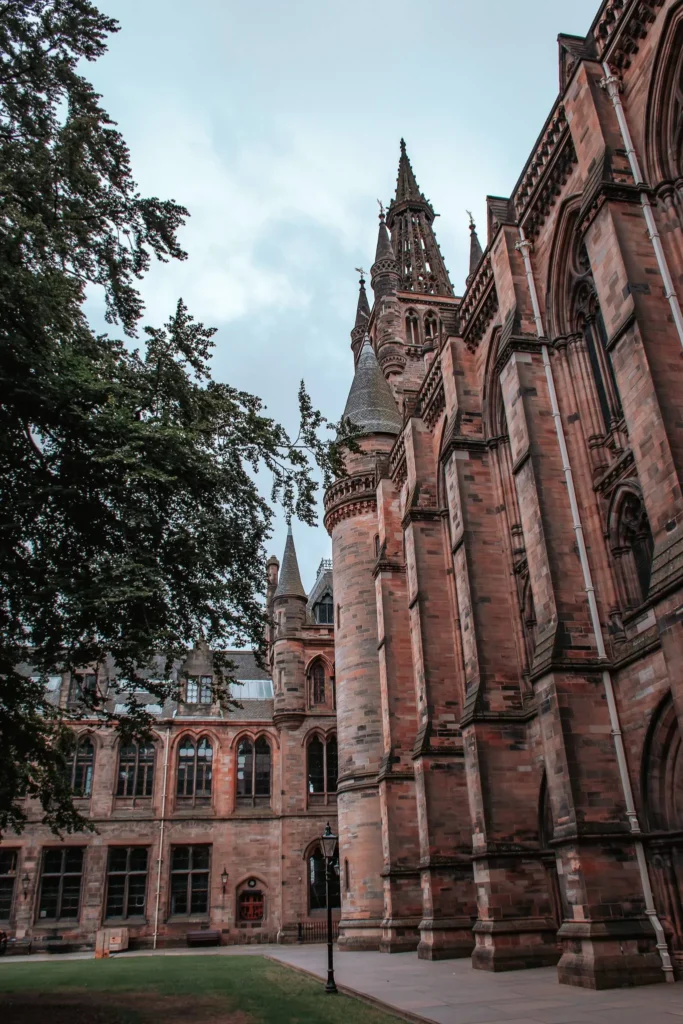
It is the phrase that came out on the spot and I have not found a better one since: you are somewhere between a cathedral and a university. The big pointed arches, the stained glass, the turrets, a spire topped with a cross, the verticality of the whole thing, it all says place of worship, and yet this is where people sit their exams. The mix genuinely throws you, and it is probably what makes the place so photogenic.
Except here is the good bit, which I did not know when I said it: the feeling is not a visitor’s fancy. The university literally came out of the cathedral. The first classes were held in the chapter house of Glasgow Cathedral, a handful of masters and about thirty students, before the whole thing moved to Rottenrow and then to High Street. So when I say we are between the cathedral and the university, we are in fact standing exactly where the two were one and the same.
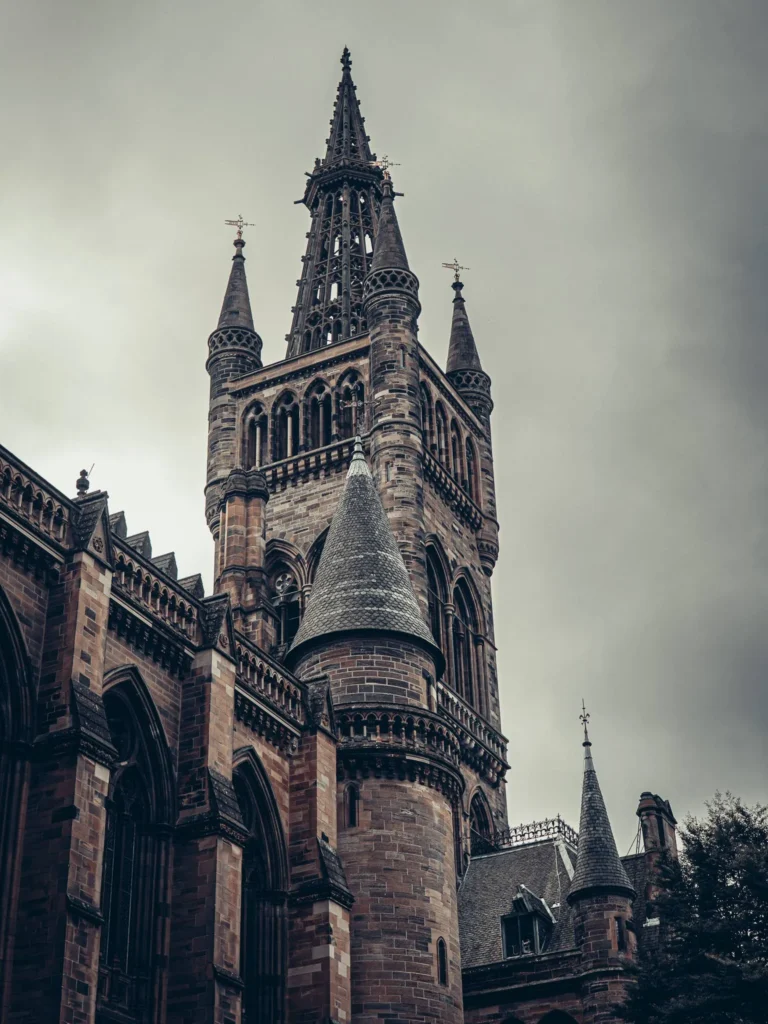
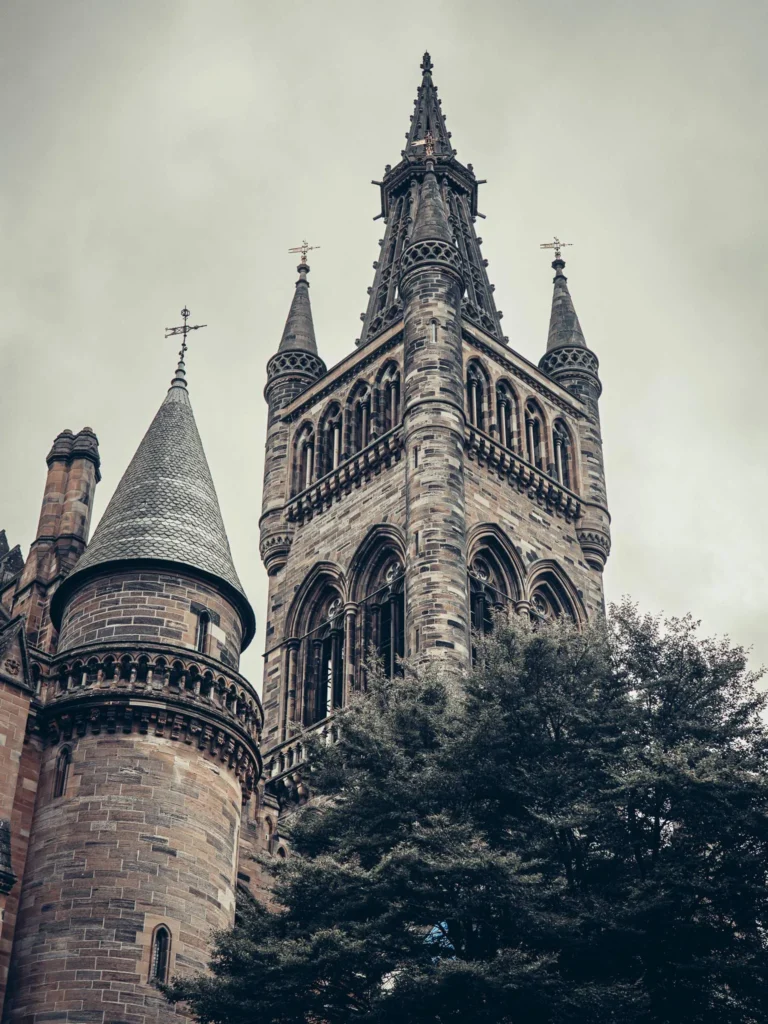
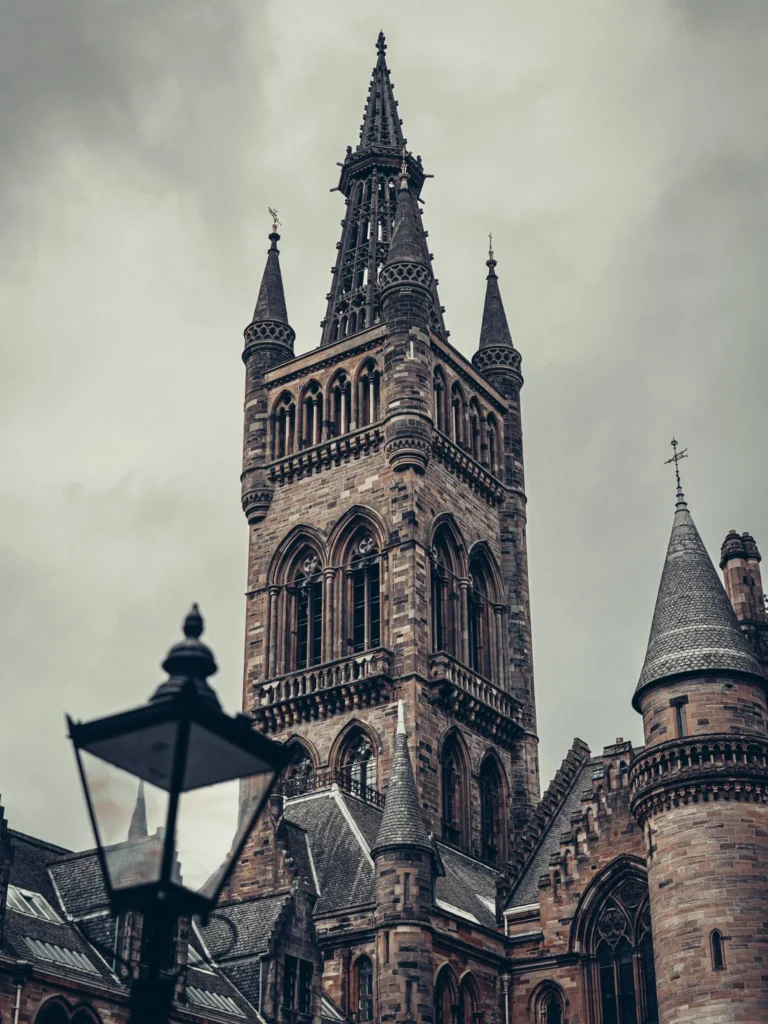
Technically, the heart of what you are looking at is the Main Building and the Bute Hall, late Victorian neo-Gothic by George Gilbert Scott. Which means the building is a great deal younger than the university: roughly four centuries younger than the institution whose walls you are photographing. That takes nothing away, it just explains why it all looks so much of a piece.
Scott died in 1878 without seeing the end of it, and it was his son John Oldrid Scott who finished the work: the Bute Hall, the Cloisters, and above all the tower, completed between 1887 and 1891, with its four turrets and its openwork stone spire. The father had drawn a much heavier clock tower, the son made it lighter, and on this occasion the son was right.
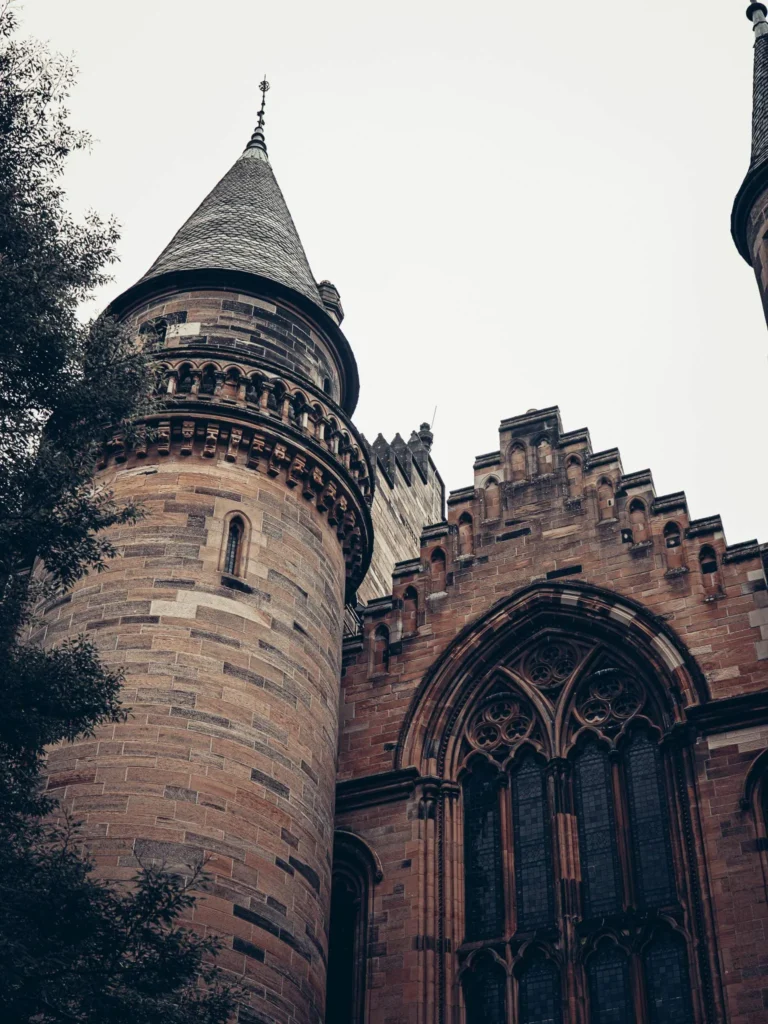
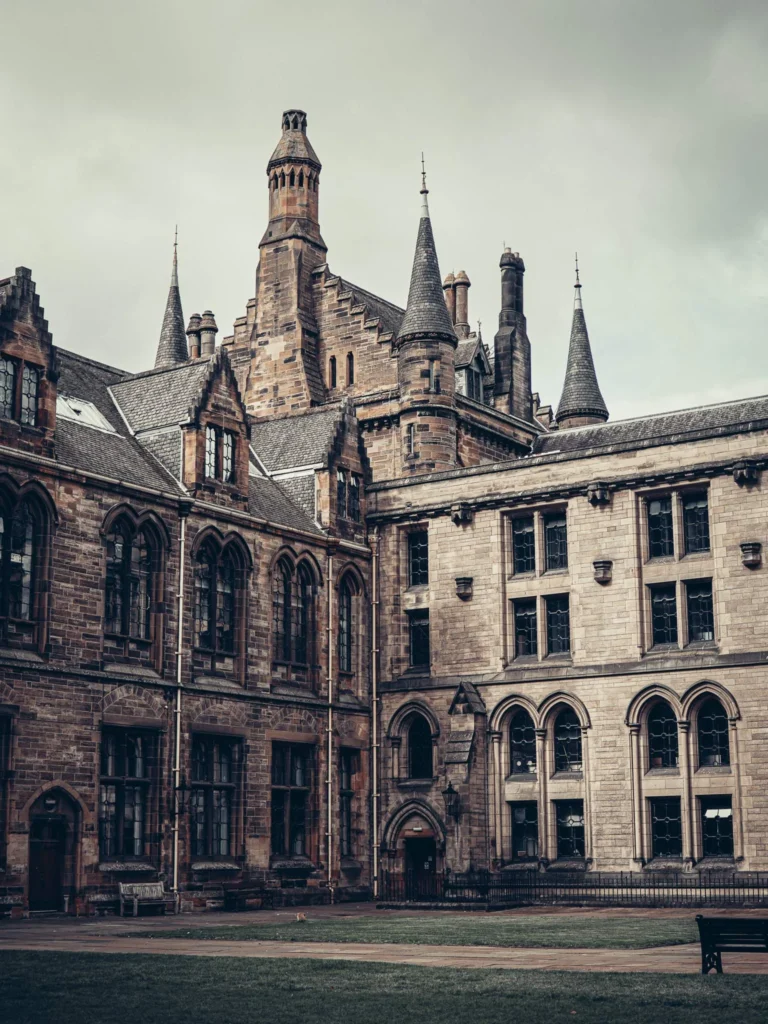
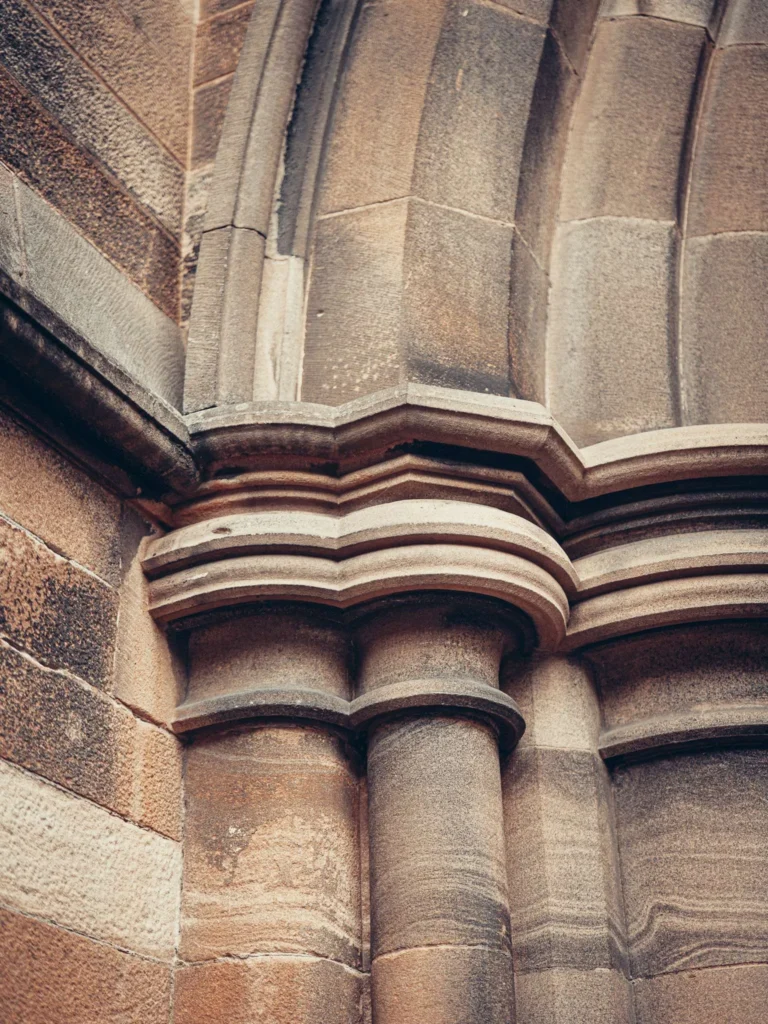
And then there is the stone itself. A good part of Glasgow’s built heritage is sandstone, blond, grey or red depending on the district, and it is that material that gives the city its very strong mineral character. It is austere, it is serious, it is not ugly, it is different, and the university is probably the most spectacular example of it in the city.
They moved the university, staircase included
Here is the thing I had no idea about, and it changed the way I look at the place: this is not the original campus. The university stayed on High Street, over on the old town side, from the 1460s until 1870. Then the land was sold to a railway company, the City of Glasgow Union Railway, to build a goods station.
You read that correctly. A university complex several centuries old was demolished to make way for a goods yard, and it now counts as one of the city’s greatest architectural losses. With the money from the sale the university bought Gilmorehill, at the time a green hill two miles west. Hence the West End, hence the park next door, hence the whole geography of the walk we are on.
They did not leave everything behind, though, and this is the part that gets you. They took down the Lion and Unicorn Staircase, whose figures were commissioned in 1690 from a mason called William Riddel, and carted it here stone by stone to rebuild it by hand on the new site. Same for part of the old High Street gatehouse, re-erected here as Pearce Lodge. So if you are looking for something on this campus that is genuinely as old as it looks, that is exactly where to go.
The Cloisters, and the famous switch
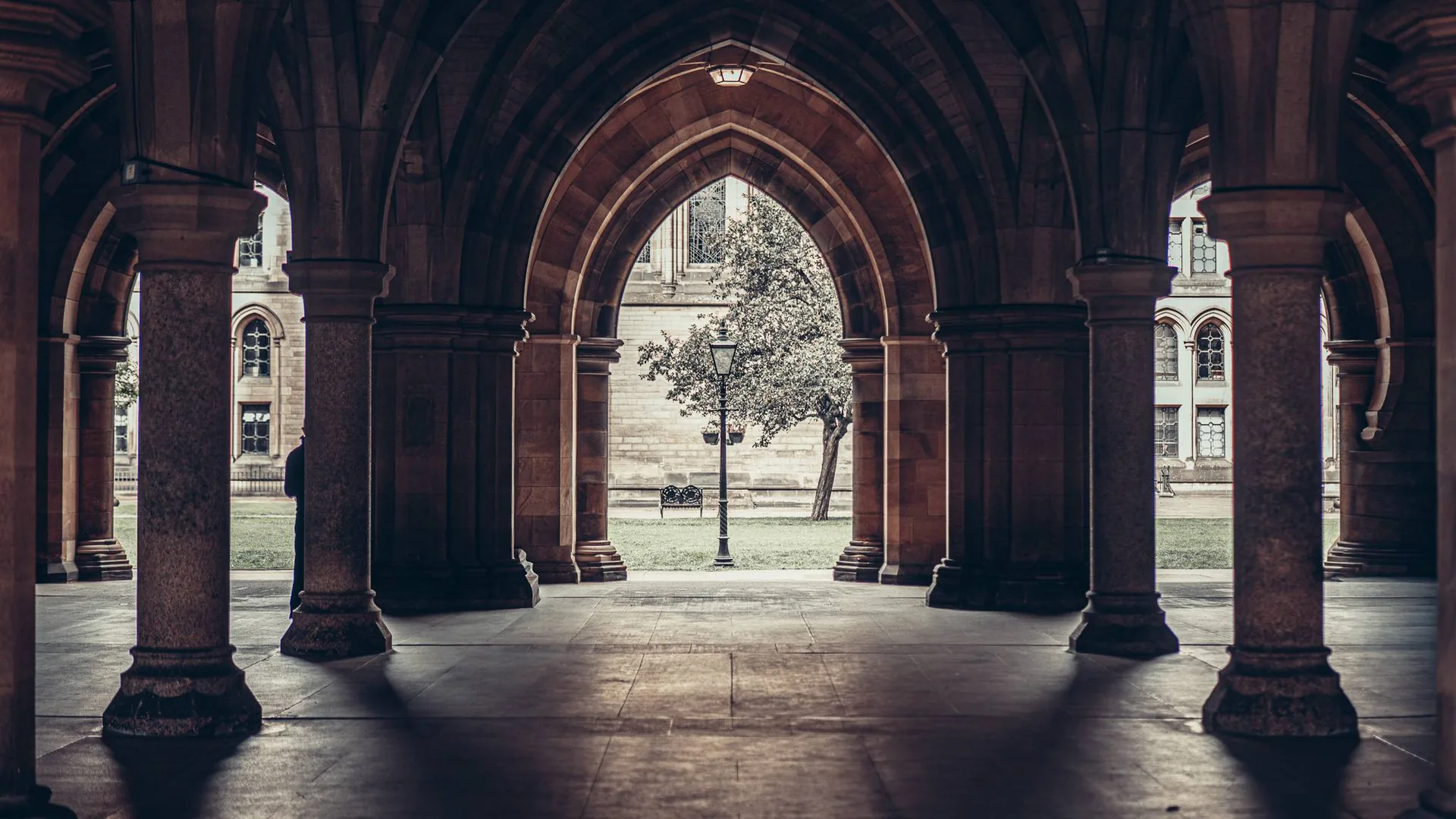
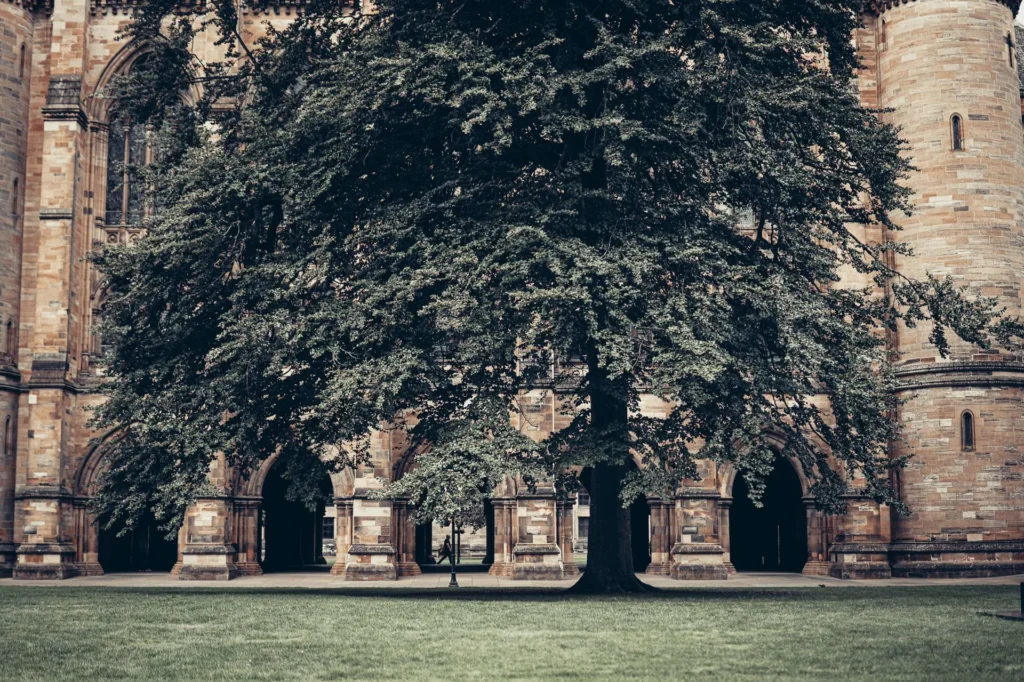
So, back to that. There are two quads, and between them a vaulted passage running under the building. It is called the Cloisters, or the Undercroft depending on who is telling you, and it is far and away the best thing on campus. You stand in the shade under the arches and on either side the light from the two quads comes through the openings. It is the sort of place where you understand immediately why it gets photographed over and over.
And the technical explanation pleased me, because it matches exactly what you feel standing there. This is not a decorative cloister: it is an undercroft, an open structure holding up the Bute Hall built directly above it (the big hall used for exams and graduations, funded by the 3rd Marquess of Bute, hence the name). Put another way, the light crossing from one side to the other is not a happy accident. Those arches are not there to look pretty, they are carrying an entire hall on their shoulders while letting the two quads talk to each other.
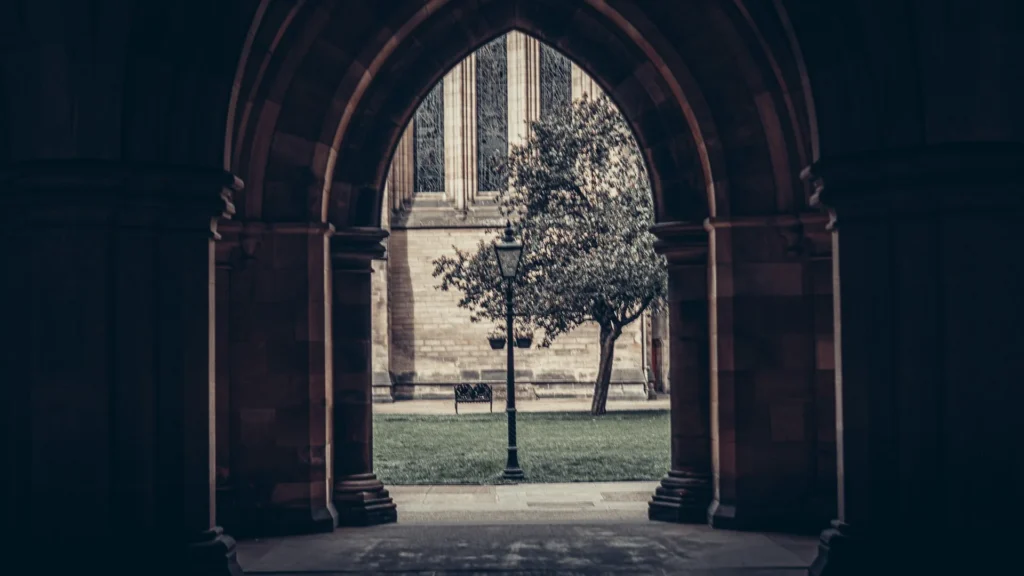
And with Glasgow weather it turns into a proper show. A shaft of light comes through the arches, the stone lights up, everything goes warm, then it is gone, the vault greys over, you wait, and twenty seconds later off it goes again. It feels like the architecture is changing to the rhythm of the sky. For filming, it is probably the best spot in the whole West End: set up a locked-off shot and let the weather do the work.
A small note for those who, like me, spend half the day with a jacket in hand: that play of light and shade looks lovely in photos, but on site it mostly means you need to enjoy taking your jacket off and putting it back on every four seconds. There you go, you now know everything about Scottish weather, class dismissed.
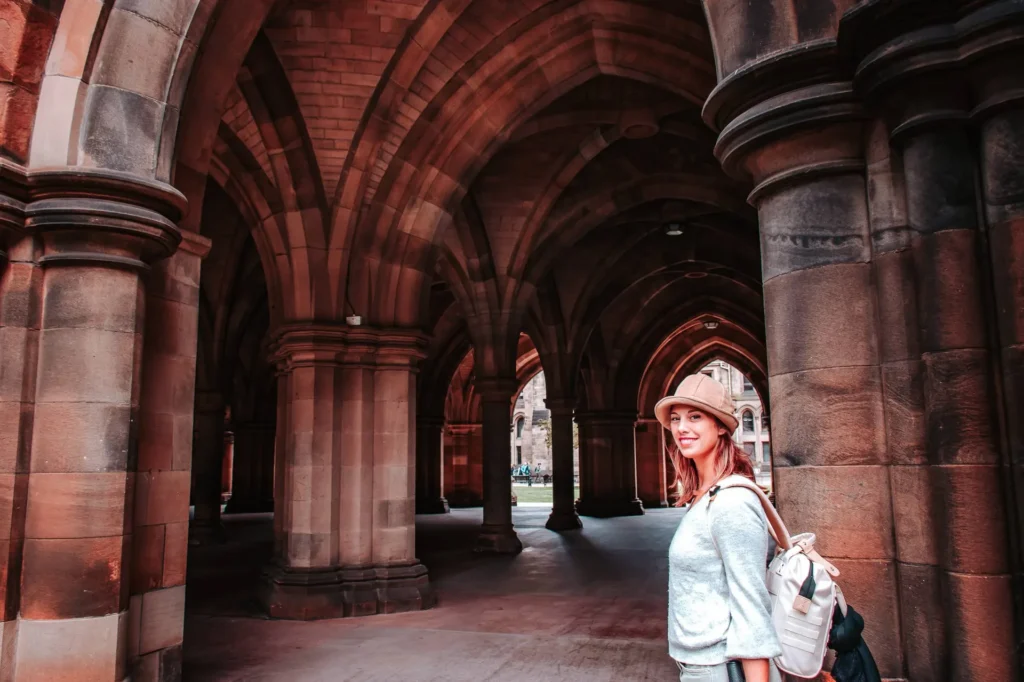
No, Harry Potter was not filmed here
You very likely half know this already, so let us just settle it rather than make a revelation of it. The Glasgow Cloisters are not in Harry Potter. The university says so itself on its own blog: whatever it looks like, Harry Potter was never filmed at the University of Glasgow. The exterior of Hogwarts in the early films is Alnwick Castle, down in Northumberland.
Which is not to say people are imagining things. The neo-Gothic, the two quads, the spire, the vaults, it all slots perfectly into the mental picture of Hogwarts, and that is exactly why the confusion has run for years. Worth knowing before you drive up expecting a film set: nothing here was invented for a camera, it was all built for real, which is arguably better.
The two quads, the benches, and time that does not push you along
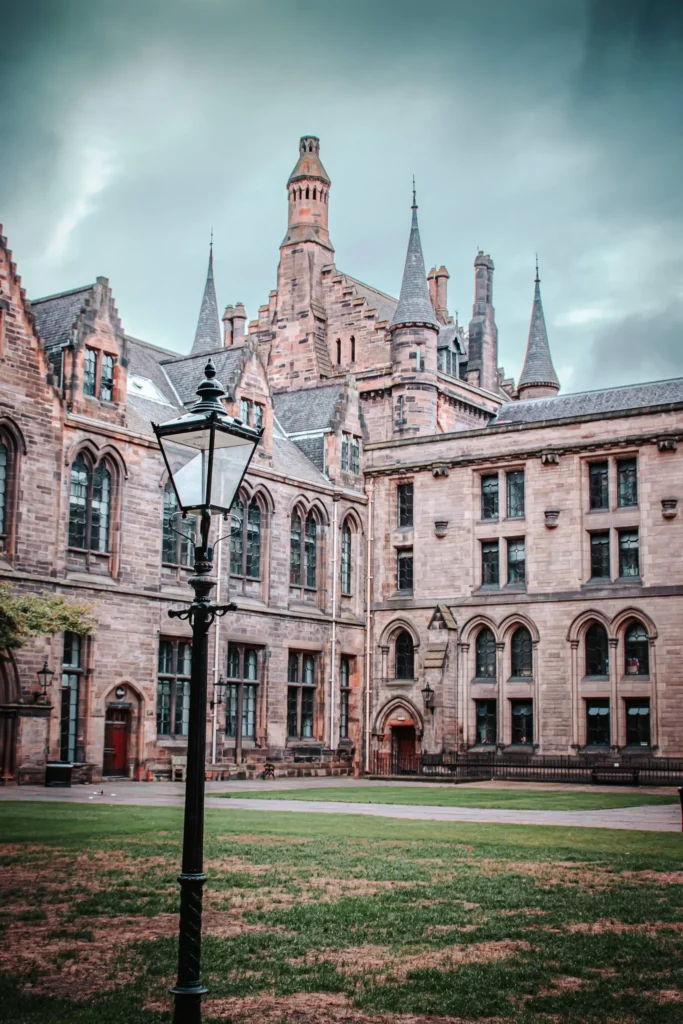
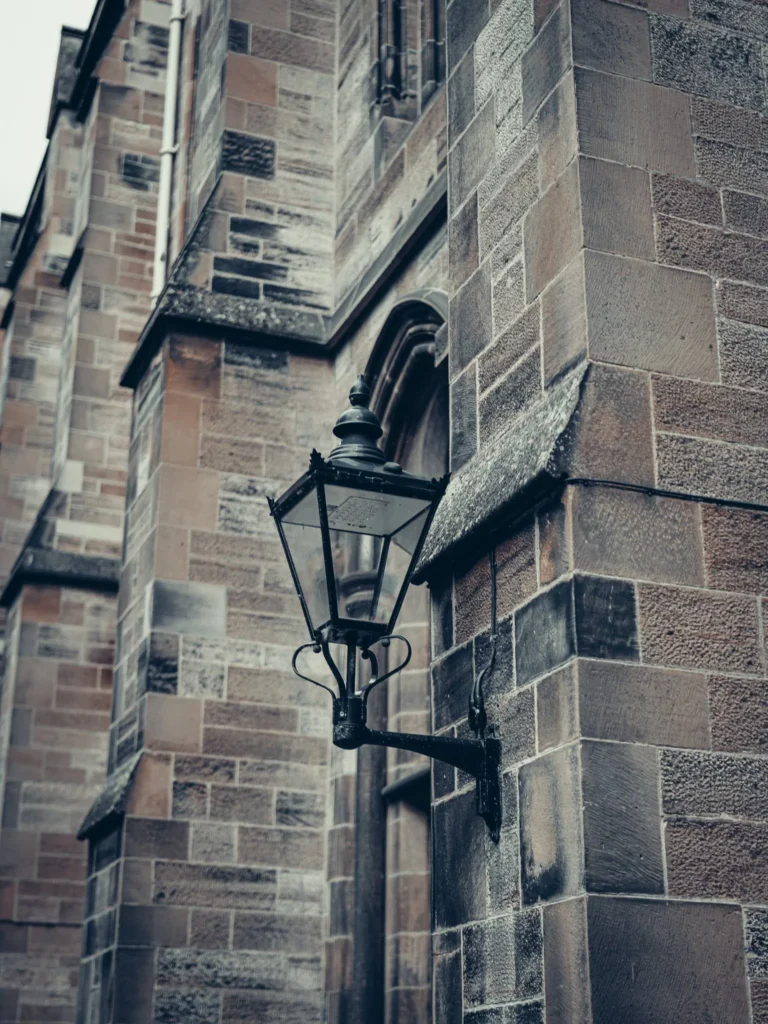
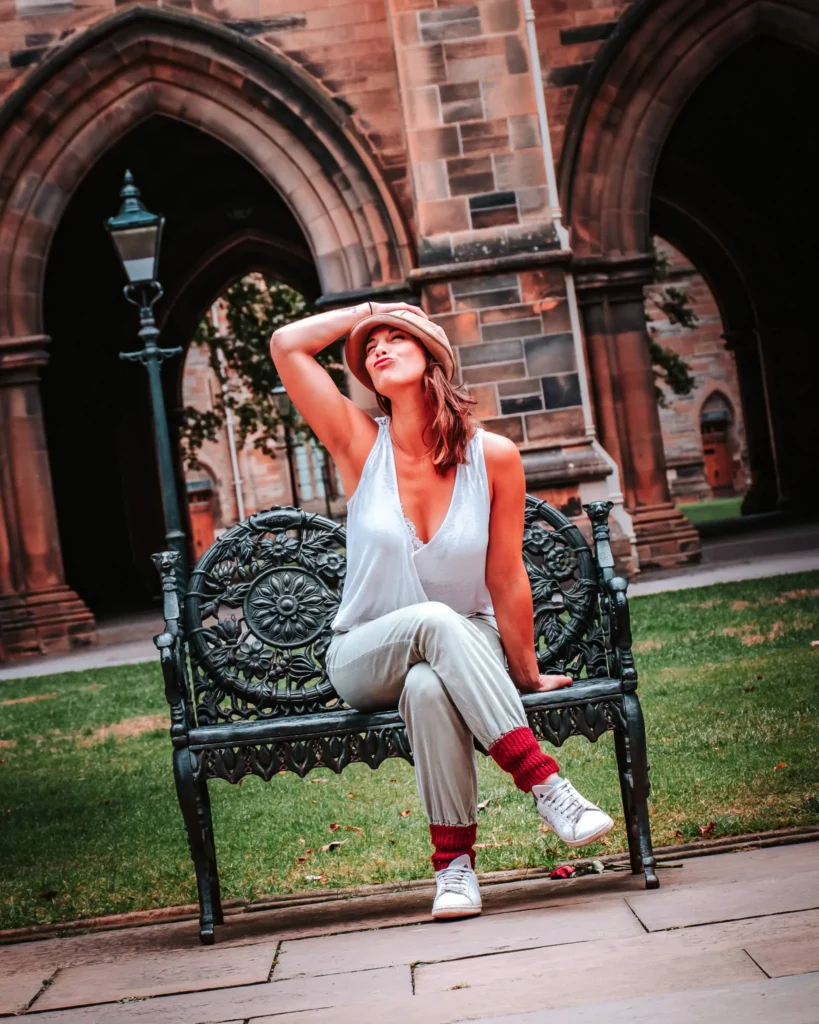
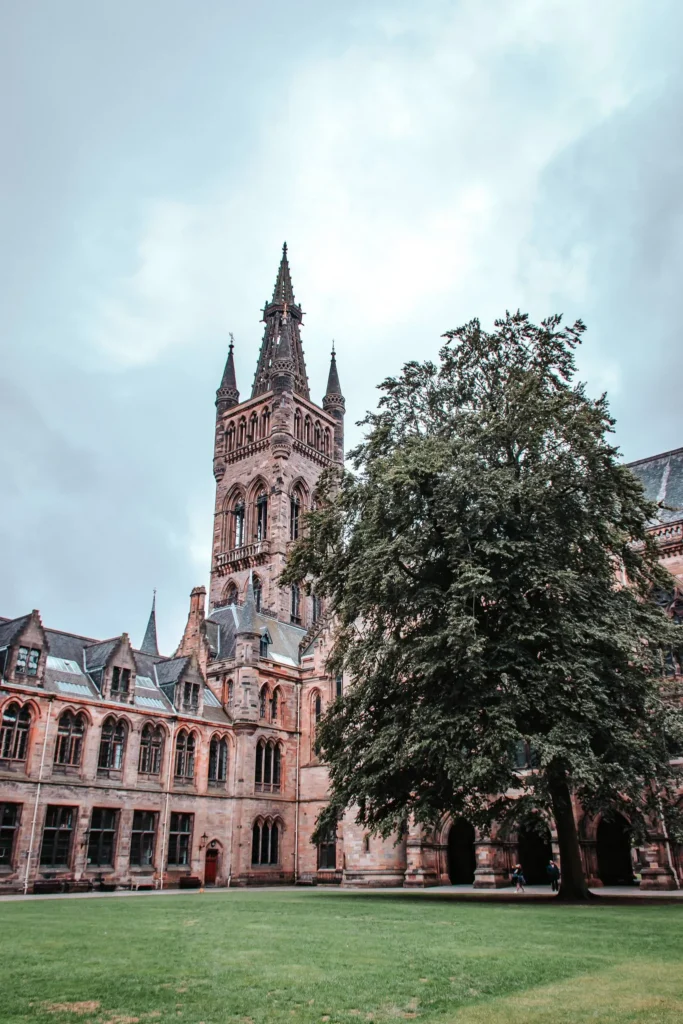
The quads are the other good surprise. Grass, trees, wrought iron benches and wooden ones, old lamp posts, and above all nobody moving you on. We sat down, a bench each, looked at the facades, and stayed there a while doing nothing in particular. Which, in a city, has become a fairly rare luxury.
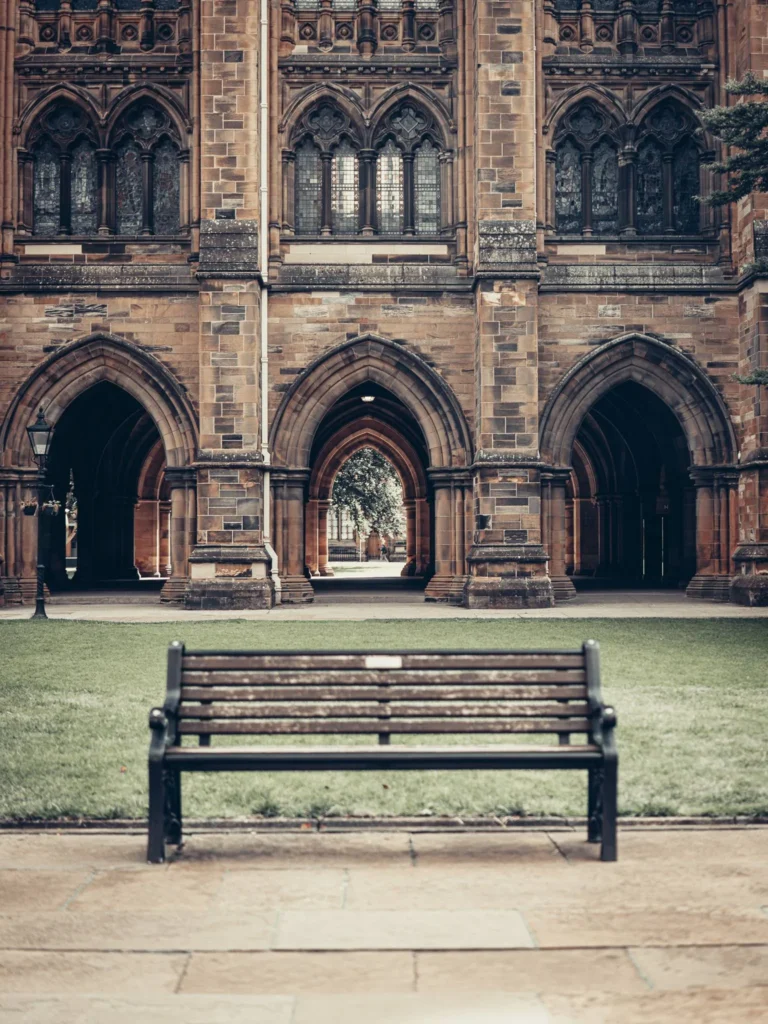
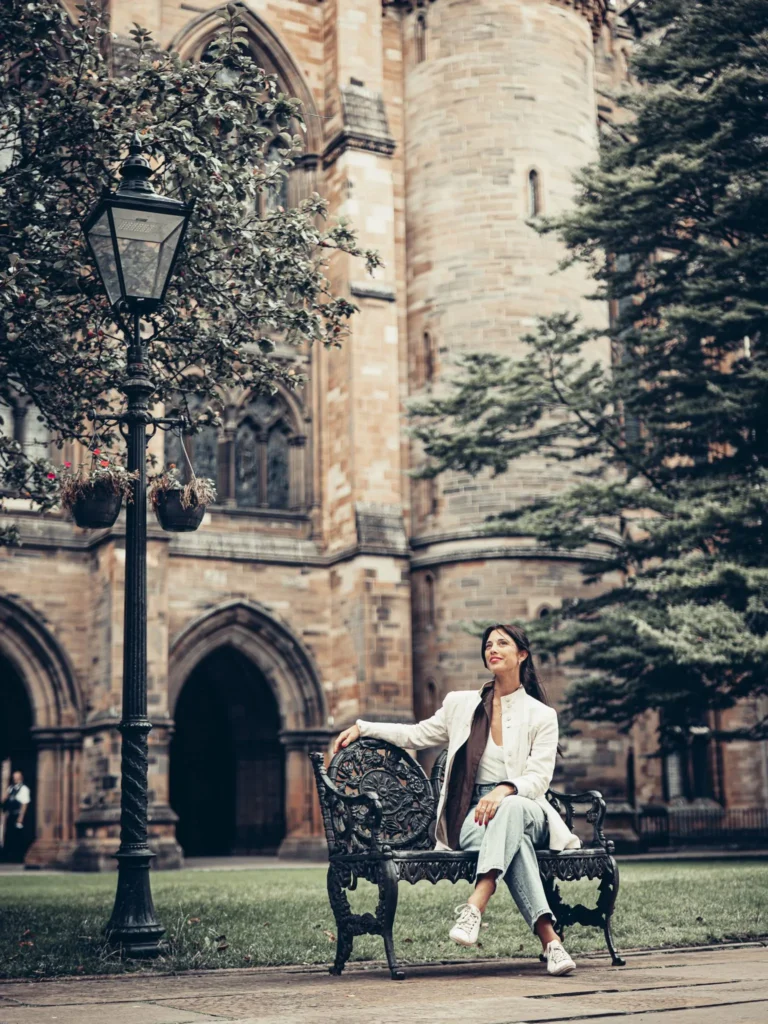
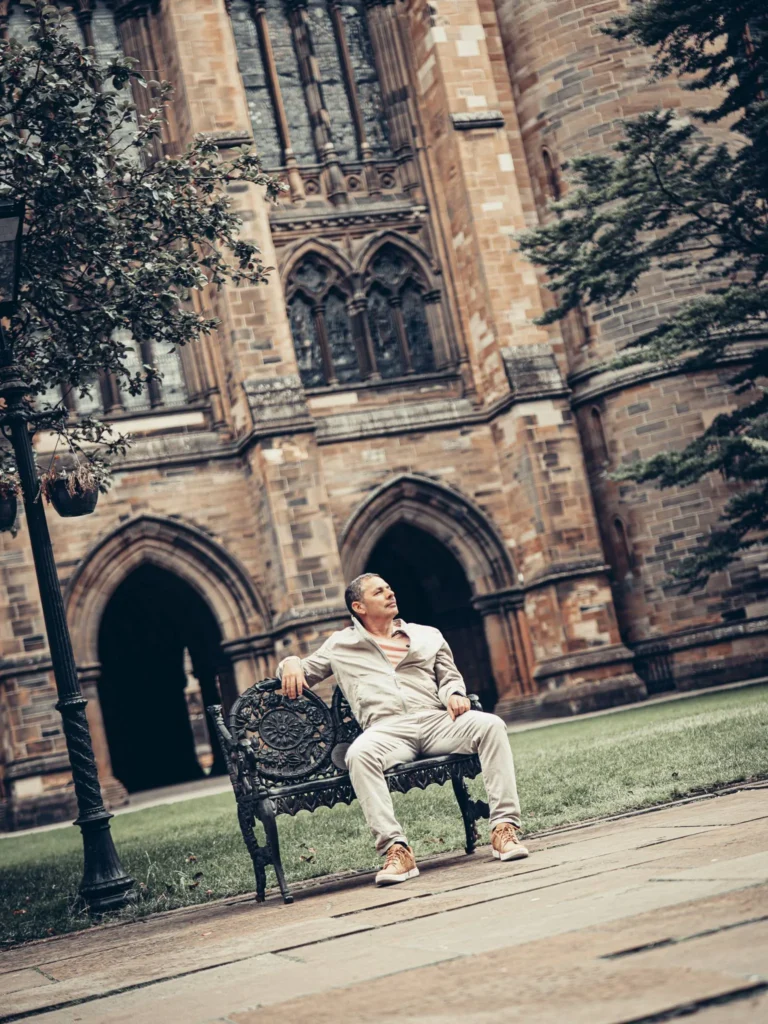
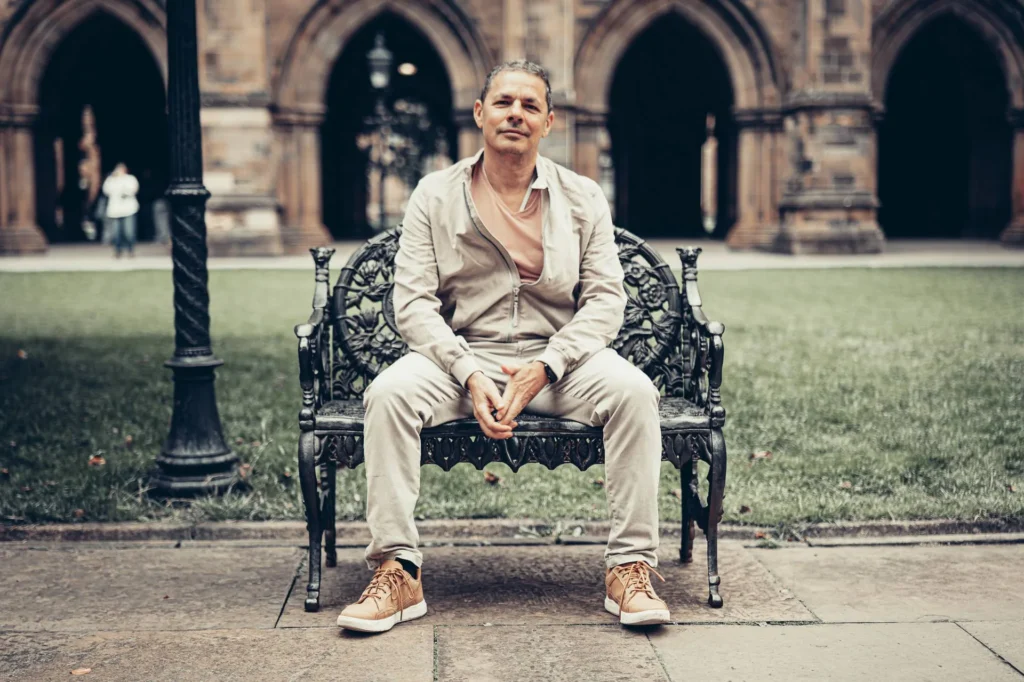
This was not our first time here, incidentally. We had already come on an earlier trip to Scotland, and even then the university was our main heritage stop in Glasgow. The funny part is that lining up the photos from both visits, we find the same benches, the same quad, the same sky that cannot make its mind up. Some places do not shift an inch, and there is something restful in that.
What the university eventually put on the table
One point that matters, even if it is not the most comfortable to tell. In 2018 the university published a report titled Slavery, Abolition and the University of Glasgow, the first of its kind by a British university. It acknowledges having received, in the 18th and 19th centuries, gifts and bequests from people who may have profited from slavery, with a value now put at somewhere between £16 million and £200 million.
And it did not stop at the acknowledgement. The following year it signed a reparative justice programme with the University of the West Indies, creating the Glasgow-Caribbean Centre for Development Research and committing to raise and spend £20 million over twenty years. You may well think that is too little, or too late, and the argument is a fair one. But when you walk these quads thinking, they clearly had the means back then, it is worth knowing where part of those means came from.
Coimbra has nothing in common with it, and that is precisely the interest
Standing there, the first thing I thought of was the University of Coimbra, which we had visited shortly before. Two old historic universities, two monuments that loom over their city, you would assume they rhyme. They do not, at all. They are close to opposite, two entirely different ways of occupying space and of making you feel something.
I am not going to tell you which is the more beautiful, that would be daft, and besides I do not know. But if you get the chance to do both, the comparison is worth making: Coimbra is sunlit, open, set high up; Glasgow is mineral, enclosed, almost monastic. Two vast universities producing sensations with nothing in common, and that is the fascinating part.
The University of Coimbra, the second time was the charm (black capes and the theory of the ass)
The oldest university in Portugal (1290), UNESCO listed. Black capes, Biblioteca Joanina, Paço das Escolas, and a view of the Mondego. Our opinion and our photos.
Read moreThe tower, and the best spot to photograph it from
One last piece of advice, and a properly practical one. Do not leave the campus without walking through Kelvingrove Park, which is right next door. The park is lovely, very green, chestnut trees, plenty of benches, a calm feel to it, and crows going at it everywhere in the trees (sound design included, gothic to the last).
And above all it is from there that you get the best line on the Main Building tower. Seen from the park, greenery in the foreground, it really does fancy itself a bell tower. It is the image that sums Glasgow up best to our eyes: thick planting in front, and behind it that monumental grey architecture reminding you where you are.
Who we would send to the University of Glasgow
If you only have one day in Glasgow then this is, to our minds, the heritage stop not to miss, and the best hour you can invest for a visual sense of the city. Allow an hour on site at a gentle pace, plus however long you end up sitting on a bench doing nothing, then carry straight on into Kelvingrove Park behind it: that is your West End half-day, with no transport and no ticket.
If on the other hand you want a guided tour with rooms, collections and a marked route, that is not really the point here: the show is outdoors, in the quads and under the arches. For interiors it is the Hunterian Museum, on campus, that takes over.
Practical information
PS: if anyone from the university is reading, we would love to know how many people stop in front of the red phone boxes pretending to make a call. We have a theory, and it does not flatter us.