


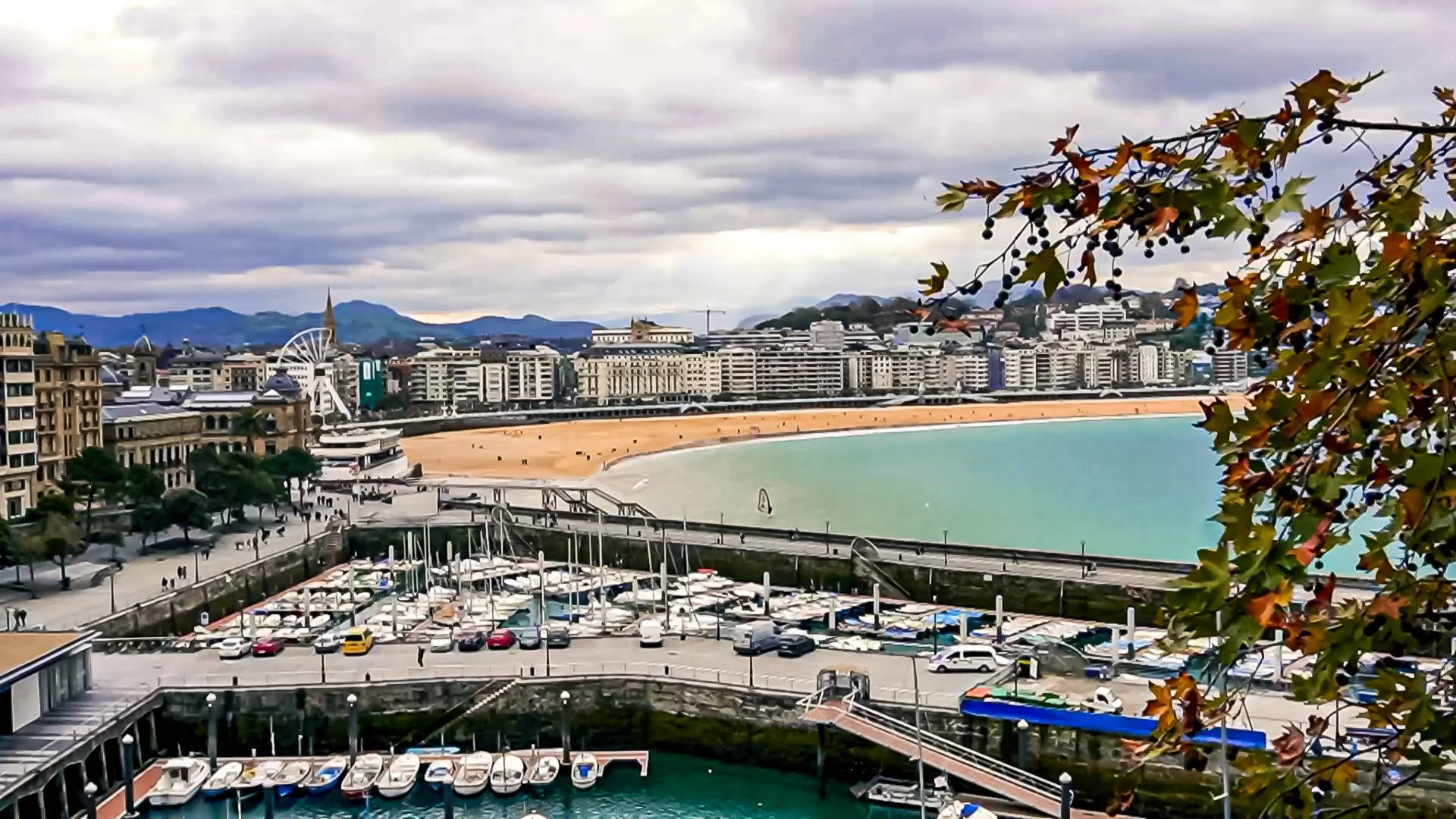
Let’s be honest for a second: we breezed through San Sebastián. One day, in rain that would keep a vanlifer indoors, before heading to Portugal for the winter. And yet… this Basque stop left us wanting more (and not just the pintxos). So if you’re planning your motorhome road trip in the area, here’s everything we saw, ate, and especially everything we would have liked to see if the sky had been a little less spiteful.
We’ll show you the stop in video
Before diving into the details, here’s the San Sebastián sequence as we experienced it, taken from our very first crossing from Spain to Portugal.
Subtitles available in your language, remember to activate them in the player.
Plan your trip: Spain
Compare rental companies and book at the best price.
Booked on Trip.com — partner link.
Provided by Holafly, our partner.
5% off with code LAPLANETEDECARO
Booked on Holafly — partner link.
San Sebastián in a motorhome: our quick stop in the rain
It was late 2021, during our first descent to Portugal. We arrived from the French side, passed Hendaye, Irun, and there, in barely twenty kilometers… we felt we had changed countries. A narrow street in the old town, a simple church around a corner, and this atmosphere that has nothing to do with France. It’s ancient, it’s typical, it’s impressive, as we say at home.
A word about the city, because its double name always intrigues: in Basque, it’s called Donostia, in Spanish San Sebastián, and both refer to the same saint (Donostia = “Done Sebastiane”, Saint Sebastian). It’s the capital of the Gipuzkoa province, an elegant seaside resort established during the Belle Époque when the regent queen María Cristina made it her summer residence. In short, a chic city set on one of the most beautiful bays in Europe, which the Spaniards nicknamed La Bella Easo. And even under the gray skies, we understood why.
Except it was pouring rain. Really. And finding a spot with electricity in northern Spain is another story (we’ll come back to that, because it’s a real issue in a van). So we did what we always do when the sky falls on our heads: we headed towards the sun. With a little pinch in our hearts, because we could see, between two showers, that the Basque landscapes knew how to be desirable.
Where to park and sleep in a motorhome or van in San Sebastián
This is THE nerve of the war here. San Sebastián, or Donostia in Basque, is a dense city, wedged between the sea and hills, and it doesn’t like large vehicles in its center. Good news: there are several designated areas and parking lots, we’ve marked them all on the map below (click on each marker for the address and our notes).
San Sebastián : Places we can tell you about
Here's our selection of places in San Sebastián: spots we've visited that might be useful to you. Use the list view to discover each address in detail, and export everything to add to Google Maps or your favorite GPS app.
| Place | Address | Download |
|---|---|---|
| Campincar San Seb | 43.30806, -2.01449 | |
| Camperarea Donostia Arena | 43.2974329, -1.969538 | |
| Camping Igara de San Sebastián | 43.2966238, -2.0369937 | |
| wecamp San Sebastián | 43.3047339, -2.0457953 |
| Place | Address | Download |
|---|---|---|
| Parking Buen Pastor | 43.3170605, -1.9811825 | |
| Txofre Aparkalekua | 43.3235979, -1.9712785 |
| Place | Address | Download |
|---|---|---|
| The Laundry Gros | 43.3239203, -1.9768409 | |
| Garbimatik - Ikuztegia | 43.3232533, -1.983417 |
| Place | Address | Download |
|---|---|---|
| Gandarias | 43.3240228, -1.9857835 | |
| Bodegón Alejandro | 43.3236037, -1.9834505 | |
| Sirimiri Gastroleku | 43.3225464, -1.985644 | |
| Arzak | 43.3214573, -1.9493146 |
| Place | Address | Download |
|---|---|---|
| Old Town (Parte Zaharra) | 43.3232446, -1.985193 |
| Place | Address | Download |
|---|---|---|
| Playa de la Concha | 43.3177013, -1.9863684 | |
| Zumaia – Itzurun Beach | 43.3009, -2.2606 |
| Place | Address | Download |
|---|---|---|
| Monte Urgull | 43.3253528, -1.9888646 | |
| Monte Igueldo | 43.3186, -2.0099 | |
| San Juan de Gaztelugatxe | 43.4474105, -2.7848295 |
Our tips for sleeping in a van in San Sebastián without a headache:
- Campincar San Seb: the most cited area by motorhome users, in the northwest in the Igara neighborhood. Water, electricity, waste disposal, the complete combo about ten minutes from the center.
- Camperárea Donostia Arena: to the south, near the Illunbe arena. Closer to transport to dive into the city without moving the motorhome.
- Camping Igara de San Sebastián: the classic about 5 km away, open year-round, if you want the comfort of a real campsite (pitches and bungalows).
- wecamp San Sebastián: a bit further west, more nature, good value for a night or two.
For the day only, you can aim for a central parking lot like Buen Pastor (near the Good Shepherd Cathedral) or Txofre in the Gros neighborhood, just enough time to go for a walk. And the famous electric puzzle: in all of northern Spain, areas with charging stations are rare, and solar power doesn’t yield much under a cloudy sky. Our advice from real power struggle veterans: arrive with your batteries full, you’ll thank yourself.

We're Caroline and Xavier
We drive to a place, stay long enough to get it wrong a few times, then write the guide we wish we'd had: parking, timing, what's worth the detour.
Ce que vous souhaitez recevoir :
Camping around San Sebastián: the campsites
If you prefer to park the van on a real equipped site (sanitary facilities, wifi, sometimes a pool), rather than in a service area, the San Sebastián crown has plenty to offer. The most convenient remains Camping Igara, 5 km from the center and open all year, with a bus that goes down to the city. A bit further, wecamp San Sebastián plays the nature card, and to the west, several campsites line the road between San Sebastián and Bilbao if you plan to follow the coast. Book in advance in summer: the Semana Grande (Aste Nagusia, the big week of festivities in mid-August with its fireworks competition) skyrockets demand, and prices too.
The Spanish Basque Country by van: we really felt the border
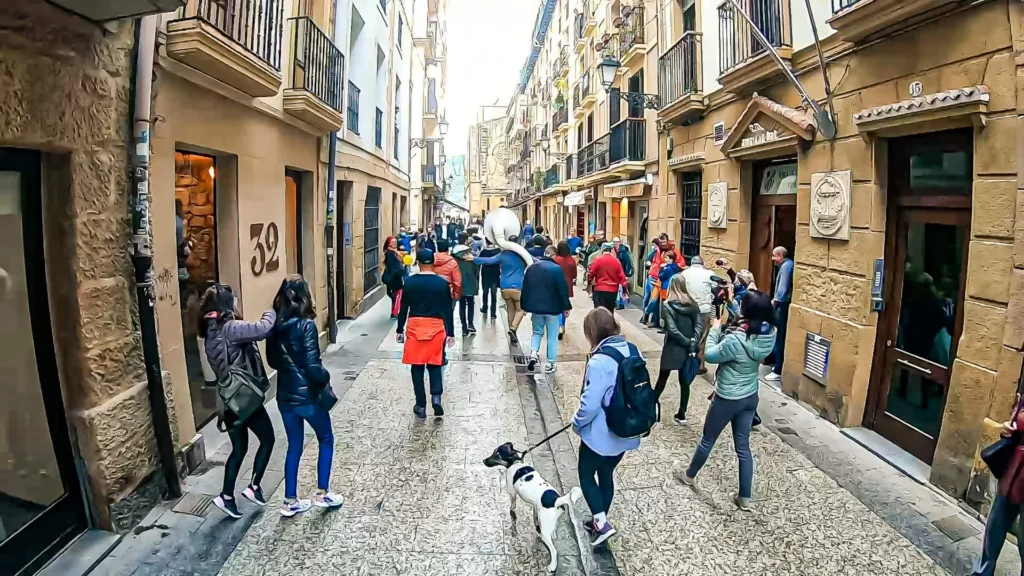
What strikes you upon arrival is the immediate shift. In just a few kilometers from France, the language changes (Basque, Euskara, everywhere on the signs), the architecture changes, and even the way of eating changes. If you’re doing a road trip in the Spanish Basque Country, know that San Sebastián is often the first major stop after the border, about half an hour from Irun, before heading to Bilbao (about an hour to the west) and the rest of the Cantabrian coast.
That’s also why the city is a great base: you arrive, park the motorhome, and explore. The coast between San Sebastián and Bilbao, we still dream about it (we’ll tell you why a bit further down, it has to do with dragons).
What to see in San Sebastián when you have two hours (or two days)
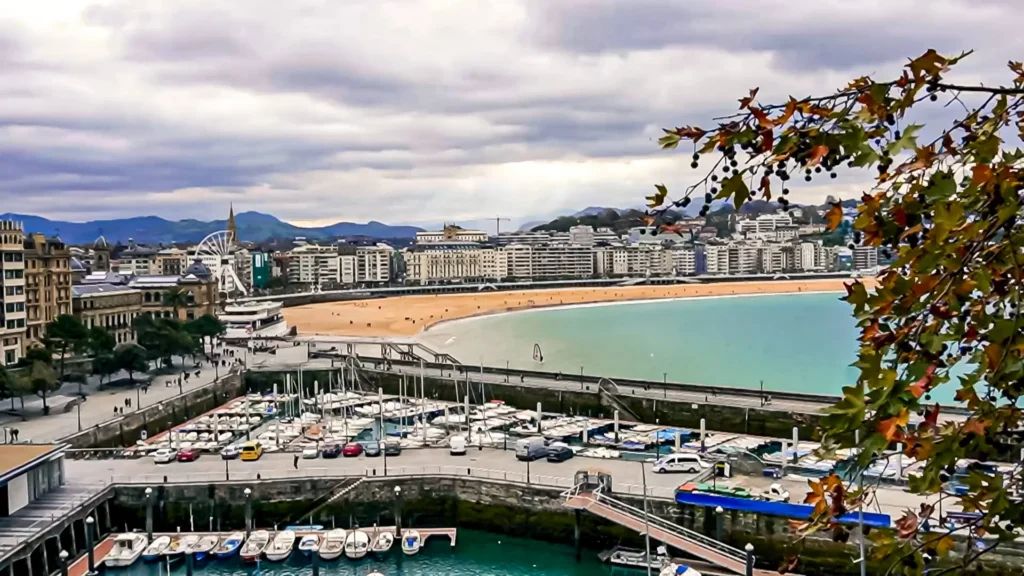
Even in express mode, the city reveals itself quickly because everything is compact around the bay. The heart is the Parte Vieja (Parte Zaharra), the old town at the foot of Mount Urgull: a maze of narrow streets, churches, and especially the headquarters of pintxos bars. That’s where we spent most of our short stop.
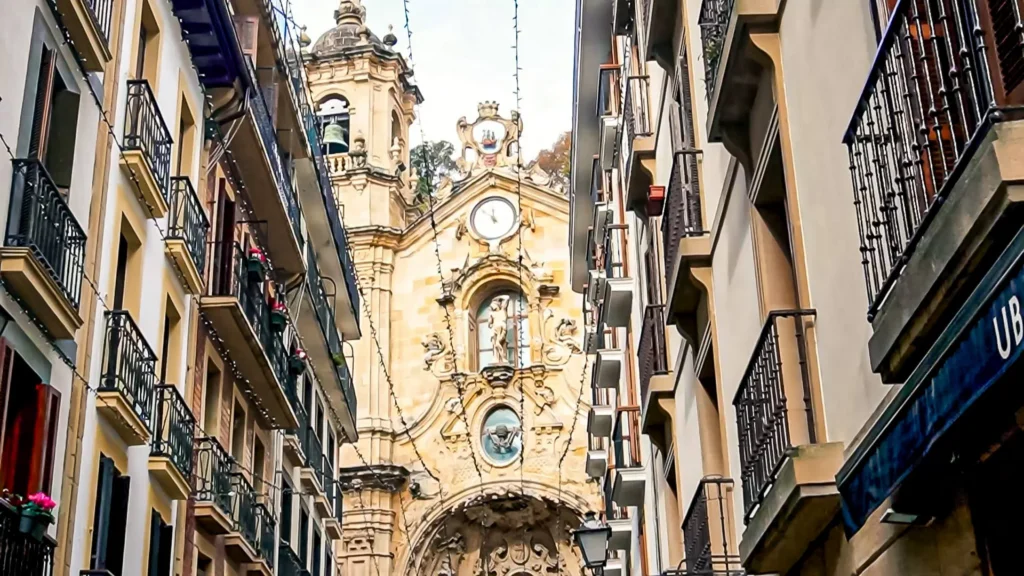
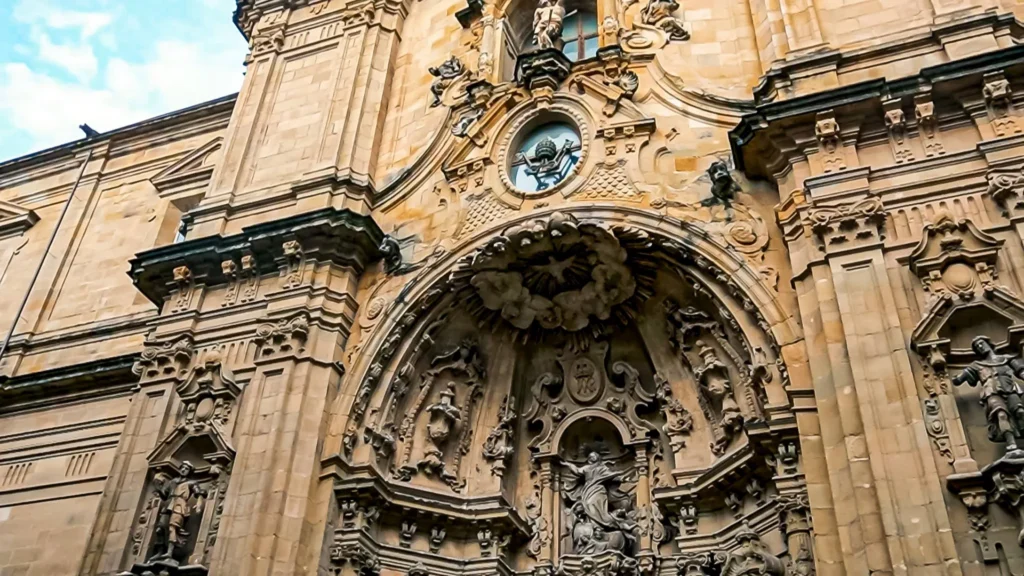
The church we stumbled upon in a narrow street is no ordinary one: it’s the Basilica of Saint Mary of the Chorus (Santa María del Coro), the grand baroque vessel of the old town, built between 1743 and 1774 on the site of an old Gothic church. Its churrigueresque-style sculpted portal is a folly of golden stone, topped with a statue of Saint Sebastian, the martyr pierced with arrows who gave his name to the city, and its main altar is dedicated to the Virgin of the Chorus, the patroness of Donostia. Look up when you pass by, it’s worth it.
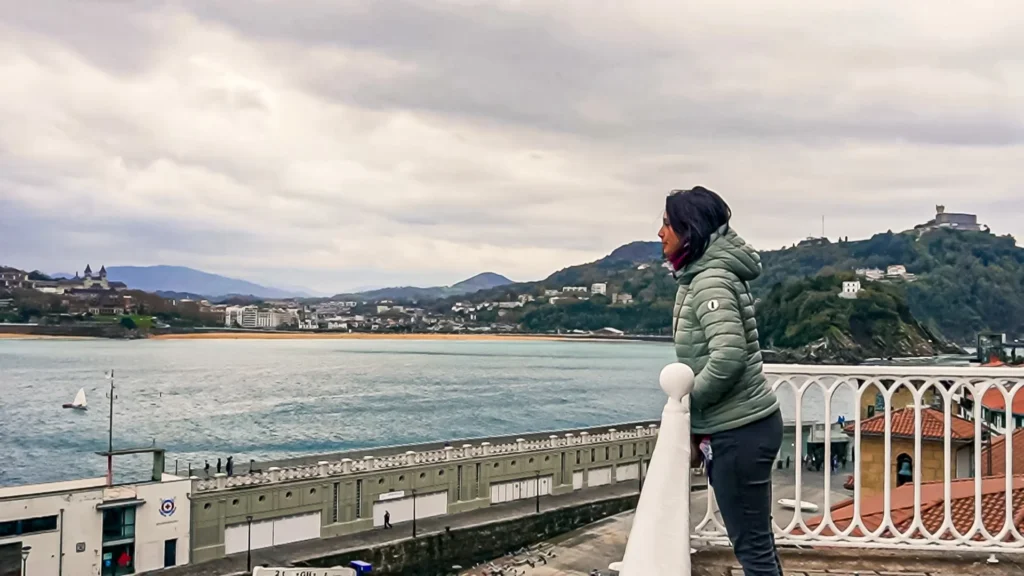
Right next to it opens the Playa de la Concha, this shell-shaped bay (concha = shell in Spanish, it’s all said) that has made the city’s reputation. Its promenade is lined with a white balustrade that has become the graphic symbol of Donostia, found even on the streetlights. For the postcard view, two hills face each other: Mount Urgull on the old town side, crowned with a 12-meter statue of the Sacred Heart watching over the old Mota castle, and Mount Igueldo to the west, with its retro funicular (the oldest in the Basque Country, in service since 1912) and its breathtaking view over the entire bay. We couldn’t go up, rain obliged… but it’s noted for the return.
Eating in San Sebastián: our very first time with pintxos
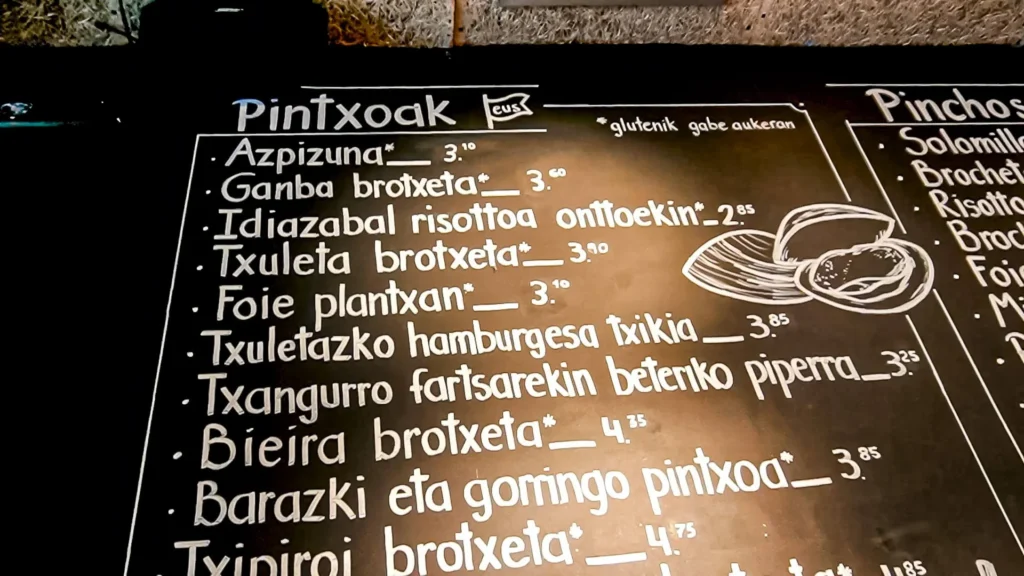
If you were to remember just one thing to do here, it would be this. The pintxos are the Basque version of tapas: small bites placed on bread or skewered (the “pintxo” is precisely the skewer), lined up on the counters of the bars in the Parte Vieja. San Sebastián is considered the world capital of pintxos, with a dizzying density of bars. It’s even here that the first modern pintxo was born in 1946: the famous Gilda (an olive, an anchovy from the Cantabrian Sea, and a sweet pepper skewered on a toothpick), named in homage to Rita Hayworth because she was said to be green, salty, and a bit spicy. The principle: you point, you taste, you hop from bar to bar (the txikiteo, the bar crawl), it’s a lifestyle as much as a meal. And for us, that night, it was a big first.
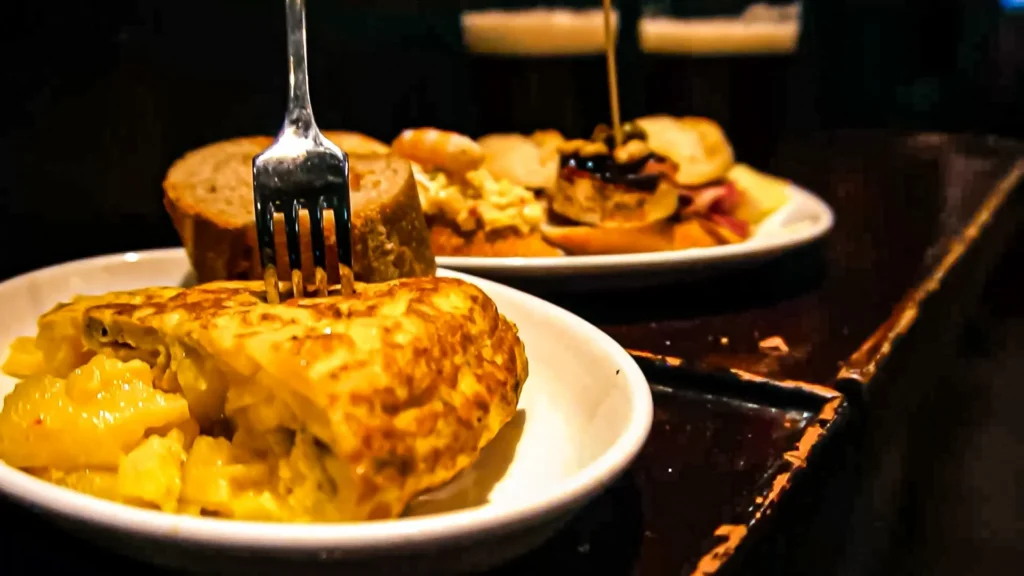
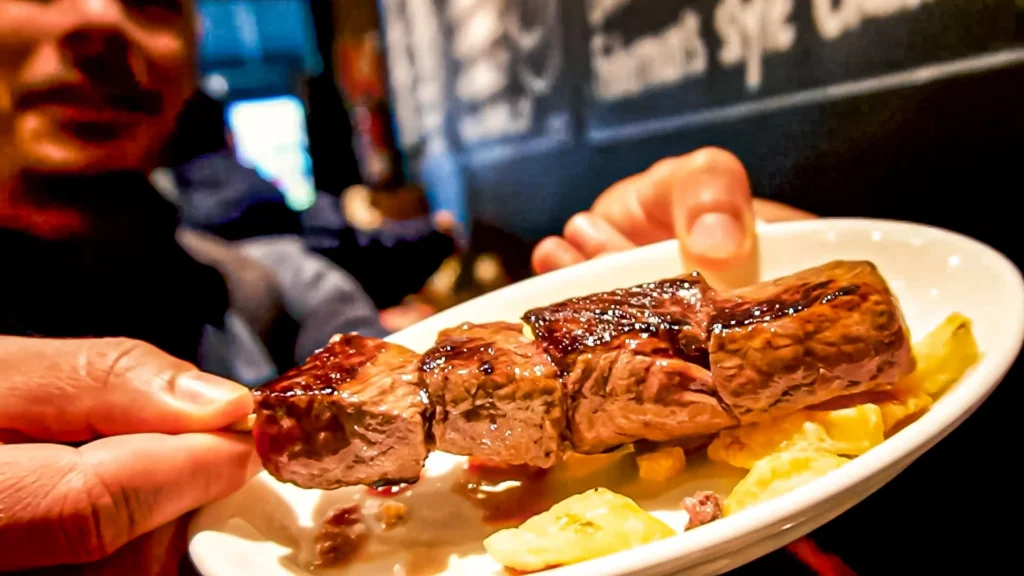
On the menu of our improvised initiation: a pintxo with delicate peas, another with shrimp wrapped in dough (a funny shape, it looked like an ice cream), a trio of sun-dried tomato-cheese-nuts on bread, a potato tortilla just how we like it, and especially a skewer of well-aged beef (the famous txuleta, the king meat of the Basque Country, a thick rib often cut from older cows and grilled over coals with coarse salt). On that one, Xavier was delighted: we’re not talking about industrial meat here, you can feel the farmer and the beef that took its time. The ham, on the other hand, was… well, let’s say we’ve had better (private joke). All for about 16 euros for two, and the memory of a truly good moment.
On the slate, you’ll also find some classic Basque dishes: txangurro (stuffed spider crab), scallop skewers (bieira), fried foie gras, or Idiazabal cheese (a smoked sheep cheese AOP from the area). We’re not going to give you a false starred address we haven’t tested: the name of our bar got lost in the mists of 2021. But know that the old town is full of them (Gandarias, Bodegón Alejandro, Sirimiri for sure bets), and that San Sebastián is one of the most Michelin-starred cities in the world per square meter, with temples like Arzak (three Michelin stars, the stronghold of Juan Mari Arzak and the new Basque cuisine) or Martín Berasategui nearby. For wealthy foodies, of course.
Around San Sebastián: the Basque coast and its Game of Thrones settings
That’s our real regret. We wanted to head up the coast to the west to see the Game of Thrones filming locations, and the weather canceled everything. Because yes, two iconic sets from the series are hidden along this coast:
- Zumaia and the Itzurun beach, about thirty kilometers away: its flysch cliffs, these layers of striped rock aged tens of millions of years, served as the shore for Peyredragon (Dragonstone) in season 7. The most accessible spot from San Sebastián.
- San Juan de Gaztelugatxe, much further, beyond Bilbao towards Bermeo (count about 120 km and 1h30 of driving, it’s really not next door): the islet connected to the mainland by a staircase of 241 steps leading to a hermitage, it’s the famous fortress of Peyredragon seen from the outside. The kind of place that justifies coming back on a nice day.
We’ve marked them on the map above so you can plan your Basque coast itinerary better than we did. If the sky is with you, don’t make our mistake: take your time.
Two resources to extend your Spanish getaway: how to stay connected without breaking the bank while roaming, and another gem of the peninsula to add to your route.

Which Unlimited SIM Plan for Spain? (Holafly promo code)
What kind of internet connection should you use during a stay in Spain? It’s a question we often ask ourselves before heading off on a trip. Caroline and I, Xavier,...
Discover
Discovering Cadiz in a Motorhome: Complete Guide
Discover our ultimate guide for an unforgettable road trip in Cadiz, Spain: fascinating history, practical tips, and must-do activities for a memorable adventure!
DiscoverWhen to go to San Sebastián in a motorhome?
Our rainy experience is no coincidence: the Basque coast is green because it’s watered. We’re in a temperate oceanic climate, showers can fall pretty much all year round, including in mid-season. The heart of summer (July-August) remains the safest in terms of weather, but it’s also the busiest and most expensive, with the famous Semana Grande in mid-August. Spring and early autumn offer a good compromise between light and tranquility, provided you’re okay with a few good Basque showers (and a dry plan B, like a pintxos tour, which is convenient).
San Sebastián : a glimpse of the weather
5-day forecast
Hesitating about leaving now? Here are the forecasts for the coming days.
Monthly climate
Let's be honest, we prefer beautiful sunny days. But if you enjoy cooler weather or rain, here's everything you need to find your perfect time.
| Month | Min temp | Max temp | Rain | Weather | Rating |
|---|---|---|---|---|---|
| September | 15°C | 23°C | 84 mm | 🌦️ | |
| October | 13°C | 21°C | 85 mm | 🌦️ | |
| November | 10°C | 17°C | 232 mm | 🌧️ | |
| December | 8°C | 14°C | 87 mm | 🌦️ | |
| January | 6°C | 12°C | 191 mm | 🌧️ | |
| February | 9°C | 16°C | 248 mm | 🌧️ | |
| March | 9°C | 16°C | 162 mm | 🌧️ | |
| April | 12°C | 20°C | 87 mm | 🌦️ | |
| May | 14°C | 22°C | 120 mm | 🌦️ | |
| June | 18°C | 27°C | 54 mm | ☀️ | |
| July | 20°C | 27°C | 59 mm | ☀️ | |
| August | 19°C | 27°C | 44 mm | 🌦️ |
In terms of budget, Spain remains gentle on the essentials: fuel and groceries are reasonable, a pintxos round goes for about 15 to 20 euros per person, and a night in an area or campsite ranges from free (tolerant parking) to around twenty euros for an equipped campsite. Enough to enjoy without breaking the bank.
Quota RapidAPI dépassé (limite par minute/mois). Réessayez plus tard.
San Sebastián: frequently asked questions
What does Donostia mean?
Donostia is simply the Basque name for San Sebastián. The two coexist everywhere, hence the full official name Donostia-San Sebastián, capital of the province of Guipúzcoa, in the Spanish Basque Country.
Can you sleep in a camper van or van in San Sebastián?
Yes, but not just anywhere: the center doesn't like large vehicles. The easiest is to aim for a parking area (Campincar San Seb in the northwest, Camperárea Donostia Arena in the south) or a campsite (Igara, wecamp). All our references are on the map of the article. Remember to arrive with fully charged batteries, as areas with electricity are rare in northern Spain.
How far are the French border and Bilbao?
San Sebastián is only about twenty kilometers from Irun and the border (Hendaye), which is less than 30 minutes. Bilbao is located about a hundred kilometers to the west, around 1 hour by highway.
When to go to San Sebastián?
Summer (July-August) is the safest in terms of weather, but also the busiest and the most expensive, with the Semana Grande in mid-August. Spring and early autumn offer a good compromise between light and tranquility, provided you accept a few showers: the Basque coast is green because it is watered all year round.
What to see around San Sebastián in a camper van?
The Basque coast to the west is worth a detour: Zumaia and its Itzurun beach with flysch cliffs (the setting of Dragonstone in Game of Thrones), San Juan de Gaztelugatxe and its 241-step staircase (the fortress of Dragonstone), then Bilbao and its Guggenheim Museum.
PS: we left under the rain with one certainty, the ham might have been better before, but San Sebastián is just waiting to be revisited in good weather. Next time, we’ll go up Mount Igueldo and say hello to the dragons of Gaztelugatxe. Promise.
Spain, and the road after
Two years of full-time van life, and the Algarve as our base ever since. We still hit the road, by van or otherwise, and we write up what we find along the way. An email when we have something to say, no more.
Ce que vous souhaitez recevoir :