


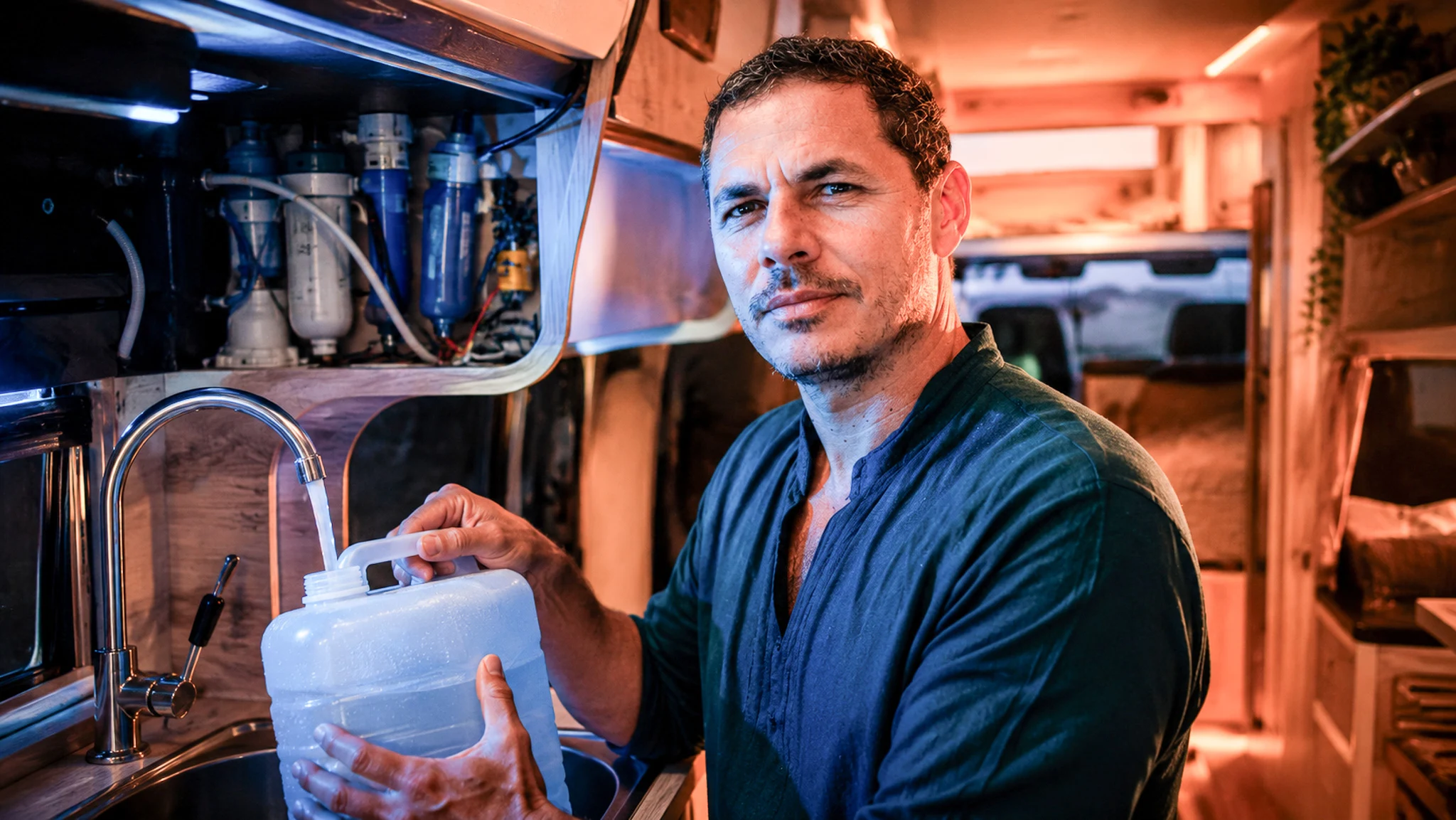
Let’s be honest from the off: when you buy a van, you dream of sunsets and secret spots, not of how much a full tank weighs. And yet water is the thing that quietly decides whether your day is easy or turns into a treasure hunt. With Edouard (our Hymer, yes he has a name, we own it), we’ve been juggling this for years, from grim fill-ups in the middle of nowhere to commando-style showers. So instead of a lecture, I’ll tell you how it really goes and what we’ve worked out along the way.
How does water work in a van or camper?
Right, before you go hunting for somewhere to fill up, you need to understand what you’re filling. And it’s simpler than it looks: it’s a closed loop, like a house’s plumbing but in nomad form.
There are two worlds that never mix: clean water on one side, waste water on the other. Clean water sits in a tank (ours holds 120 litres), a pump pushes it to the taps when you open them, and some of it runs through a water heater on the way for the shower. Once used, it drains into the grey water tank (from the sink and shower) and, if you’ve got a conventional loo, into the black water cassette. That’s it. That’s the whole mystery.
Two circuits that never mix: clean water flows from the reservoir to the taps; used water goes back to the waste tanks.
The one slightly temperamental part is the water pump: it does all the graft and it’s the first thing to pack in. If it gurgles into thin air one morning, nine times out of ten it’s lost its prime (an air bubble stuck in the line) or the tank is simply dry. Yes, it’s happened to me, and yes, I spent twenty minutes chasing the fault before realising I just needed to refill (not even embarrassed).
Where to fill up with water, and where to find it for free?
This is THE question. Because driving around is all well and good, but a van with no water, after three days, starts to smell like a wet dog.
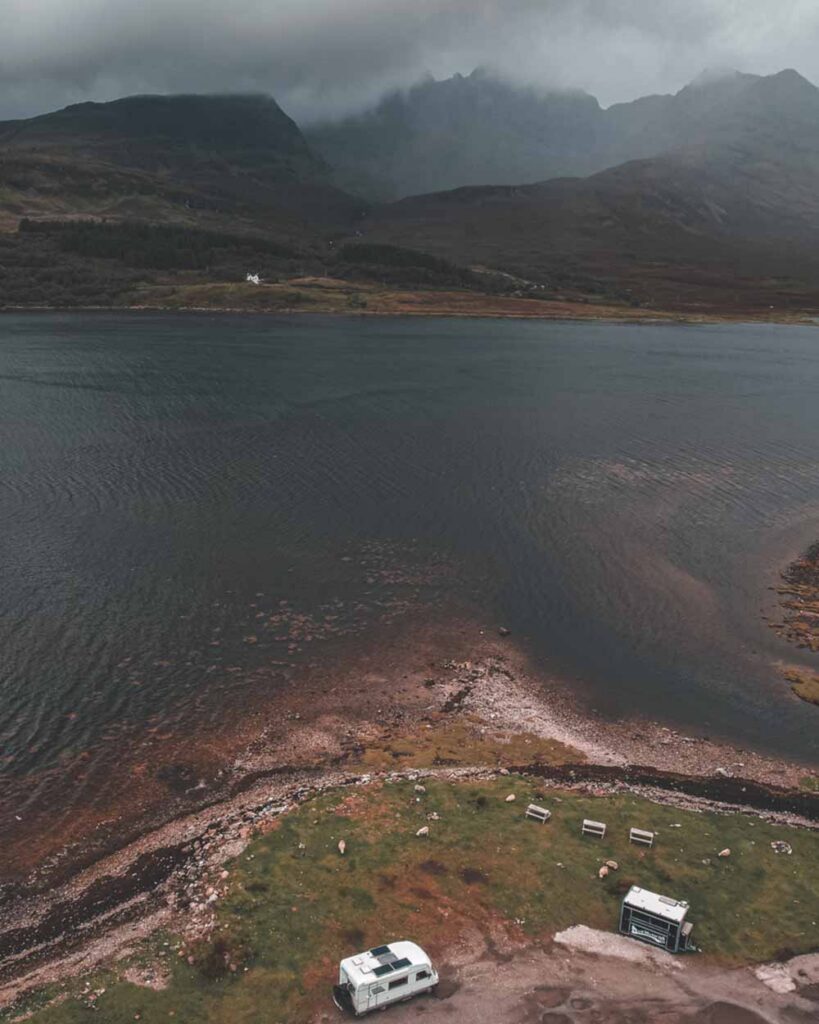
I’ll spare you the sermon: the best water source is the free one. Anywhere we can hook up our hose without reaching for the card, we take it. And honestly, there’s more of it about than you’d think once your eye is trained: motorhome service points on Caravan and Motorhome Club or Camping and Caravanning Club sites, the odd churchyard or cemetery tap, marina and leisure-centre taps, a friendly pub or garage if you ask nicely, and campsites that’ll top you up for a couple of quid. The summer we did Scotland, we leaned hard on campsite taps and the occasional Highland churchyard tap, the water is everywhere once you stop expecting a dedicated point with a sign on it.
Why do I bang on about free? Because paid adds up fast. The little paid point near us in Portugal has gone from 2.2 € to 4 € a fill in five years. That’s for water, mind, not diesel. So yes, clocking the free points pays off over time (and it saves you circling a machine that keeps spitting your tokens back out, a proper classic).
Now, if we’re honest, the dream would be a submersible pump you drop in a stream to fill straight up with clear water, beholden to no one. We fantasise about it. Not sure we’d drink that water (stream water is spot on for dishes, showers and the loo, less so for your stomach), but for autonomy it’d be the holy grail.
| Water Source | Availability | Cost | Drinkable? |
|---|---|---|---|
| Campsite / CL / CAMC & C&CC site | Very common | Free with a stay | Yes (drinkable) |
| Motorhome service point (aire, Britstops) | Growing | Free to £5 | Yes (drinkable) |
| Churchyard / cemetery tap | Occasional (ask first) | Free | Usually (check the sign) |
| Marina / leisure centre / public tap | Occasional | Free | Yes (drinkable) |
| Stream / spring | Route-dependent | Free | No, not without a filter |
Our rule: free first (churchyard and public taps, campsite while you stay), pay only in a pinch. Stream water stays perfect for dishes, showers and the loo.
To find these points without losing a whole day to it, there are dedicated apps that map out service points and water taps with reviews from other travellers. We go into it in our piece on the apps we actually keep on our phones, and I’m not reinventing the wheel here (it’s already in the water heater, that one).

The apps we really have on the phone (and those that are dormant)
In this article, we will present the mobile applications that we use on a daily basis. Apps to find places to sleep, to navigate, for your gear, and even to...
Read moreHow much water to carry? In reality, the issue is weight
Here’s the bit nobody harps on about enough: water is genuinely heavy. One litre is one kilo. Our full 120-litre tank is 120 kilos sloshing around, the equivalent of an invisible adult riding shotgun full-time.
And it matters, because a camper has a limited payload (the gap between its empty weight and the 3.5-tonne limit that comes with a standard category B licence). Between the conversion, the kit, the food and the people, you hit the ceiling quickly. So driving around with a brimming tank just in case is the reflex that quietly costs you weight and fuel for nothing. On long legs we often run with the tank half full and fill up when we arrive.
Which leaves the real question: how long do you actually last on one fill? That depends on you, so I’ll let you play with your own numbers (the defaults are us, as a pair):

We're Caroline and Xavier
We got most of it wrong before we got it right. We share what actually holds up day to day in a van, and what we wouldn't do again.
Ce que vous souhaitez recevoir :
Managing and saving water daily
Our figures, then: as a pair, we get through 135 litres in three days, roughly 20 litres per person per day. For context, the average person in the UK gets through around 140 litres a day. On their own. Which means the two of us take four days to use what one settled person drinks-showers-flushes in a single day. Our water use dropped roughly sevenfold when we moved into the van, and no, we don’t feel grubby for it.
How? No magic, just habits that bed in within a week. In the shower we turn the water off while we soap up (the “navy shower”, terribly glamorous). We don’t wash up under a running tap; we fill a bowl. As for the loo, let’s just say we wait for the main event before flushing, I’ll spare you the diagram. And for everything else, plain biodegradable soap, because your grey water ends up in nature or at a dump station either way, so it may as well be clean.
The real game changer, if you want to push it, is a composting dry toilet: no water for the loo, none of that blue chemical that poisons the water table, and a black water cassette you never go looking to empty again. We haven’t gone fully dry on Edouard, but for a fresh build, honestly, it’s worth a proper think.

Shower and hygiene in a campervan
Discover the best techniques for maintaining good hygiene in a camper van. From solar showers to effective routines, learn how to stay clean while saving water during your nomadic adventures.
Read moreAnd what do we do with drinking water?
A quick heads-up that saves nasty surprises: the water in your tank isn’t necessarily safe to drink, even if you filled it from a drinking-water tap. Between the hose, a tank that sits around, heat and time, it stagnates and can pick up bacteria or algae (that green film at the bottom, yes). We keep a 15-litre jerrycan purely for drinking and cooking, kept well apart from the main tank. A cheap in-line or jug filter, the odd purifying tablet, and rinsing the tank now and then will take you a long way; if you want to drink straight from your tanks with total peace of mind, a proper carbon or UV setup is the next step up.
And for the other end of the circuit, when the grey tank is full and it needs emptying properly (because no, you don’t tip that down the gutter), we’ve got the guide for it: emptying your camper’s waste water.
Emptying the wastewater from a camper van: where to really empty it
For a peaceful vanlife, discover why and how to empty your camper van. From the distinctions between grey and black water to tips for finding service areas, this article provides...
Read moreWater in a van and motorhome: your questions
How to prime a motorhome water pump that is running dry?
How to clean and descale the fresh water tank (and get rid of algae)?
Why is water flowing under my camper van?
What hose to use for filling up with water?
Can you leave water in the tank all winter?
How to open a stuck water filler cap (Fiat Ducato type)?
How long does water stay good in the tank?
How long does a camper van water pump last and how much does it cost?
How to gain payload when transporting a lot of water?
PS: the day someone invents the stream pump with a built-in drinking filter, we’ll be first in the queue. Until then, we’ll keep scouting churchyards. Sounds morbid put like that, but the water there is superb.
Fitting out, equipping, making it last
Batteries, solar, conversion, security. What we found after months of real use, and what we would not buy again. An email when we have actually tested something, not before.
Ce que vous souhaitez recevoir :