


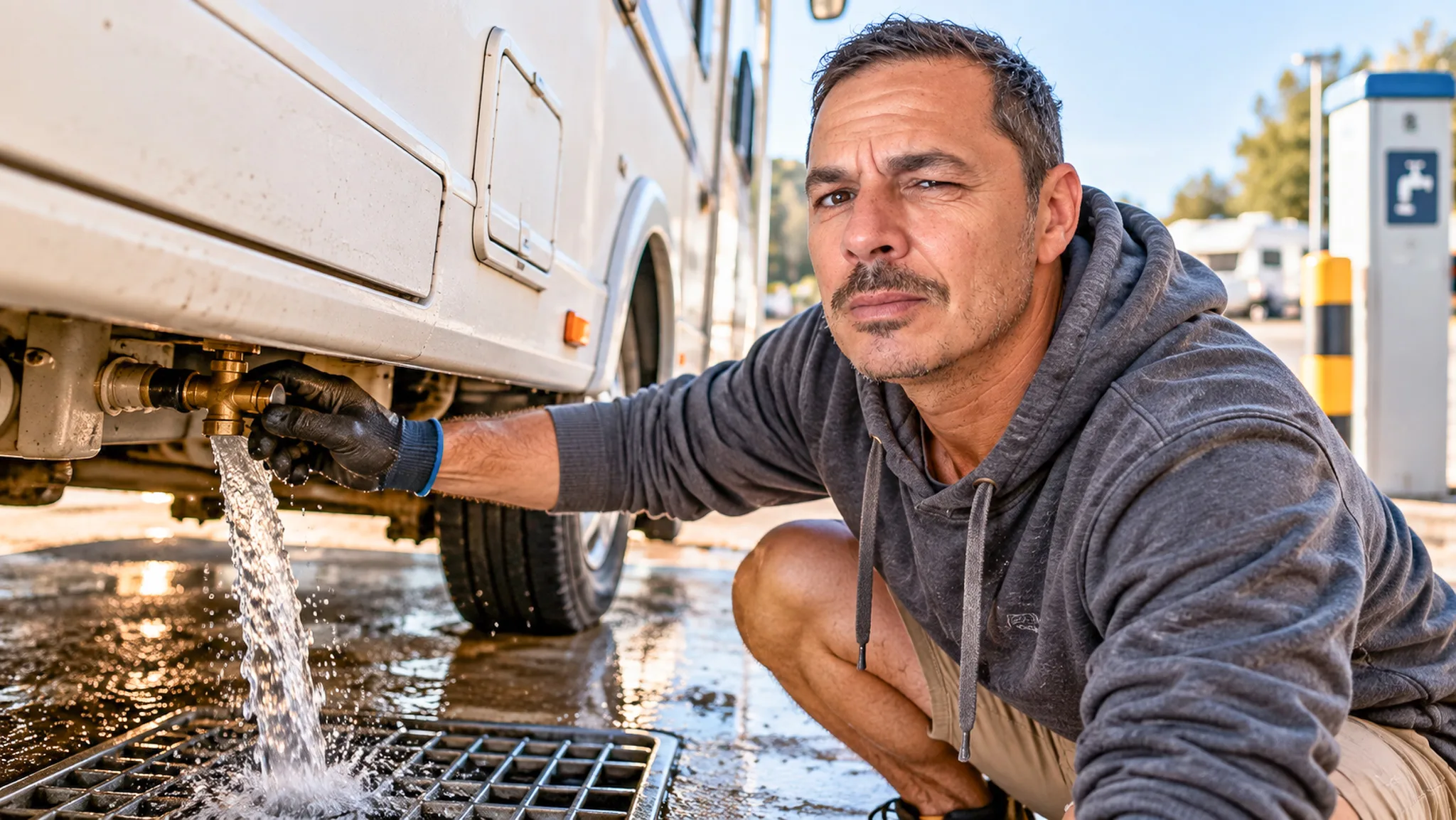
The worst place we struggled to dump was not a faraway country. It’s the department where I lived for thirty years.
The Alpes-Maritimes. I spent most of my previous life there, and I had to return in a camper van to discover that there’s hardly anywhere to empty your waste or refill your tank. This is not a comfort detail. When you live in it, a service area that is hard to find becomes a route constraint: you no longer choose your evening spot, you choose your service point, and the spot is decided around that.
This is exactly what articles about dumping never talk about. They explain the action, which takes four minutes and is mastered after a week. They don’t explain the geography of the action, which is the real issue when you’re not going home on Sunday night.
Grey water, black water: what it really changes
The distinction is simple and needs to be made once and for all. Grey water comes from the sink and the shower. It’s dirty but ordinary: soap, a bit of grease, food residues (nothing dramatic, then). It goes into a tank under the chassis, and this tank is emptied through a valve.
Black water comes from the toilet. It’s stored separately, in a removable cassette accessible through a hatch on the side of the vehicle. For us, it’s a fifteen-liter cassette, original, that’s as old as the vehicle.
This is not a theoretical nuance. The two do not empty in the same place, not with the same action, and especially not at the same rate. In practice, the cassette puts pressure on you long before the grey water tank: for two people, full-time, it lasts about three days. And these three days depend heavily on a parameter that no one writes down explicitly: the ability to pee outside. Half the volume of the cassette is flush water.
Everything regarding the cassette itself, what we put inside, the smell, how long it really lasts, and why we still haven’t switched to dry toilets, has been written elsewhere: cassette toilets in a motorhome, for real. Here, we talk about the rest. That is, where we are going to empty all this.
The three waters of a camper van
Where it comes from, where it is stored, where it empties. And at our place, who takes care of it.
Where we really dump when we live in it
This is the question that comes up the most, and it’s the one that is most poorly addressed. The honest answer is that there isn’t one place, there are five or six, and we take the one that’s on the way.
Service points, and what they actually cost in the UK
This is the place designed for it. In Britain the black-water part has its own name: a Chemical Disposal Point, usually shortened to CDP, or simply an Elsan point after the chemical brand. Next to it you normally get a grey-water gully and a fresh-water tap, and together the three make a proper service point. The whole thing fits in five square metres and the complete operation takes about fifteen minutes if you take your time.
Over three years, the range we have actually paid to empty the tanks runs from nothing to ten Swiss francs, roughly nine pounds. And it is no accident that the top of that range is Swiss: Switzerland is by a distance the most expensive country we have crossed on this, as on everything else. Everywhere else, emptying on its own is free far more often than you would expect (I assumed we would be paying everywhere, and I was wrong).
What nobody tells you is that emptying and filling are not priced the same way. Plenty of sites let the waste side go free and charge only for fresh water, because fresh water is what costs the operator. Others take a flat token fee for the lot. What creeps up year after year is nearly always the fill, rarely the disposal point, and we put numbers on that drift on the water side.
Some areas are completely free, often municipal. Others charge only for clean water and allow free dumping. Still others charge for everything with tokens. There are no rules, it’s case by case, and that’s precisely why the app matters more than the theory.
One word often comes up in the comments, and it deserves to be explained: the so-called artisan dump. It’s not a brand, it’s a makeshift installation on-site, often by a municipality or a merchant, that does the same thing as a commercial dump but without the casing or signage. A pipe, a grid, sometimes a simple masonry pit. It works, it’s often free, and it’s rarely signposted: you find it through an app listing, not by a sign. The best ones are, funnily enough, the ones nobody talks about…
Here is the part that matters if you are touring Britain rather than the continent: the public network is thin. France, Germany and Italy have thousands of municipal and roadside service points designed for motorhomes. The UK mostly does not. In practice you empty at a campsite, at a Certificated Location, or at one of the rare council-run points, which changes the planning completely.
The upside is that almost every registered campsite in England, Scotland, Wales and Northern Ireland has a CDP, and a good number of independent sites will let non-residents use the services on their own. Expect to pay somewhere around five to ten pounds for the full round of empty and refill. It is not free, but it is predictable, and predictable beats free when the cassette is full.
Campsites, filling stations and supermarkets
A campsite where you spend the night does the job without any negotiation, and in Britain that is simply the default. It is the option we take most willingly, with one honest caveat: campsites vary enormously in standard from one country to the next, and some of them really do not make you dream.
Beyond that, some filling stations and a few large supermarkets have a disposal point, usually off to one side near the lorry parking. Let us be blunt about those: they are a last resort and nothing else. They get you out of trouble, nobody enjoys them, and we have never once planned a stop around one. Marinas and caravan dealers are worth asking too, and they are almost never listed anywhere.
On the continent, a fair number of motorway rest areas are equipped, which is a genuine luxury once you are used to British motorway services where the answer is almost always no. It is rarely signposted from a distance, so it has to be checked before you commit to the slip road rather than after.
And then there’s the special case. In Morocco, we chose to operate only in campsites and service areas, never otherwise. It wasn’t a legal constraint, it was a decision: in such countries, we preferred to be straight.
How to find them: Searchforsites in Britain, Park4night elsewhere
Our reflex depends on geography, not on the quality of the app. On the continent, Park4night is the one we open, and in France we switch to Caramaps because the community there is mostly French and therefore denser on the ground. For Britain the honest answer is a different one: Searchforsites is better stocked on UK stopovers and service points than Park4night, which thins out badly north of the Channel.
Both have the same service filters: water point, grey water dump, black water dump, electricity. It’s this function that justifies having them, much more than sunset photos. When you don’t have a drop at the tap or when the cassette is full, you’re really happy to have a place where you can quickly empty and quickly refill with water.
Whichever one you settle on, the filter you want is the service filter, not the scenery one. Our detailed verdict on the main app, after three years of using it in anger, is in our Park4night review.
Not all service points work, and some are worse than others
Let us say it plainly: roughly one point in ten is dead. Broken, decommissioned, or simply locked. Winter makes it worse, because frost is added to everything else and a lot of operators shut the water off to protect the pipework. The practical consequence never changes: you do not set off towards a single point, you keep a second one in mind (a lesson learned the hard way, as usual).
And among those that do work, two kinds are worth avoiding when you have the choice. Token-operated ones first, which are by far the most annoying: you have to find the shop, hit its opening hours, and discover the price afterwards. And the ones with a pitiful flow rate, where you watch the tank fill drop by drop while a queue builds up behind you… and you pretend very hard not to see it.
Where we never dump
The rule for us has never changed, and I state it as it is: never anything in nature. Not in a ditch, not behind a bush because no one is around, not in a street drain thinking it goes to treatment. Very often, it goes to stormwater, thus to the river.
The valve, the handle, the tap: the action for grey water
On paper, emptying grey water is the simplest operation in the world. You place the vehicle over the grid, open the valve under the chassis, let it flow, close it. Three minutes.
In real life, this valve is a wear part, and it’s even one of the first to break on an older vehicle. For us, the original handle has broken. It has been replaced by a screw tap at the end of the outlet, which works perfectly well, with one downside: to open it, my hand is pretty much in contact with the water coming out. So no, gloves are not a luxury here (and I wear both, not one, I learned that the hard way).
This is the kind of repair that costs little and changes daily life, provided you anticipate it. A pull handle that sticks, a lever that doesn’t quite return to the closed position, a constant drip under the chassis: these are the warning signs, and it’s much more comfortable to deal with this at the garage than in a parking area on a Friday night with a full tank.
There is one accessory we keep in the locker permanently and it is worth far more than the few pounds it costs: an extension hose for the grey water outlet. The reason is stupid and you only understand it once you are standing there. On plenty of sites, the drain is slightly further away than where the vehicle can actually sit. Without an extension, the whole lot pours out precisely under the electric step, the one you use to climb into the motorhome. I will let you picture the rest… and I will especially let you picture the face you pull the first time.

We're Caroline and Xavier
We got most of it wrong before we got it right. We share what actually holds up day to day in a van, and what we wouldn't do again.
Ce que vous souhaitez recevoir :
The cassette: the gesture for black water
The gesture itself never changes: you take the cassette out through the side hatch, carry it to the disposal point, open the spout, empty it, rinse with the tap next to it, add a dose of product, and put it back.
There is no order of operations at our place, though, and I am not going to invent one to sound methodical. What is stable is not the sequence, it is the division of roles: I handle the black, Caroline handles the grey and the fresh. It settled itself and it has never moved since (I never tried to negotiate, I admit that freely).
Two things that experience teaches quickly. The first is that the disposal point and the drinking water tap never touch: they are two distinct networks, and you don’t rinse a cassette with the filling hose. The second is that everything hinges on the distance to the disposal point. A full cassette weighs about fifteen kilos, and depending on the site, you might carry it two meters or fifty.
As for the rest, that is, the product, the actual rhythm, what really triggers the odors, and the time it overflowed, everything is detailed here.
Cassette toilet: our 1999 unit, and what we actually put in it
In our toilets, there has never been the slightest camper product. Not a blue pod, not a green jug, nothing. What we've been pouring into the cassette from the beginning...
Available on 8 October 2026When to empty, and why it determines your route
The theory says to monitor the gauges. The practice says that the gauges in older motorhomes are conceptual works of art. In our case, the indicator has been dead for a long time, and the replacement method is still in use: you open the hatch and check the level through the hole. No sensor, no app, just the eye. Crude, works fine, there you go.
Regarding frequency, the honest answer is two numbers and a nuance. The black water for us is about every three days, or two with heavy use. The gray water lasts longer, except in summer when we shower more and cook more often in it. The nuance is that these numbers only apply to us, as a couple. With four people, including kids who shower, you can divide by two without discussion.
The real principle is therefore not to empty when it’s full. It’s to empty when the opportunity arises, even if it’s half full, because you never know what you’ll encounter in the next two hundred kilometers. It’s counterintuitive the first week, but it becomes automatic after a month.
And this is where emptying stops being a technical gesture and becomes a route parameter. The disposal point is identified before choosing where to sleep, not when the cassette is overflowing. When we set off for several days in an unfamiliar area, we first look for the disposal points and build the rest around that.
The best example we have is Edinburgh. We had been parked for several days on a square in the city, perfectly happy. Except the tanks needed doing and there was nothing anywhere near for it. So we drove out of the city a few miles to a campsite, did the whole round there, and drove back to park in Edinburgh again. That trip had no touristic purpose whatsoever. It existed for a service point (and knowing that in advance does not make it any less annoying).
And we are clearly not alone in this: picking a route because you need to empty and refill is an ordinary constraint once you stay out for long stretches. Nobody writes about it because it does not make a good photo.
The number one rule has nothing to do with waste water
If I could give only one piece of advice to somebody setting off next week, it would be neither gloves, nor chemicals, nor frequency. It would be this: pay attention to the flaps. On a lot of vehicles the fresh water filler and the fuel filler look alike, sit on the same side, and are about half a metre apart.
It is not rare for a distracted person to fill the water tank with fuel. And at that point it is over: a tank designed for drinking water cannot be cleaned after that. It is finished, done, a tank designed for drinking water cannot be cleaned after that… it has to be replaced. Ask any motorhome rental company what frightens them most when they hand a vehicle to a beginner, and they will tell you this long before they mention the bodywork.
Wild dumping: what the law actually says
A lot of figures circulate on this subject and most of them are somebody else’s country. Here is what actually applies in Britain.
Two practical consequences follow. A street gully is not a sewer: in most British towns it is a surface water drain that runs to the nearest watercourse, so emptying into one is the textbook version of the offence rather than a shortcut. And grey water is not exempt just because it looks harmless, because the soap and grease in it are exactly what the legislation is about.
Beyond the fine, the compelling argument lies elsewhere. Gray water contains soap and grease, while black water contains a product designed to block fermentation. Neither is meant to end up in a ditch, and each wild dump brings the concerned municipality closer to the decision to close its area or prohibit parking.
For the rest of the regulations that concern us, the parking section is treated separately in the article on where to sleep on a road trip.
Wastewater disposal: the questions we are asked
Should you pay to empty your waste, and is it the same everywhere in Europe?
Motorhome waste disposal: are we talking about wastewater or engine oil change?
Where to empty your cassette in winter when the service areas are closed?
What to do if the terminal is down or the token is missing?
Can you empty your grey water at a private individual or in France Passion?
Can you empty the cassette in regular toilets?
Does a motorway service area allow you to empty your waste?
Should you drain before long-term storage or wintering?
A van without a cassette or tank, how do we manage?

Water in a van and motorhome: finding it, filling it, managing it
How your van water system works, where to fill up (including free), how many days you really last and the habits that save it, from years on the road.
Read more
Where to Sleep on a Road Trip
Ready to find the best places to park your van for the night? From wild nature spots to service areas, this article explores the top spots for a peaceful night's...
Read more
Park4night review: three years in, and the spots we never publish
It’s a bit like mushrooms: when you find a really good one, you keep quiet about it. It took us a while to admit it, but our best spots stay...
Read moreP.S.: If you ever encounter a white motorhome registered in Portugal with a driver opening a gray water tap with a bomb disposal expert’s expression, say hello. It’s us.
Fitting out, equipping, making it last
Batteries, solar, conversion, security. What we found after months of real use, and what we would not buy again. An email when we have actually tested something, not before.
Ce que vous souhaitez recevoir :