



So, I’ll be honest with you right from the start, because this is a bit of a tricky subject in the vanlife world. When I’m asked which vehicle to choose, I want to say “it depends,” and you’ll see, that’s really the only honest answer… but I will explain what it depends on, otherwise there’s no point in you being here.
For us, to be honest, it was more like he chose us. And when I say that, it’s not just a nice phrase; it’s just that our way of travelling made all the decisions for us. We were travelling year-round, working every day from the vehicle, and from there, half of the options on the list just fell away. So before I talk to you about campervans, van conversions and motorhomes, keep this in mind throughout: the right vehicle isn’t the prettiest on Instagram; it’s the one that fits YOUR journey.
The main types of vehicle (and who they’re really for)
First, let’s clear up the vocabulary, because it’s a mess and everyone calls everything “a van.” In reality there are several types, each with its own logic.
There’s the campervan, the iconic little VW with its friendly face, perfect for weekends and staying discreet in town, but where you live a bit like in a shoebox. Then there’s the panel van conversion, your big work van like a Transit or Ducato turned into a living space while keeping the panel body, the favourite of modern vanlife. Next is the low-profile coachbuilt, a motorhome that keeps the original cab, a good compromise between space and price. The overcab coachbuilt (a “luton”) is the one with the big bump above the cab to fit a bed, the family favourite. And then there’s the A-class, the high-end fully built motorhome with its big panoramic windscreen, the most spacious, the most comfortable… and the most expensive. Not forgetting the 4×4 for those who want to leave the tarmac.
To help you see it all at a glance, I’ve summed it up in a little table:
| Type | Size & licence | Used budget | For whom | Year-round / 4 seasons |
|---|---|---|---|---|
| Campervan | < 5 m · cat. B | £8,000 - 30,000 | Weekends, solo or duo, town, discretion | Too tight |
| Panel van conversion | < 6 m · cat. B | £15,000 - 45,000 | Versatile nomadic duo, parks anywhere | OK if well insulated |
| Low-profile coachbuilt | 6-7 m · cat. B | £25,000 - 55,000 | Couple or small family, space/price balance | Good |
| Overcab coachbuilt | 6-7 m · cat. B (heavy) | £18,000 - 45,000 | Family (kids' beds over the cab) | Good, but drinks more |
| A-class motorhome ★ | 6-8 m · cat. B if < 3,500 kg, else C1 | £35,000 - 90,000 | Max comfort, year-round living, working on board | The best |
| 4x4 camper | variable · cat. B to C1 | £40,000 - 120,000+ | Off-road, expedition, beyond Europe | Specialist |
Indicative used prices: they vary hugely with age, mileage and spec. ★ Our pick: the A-class (Edouard, a Hymer B544).
And now you’re thinking, “okay, but which one is for me,” and that’s exactly the trap. There’s no best type in absolute terms. There’s just the one that matches how you plan to travel. Which brings me to the next point.
Campervan, van conversion or motorhome: it’s your journey that decides
This is really THE question, and the answer comes down to two simple things: how long you’re going, and how many of you.
If you’re off for two weeks in summer, solo or as a couple, just enjoying the drive, honestly a campervan or a small conversion is bliss; you park anywhere, you sip fuel, and you don’t feel the lack of space because you’re outside all day. But if you’re going year-round, as we did, and you’re also working from the vehicle, everything changes. Living in a small space with someone is already tricky (ask any couple who did lockdown together in a studio flat, you’ll get it), so if you also have to work in there every day, you might as well give yourself a bit of comfort. By the way, if remote work is your plan, we have a whole article on how to set up a real mobile office in a van under 6m.
And for us, the van was a total dealbreaker. Living together in something that small was hell for me, full stop. I know it sounds less dreamy than the videos of someone sipping coffee in a dressing gown by the ocean through the sliding door, but the reality of a van when it rains for three days straight and you’re both working in it is not quite the same vibe.
The budget: what it really costs (and the trap we all forget)
Let’s talk cash, because that’s often what really makes the decision.
Our budget was around £16,000 to £22,000, and let me tell you, at the time, with prices already climbing, it wasn’t much to find something not too old. At first I mostly did the rounds of the dealers, because even second-hand I figured at least the vehicle would have been serviced, which reassured me (if you’re torn, we compared buying ready-made versus converting it yourself in another article). And then life is what happens when you’d planned something else, and I stumbled on a classified ad (on Le Bon Coin, France’s AutoTrader)… for Édouard. Little aside: Édouard is the name of the bloke selling the motorhome, and it’s also my great-grandfather’s name, so there you go, the name stuck.
What reassured me about that ad was that the owner had kept ALL the service invoices since he bought it. And that, for me, is the real sign of a serious seller, far more than the mileage on the clock (more on that shortly).
But the thing nobody tells you, the hidden cost that hurts, is the conversion and especially the electrics. Because the purchase price is only part of the story. If, like us, you plan to work from your vehicle, the original electrical system, I’ll be blunt, is useless. You’ll have to fork out for something proper, either a portable power station or a real solar setup with panels. So in your total budget, plan for that line, because it always shows up, and always sooner than you’d think.

Buying a converted van from a dealership or converting it yourself: the comparison
New camper van from a dealership or van to convert yourself? Complete comparison: budget, VASP approval, warranty, timelines, and profiles.
Read more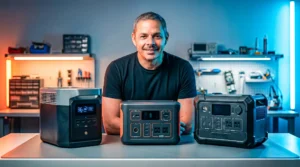
How to Choose Your Portable Electric Station: Buying Guide
The market for portable batteries has exploded in recent years, offering solutions for autonomy ranging from simply recharging a smartphone to fully powering a household in distress. But between pocket-sized...
Coming soon
We're Caroline and Xavier
We got most of it wrong before we got it right. We share what actually holds up day to day in a van, and what we wouldn't do again.
Ce que vous souhaitez recevoir :
Licence and weight: what you’re allowed to drive (and the overloading trap)
Good news first: in the UK, a standard category B licence lets you drive the vast majority of campervans and motorhomes, as long as the vehicle stays under 3,500 kg MAM (maximum authorised mass). Our A-class sits under that limit, so no panic, you don’t need anything special to get going. The catch is the bigger, heavier motorhomes: anything over 3,500 kg needs a C1 licence, which means an extra test and a medical (the D4 form). If you passed your driving test before 1 January 1997, you’ve probably got C1 grandfathered on your licence already, so check your categories before you fall for a big A-class.
But honestly, the real trap isn’t the licence, it’s the weight. Because when you start out in vanlife, we ALL do the same thing: we overload. We bring the paddleboard “just in case,” three boxes of books, the full kitchen set, and 100 litres of water always topped up (and 100 litres of water is 100 kilos, remember). And I’m speaking from experience, because it’s only now, getting back on the road after a few years, that I realise how overloaded we were at the very start. So the advice is: pick a vehicle that leaves you a real payload margin, and learn to travel light. Your clutch, your brakes and your wallet will thank you.
The destination dictates the vehicle (and the windscreen isn’t always the enemy)
This is probably the factor that’ll influence your choice the most, because depending on where in the world you plan to drive, some vehicles are brilliant and others much less so.
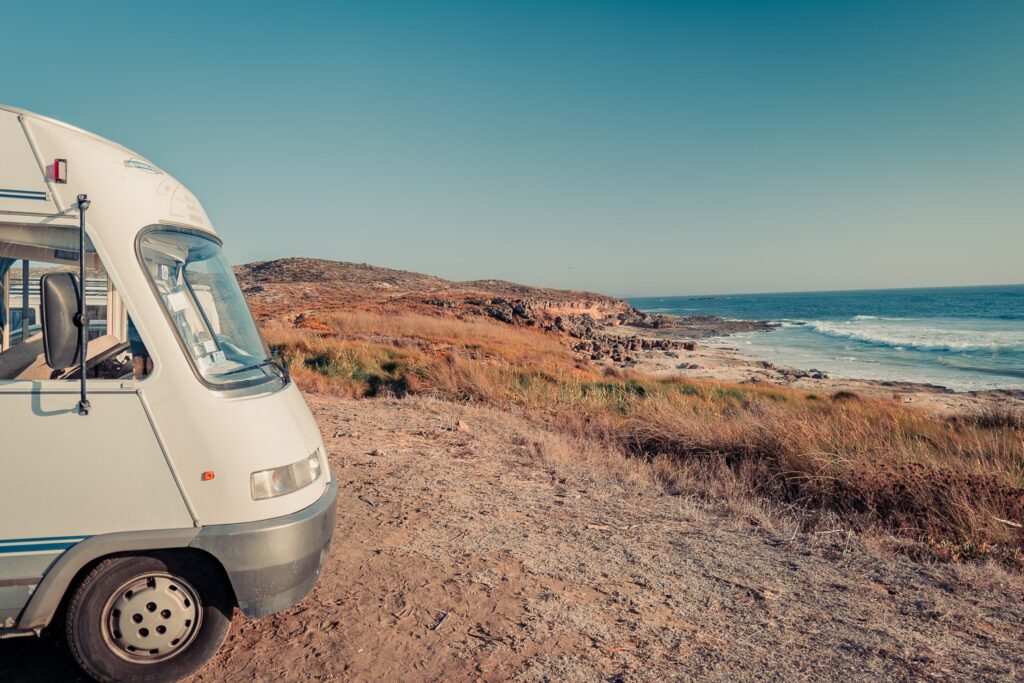
For Europe, our A-class is great. It’s 6 metres long, spacious, and well enough insulated for us to head south in winter and back north in summer. On the wide roads of North America it would be perfect too. But on really tricky terrain, tracks, or proper off-road, it would give us a few scares, because of both its size and its age. For that kind of trip you want a converted 4×4, not a 6-metre A-class.
And here’s a little counterintuitive tip about the big windscreen on A-class motorhomes. Everyone will tell you it’s a thermal bridge, that you’ll freeze in winter, and that’s not wrong. But what nobody tells you is that if you park facing the sun, that big sloped windscreen actually lets in far more light and warmth in the depths of winter than the little windows on other vehicles. In southern Europe in winter, parked due south, it’s a proper free radiator (we spend our winters chasing the sun down south, and it makes a real difference). So the thermal bridge, as so often, cuts both ways.
Our choice: why Édouard the A-class (and what I’d pick today)
So for the reasons I’ve just gone through (comfort, layout, Europe, year-round work), the A-class was the best solution for us, and Édouard really is the perfect motorhome for travelling around Europe year-round. If you fancy seeing it in person, we made a little walkaround video:
But here’s the interesting bit. At first, the A-class seemed way too expensive to me, and I was leaning more towards an overcab or a panel van. I mainly wanted to avoid something too long, because I’d never driven a big vehicle and I wanted to keep it manageable. And then chance threw the right ad my way.
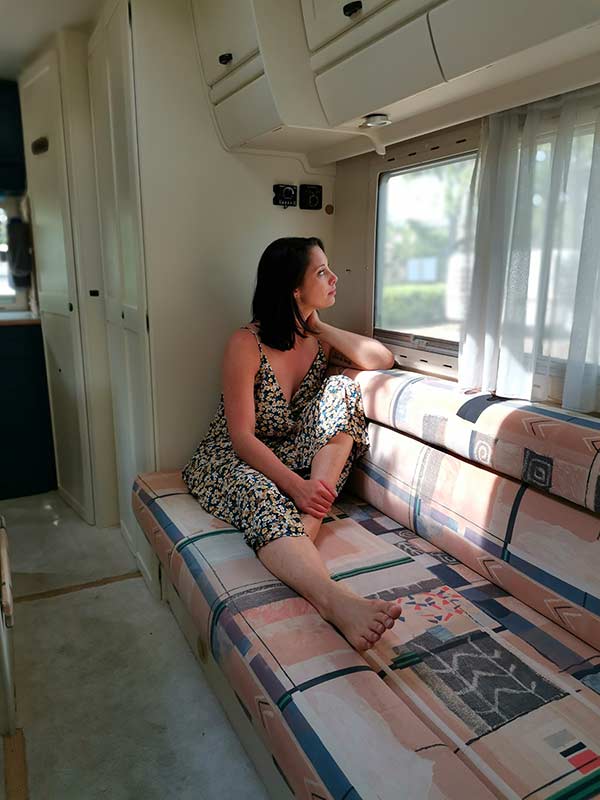
What I love about our Hymer B544 is its drop-down bed, the one that comes down over the cab and lifts up against the roof during the day. At first it worried me; I thought I’d roast under it… but not at all, it even adds a bit of warmth in winter. More importantly, lifting the bed frees up maximum floor space, and when every square metre counts, that changes everything. That’s why I never wanted a fixed elevated bed that eats your floor space all day long.
And the size, the age, the 200,000 km? No regrets, ever. We did snap a clutch, fair enough, but these are reliable engines, it’s a Fiat Ducato base so you find parts absolutely everywhere in Europe, and as long as there was no AdBlue to deal with, it suited me perfectly. With the full service history, I drove with real peace of mind.
So, would I buy exactly the same thing today? Not sure, and that’s what’s funny. If I had to replace Édouard, it would either be to get rich and buy something massive like a Morello or a Concorde (those things that are more coach than motorhome), or, and this is what really excites me, it would be to be among the first to drive an electric motorhome. For me, that would be the dream. And since the closest thing to electric today is the van, I’m definitely not ruling out a panel van for the future, especially one with a pop-top roof to save floor space. But that would be for a trip where we’d work less. You see, once again: it’s the journey that chooses the vehicle.
Which vehicle for vanlife: frequently asked questions
What type of vehicle should you start vanlife with?
The easiest to live in and to drive is a compact panel van conversion. You park almost anywhere, fuel stays reasonable, and you quickly learn what you're really missing before spending more. For a first big trip as a couple, it's the best balance of manoeuvrability and comfort.
Campervan, van conversion or motorhome: which to choose?
It mainly depends on how long your trip is and how many of you there are. Weekends, solo or as a couple: a campervan or small conversion is plenty. Year-round, especially if you work on board: aim for a well-fitted conversion or a motorhome, so you have a real bit of comfort.
What budget for a vanlife vehicle?
Second-hand, reckon from around £15,000 for a panel van conversion or an older overcab, around £25,000 for a low-profile coachbuilt, and £35,000 and up for an A-class. And don't forget the hidden cost: the conversion and especially the electrics if you work on board.
Can you drive a motorhome on a category B licence?
Yes, as long as the maximum authorised mass (MAM) stays under 3,500 kg. The vast majority of conversions, coachbuilts and even many A-class motorhomes come under that. Above 3,500 kg you need a C1 licence. If you passed your test before 1 January 1997, you likely already have C1, so check your licence.
Which motorhome stays under 3,500 kg on a B licence?
Conversions and most coachbuilts and overcabs stay under 3,500 kg. With A-class motorhomes, some lighter models qualify, others don't. The real catch isn't the licence but the payload: a van at 3,400 kg empty leaves you very little margin for water, kit and passengers.
Van conversion or motorhome for a beginner?
A conversion is more reassuring to start with: shorter, easier to handle, more discreet, and you park almost like a car. A motorhome gives you more comfort (shower, proper beds) but takes some getting used to size-wise. If in doubt, start small, you can size up later.
Which type for two people or for a family?
For two, a conversion or a small low-profile is plenty, especially if you travel light. With kids, the overcab is hard to beat for its beds above the cab, or a coachbuilt or A-class with bunks. The key criterion: the number of proper, certified berths.
What's the cheapest camper?
Second-hand, an entry-level panel van conversion (from ~£15,000) and an older overcab coachbuilt are the most affordable. A used VW campervan can also be budget-friendly, but watch out, VWs hold their value very well.
Better to buy new or used?
To start, used is nearly always the right call: you lose less on resale and you learn what you actually want. What matters most isn't the mileage, it's the service history. A vehicle at 200,000 km with every invoice beats a mystery one at 80,000.
Which type of motorhome holds its value best?
Panel van conversions and VW campervans are the most sought-after used, so the easiest to resell and the slowest to depreciate. Big high-end A-class motorhomes sell more slowly. If resale matters to you, stick to a versatile format and a known brand.
Low-profile or A-class for winter and fuel?
The A-class is more comfortable and often better insulated, but its bigger volume drinks a little more. The low-profile, more aerodynamic, uses less. For winter, look mainly at insulation and heating, not just the type. And a big A-class windscreen, parked facing the sun, warms you for free.
Do you need a 4x4 for vanlife?
For travelling around Europe on roads and aires, no, two-wheel drive is plenty. A 4x4 only makes sense if you're really going off-road or beyond Europe (Africa, Central Asia, tracks). It costs more to buy, to run and at the pump for a use 95% of travellers will never have.
Is a pop-top roof worth it?
On a conversion or a campervan, yes: it gives you a proper raised bed without eating your floor space during the day, exactly like a drop-down bed. It's the best way to gain room in a small vehicle. Only downside: a bit less insulation on the canvas side.
P.S.: If you ever spot a 6-metre A-class parked due south in the dead of winter with a bloke in shorts inside working on his laptop, say hello to Édouard from us.
Fitting out, equipping, making it last
Batteries, solar, conversion, security. What we found after months of real use, and what we would not buy again. An email when we have actually tested something, not before.
Ce que vous souhaitez recevoir :