



Well, let me tell you right away, and it might surprise you coming from us: we have gas. Our Hymer Édouard cooks with gas, heats with gas, and the fridge runs on gas for a good part of the year. So when I talk to you about “living without gas,” I’m not speaking from my little cloud of someone who got everything right the first time. I’m speaking from the other side, the one that faced all the hassles of gas and who, precisely because of that, looks at all-electric with longing eyes.
Because the real question is not “is it possible” (the answer is yes, people do it), but rather “is it worth it for you.” And that depends on how you cook, where you travel in winter, and how much you’re willing to invest in batteries. We’ll break down the four functions that gas provides in a van (cooking, heating, fridge, hot water), the famous gas safety certificate question, and the honest assessment at the end. I promise, I’m not selling you anything.
Why would you want to do without gas in your van?
There’s the reason we highlight in articles (safety) and then there’s the one we really experience on the road (logistics). Let’s start with the one we experience.
Our first real anti-gas moment was in Porto, our first winter. We headed down to Portugal all excited, and then, impossible to refill our bottles. We had French bottles, and a French bottle doesn’t refill just anywhere across the border (each country has its system, its regulations, its standards). You find yourself in a bind, with your heating and stove relying on something you can’t refill. That was the exact moment we thought: gas is a hassle.
What followed was a little saga I’m not particularly proud of. To make do, we bought one of those rechargeable hybrid bottles, you know, a classic bottle with an entry to plug in a GPL pump. But as soon as we showed up at the station, the answer was a flat no: “No, we won’t fill that for you.” And they’re right, it’s illegal (refilling a mobile bottle without a fixed and approved filling point outside the vehicle is a no-go). Result: a gas bottle bought for nothing. If you want the short version of the lesson, here it is: with gas, DIY always costs you more than expected.
We ended up having a real GPL system installed with a approved external outlet, and frankly, for those who drive year-round, GPL remains a good solution. But even then, surprise: you need a different nozzle for each country. The French connector doesn’t fit in Portugal, which is different from Spain, which is different from Italy, which is different from the UK. We carry a little bag of adapters like others carry phone chargers. That’s the reality of gas while traveling: it works, but it keeps you busy.
And then there’s safety, the real kind, the one we tend to forget because “it only happens to others”:
In short, we don’t do without gas out of eco-ideology (though it could be), but because it’s one less point of dependency and stress. Now, let’s see what it costs to replace it, function by function.
Gas safety certificate: do you even need one if your camper is gas-free?
So hold on tight, because this is THE topic with the most nonsense floating around it, and it’s also (admit it) the reason a lot of you ended up here.
First truth that surprises many: gas is not mandatory to build or register a campervan in the UK. Nothing in the rules says your cooking has to run on LPG. A properly fixed induction hob and a clean electrical setup tick the “cooking” box just fine.
Second truth, the one nobody states plainly: a gas safety certificate is not legally required for a privately owned, privately used campervan. It becomes a legal requirement the moment you hire it out or rent it, under the Gas Safety (Installation and Use) Regulations 1998. And even for private use, your insurer or a campsite may well ask to see one before they cover you or let you pitch up.
Now connect the dots, because this is the part the gas-free crowd never spells out: no gas means nothing to certify. The relevant standard, BS EN 1949, governs LPG installations in leisure vehicles; rip the installation out and the recurring obligation goes with it. A Gas Safe registered engineer (with the LPG and LAV qualifications, mind, a domestic boiler fitter can’t sign it off) is who you’d be paying otherwise, and a certificate runs roughly £85 to £255. That’s the bill a gas-free build quietly dodges, year after year.
That said, gas-free doesn’t mean zero safety paperwork. You still want a carbon monoxide alarm and a smoke alarm (your diesel heater and your own cooking still deserve respect), and a habitation check covers the rest of the living area. We, for the record, have never had a gas inspection on our side, but don’t take that as a given: depending on where you are and how you use the van (especially if you ever rent it out), the rules change fast.
Cooking without gas: induction in daily life
I’m going to be honest about this part because it’s important: we cook with gas, on a good old three-burner stove that came with Édouard. We’ve never made the big leap to long-term induction. The only “electric” we’ve used is occasionally plugging in a small electric barbecue to our EcoFlow battery (the Delta 2 at the time), and even then, rarely. So what follows is honest analysis, not a “look how I’ve succeeded.”
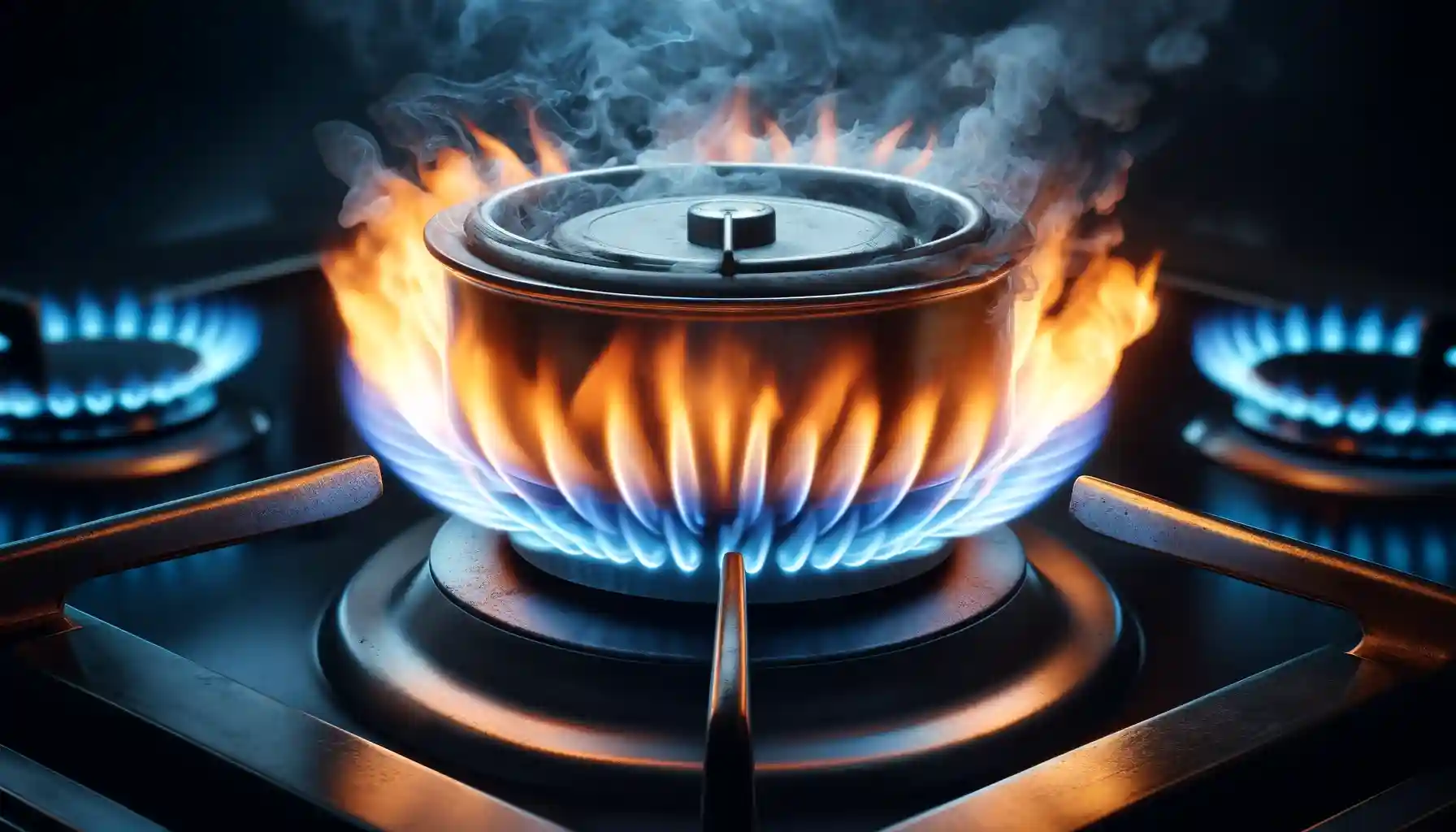
The principle of induction is that it heats the pot directly through a magnetic field, without flame and with excellent efficiency (over 80% of the energy goes into the food, compared to half for gas which mainly heats the air around). The catch is the instantaneous power it demands: an induction hob easily draws 1500 to 2000 watts when it’s cranked up. And 2000 watts, for a van battery, is huge in the moment.
In practical terms, here’s what that implies: you can’t do serious induction with just a few gadgets. You need a substantial lithium battery (count on 200 to 300 Ah of LiFePO4 minimum if you want to cook without anxiety), a robust pure sine wave inverter (at least 2000 W), and a way to recharge afterwards (solar, alternator). The good news is that a meal doesn’t take three hours: sautéing onions, cooking pasta, or using a griddle takes just a few minutes at full power, then you turn it down. Over the course of the day, cooking weighs less than we imagine.
What works with induction: everything that’s quick and everything that’s simmered on low heat. What works less well: “flame cooking,” the screaming wok, and the psychological comfort of being able to cook even when the battery is flat (with gas, as long as there’s a bottle left, you can eat hot). Many all-electric nomads end up using “one pot, a multicooker, an air fryer,” and they do just fine. It’s more of a change in habits than a deprivation.
Heating without gas: diesel, king of winter
Heating is the area where gas has long been unbeatable, and it’s also where the alternative is now the most convincing. For us, it’s a gas Truma heater, and I’ll be frank: it works very, very well. Our only concern has nothing to do with gas; it’s that our air distribution ducts are pierced, so sometimes the heat goes more into the storage compartments than into the living area (a classic issue with used motorhomes).
If we had to redo the installation from scratch and get rid of gas, we would definitely go for the diesel autonomous heating. The idea is brilliant: it draws from your fuel tank (the same one that makes you go), consumes very little electricity (just for the fan and ignition), and provides dry, powerful heat. A full tank of diesel, and you have enough to keep warm for weeks. Here are the options, from the most well-known to the cleverest.
The diesel air heater (Webasto, Autoterm, Planar)
This is the reference. A small unit under the floor or in a storage compartment that draws air from the living area, heats it, and blows it out through vents. Webasto and Eberspächer are the historic brands (expensive but indestructible), Autoterm (formerly Planar) offers excellent value for money, and the famous “Chinese heaters” at £120 are making waves because they really heat, even if the finish and safety are more variable.
The combined diesel air + hot water heater (Truma Combi D, Autoterm Flow)
The two-in-one version: the same device heats the living area AND produces your hot water, still using diesel. It’s the direct equivalent of the gas Truma Combi that many know, but without the bottle. More expensive to buy, but you set the heating and hot water in one go, which is precisely two of the four functions of gas.
Electric solutions (and grandma’s methods)
You can also heat purely electrically (fan heater, or even a reversible air conditioning unit like a heat pump), but here, watch out for the energy bill: heating with electric resistance is the most gluttonous way for a battery. It works in a campsite plugged into 230 V, but it won’t last a winter night autonomously. And then there are the classics that consume nothing: good insulation, thermal curtains, a serious sleeping bag, and the tip I give you for free, choose where you spend the winter.
The fridge: compression vs absorption (the real match)
If you remember one technical thing from this article, let it be this, because this is where the gas-free living really plays out daily.
There are two main families of fridges in motorhomes. The absorption fridge (called trimix), which can run on gas, 12V, or 230V. That’s what we have at home. And the compression fridge, which only works on electricity (like the one in your kitchen, but smaller). And between the two, it’s not a balanced match as soon as we talk about autonomy.
Absorption is silent and doesn’t tolerate heat well (beyond 30 degrees outside, your trimix struggles to cool down). Moreover, in 12V mode, it is so power-hungry that it drains a battery in a few hours, which is why we run it on gas while driving and when stationary. The compression fridge, on the other hand, is much more economical in electricity (a good model runs around 30 to 40 Ah per day), it maintains its power even in extreme heat, and it doesn’t care much about the vehicle’s tilt. It’s the only coherent choice once we eliminate gas.

A little aside about our personal hack, because I’m quite proud of this one. To relieve our trimix in summer without switching to gas, I set up two separate electrical networks: the original network of the motorhome, and a second independent network powered by 450 W of solar panels. When the sun is strong at noon, I inject my secondary network into the main network via the external socket (the one you plug in at a campsite), and voila, the fridge switches to solar electric during the hot hours. It’s a DIY system, but it illustrates the idea well: with solar power and a bit of ingenuity, we can already start to unplug from gas.
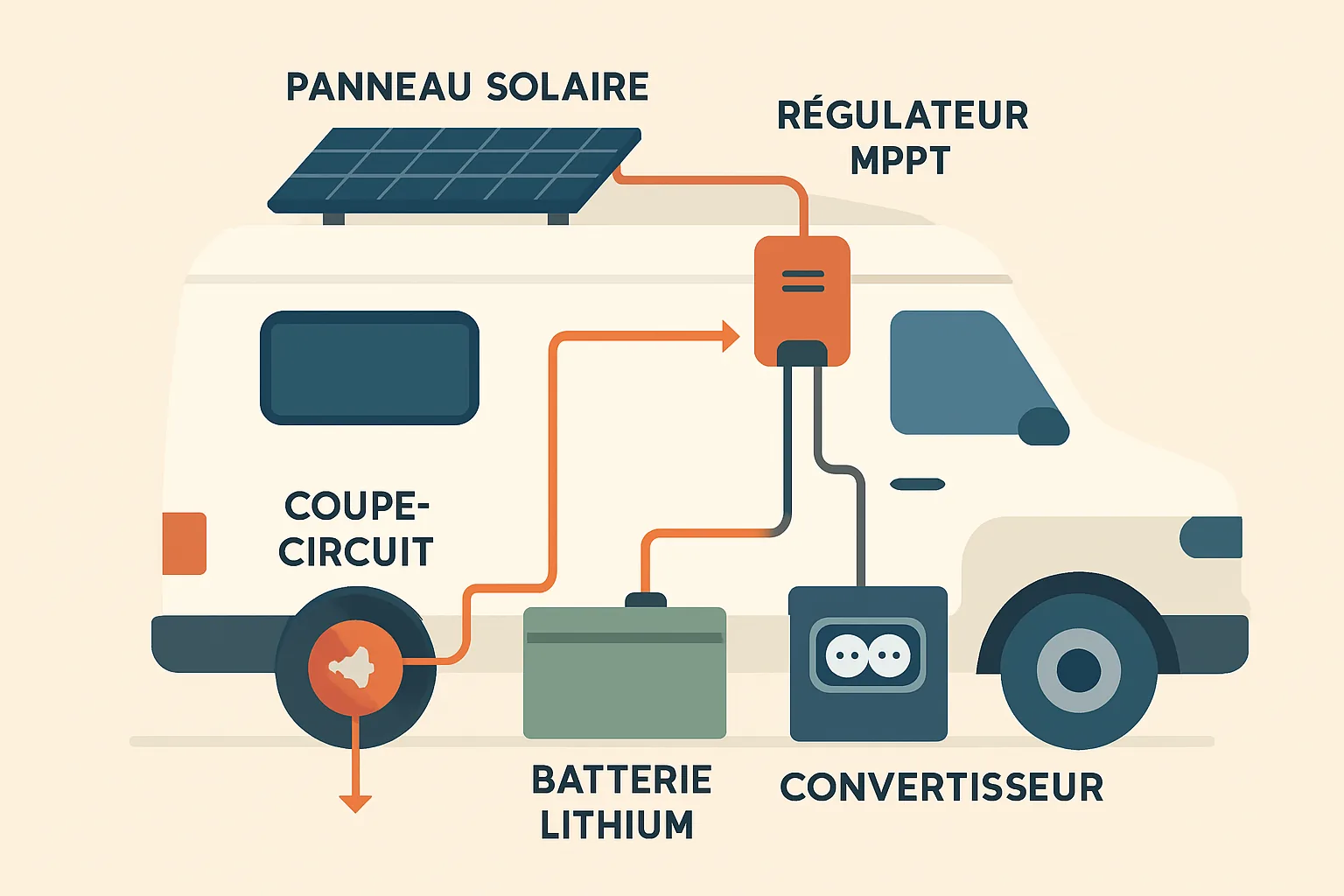
If you want to delve into the sizing of all this (how many panels, what battery, what station), we have two dedicated articles that we won’t repeat here: managing your electricity while wild camping and our comparison for choosing your portable power station.

We're Caroline and Xavier
We got most of it wrong before we got it right. We share what actually holds up day to day in a van, and what we wouldn't do again.
Ce que vous souhaitez recevoir :
Hot water without gas: less complicated than you think
It’s the function we always forget, yet a hot shower after a day of hiking is priceless. Good news: going without gas for hot water is probably the simplest of the four.
The first option is the dedicated electric water heater (Truma Therme, Elgena Nautic): a small tank of a few liters that you heat on 230 V when you’re plugged in or when your battery allows it. Simple, reliable, but energy-consuming if you want hot water while fully off-grid.
The second option, and the smartest one, is the diesel combined air + water heater I mentioned earlier (Truma Combi D, Autoterm Flow). Since your diesel heater is already running, why not let it produce hot water in the process: you share a single energy source (diesel) for two functions. In my opinion, this is the winning combination for a truly gas-free van.
The third option for tight budgets or sunny days is the pure auxiliary solutions: a water heater that recovers heat from the engine while driving (heat exchanger), a solar shower placed on the roof that gives you free lukewarm water in the afternoon, or simply heating water in a pot on induction. Not glamorous, but it comes in handy more often than we admit.
The honest assessment: autonomy, weight, budget, winter
Now that we’ve looked at each function, let’s lay things out coldly, because I hate articles that sell you dreams without showing you the bill.
The first thing to digest is the energy density of gas. A 13 kg bottle is equivalent to about 80 to 90 kWh of energy, for about £30 and 13 kilos. To store that much in lithium batteries, you would need the equivalent of several thousand pounds worth of cells and a comparable weight. In other words: gas is unbeatable in pure storage. The gas-free option doesn’t win in this area; it wins in all the others (safety, simplicity, no recharging at the border, no maintenance).
In terms of budget, a serious all-electric installation (large LiFePO4 battery, pure sine inverter, generous solar panels, diesel heating, compression fridge) quickly adds up to several thousand pounds, whereas a classic gas installation costs a fraction of that. But it’s an investment that pays off in the long run and, above all, gains its full value if you live in your van year-round and seek total autonomy.
And in winter, let’s be clear: it’s the ultimate judge. In gray and cold weather, your panels produce a pittance just when you consume the most (heating, lighting, fridge running). Pure all-electric in the middle of a Nordic winter without driving or plugging in is an equation that doesn’t add up. That’s exactly why the diesel heating changes everything: it frees you from battery dependence for the most power-hungry function.
So, what would we do? I’ll tell you my honest thoughts. Our dream, the real one, the one that would make us hit the road for much longer, is the all-electric and composting toilets (getting rid of the WC cassette and gas at once, for several days of autonomy parked in a slow travel spot, while the panels recharge everything). I know very well that it’s still a bit of a utopia with today’s solar technology; we would need ultra-efficient panels. But it’s clearly the direction to go. If you’re starting a new build today, indulge yourself, aim for gas-free from the start, you won’t look back. And if, like us, you already have gas, start nibbling away at it (a compression fridge here, an induction plate there) before switching everything over.
Gas and its alternatives, function by function
What it takes to replace each of the four functions of gas, and how it really changes daily life.
| Function | The gas-free solution | Required electric energy | Indicative budget | Winter verdict |
|---|---|---|---|---|
| Cooking | Induction hob (+ multi-cooker, air fryer as backup) | High at the moment (1500-2000 W), low throughout the day | £100-£300 | Worry-free (quick cooking) |
| Heating | Standalone diesel heater (Webasto, Autoterm, Truma Combi D) | Very low (just blower + ignition) | £250-£1500 | Excellent (the winter weapon) |
| Fridge | Compression fridge (forget absorption/trimix) | Moderate and constant (~30-40 Ah/day) | £300-£900 | Very good (low consumption) |
| Hot water | Electric water heater or combined diesel air + water | High if purely electric, low if combined diesel | £150-£1200 | Variable (combined diesel recommended) |
Indicative budgets excluding installation and excluding battery/solar (the real major expense of a gas-free van). To be weighed according to your usage: weekend plugged in at a campsite or total autonomy year-round.
Living gas-free in a van: your questions
Is gas mandatory to build or register a campervan in the UK?
No. A campervan needs the right living functions on board (sleeping, seating, table, storage, a way to cook), but nothing says the cooking has to run on LPG. A fixed induction hob and a clean electrical setup tick the box perfectly well.
Do I legally need a gas safety certificate for my campervan?
Not for a privately owned, privately used van. A gas safety certificate becomes a legal requirement when you hire or rent the vehicle out, under the Gas Safety (Installation and Use) Regulations 1998. Even for private use, though, your insurer or a campsite may ask to see one.
Does going gas-free mean I avoid the gas safety check entirely?
Yes, in the sense that there is no LPG installation left to certify, so the recurring gas check has nothing to inspect. BS EN 1949 governs LPG installations in leisure vehicles; remove the installation and the obligation goes with it. You still want a carbon monoxide alarm and a smoke alarm, and a habitation check covers the rest of the living area.
How much does a gas safety certificate cost (the one you'd avoid)?
Roughly £85 to £255, carried out by a Gas Safe registered engineer holding the LPG and LAV (Leisure Accommodation Vehicle) qualifications, a domestic boiler fitter can't sign it off. Going gas-free quietly saves that recurring bill.
How big a battery do I need to cook on induction?
An induction hob pulls 1500 to 2000 watts at full power. To cook without anxiety, plan on at least 200 to 300 Ah of lithium (LiFePO4) battery, a pure sine wave inverter of at least 2000 W, and a way to recharge (solar, alternator). The good news: a meal only runs at full power for a few minutes, so over a day cooking weighs less than you'd fear.
How much does a full electric setup cost to replace gas?
A serious setup (large LiFePO4 battery, pure sine wave inverter, generous solar, diesel heater, compressor fridge) quickly runs into several thousand pounds, where a classic gas setup costs a fraction of that. It pays off if you live in the van year-round and want real autonomy.
Is a diesel heater dangerous for carbon monoxide?
A correctly installed standalone diesel heater vents its combustion gases outside: the warm air blown into the cabin never touches the fumes. It's arguably safer than an open gas flame. On budget models (the famous cheap heaters), always fit a CO alarm to be safe.
What's the difference between an absorption (trimix) and a compression fridge?
An absorption (trimix) fridge runs on gas, 12V or 230V, but it's silent, struggles above 30 degrees and drains a battery within hours in 12V mode. A compression fridge runs on electricity only, uses far less (around 30 to 40 Ah a day), keeps its power in a heatwave and ignores tilt. Once you drop gas, compression is the only sensible choice.
Does a fully electric van really cope with winter?
Winter is the decider. On grey, cold days your panels produce little exactly when you consume the most. Fully electric in deep northern winter, without driving or plugging in, is an equation that doesn't add up. That's precisely why a diesel heater changes everything: it takes the hungriest function off the battery.
How do I get hot water without gas?
Three options: a dedicated electric water heater (Truma Therme, Elgena Nautic) on mains or battery; a combined diesel air + water unit (Truma Combi D, Autoterm Flow) that shares one fuel for heating and hot water, the smartest route; or backup solutions (an engine heat exchanger while you drive, a roof solar shower, a pan of water on the induction hob).
Should I keep a small gas bottle as a backup?
It's a question of habit. Some fully electric nomads keep a little cartridge stove in a cupboard, just for the day the battery is flat and the sky is grey. That's not a return to gas, it's a spare wheel. If it reassures you to start out, why not, and you can drop it once your confidence is built.
Is one fuel (diesel) really simpler than carrying gas bottles?
For a year-round traveller, yes. A diesel heater, a compressor fridge and an induction hob all draw from the same diesel tank you drive on, plus your batteries. No LPG locker, no bottle swaps, no hunting for the right refill adapter in each country, and no gas certificate to chase. That simplicity is half the appeal of going gas-free.
To go further on energy onboard, these three complement each other well:

Getting Electricity in Off-Grid Vanlife
From fixed solar installations to portable batteries and smart energy management, we'll explain everything you need to know.
Read more
How to Choose Your Portable Electric Station: Buying Guide
The market for portable batteries has exploded in recent years, offering solutions for autonomy ranging from simply recharging a smartphone to fully powering a household in distress. But between pocket-sized...
Coming soon
All-Electric Vanlife: What’s the Deal with Electric RVs and Vans?
All-electric vanlife sounds perfect, but in practice, for those with only a few weeks of vacation, frequent recharges and dependence on charging stations can really extend the journey. For year-round...
Read morePS: since we had LPG installed, we have a small bag of adapters, one for each country. France, Portugal, Spain, Italy, United Kingdom. At this stage, I think I’m collecting filling nozzles like others collect fridge magnets. Except my fridge, it’s gas. For now.
Fitting out, equipping, making it last
Batteries, solar, conversion, security. What we found after months of real use, and what we would not buy again. An email when we have actually tested something, not before.
Ce que vous souhaitez recevoir :