


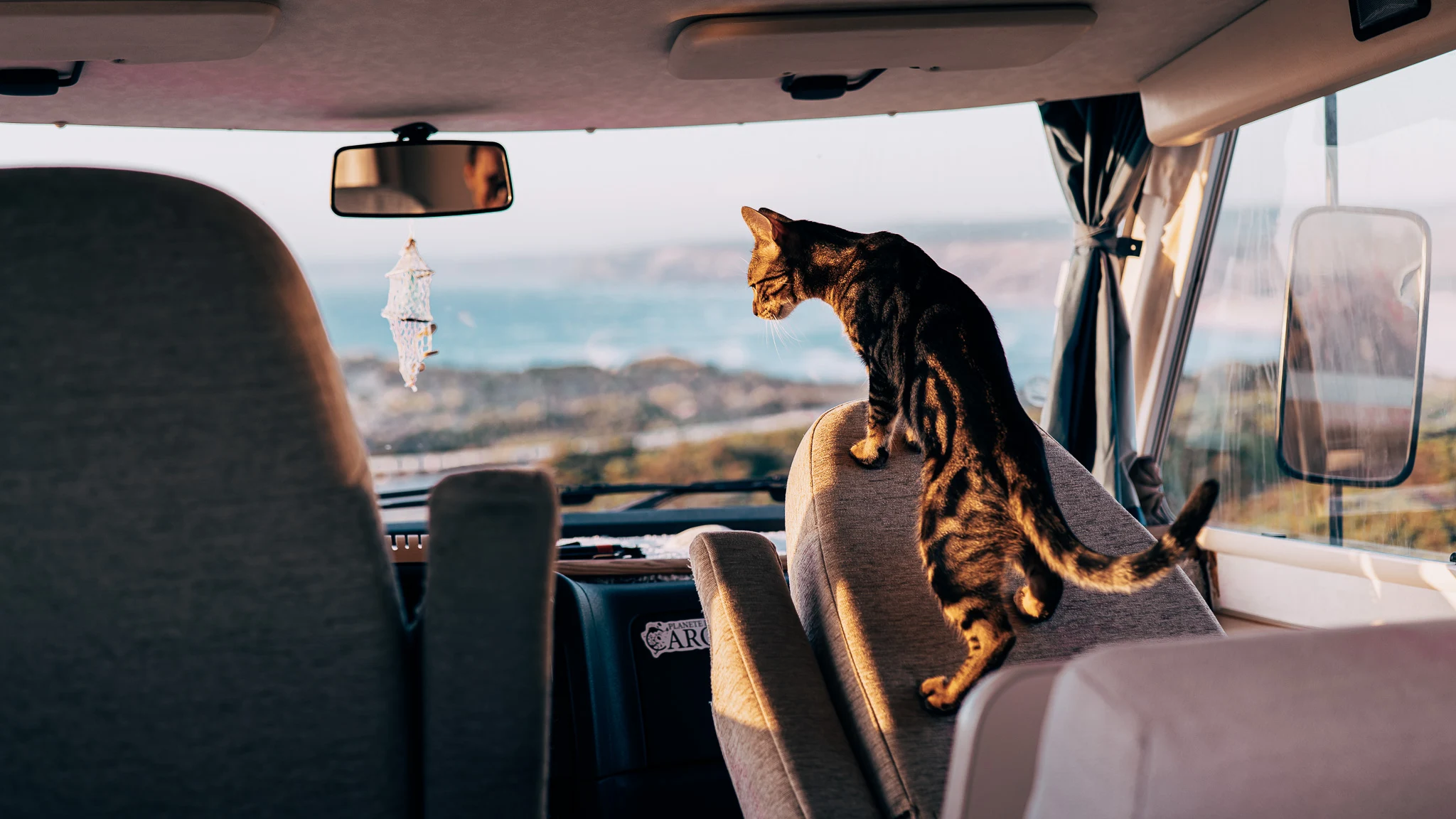
So here it is, I’m going to be honest with you from the start: our big road trip, the real one that started it all, we did it without an animal on board. At that time, we didn’t have one. Then a few months ago, we adopted Vasco from a shelter, a cat who hadn’t asked for anything from anyone, and of course… when we took the camper van again, the question arose. Do we take him with us, or do we have someone look after him?
We took him with us. And since then, we’ve done several short trips with him, enough to form a real opinion based on experience rather than just regurgitating the advice sheet that everyone copies. Because there are articles about “traveling in a van with your dog” that list ten affiliate accessories everywhere. What I’m sharing here is what we’ve actually tested, with our struggles and discoveries (and a torn mosquito net, we’ll get back to that).

Having an animal in a van is something you learn (for him, and a bit for you too)
The thing that nobody tells you is that the first day doesn’t mean anything. When we first put Vasco in the camper van, he meowed all over the place, trying to figure out where the apartment had gone… and then he quickly realized it resembled a rolling apartment. Same smells, same humans, same bowl. A cat (or a dog) doesn’t hate the van; it hates the sudden change.
So the real advice is NOT to make the first night in the van the very first trip of their life. Since we both work from home, we’re with him 24/7, and we had already taken him in the car, to the beach, to my mother’s, in an expandable transport bag (the kind of backpack that grows). So the van was just another step, not a leap into the void. If you’re starting from scratch, begin with short trips; the goal is for him to associate the vehicle with “we’re going somewhere nice,” not “we’re going to the vet.”
And you can see the habituation happening almost in real-time. On our first little week-long road trip, Vasco meowed at first, then less and less. In the first few days, he stayed curled up, head in the air, never really relaxed, his ear twitching at the slightest noise. Then after a few days, he ended up actually sleeping in his basket, sprawled out like a pasha. So if your animal is stressed at first, don’t judge too quickly… give him his adaptation curve; it counts in days, not minutes.
Setting up the van so he feels at home
Now we’re getting into the practical side because this is where it matters. Having an animal in a van is mainly about organizing the space (and when you have 10 square meters, every centimeter counts, believe me).
The best find on our side, by far, is the litter box suitcase. Basically, it’s a closed litter box in a kind of suitcase, found on Amazon. Why is it great? Because the litter doesn’t spread all over the vehicle as soon as you take a roundabout (the absolute nightmare of an open litter box spilling during a turn), because we place it in the bathroom of the camper van and it doesn’t smell any worse than our own toilets, and because we can transport it everywhere. We even take it to Airbnb or to my mother’s. A litter box that moves with us provides continuity for the cat, and continuity is what reassures him.
Next, the bedding and transport are the same item for us. While driving, Vasco settles between us in the front, always in his bag, which I call his little house in the big house. He doesn’t roam around the vehicle when we’re driving (it’s safer for him, and an animal wandering in a moving vehicle is dangerous for everyone), and the bag serves as a reassuring den. Since it’s the same bag we use at the beach and in the car, he associates it with travel and not with constraint.
For the rest, think smart without overloading: spill-proof bowls so water doesn’t splash everywhere at the first speed bump, a storage bin for food in an airtight container (otherwise the whole van smells like kibble), and ways to manage the heat, which I’ll get back to shortly because it’s a vital point. Here’s what we actually have on board.
The basic kit for traveling with your pet
What we really have in the van for Vasco (and what you would bring for a dog)
| Equipment | Why, specifically | Price reference |
|---|---|---|
| Litter box (cat) | The litter doesn't move around while driving, placed in the bathroom, portable everywhere | £30 to £50 |
| Expandable transport bag | Its home within a home, wedged between the front seats, also serves in the car and at the beach | £30 to £60 |
| Harness + leash | Supervised freedom at the stop, no risk of escaping towards the road | £15 to £30 |
| Anti-spill bowls | Water and kibble don't splash everywhere as soon as it sways | £10 to £20 |
| Sunshade + ventilation | Keep the cabin livable, trapped heat can kill an animal in minutes | £20 to £80 |
| Microchip + AHC (per trip) | Since Brexit, an Animal Health Certificate is needed for every trip from GB to the EU (at the vet) | £100 to £200 |
Indicative price references, it varies by brands and veterinarians. The idea is to give a rough estimate of a starting budget.
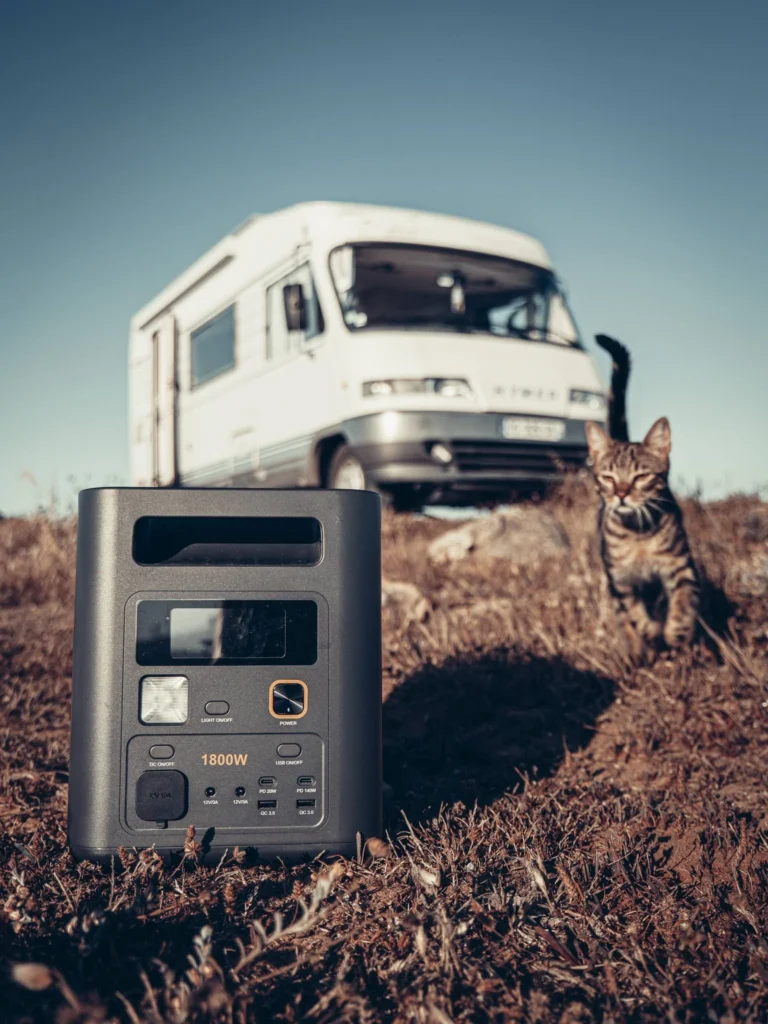
And because a picture is worth a thousand words, here’s the main interested party doing a technical check on his own electric station. Yes, he took over the van faster than we did.
At this stage: freedom, yes, but supervised
This is where the magic of van life with an animal happens… and the trap at the same time. When stopped, we always start with the harness and leash. And then, it completely depends on the location. If we’re in the middle of nature, isolated, with practically only us and no road nearby, we let Vasco explore freely. And the crazy thing is, he comes back. He quickly understood that the camper van was his travel home, his rallying point. As soon as a car approaches, he comes back on his own.
But (because there’s always a but, of course), I’m going to tell you about the time it almost went wrong, so you don’t make the same mistake. It was at the camping site in Porto Covo, Portugal. We went out to eat, relaxed, leaving the windows open with the mosquito net, thinking “he’s safe, everything’s fine.” We came back… and there, the mosquito net was torn from the inside. Vasco had made his escape. Caroline called him in the camper van, nothing, then she heard a meow… outside. The rascal had gone out to watch a face-off between two other cats at the campsite, frozen in place observing the duel like in a movie. Moral of the story: a mosquito net won’t hold back a motivated cat, and in a busy campsite (with other animals and cars), you don’t leave him alone behind a simple window screen.
And the most serious point of all van life with an animal is this: never alone in direct sunlight. A closed vehicle can heat up to 50°C in a few minutes, and it can kill an animal very, very quickly. This is non-negotiable. If you need to leave and it’s hot, either you take him with you, or one of you stays, period. By the way, everything we’ve learned to keep the van livable when it’s hot is even more important when there’s a furball inside.

Microchip, AHC, rabies: the paperwork before you leave Britain
So, let me be straight with you, because honesty matters: we haven’t crossed any borders yet with Vasco. For now our experience with him is within Portugal. But we’ve done our homework, and the day we actually go through it, we’ll come back here to tell you how it went, struggles included. In the meantime, here’s what you need to know if you’re setting off from the UK, and it applies whether you travel with a cat or a dog.
Since Brexit, the old EU pet passport issued in Great Britain no longer works for travel to Europe. To take your pet from GB to the EU, you now need an Animal Health Certificate (AHC), issued by an official vet no more than 10 days before you cross. Your animal must be microchipped and have a valid rabies vaccination, done at least 21 days before the certificate. The AHC covers your entry into the EU, onward travel for four months, and your return to GB within that window.
And watch the catch on the way home: coming back into Great Britain with a dog, you must have it treated for tapeworm by a vet between 24 and 120 hours (one to five days) before you arrive. An AHC is single-use, so you need a fresh one for every trip, and each costs roughly £100 to £200 at the vet. For non-EU destinations like Morocco, you’ll need an export health certificate and sometimes a rabies blood test, with timelines running into weeks. Check the exact rules for your route on GOV.UK well ahead. It’s the same logic as everything around the legal side of van life: better to know the rules before you leave than to discover the problem at the border.

We're Caroline and Xavier
We got most of it wrong before we got it right. We share what actually holds up day to day in a van, and what we wouldn't do again.
Ce que vous souhaitez recevoir :
Vet, small kit, and good manners in the area
Last block, because traveling with an animal also requires some health anticipation. We always take a mini-kit: its papers, its anti-parasitic treatment (ticks and fleas, especially in the South where they are rampant), something to clean a small wound, and the number of a vet identified in advance in our stopover area. For expenses on site, we seriously consider pet insurance, because a nasty veterinary surprise abroad can be costly (and our thinking about pet insurance raises the question of civil liability, often included where you least expect it).
And then there’s good manners, which is not a detail. In areas or camping, we clean up, systematically, without discussion. We avoid letting the animal bark or cry when we are away (that’s the best way to get on everyone’s bad side), and we respect the places where dogs are not welcome. Van life with an animal relies on a collective reputation: the cleaner and more discreet we are, the more the areas remain open to pets. It’s as simple as that. For the rest, we choose our stops by cross-referencing what we already know about places to sleep on a road trip, favoring nature spots where it can stretch its legs safely.
Vanlife with a pet: your questions (and our on-the-ground answers)
How to get your cat or dog used to the van?
Step by step, and definitely not on the day of the big departure. First, we took our cat for a drive, to the beach, to family, in his carrier, long before putting him in the camper van. Once on board, he meowed loudly... then he realized it was like a rolling apartment (same smells, same humans). Allow a few days on a journey for him to go from stress to peaceful sleep. Never judge an animal by its first trip.
How to manage a cat's litter box in a van?
The best find on our side: a litter suitcase (a closed litter box in a suitcase). The sand doesn't move around the cabin when we drive, we place it in the bathroom of the camper van and it doesn't smell more than our own toilets. Bonus: it can be transported everywhere, we even take it to Airbnb or to family. For a dog, we arrange for regular potty breaks and bags.
Should you secure your pet during travel?
It must be secured, yes. Either in a carrier bag wedged between the seats or strapped in, or with a harness connected to the seatbelt. An animal roaming freely in a moving vehicle is a danger to itself and to you (and it's a reason for a fine). Our cat travels in its bag, placed between the two of us in the front: its little house in the big house, it doesn't move.
Can you leave your pet alone in a van?
Never in full sun, never without monitoring the temperature. A closed cabin can reach 50°C in a few minutes and it can kill an animal very quickly. In the shade, with windows and hatch open, for a short duration and with water, at a pinch. And be careful: a simple mosquito net won't hold back a motivated cat (ours broke through it to go see other cats outside). When in doubt, we take it with us or one of us stays.
What paperwork do you need to take a pet from the UK to Europe?
Since Brexit, the EU pet passport issued in Great Britain no longer counts. You now need three things: a microchip, an up-to-date rabies vaccination (done at least 21 days before you travel), and an Animal Health Certificate (AHC) issued by an official vet no more than 10 days before you cross. The AHC covers your entry to the EU, four months of onward travel and your return to GB. We detail all of this earlier in the article.
Dog or cat, which adapts best to vanlife?
Both can live very well in a van, it mainly depends on the animal's character, not the species. A dog needs regular outings and physical exercise (so nature stops). A cat requires a litter box on board and a harness for outings, but it takes up less space. The real criterion: an animal that is already calm in the car and used to following you will leave more easily than an anxious animal.
My pet gets motion sickness, what to do?
Start with very short trips to gently acclimate, with the stomach rather empty (no big meals just before driving), and air it out. If it persists, a veterinarian can prescribe an anti-nausea medication or a suitable calming agent before a long trip. Avoid human self-medication, as it is often toxic to animals.
How much does an Animal Health Certificate (AHC) cost?
Expect roughly £100 to £200 at the vet for the AHC, and the catch is that it's single-use, so you pay it again for every trip to Europe. On top of that, budget the one-off microchip if it isn't done (around £15-£30) and the rabies vaccination (around £50-£70 with boosters). It's the recurring cost UK pet owners didn't have before Brexit.
Do you need insurance for your pet while traveling?
It's not mandatory, but we're seriously considering it. Your liability cover (often included in your home or van insurance) generally covers damage your pet causes to a third party. For vet bills abroad, pet insurance can save you from a nasty surprise, especially as an AHC and treatments already add up. Check what your existing policies cover before you leave.
What do you need to bring a pet back into Britain, or go further like Morocco?
Coming back into Great Britain with a dog, you must have it treated for tapeworm by a vet between 24 and 120 hours (one to five days) before you arrive, no exceptions. For non-EU destinations like Morocco, you'll need an export health certificate and sometimes a rabies blood test, with lead times running into weeks. Always check the exact requirements for your route on GOV.UK well in advance, because the delays are the part that catches people out.
What to do if my pet gets lost at a stop?
First, prevention: chip updated with your contact information, and a tag on the harness with a phone number. If it happens, don't panic right away: an animal tends to stay nearby and return to the van, which it identifies as its base. We call, we listen (we found ours by hearing its meowing outside), and we inform the campsite and local vets. The chip is what allows you to get it back if someone finds it.

Refreshing your van or camper, how to avoid heat in Vanlife?
Heat can quickly turn your vanlife adventure into a nightmare. But with the right insulation techniques, thoughtful layout, and a few clever tips, you can keep your van pleasantly cool,...
Read more
Is it legal to live in a van?
In this article, we will see if it is allowed to spend the whole year in a motorhome or other converted vehicle. What does the law say? What are the...
Read more
Where to Sleep on a Road Trip
Ready to find the best places to park your van for the night? From wild nature spots to service areas, this article explores the top spots for a peaceful night's...
Read morePS: the only time I wondered if it was a good idea to bring him along was when he kept us up two nights out of three because he couldn’t let off steam outside. The worst part is the paradox: when he has all the space outside, he prefers to sleep inside… and in the evening, just when we’re sleeping inside, he absolutely wants to go out. A cat, right?
Van life day to day, unfiltered
Two years of full-time van life, and the Algarve as our base ever since. We still hit the road, by van or otherwise, and we write up what we find along the way. An email when we have something to say, no more.
Ce que vous souhaitez recevoir :