


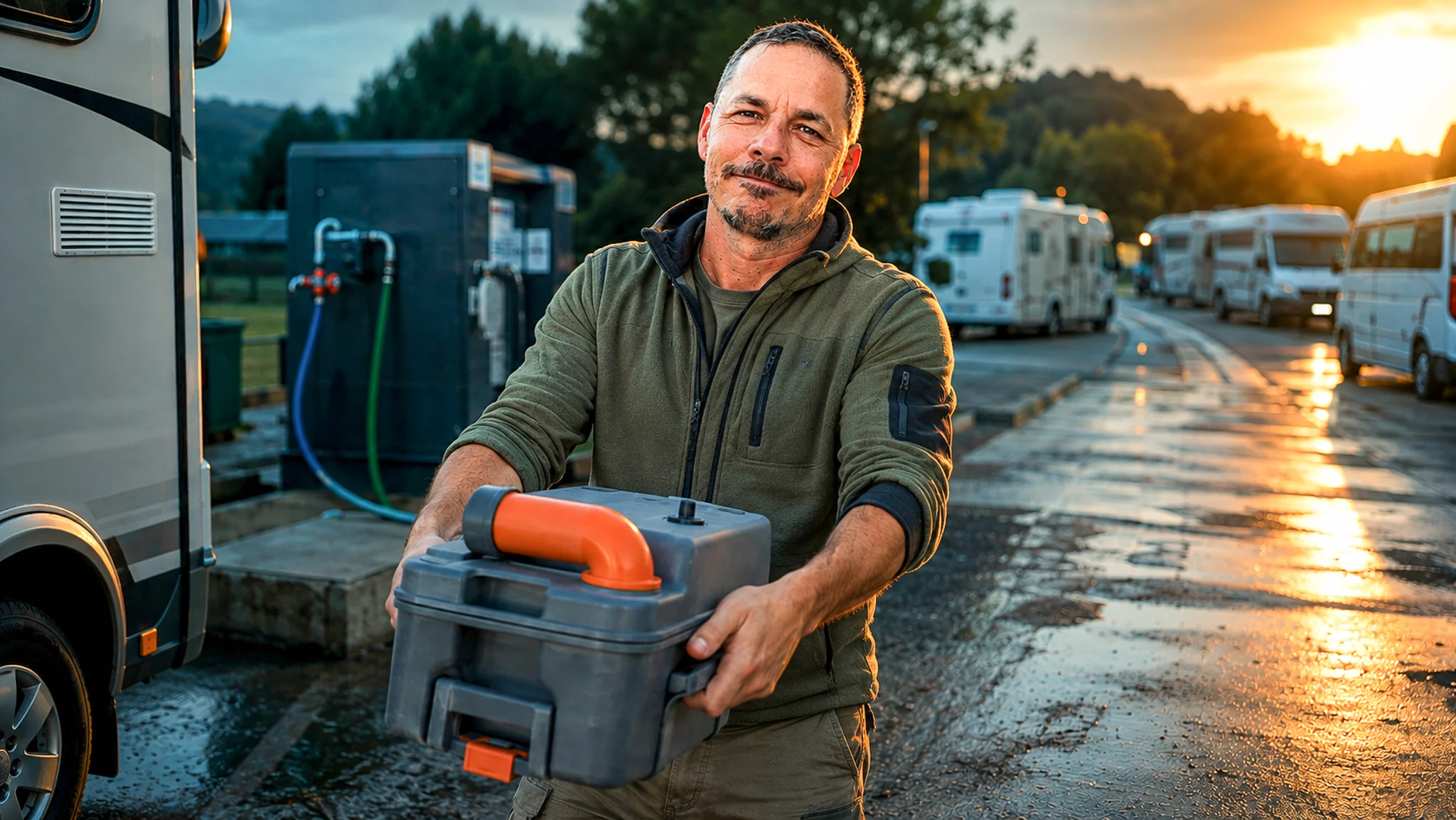
In our toilets, there has never been the slightest camper product. Not a blue pod, not a green jug, nothing. What we’ve been pouring into the cassette from the beginning is Bordeaux mixture, the kind used by gardeners, found on a forum one evening when I was looking to reduce the budget (and I specify right away that I have never used a branded product, so I have no basis for comparison, I will return to this later).
There, it’s said. The rest of this article is what we’ve learned living together, year-round, with a fifteen-liter cassette that is the same age as the camper. How it really works, how long it lasts, what triggers the smell, the day it overflowed, and why the dry toilets I’ve been dreaming of since the beginning are still not installed.
How a cassette toilet works
The principle consists of three parts. A bowl with its own flush tank, which is used only for flushing and is filled through a dedicated cap. A guillotine valve under the bowl, which isolates the rest of the time and which we open when using it. And below, the cassette, a removable tank that we will retrieve from the outside of the vehicle, through a hatch.
What’s really under the seat
Three parts, two unrelated water tanks, and a hatch that leads outside. Once you have that in mind, everything else makes sense.
The word chemical is scary, but it only describes one thing: the liquid we add to the cassette to block fermentation. Without additive, in two days in hot weather, bacteria take over and you know it right away. With an additive, they stop working. That’s all the product does, it dissolves nothing, it cleans nothing, it prevents rotting.
In our case, the cassette is the original one, from 1999, never changed. It’s no longer brand new, but it doesn’t leak, so we leave it alone. It’s really not the kind of thing you want to change every few mornings. I did buy a spare seal that I never installed, just in case, because in a camper you always like to have several things in advance. It has been sleeping in a storage compartment since then, and that’s just fine.
What we put in it: Bordeaux mixture
The initial reasoning was purely financial. Branded sachets, for two, year-round, add up on the grocery bill, and I looked for something else. Bordeaux mixture has been mentioned for years on French camper forums, with a dosage that revolves around a tablespoon and a half to two tablespoons diluted in half a litre of water. We prepare a dose in a bottle before pouring it into the cassette, and we have never changed the method.
What it results in: nothing. No stains, no deposits, no damaged seals, no surprises since we started using it. But I want to be honest about what this testimony is worth: I have never used a branded product, so I can’t tell you it’s just as good. I can only tell you that I haven’t noticed anything.
The classic one, the one sold with the camper. Very effective against odor, and for good reason: historical formulations rely on formaldehyde derivatives, which do exactly what is asked of them, namely kill all bacterial life in the tank. The problem arises later, when the contents go into a pit or a treatment plant that relies on bacteria.
The so-called ecological range, based on enzymes or bacteria that digest instead of sterilizing. It’s the only family actually designed to end up in a treatment system, and it is the one UK sites ask for when they run their own treatment, which most rural ones do. A trade-off accepted by manufacturers: it’s less radical against odor in high heat.
This is not a cassette product, it’s a bowl product. It goes into the clean water tank for flushing or is sprayed into the bowl. It perfumes and limits the film that settles on the porcelain. It never replaces the product below, many people discover this when they find their cassette in fermentation.
Our solution. It’s a mixture of copper sulfate and slaked lime, sold everywhere in the garden section, and used forever against downy mildew. Copper is an excellent biocide, which explains why it works in a cassette. It’s also what raises the fundamental question, and I’ll get to that just below.
What I know today that I didn’t know at the beginning
My argument, when I’m told it’s toxic, has always been the same: it’s something that gardeners use in their gardens, so it’s quite surprising. The argument holds, and it doesn’t hold.
It holds because the shortcut that branded products equal clean, forum tricks equal dirty, is false. Blue formaldehyde products have been attacked for exactly the same reason as Bordeaux mixture: they destroy the bacterial life that pits and treatment plants depend on.
And it doesn’t hold because copper is a heavy metal that does not degrade. It accumulates in soils, year after year. In the European Union the agricultural ceiling was cut to 4 kg per hectare per year in 2019, averaged over seven years, and French agronomy institutes report more than 200 mg of copper per kilo of soil in several wine regions against 2 to 60 mg naturally. Great Britain has run its own pesticide authorisations since leaving the EU, and we could not find a published GB figure equivalent to that 4 kg cap, so we are not going to quote the European one as though it were British. What is documented on this side of the Channel is simpler and blunter: the amateur approval was withdrawn altogether.
How long does a 15-liter cassette last
The number we are asked the most, and the answer is disappointingly simple: three days for two, under normal use, and two days when we stay several days in the same spot without moving. The calculation falls exactly at the same point as the experience, which is rare and therefore reassuring. Count about two liters of urine per person per day, add the flushing water, and see what remains of your fifteen liters.
The real lesson is elsewhere, and it is counterintuitive: half of the cassette’s volume is flushing water. It’s not us who fill the cassette, it’s the flush. Hence the fact that everything depends, for us, on the possibility of peeing outside when we’re at an isolated spot. It’s easy to fill a cassette with urine, and every time we go outside, it’s one liter of urine and its flushing water that don’t go into the tank.

Water in a van and motorhome: finding it, filling it, managing it
How your van water system works, where to fill up (including free), how many days you really last and the habits that save it, from years on the road.
Read moreThe smell: it’s not the heat, it’s the movement
You’ll be told everywhere that the smell is a matter of temperature. For us, I have never noticed a clear difference between hot and cold. What triggers it, very clearly, is something else: there are more odors when you start moving after having been stable.
This makes sense when you think about it. A resting cassette is a liquid that stratifies and a calm surface. You drive for twenty minutes, everything stirs, everything re-oxygenates, and the charged air rises through the bowl at the first pass. The sensitive moment is therefore not the peak of the afternoon, it’s the first opening after a driving stage. Once we know this, we ventilate upon arrival instead of worrying about the thermometer.
The day it overflowed through the seat
It only happened once in two years, and I can guarantee you that it’s enough. Full cassette, we were driving to find a place to empty, and the overflow came up from the top, thus through the seat. I’ll let you imagine the scene and the cleaning.
Two causes, and neither is a fatality. The first is lack of experience, it was right at the beginning, we didn’t yet know how to read our own vehicle. The second is more interesting: the level indicator was broken. It no longer worked, and I kept checking it. A dead light that stays lit green is worse than no indicator at all, because you trust it.
What we did before
We looked at the indicator on the panel, like everyone else, and assumed it was telling the truth. We emptied when it asked. Result, a cassette full to the brim at the worst possible moment, in motion, and an overflow through the only available path, the bowl.
What we do now
We open the outside hatch and look at the level through the hole. No gauge, no app, just the eye. It takes five seconds, it happens at coffee time, and it provides information we went to find instead of information we wait for. Zero overflow since.

I'm Xavier
I write up what we learn on the road, from the gear we wear out to the paperwork that lets us live off it. Without dressing it up.
Ce que vous souhaitez recevoir :
Where we empty, and where we never empty
The rule for us has never changed, and I state it as it is: always where it’s allowed, never anything in nature. Not in a ditch, not behind a bush because there’s no one around, not down a roadside gully thinking it goes to treatment, because in Britain a gully is usually surface water drainage and it goes to the nearest watercourse.
This means one very concrete thing for your route: the chemical disposal point is part of it. In Britain you will see it signed as the Elsan point or the CDP, and it lives on club sites, most commercial sites, and a thinner scattering of service points on the road. It is identified before you choose the evening spot, not when the indicator turns red. The action itself, the order of operations, the rinsing and the connection stories, we have already detailed in our article on emptying a camper’s waste water, I won’t repeat it here.

Emptying the wastewater from a camper van: where to really empty it
For a peaceful vanlife, discover why and how to empty your camper van. From the distinctions between grey and black water to tips for finding service areas, this article provides...
Read moreFifteen kilos, on foot, without wheels
Our cassette does not have wheels. On paper, it’s a detail; in real life, it’s the number one issue as soon as we’re camping. Because when camping, you can’t bring the vehicle close to the emptying point, so the only way to get there is on foot, carrying the jug. And fifteen kilos, is something that weighs quite a bit when the location is at the other end of the site.
I add something I see everywhere and have never heard said out loud: I have very often seen that it was the men’s responsibility. I’m not going to make a theory out of it, I just observe, and the explanation seems quite silly to me; it’s in the weight and in the walk. On a wheeled model, the question probably wouldn’t even arise.
Dry toilets: the brake has fallen, and yet
I’ve been dreaming of it from the start, for one unique and very practical reason: no need to look for a station. You put it in a bag and off to the trash. When you’ve built your last three itineraries around a waste disposal point, you understand what that represents.
My historical brake was the fear that it would smell. It fell the day I understood that the whole issue lies in the separation between urine and solids: what stinks is the mixture, not the two separately. And the litter, which was my second argument, is no longer one since we travel with Vasco. The cat already has its litter suitcase on board. We’ll all poop in a litter box, in fact.
There’s even an argument I like: on a camper, it’s a reversible and not very complicated modification. You can go back. So why is it still not done?
What to look for in toilets when buying a camper
Here, I’m going to say the opposite of what you read elsewhere. Someone buying a camper, the toilet is one of the last details they look at. And in hindsight, I think it’s perfectly justified.
The reason is simple and budgetary. A leaking cassette costs much less than a leaking shower. A cassette can be changed, it’s a part, it’s never the highest item in your budget (that’s the reasoning we lay out in our article on buying an old camper). A leaking shower, on the other hand, directly attacks the camper, causing water damage in the living area, and then we’re not talking about the same amounts or the same project at all.
So if you’re looking at an old vehicle, don’t spend twenty minutes inspecting the bowl. Spend them looking for the slightest crack in the shower tray and around, feeling the wood under the furniture, checking if the monocoque is intact. It’s the same reasoning as in our article on what the maintenance of a converted vehicle really costs: the item that hurts is almost never the one you dreaded. And for everything related to hot water, the curtain, and the actual organization of the bathroom, we have a dedicated page on the shower and hygiene in a campervan.
Buying an old motorhome: what actually decided our purchase
What made the decision was not the vehicle. It's a binder of invoices. I was afraid to buy from a private seller. Really afraid. We're talking about a twenty-two-year-old motorhome...
Read more
The cost of maintaining a converted vehicle
Maintaining a motorhome is like taking care of a house on wheels. With an average annual budget of £1,300 to £2,600, you need to think of everything: from mechanics to...
Read more
Shower and hygiene in a campervan
Discover the best techniques for maintaining good hygiene in a camper van. From solar showers to effective routines, learn how to stay clean while saving water during your nomadic adventures.
Read moreAt the time I’m writing these lines (October 2026), the original cassette of our Hymer B544 is twenty-seven years old, it has never been replaced, and the only incident we’ve had came from a broken indicator and a lack of experience. Maybe that’s the real information in this article.
Camper van toilet: what we're still being asked
What toilet paper to use in a camper van cassette?
A paper that disintegrates quickly in water. The paper called special camper van is made for that, but a very thin household paper does the same job, and a thick, fluffy, three-ply paper ends up in a compact mass at the bottom of the cassette and blocks the valve when emptying. The test is done in ten seconds at home: a square in a glass of water, you stir, if it turns to mush it's good, if it stays whole it's no.
Can you empty a cassette in regular toilets?
Into a toilet on mains drainage, yes, and it is a thousand times better than a hedge. Two caveats. A domestic pan is designed for regular use, not fifteen litres in one go, so pour slowly and rinse afterwards. And if the property is on a septic tank or a cesspit, which a lot of rural British houses are, you must not: the additive is there precisely to stop bacteria working, and a septic tank is nothing but bacteria.
Why should you never empty a cassette down a roadside gully?
Because in most of Britain the drainage is separated: the gully at the kerb is surface water, and surface water goes to the nearest brook, river or beach with no treatment at all. What feels like a tidy gesture is a raw discharge. The simple rule: an Elsan point, a chemical disposal point, or a toilet on mains drainage. Nothing else.
How to descale a chemical toilet cassette?
Warm water, a good amount of white vinegar, a night to sit, one or two trips rolling to mix it up inside, then a serious rinse. It's a deep cleaning, not a daily use: vinegar attacks limescale but it also attacks the seals over time, so we don't live with vinegar inside permanently.
What to do with the cassette when the motorhome isn't moving for weeks?
We empty it, rinse it, and store it empty, valve and cap open to let it breathe. A cassette left closed with a bit of liquid for two months is exactly the recipe for finding a stuck smell and glued seals. The flush tank also empties, especially if the vehicle is parked in a freezing area.
Does the guillotine valve slide poorly or leak, should the entire cassette be replaced?
Not necessarily. The guillotine valve has a seal, and this seal is a wear part that can be replaced on its own, for a price unrelated to that of a complete cartridge. The useful reflex is to keep one in reserve in the hold: it doesn't take up space, and it's the part that decides whether you can keep driving or not. A little silicone lubricant on the slide solves a good part of the stiff valves.
The level indicator is not working anymore, how can we know where we stand?
At a glance, through the external hatch. You open it, you look at the tank, you know. It's less elegant than a gauge, but it's information you seek rather than information you wait for, and that changes everything: a gauge that is mistakenly trusted is more dangerous than an absent gauge.
Are Thetford and Dometic cassettes interchangeable?
No. The cassette is not a generic tank, it is a part that fits into a specific housing, with its height, valve position, and bowl connection. A cassette is replaced by the exact model intended for the unit installed in the vehicle. Before ordering, the reference molded into the plastic of the tank is noted.
Which toilet to choose in a van that doesn't have a built-in cassette system?
The two real options are a standalone portable toilet, a self-contained block with its own flush tank and waste tank, and a separating dry toilet. The portable one is the cheapest and simplest, but it needs a home in the van and it still empties like a cassette. The separating one costs more and means managing the cover material, but it takes the disposal point off your route planning entirely.
Where do you empty a separating dry toilet?
The urine goes into a toilet or an Elsan point, exactly like a cassette, only far more fluid and rinsed in seconds. The solids, mixed with their cover material and sealed in a bag, go into general household waste. That is precisely what makes the system interesting on the road in Britain: bins are everywhere, chemical disposal points are not, and out of season a lot of the sites that have one are shut.
Van life day to day, unfiltered
Two years of full-time van life, and the Algarve as our base ever since. We still hit the road, by van or otherwise, and we write up what we find along the way. An email when we have something to say, no more.
Ce que vous souhaitez recevoir :