Our review of Sanctuary of Our Lady of El Rocío
Benefits
- Striking white interior
- Gilded altarpiece and heraldic details
- Easy to combine with a village walk
Disadvantages
- Check access around services and events
Who is this place for?
- Visitors interested in religious heritage
- Photography and village walks
A beautiful interior whose whiteness struck us again on our return to El Rocío.
What struck me as soon as I entered was all this white around. After the sandy streets of El Rocío, you pass through the doors of the sanctuary, look up, and honestly.. it’s very, very beautiful.
We already knew the village from our visit in December with Édouard. On 17 October 2026, we returned by car, and took the time to take more photos of Our Lady of Rocío. You will also see it under its Spanish name, Santuario de Nuestra Señora del Rocío, or under the traditional name Ermita del Rocío.
The sanctuary in the midst of sandy streets
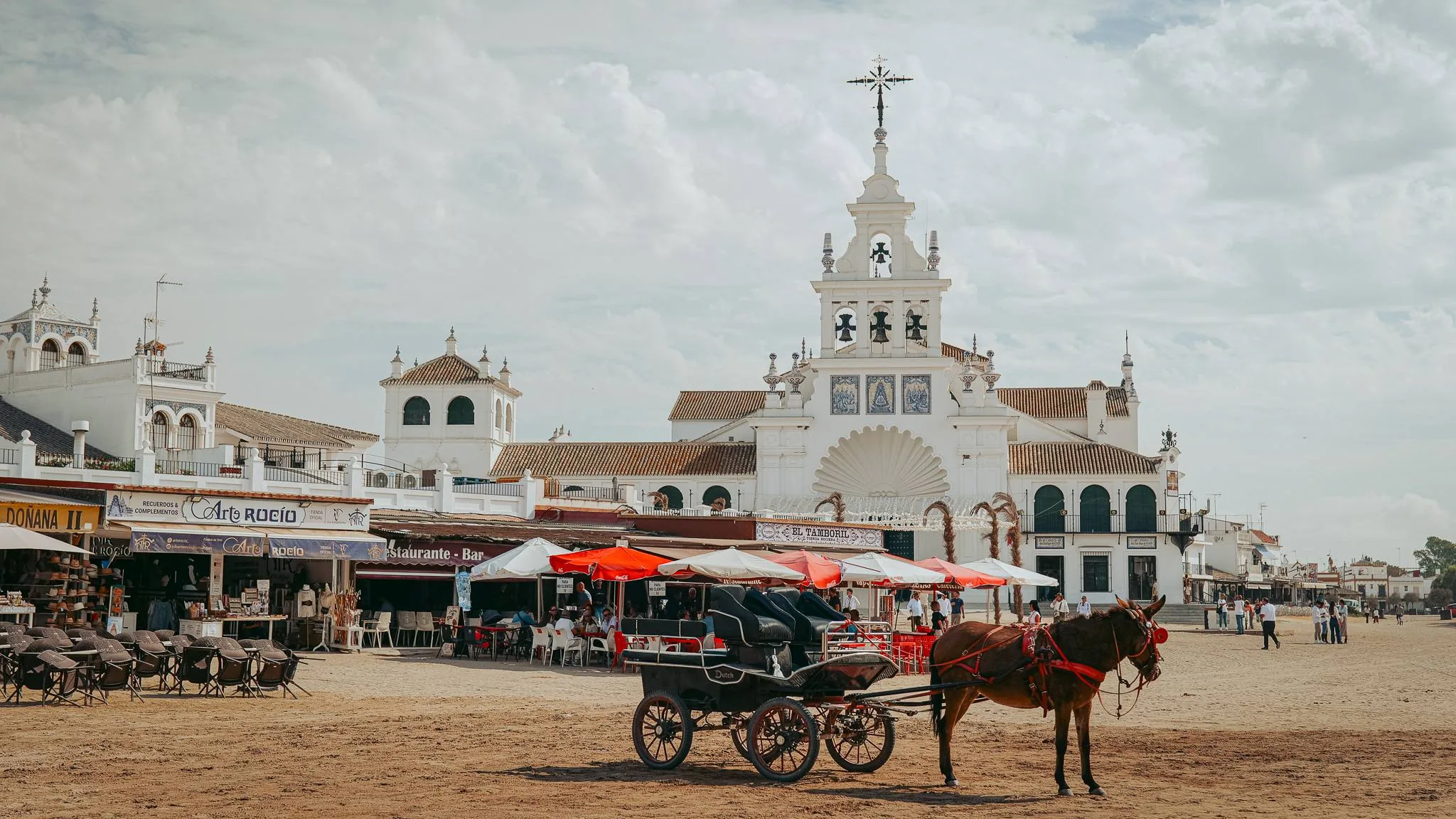
You have to see the decor surrounding it: sand in the square, terraces, horses, a carriage stopped in front of the white facade. El Rocío always gives us this impression of a place out of time, and the sanctuary is one of its great landmarks. It is located on the edge of the Madre de las Marismas, in the municipality of Almonte, in Andalusia.
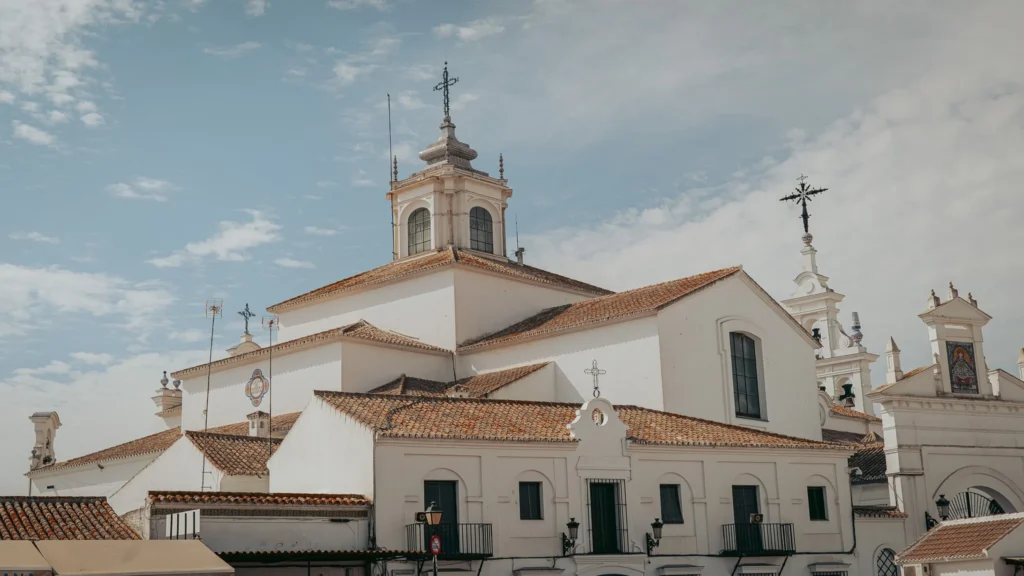
The facade features a bell gable, this bell tower pierced with openings that can be recognized from the square. The building seems to have been part of the landscape forever, but it is more recent than one might imagine.
An ancient place, a building reconstructed in the 20th century
A hermitage is documented here since the 14th century. Almost destroyed by the Lisbon earthquake of 1755, its replacement was blessed in 1760.
The building we visit today comes from another project: that of architects Delgado Roig and Balbontín. The first stone was laid on 26 January 1964, and the sanctuary was blessed on 12 April 1969, while work was still to be completed. The chronology of the Hermandad Matriz allows us to follow these reconstructions.
Inside, the white and the gilded altarpiece
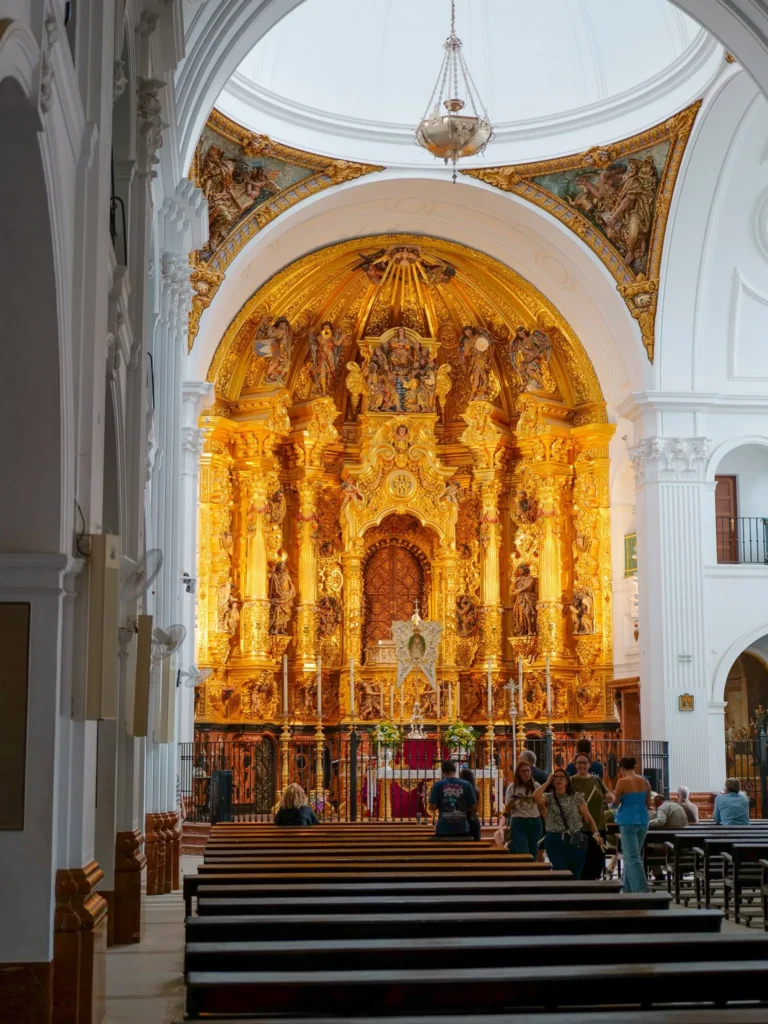
The gaze immediately goes to the gilded altarpiece, at the back of the nave. But what struck me the most during this visit was also the white space all around, the arches, the volumes, the galleries. The gold attracts the eye, and the white gives it all the space. We wanted to look everywhere at once.
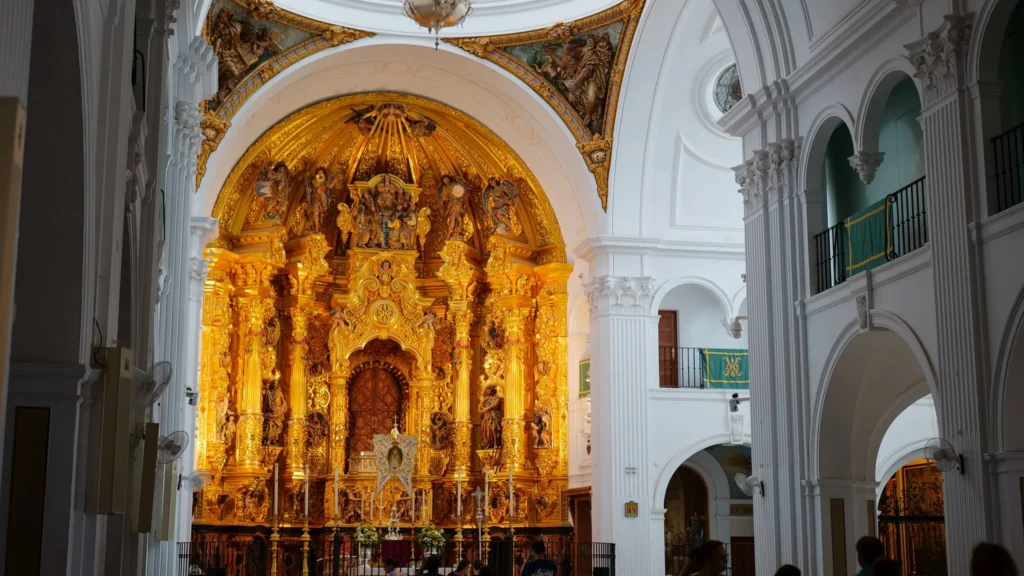
The main altarpiece was blessed in 2006. The Hermandad Matriz cites the works of Antonio Martín Fernández, Manuel Carmona Martínez, and Matías Aceitón Vega. We are indeed talking about a gilded altarpiece: the photo does not allow us to conclude that it is solid gold or to attribute a specific material to everything that shines in the sanctuary.
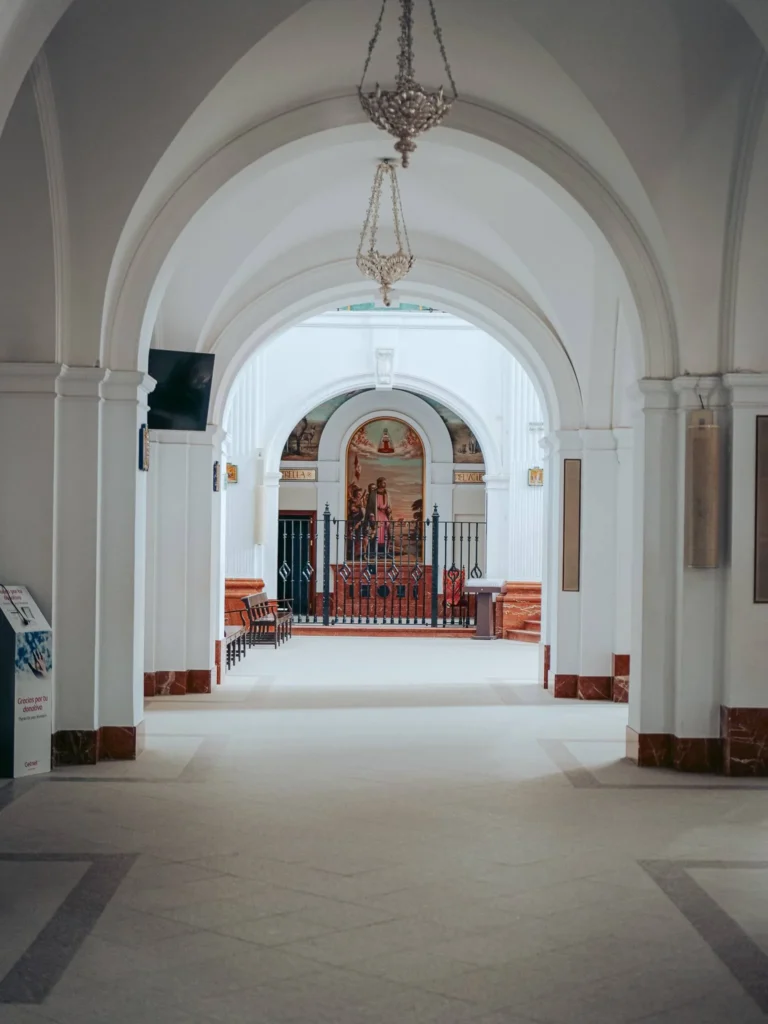
In the side aisles, we find this row of white arches, hanging lights, and religious scenes. It is also here that we measure the volume of the building, beyond the frontal view towards the altarpiece. And it’s pretty even when we stop looking for the perfect photo for two minutes.
What the coats of arms and ceramics tell
We had photographed the hangings above the doors without knowing all the details on site. Looking closely at the full-resolution originals, the inscriptions and patterns become easier to read. And there, we find a part of the history of Rocío.
The red banners bear the emblem of the Hermandad Matriz
The coat of arms is that of the mother brotherhood of Almonte, the Pontificia, Real e Ilustre Hermandad Matriz de Nuestra Señora del Rocío. The composition and the inscription that surrounds it correspond to its official emblem. These are therefore hangings with the arms of the brotherhood that oversees the worship of the Virgin and organizes the pilgrimage with the affiliated brotherhoods.
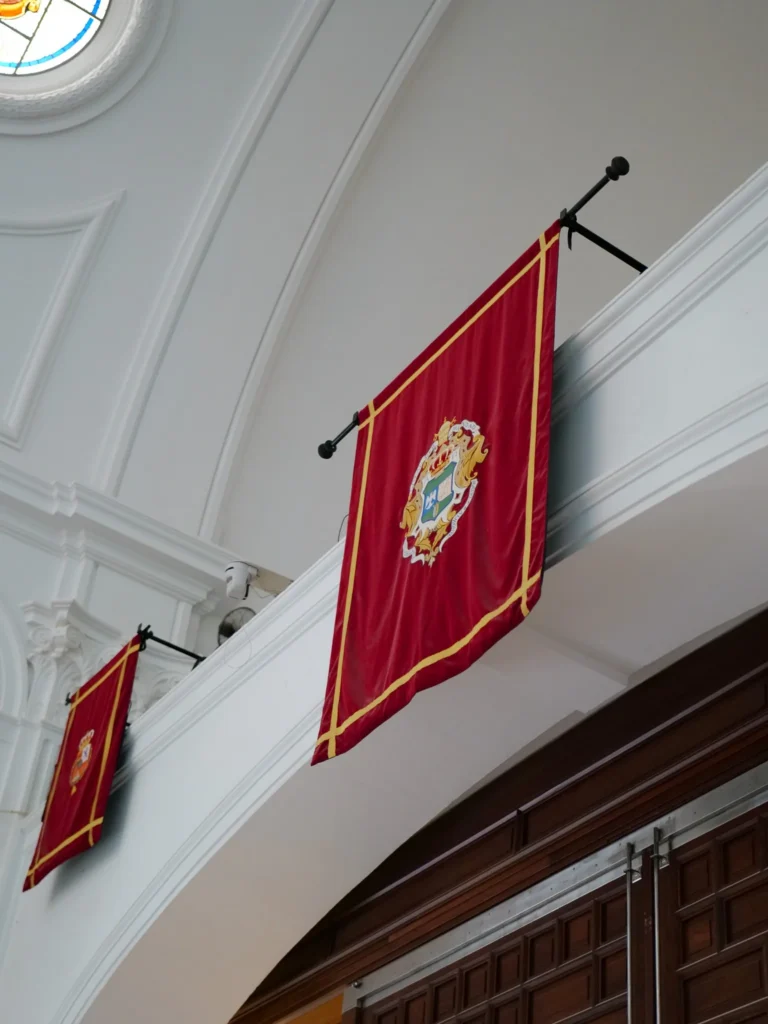
At the very top, we can distinguish the tiara and the keys, the papal insignia. Lower down, the royal crown recalls the other title of the brotherhood. Its official history specifies that the titles of Real and Pontificia were granted to it in 1920, respectively by Alfonso XIII and Benedict XV.
The Latin inscription Ave Maria, “Hail Mary”, refers to the Marian devotion of the place. On either side of the crown, the alpha and omega are the first and last letters of the Greek alphabet: in Christian iconography, they designate Christ as beginning and end, a meaning recalled by the Vatican Museums. By looking at these details, we better understand the religious and royal ties claimed by the brotherhood.
The blue plaque commemorates the bicentennial of Rocío Chico
On the ceramic, the mentions 1813–2013 and Año Jubilar provide the key. The plaque represents the Virgin and commemorates the bicentennial of the vow of Rocío Chico. Its inscription also recalls the closure of the jubilee year, on 8 September 2013. This panel therefore has a precise historical subject.
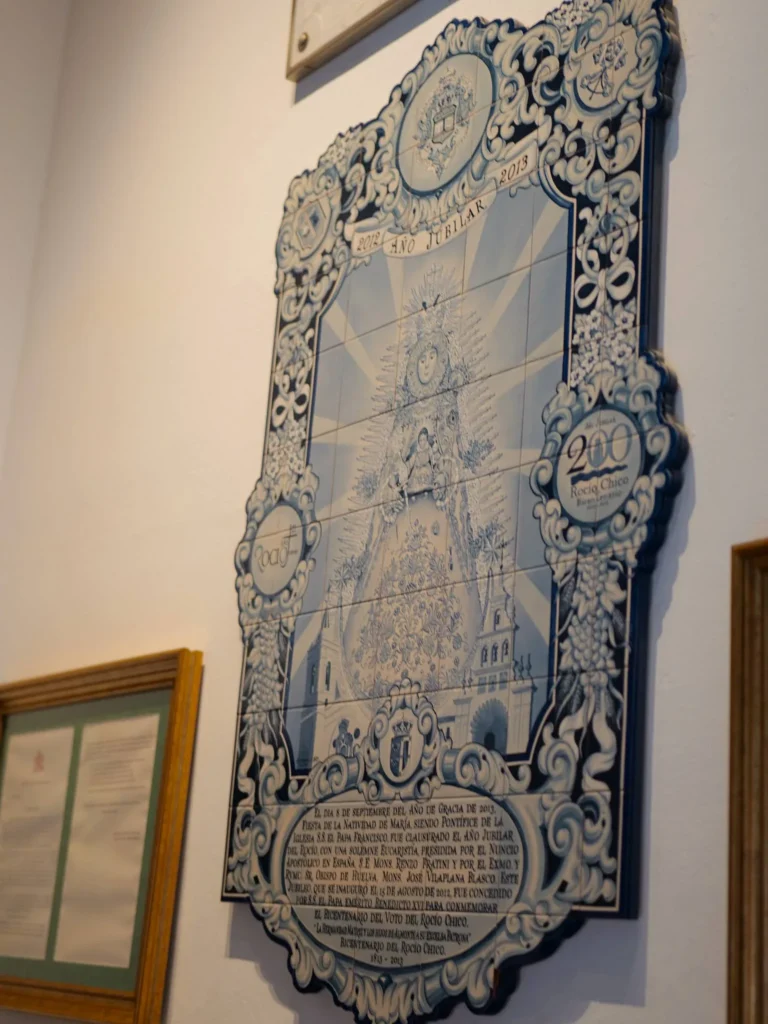
The narrative preserved by the Hermandad Matriz dates back to the Napoleonic occupation of 1810. In Almonte, an attack against the French garrison causes the death of a captain and five soldiers, followed by the threat of reprisals. The inhabitants attribute the fact that the feared reprisals did not occur to the protection of the Virgin. This is the religious interpretation of this episode that the local tradition preserves.
On 16 August 1813, the municipality, the clergy, and the brotherhood made an annual vow of thanksgiving: to celebrate a mass on 19 August at the sanctuary. This is the origin of Rocío Chico, distinct from the great Romería of Pentecost. The two hundred years of this vow explain the dates inscribed on the plaque we photographed.
And the green hanging bordered in yellow?
On the gallery, the photo shows a green fabric with yellow trim, folded over the railing. No coat of arms is visible on the photographed part. The large yellow rectangle I had noticed corresponds to a border of the fabric; the photo does not allow us to recognize a regional flag.
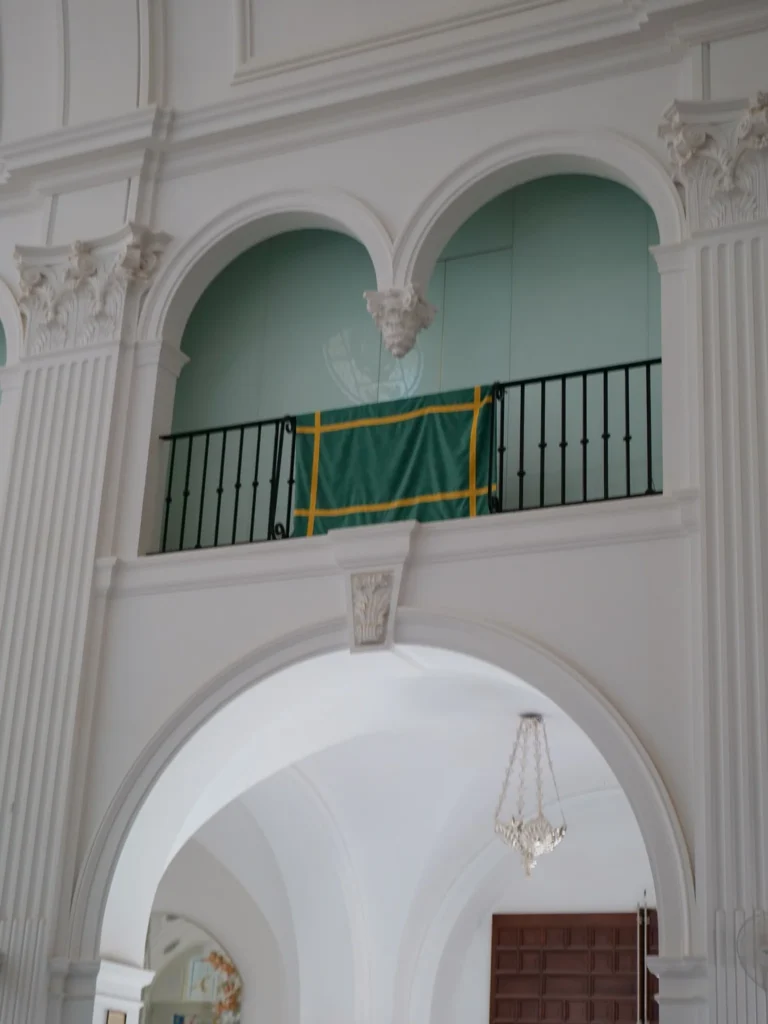
This decor fits into the use of hangings in the sanctuary: the 2023 annual report of the brotherhood mentions the making of reposteros, decorative textile panels, with the Ave Maria for the upper parts of the building. This source documents this use, without allowing us to precisely attribute our green fabric to this set or to date it.
A visit to be placed in the life of the village
The sanctuary is a place of worship, linked to the devotion to the Virgin of Rocío and the pilgrimages of the brotherhoods. The Romería takes place around Pentecost: if you want to understand why the village changes so much in rhythm according to the dates, this link with the pilgrimage matters a lot. During a celebration, priority is naturally given to those who have come to pray.
Our return in October also reminded us that the landscape changes completely from one passage to another. In front of the promenade, the Madre de las Marismas was dry, while we remembered a large expanse of water during our December stay. The sanctuary, the horses, and the sandy streets were still there, but the stroll did not have the same atmosphere.
We recount the two visits and the landmarks to prepare your day in our guide to El Rocío: discover the village by car or motorhome. After the morning stroll, we had lunch at La Tata, where the seafood rice kept us occupied for a good while.
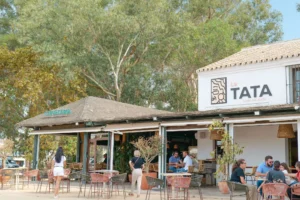
La Tata in El Rocío: three of us, and the rice still won
Lunch at La Tata in El Rocío: wood and plants, generous bravas and seafood rice served in an earthenware pot that defeated three of us.
Available on 26 November 2026Practical information for coming
ps: personally, I came to take more photos of the sanctuary. I left repeating that it was very beautiful.. The vocabulary of the day may have been limited, but the impression was definitely there.