Our review of The Hidden Lane
Benefits
- The surprise of the close, you do not expect a whole courtyard behind it
- Painted fronts that cut straight against Glasgow's grey sandstone
- Free to walk into, on the edge of the West End
- Pottery, painting, stained glass and jewellery classes run by the studios
Disadvantages
- A ten to fifteen minute lap if you do not go into the shops
- Very quiet, the place is not humming all day every day
- The Hidden Lane Gallery has been shut since July 2025, though its sign is still up
Who is this place for?
- Anyone drawn to craft and repurposed places
- Photographers after colour in a city of stone
- West End visitors looking for a short stop between two spots
A short stop, but worth the detour for the surprise alone. Slot it into a West End day rather than treating it as a destination in its own right.
Just to the left of the close there is an old painted sign that nobody looks at: Funeral Directors. Motor Hirers. Monumental Sculptors. Two of the three you can still read straight off. The middle one has aged out of everyday English, and it turns out to be the key to the whole place. We walked past it twice without paying it any attention, and it was only back home, going through the photos, that I realised the answer had been in front of us the whole time.
Because the question we asked ourselves walking in was this: why is this close so wide?
Right, from the beginning. The Hidden Lane, at 1103 Argyle Street in Finnieston, was not on the plan at all for our day on 14 August. We were doing the west side of Glasgow and looking for two or three extra things nearby. Caroline’s friend told us about it (she is the one who showed us the whole city, honestly), and since it was on our way we thought, right, five minutes.
A close under a tenement, and a whole village behind it
What gets you first is the way in. From Argyle Street all you see is a black close mouth wedged between a Subway and a pink-fronted off-licence (GG Brothers, “EST. 1984”, you cannot miss it). Above it, a sign with every letter in a different colour: 1103 THE HIDDEN LANE. And behind that, a long passage under the tenement, wide enough to drive through. I called it a mini road under a building at the time, and that is more or less what it is.
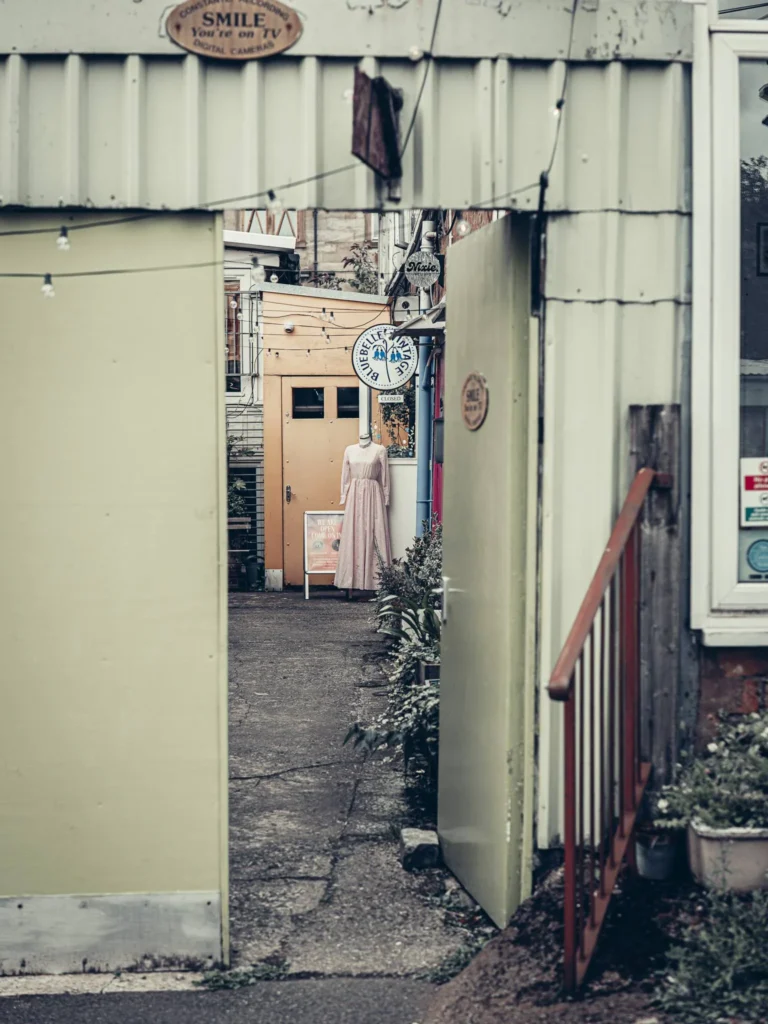
Then you come out the other end and, no, you do not expect a village inside the city. It is a courtyard with lanes running off it, painted sheds, coloured houses, workshops opening straight onto the cobbles. Not a concept store dropped into a shopping street: a whole chunk of town, tucked behind an entrance you would have walked past.
What was at 1103 before the artists
So, the width. It is not an architect’s flourish, it is the job the place used to do. 1103 Argyle Street was the hearse and limousine garage of the local undertaker’s. The passage was never built for people on foot, it was built to get vehicles in and out, and it has stayed exactly as it was.
And that ghost sign at the start, the one I photographed without knowing what I had: it is the same firm. Motor Hirers means hiring out cars with a driver, so the limousines that made up the funeral cortege. Monumental Sculptors is the workshop that cut the headstones. Which means the entire trade sat on thirty metres of street: the office at the front, the stone yard, and the cars at the back of the court. Knowing that, then looking at what is there now, is genuinely a bit dizzying.
More broadly, this is a Victorian back court still standing. If you grew up in a Scottish city you know exactly what a back court is, and you probably remember them being cleared, which is rather the point: almost all of Glasgow’s went. The shift to art is recent enough. Joe Mulholland, a former lawyer and journalist, developed the place, and his gallery opened here in November 2009. Today the whole thing claims more than a hundred studios, spread across 1103 and three neighbouring addresses on Argyle Street (1079, 1083, and 1069 for The Hive).
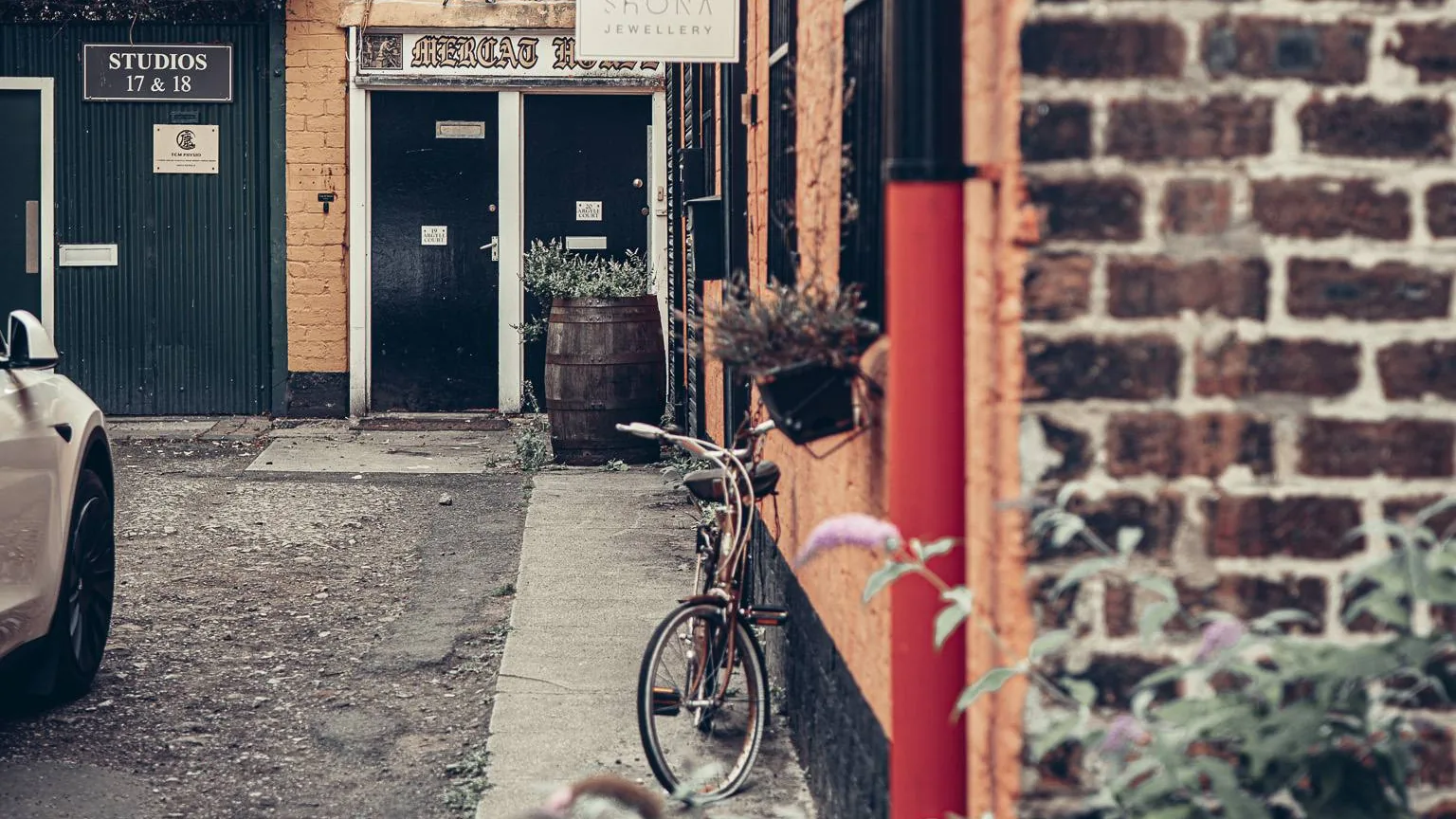
The detail that made me smile when I went back through the photos: the plates on the doors at the back still read Argyle Court. The court never changed its name, only its trade.
The contrast is the entire point
Context first. Outside, Glasgow is sandstone and stone and grey, under a sky that does not help. It is a city I find beautiful for its sadness, and I do mean that as a compliment (I have been told it is badly phrased; I will stand by it).
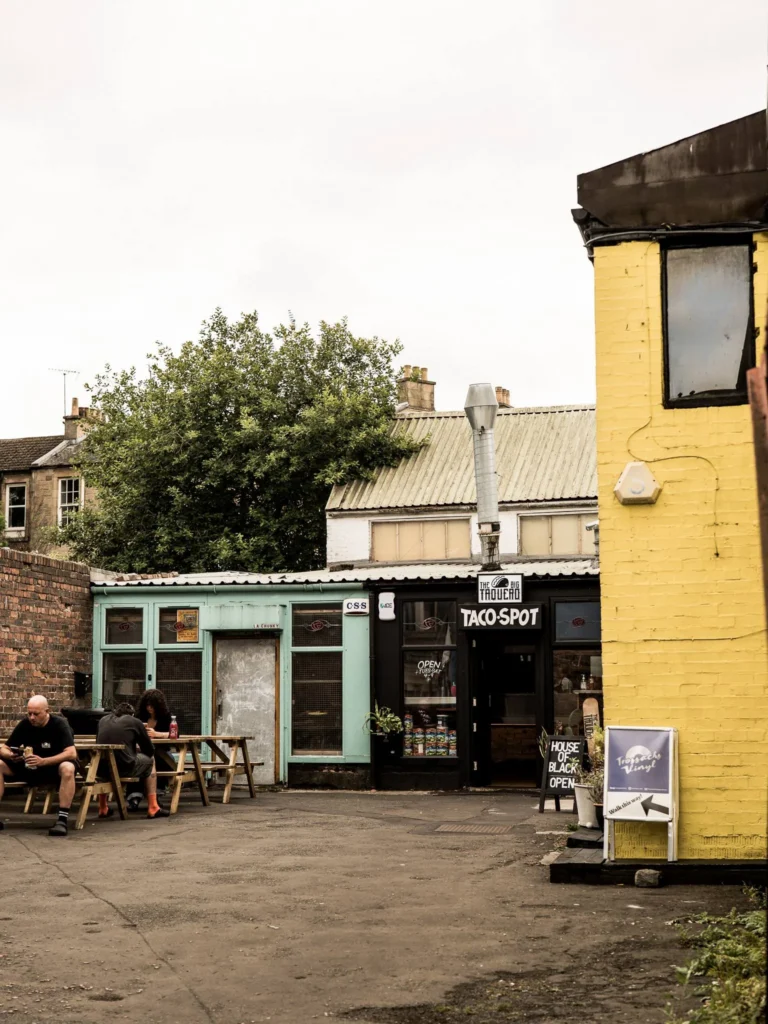
In here it flips. Doors in every colour, walls in every colour, and even the door and window surrounds repainted for the extra bit. Sea green, yellow, blue, orange, burgundy, side by side, bunting strung overhead, a painted bench outside each workshop. Plants everywhere, paintings, dresses hung outside, all the clutter of people who make things.
And that is the thread running through our whole Scottish trip: the outside gets broken up from the inside. You see it in the pubs, you see it in the restaurants, and here you get it across an entire site. The best of it is that you only have to look up above the painted sheds to find the grey sandstone tenement standing behind them. Both Glasgows in one frame.
Who works here, and what you will find
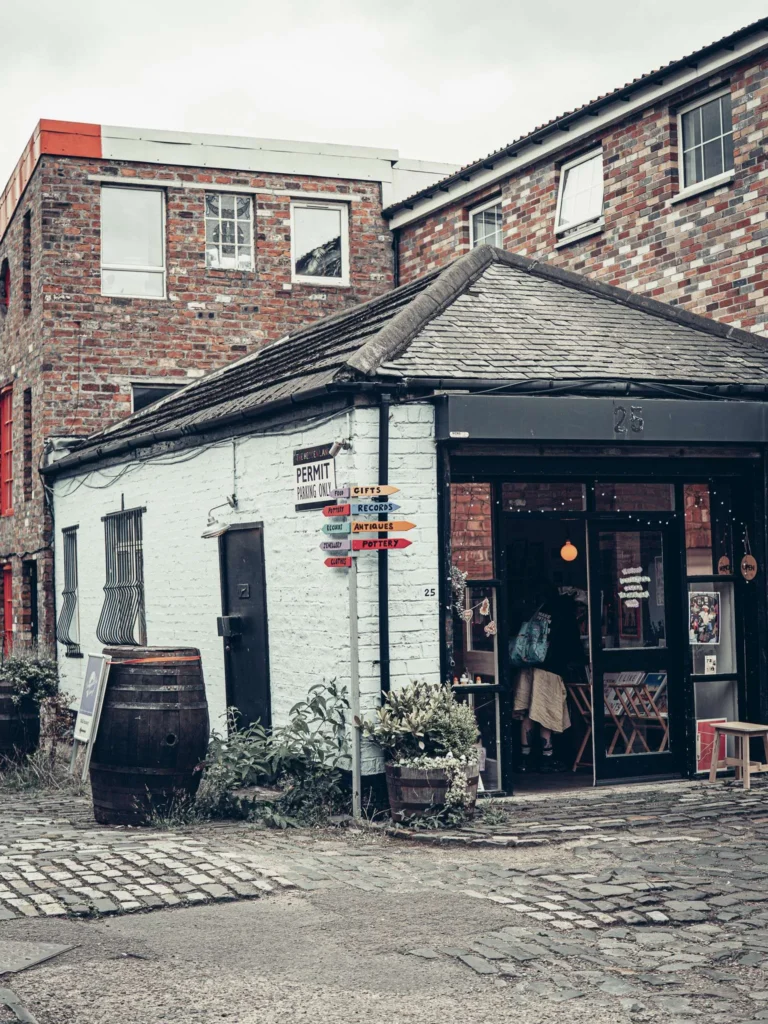
We did not take a full inventory, but we came across antique dealers, people painting, and more generally people who work with their hands. There is a food corner in the courtyard too, with picnic benches, a taco stall and a record shop.
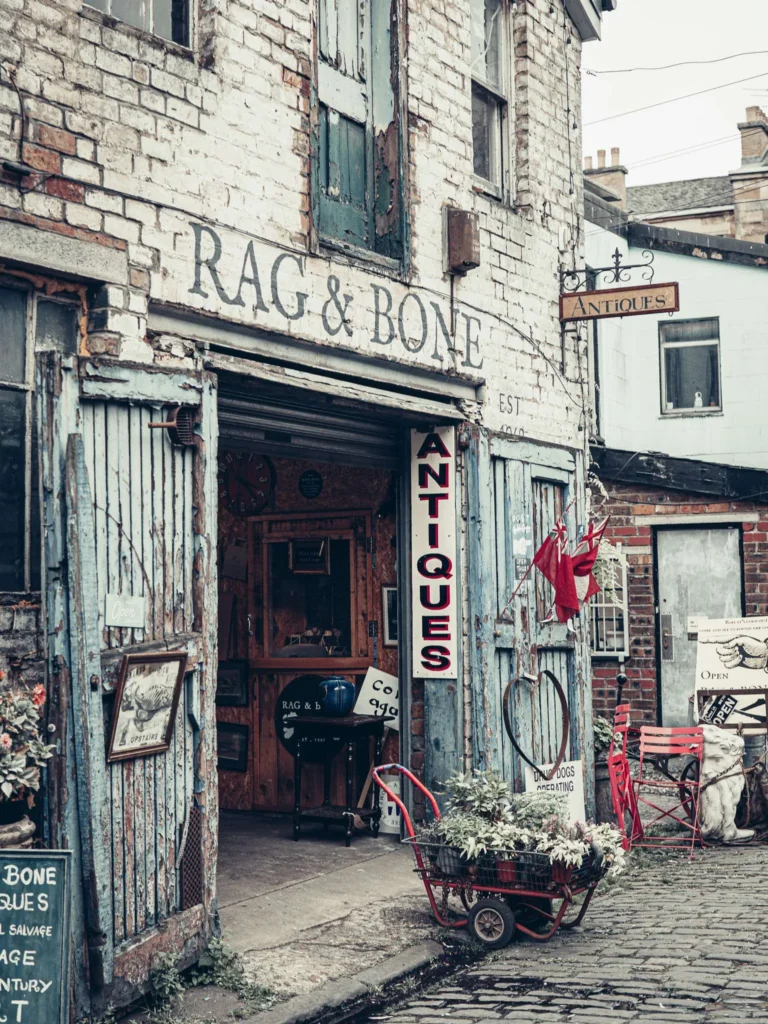
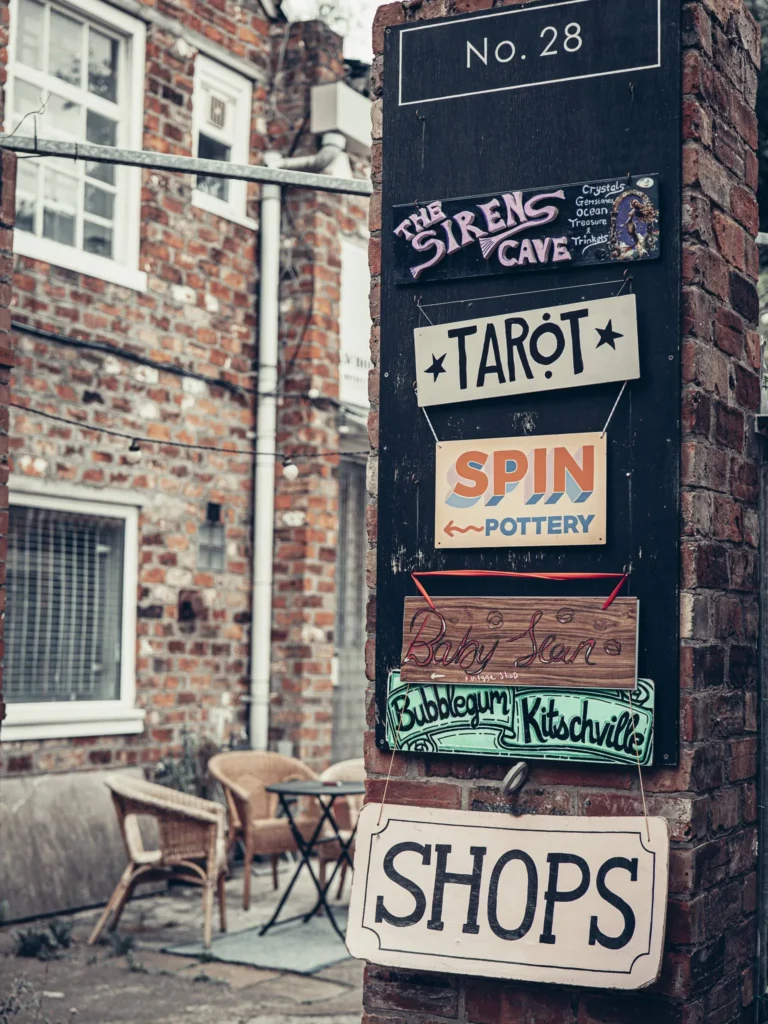
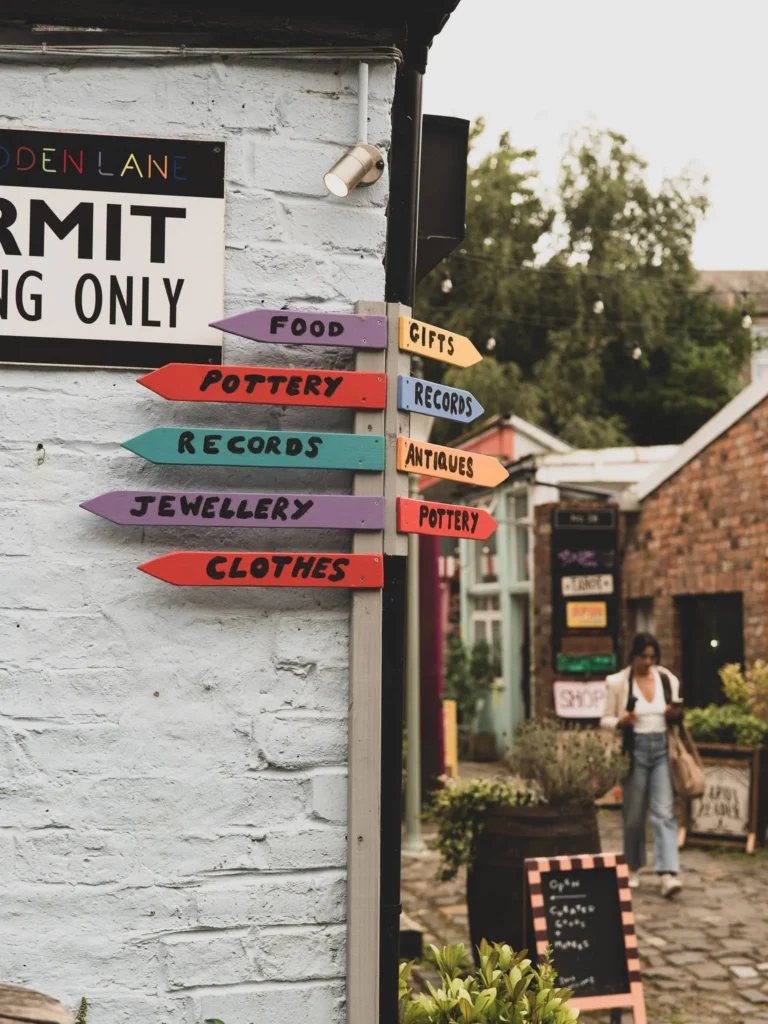
A few names we noted on the spot, off the unit 28 board: The Sirens Cave, which sells crystals, stones and seaside odds and ends, tarot, Spin Pottery, Bubblegum Kitschville, a RAG & BONE vintage shop with a red cart of plants parked outside, and a jeweller, Shona Jewellery. The studios also run pottery, painting, stained glass and jewellery classes, which is probably the best way to do the place properly if you have more than ten minutes.
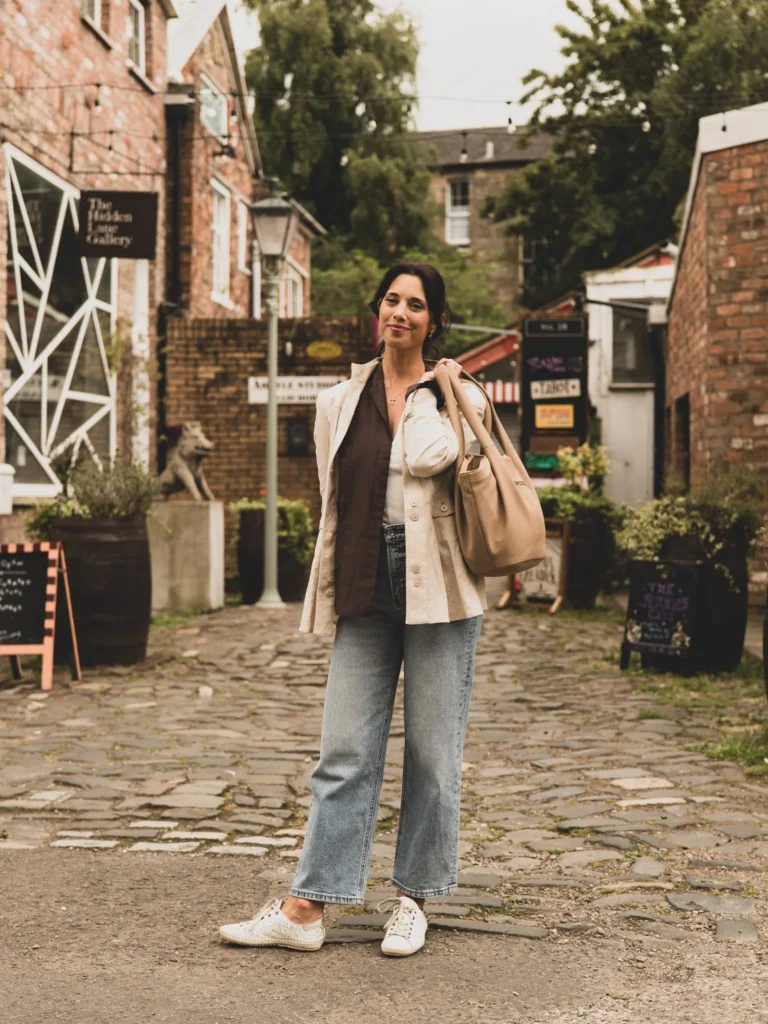
One thing worth knowing so you do not come for nothing: the Hidden Lane Gallery has been shut since July 2025. Its sign is still up and shows clearly in our photos, but the unit is now the office for The Hidden Lane and The Hive. Do not turn up expecting an exhibition.
What we actually made of it
Straight up, because there is no point overselling. When we came through it was very quiet, no crowd at all, which is pleasant in itself but also tells you the place is not humming all day every day. We stayed ten, fifteen minutes. Long enough for a lap, and for Caroline to poke about in two or three shops (she bought nothing, for once).
And personally, that kind of art does not really get me. Caroline more so: this is a place she liked, clearly more than I did. So if you are after an artistic revelation, this is probably not where it happens.
I would still send you, without hesitating, and for one specific reason: it is the surprise that is worth the detour, not what is in the shops. That gap between two unremarkable Argyle Street units, and what sits behind it. You already know Glasgow does grey and serious better than anywhere, so the interesting part is not that it does, it is what it keeps round the back. Treat it as a stop inside a West End day rather than a destination in its own right and you will come away pleased.
We did it the same day as the university campus, a quarter of an hour away and playing an entirely different game:
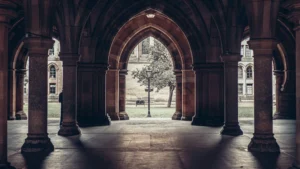
University of Glasgow
Under the arches the light switches on and off every fifteen seconds. It is the Glasgow weather holding the switch, and we just stood there, doing nothing but watching the...
Read morePractical information
And if you are planning the rest of the city, we put the whole stay, both visits and the addresses worth having into our complete guide to Glasgow.
PS: I walked past that undertaker’s sign twice, there and back, without reading it. It was sorting the photos that evening that the place finally told me its story. Moral: photograph the ugly walls, they are usually the ones with something to say.