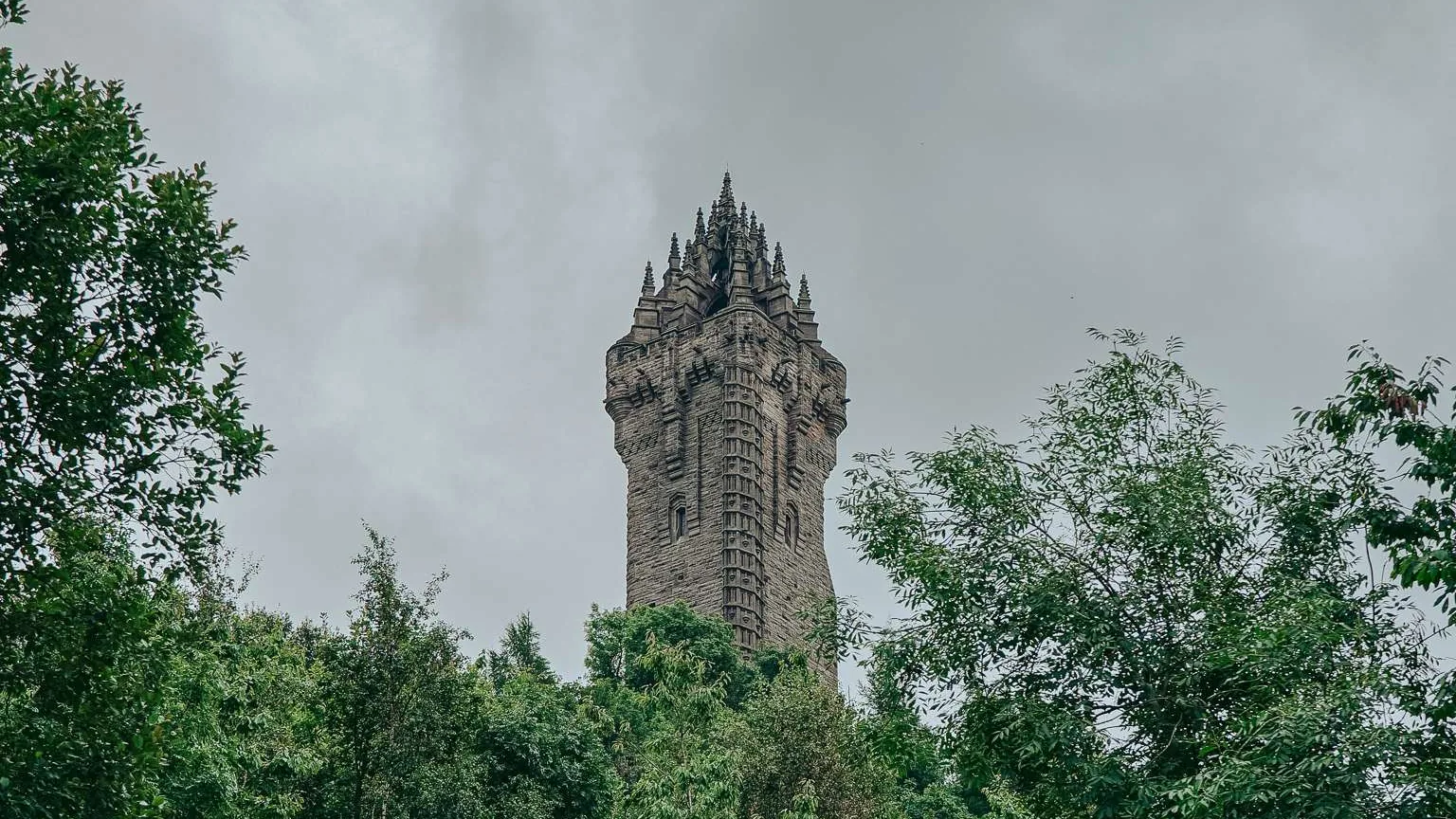
Our review of The Wallace Monument
Benefits
- The climb through the Abbey Craig woodland is already part of the visit, shaded and full of smell
- The Wallace Way carvings tell the story of the site in order, from the Ice Age onwards
- The view from the esplanade reassembles the whole geography of Stirling, castle included
- A free shuttle takes the climb out of it for anyone who needs that
Disadvantages
- We did not go inside or climb the 246 steps, so we cannot tell you whether the ticket is worth it
- The last stretch of the climb gets noticeably steeper
- A busy and very international site, we never had it to ourselves
Who is this place for?
- Anyone curious about Scottish history who wants to understand Stirling Bridge on the ground
- Walkers who prefer a visit where getting there is part of the pleasure
- Travellers on a tight budget, since the path and the esplanade cost nothing
Even without going up the tower, the hill, the carved path and the view more than justify the stop before heading for the Highlands.
The first thing that greets you at the foot of Scotland’s national monument is not William Wallace, and it is not his sword. It is an entirely relaxed rabbit. It was wandering about ten feet from the cars, in the middle of the car park, watching us go past without moving an ear, and it became clear fairly quickly that the startled animal in this scene was us.
This was our last stop in Stirling before heading for Glencoe, and we were pleasantly surprised to park at the bottom without any trouble. By the time we had the drone out, the governing principle of the visit had landed: the monument is at the very top. A monument on a hill means climbing the hill. There you are. That is the walk of the day.
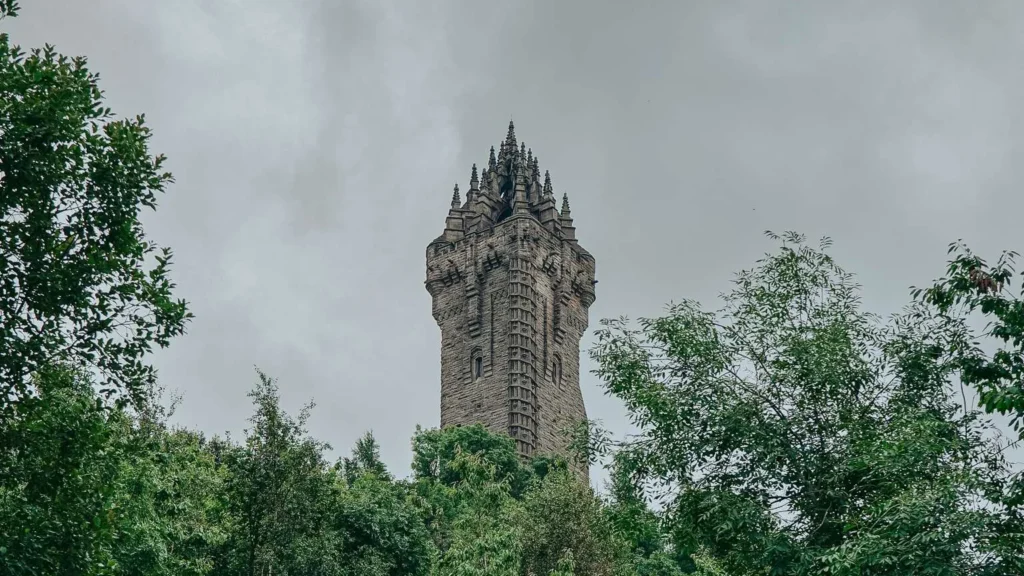
From below it looks like this: a stone tower above a thick forest, a Scottish sky sitting low over it, and very little else to give you any sense of scale. It is exactly the image we had carried since our first visit in 2022, when Wallace seemed to be absolutely everywhere in Stirling, to the point that we joked about doing a full Wallace Tour. We came back specifically to close the loop in the right place. If you are planning the area, we have set out the rest in our Stirling road trip and van guide.
It is a climb, and that is the good part
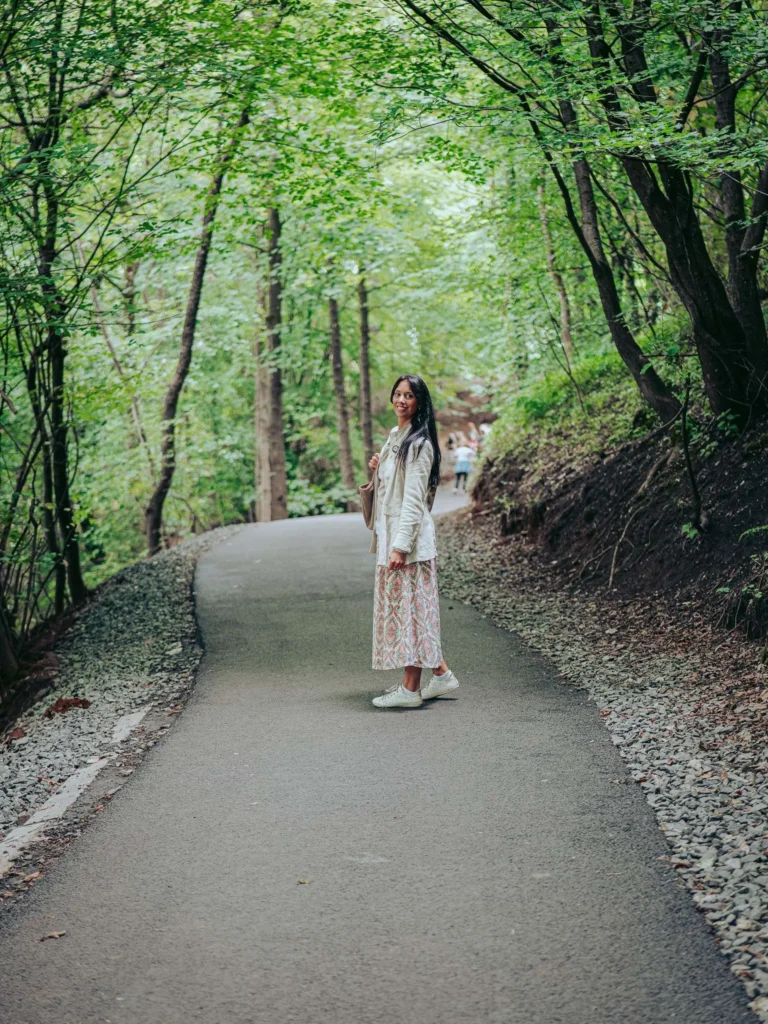
The path up is surfaced, which sounds a bit municipal, except that it runs through a genuinely lovely stretch of woodland, thick, green and very Scottish. It took us about ten minutes from the car park, and we should say plainly that we are both reasonably fit, so take that as our experience rather than a standard. There is one very reliable marker on the way: the steeper it gets, the closer you are.
What struck us was not the gradient, it was the smell. Leaf mould, moss, greenery, damp woodland, it fills the lungs, which is convenient, because up here the lungs are in use. It is exactly the sort of detail that never survives a photograph and that makes up half the climb.
And you meet everybody. In ten minutes of walking we heard French, Italian, Spanish and German alongside Scottish and English voices. This is not a solitary wander in the trees, it is a small parade of nationalities, and a reminder of how far beyond Scotland this site is known. There were also the greetings on the way up, which the two of us had been hearing as a sort of “yeah” and which is, of course, aye. You did not need us for that one.
If the climb puts you off, do not worry: a free shuttle runs from the stop by the car park roughly every fifteen minutes, nine seats, four minutes to the tower. It does not run between 1pm and 1.30pm, and the wait can stretch at busy times, but it is there. Worth knowing for anyone who looks up at the hill and writes the place off on the spot.
Doing the climb on foot did put the period back into scale, at least for us. Today it is a few minutes of effort and we are already thinking about the car, the shuttle, the e-scooter. In Wallace’s day, getting to high ground meant walking, or a horse if you had one. We came away with a conclusion that is slightly daft and entirely accurate: you could not be in a hurry. Distances, travel times and therefore the shape of the day were simply not the same.
Those wooden carvings are not decoration
Someone did think of something other than making your legs work: carvings punctuate the path. We photographed them on the way up like idiots, thinking they were a nice touch for children, and only worked out afterwards that we had missed the whole point.
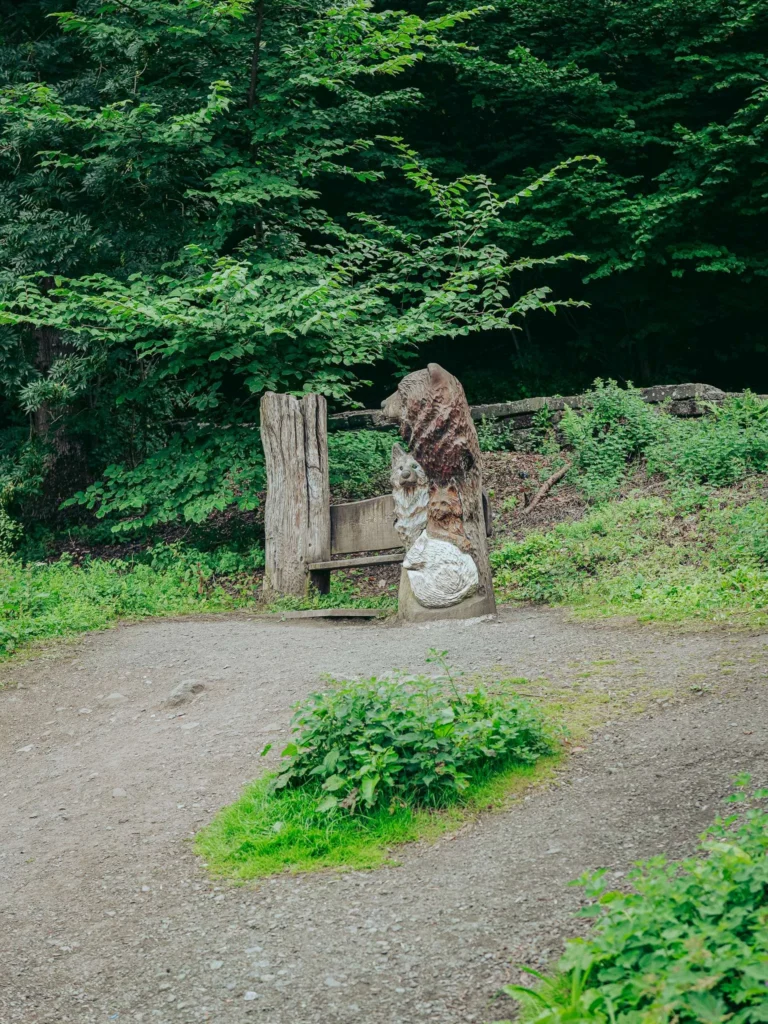
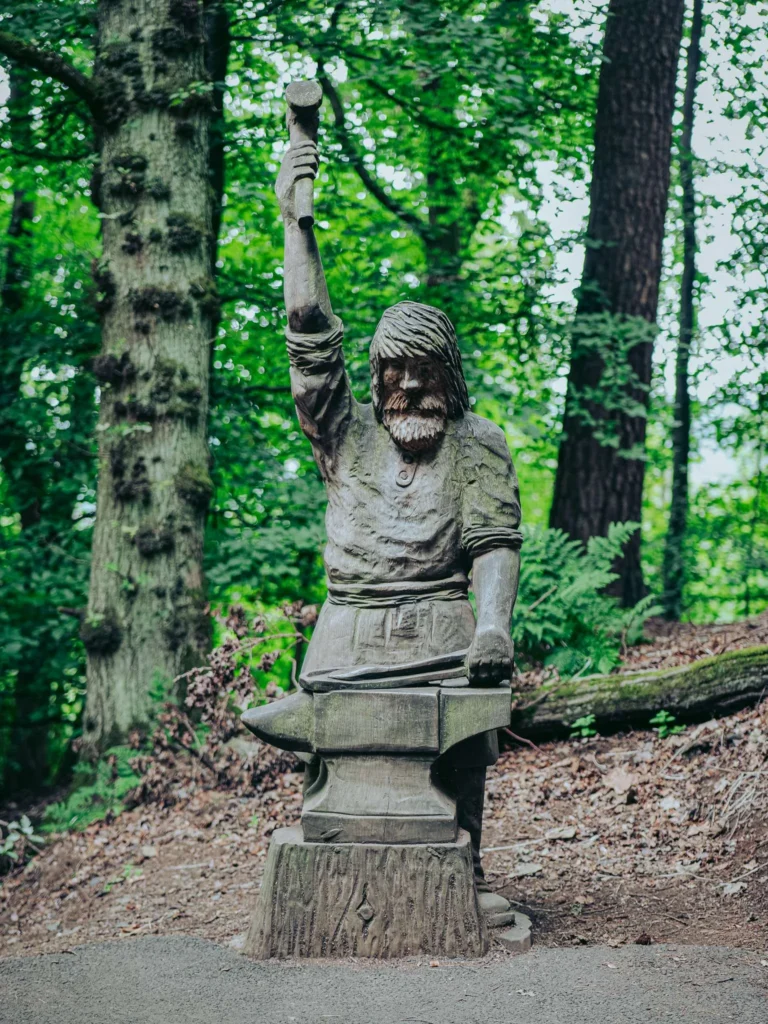
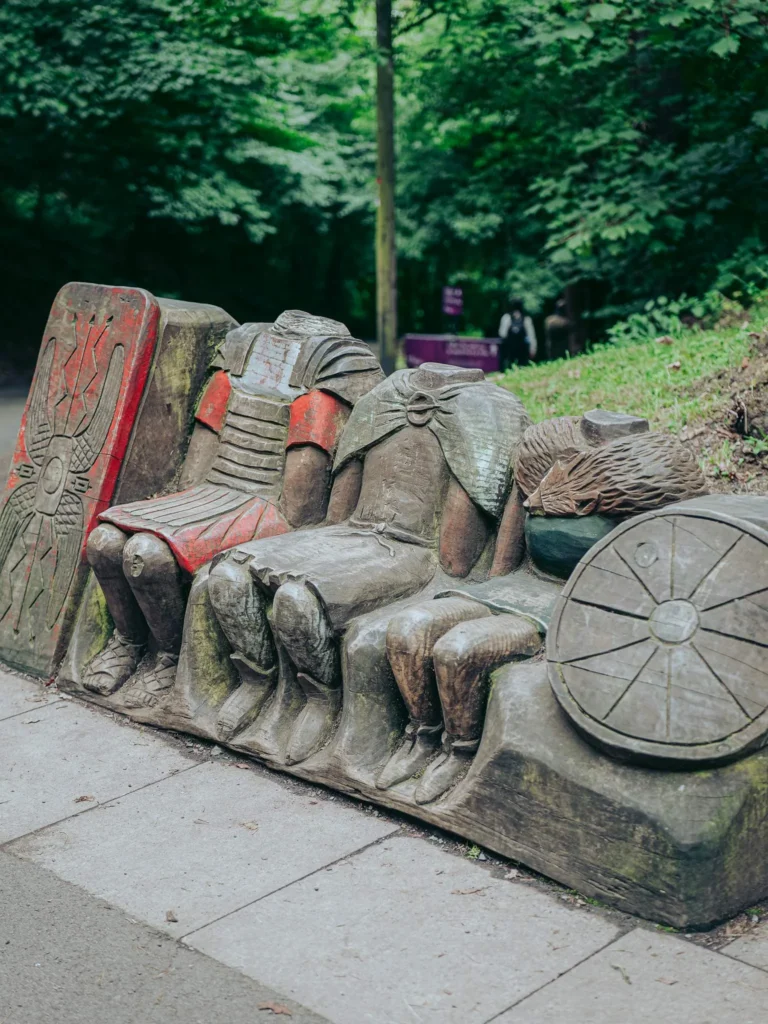
The trail is the Wallace Way, and the carvings form a timeline, cut mostly from cedar by Iain Chalmers. They tell the story of Stirling and Abbey Craig in order, from the Ice Age to the building of the monument. Which is to say: as you climb, you are walking forwards through time, and nobody had mentioned it.
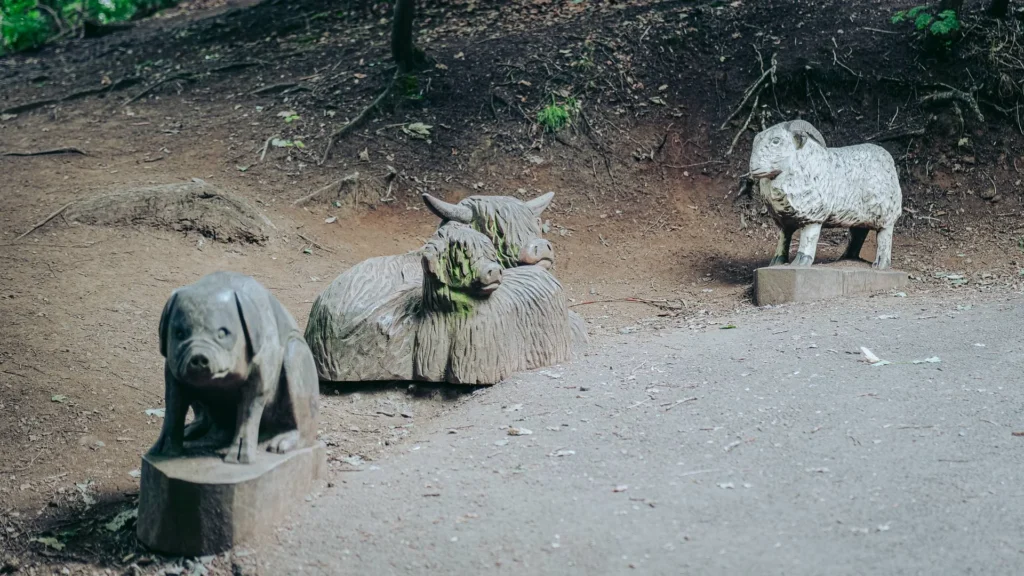
So the photographs we took at random turn out to mean something. The pig, the Highland cow and the sheep mark the arrival of the first farmers in Scotland, around 3800 BC, the point at which domestication begins. The blacksmith with the raised hammer stands for the first metalworkers, around 2000 BC. And the small carved monument near the top of the path marks the building works of 1861 to 1869, the one that tells the story of the railway we come to below.
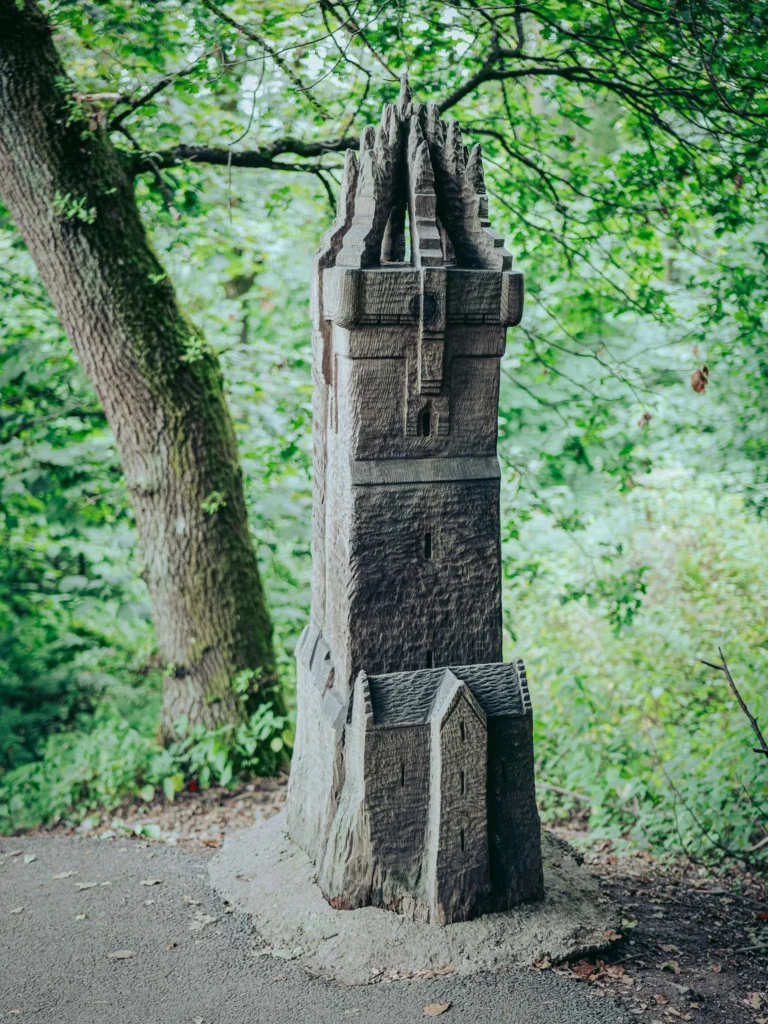
The castle was watching us, and we were watching it
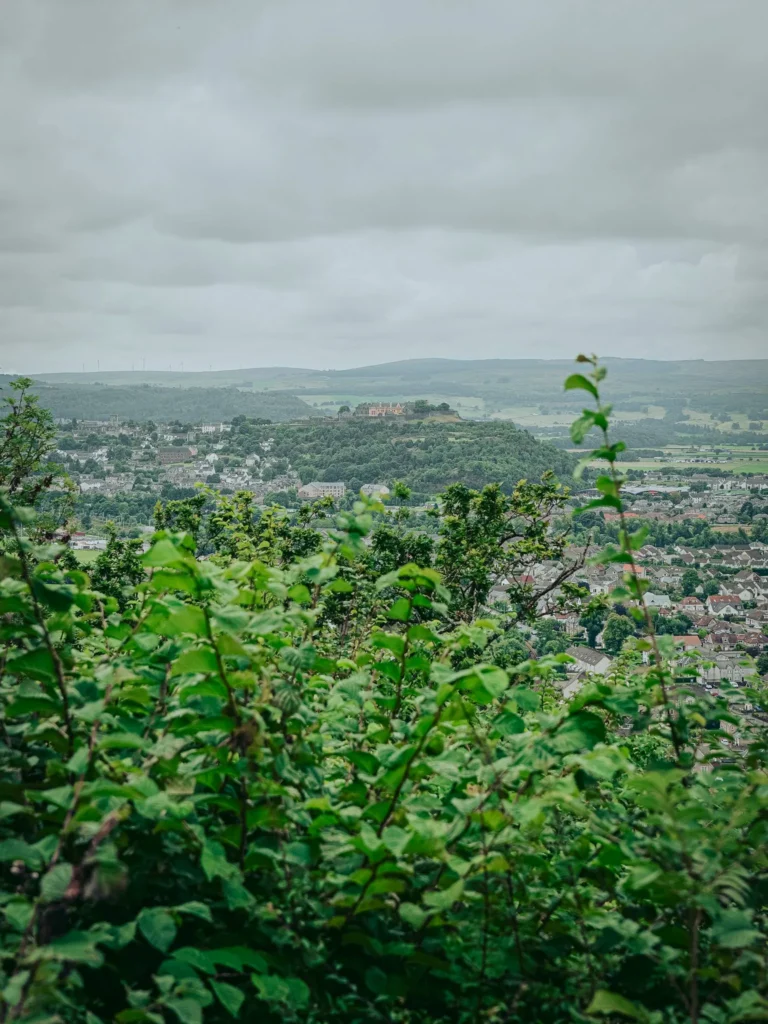
The climb opens onto an esplanade just below the tower, and before you have given any thought to going inside, the view reassembles the whole geography of Stirling. The town, the carse, the hills in the distance, and above all the castle up on its rock across the plain.
That produces a mirror effect we had not expected. From the ramparts of Stirling Castle we had pointed out the Wallace Monument in the distance. Now we were looking back at the castle from the monument. The distance is obviously the same in both directions, which is simple arithmetic, but having both ends of it within a couple of days makes it far clearer how the two heights lock the landscape shut.
Stirling Castle: we walked away in 2022, we paid up in 2026
In 2022 we walked up to the gate of Stirling Castle, read the price board, looked at each other, and walked away. Four years later we came back specifically to...
Read moreAnd it is not only a visitor’s impression. The castle is a fortress on a strategic site. The monument is a different proposition: nobody was defending anything from up here, but the height lets you read the ground in a single sweep. You can see at a glance why this crossing was fought over for centuries.

This was our second climb in two days in this town. While we were in Stirling we also went to the Church of the Holy Rude, and ended up spending most of our time in the kirkyard, which remains one of the best surprises of the trip.
We came for the church, we stayed in the kirkyard
We came up to Stirling to see a church. We ended up spending most of the day in its kirkyard, and we are not going to apologise for it. The...
Read moreWhy the tower is up there at all
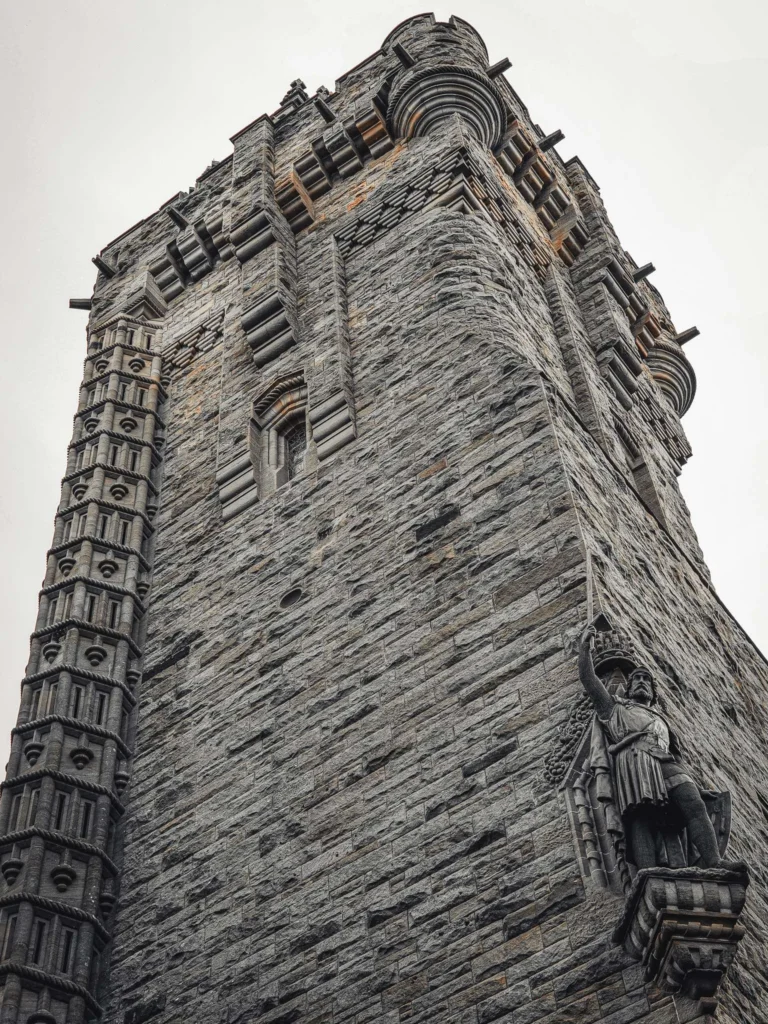
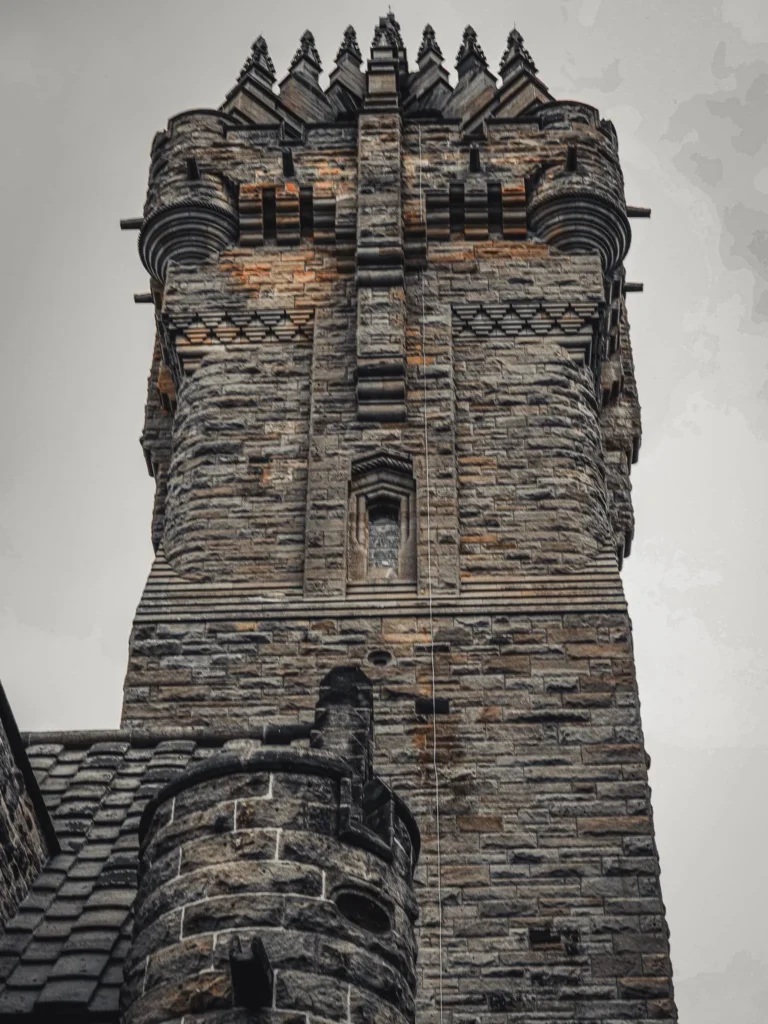
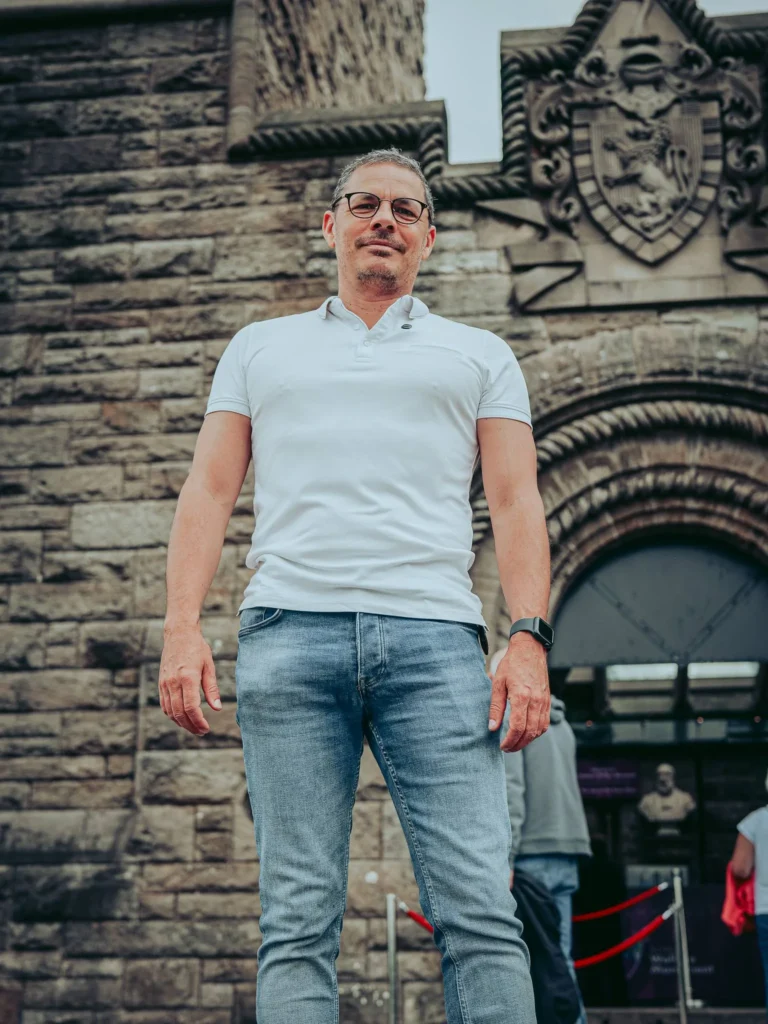
Standing at the foot of it, Xavier struggled to read it as a monument in the usual sense. What he saw was a very tall tower, and that is all. Massive, vertical, sitting on a summit. Which raises the only question that really matters: why here?
The answer is a name and a date. The hill is Abbey Craig, and this is where Wallace is said to have watched Edward I’s army gathering, just before the Battle of Stirling Bridge in 1297. The monument puts it its own way on site: the tower stands above the fields where Wallace led his men to victory. There are even, behind the monument, the remains of a three-rampart fort thought to have been in use at the time. So no, it was not a decorative choice: the hill is the observation post, and the tower arrived on top of it five and a half centuries later.
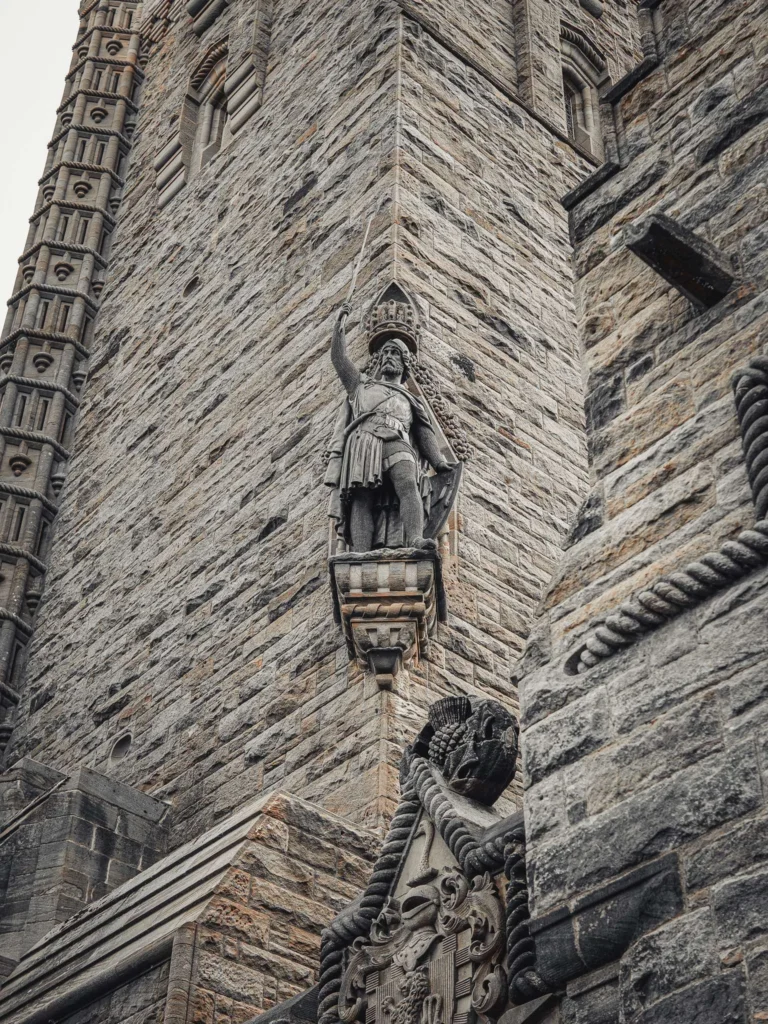
The next thing to take in is the statue. William Wallace raises his sword to the sky in a pose that leaves no room for doubt about the message. It is by the Scottish sculptor David Watson Stevenson, unveiled in 1887, and it stands about twenty feet from the corbel that carries it to the tip of the raised blade. Xavier’s reaction to it comes down to one line: you can tell that at the time, this was not a joke. Simply lifting a weapon of that size gives you a very physical idea of what the sculpture is after.
The sword itself, or at least the one attributed to him, is kept inside. A little over five feet, something like five and a half pounds, recorded at Dumbarton Castle as early as 1505 and moved here in 1888. It has been stolen twice, in 1936 and again in 1972, and recovered both times. That is a story on its own.
Eight years, a quarry and a railway
The other thing we stood there wondering about was the building of it: how long, and how on earth do you get tons of stone to the top of a hill? The answer is more practical than we had imagined, and frankly satisfying.
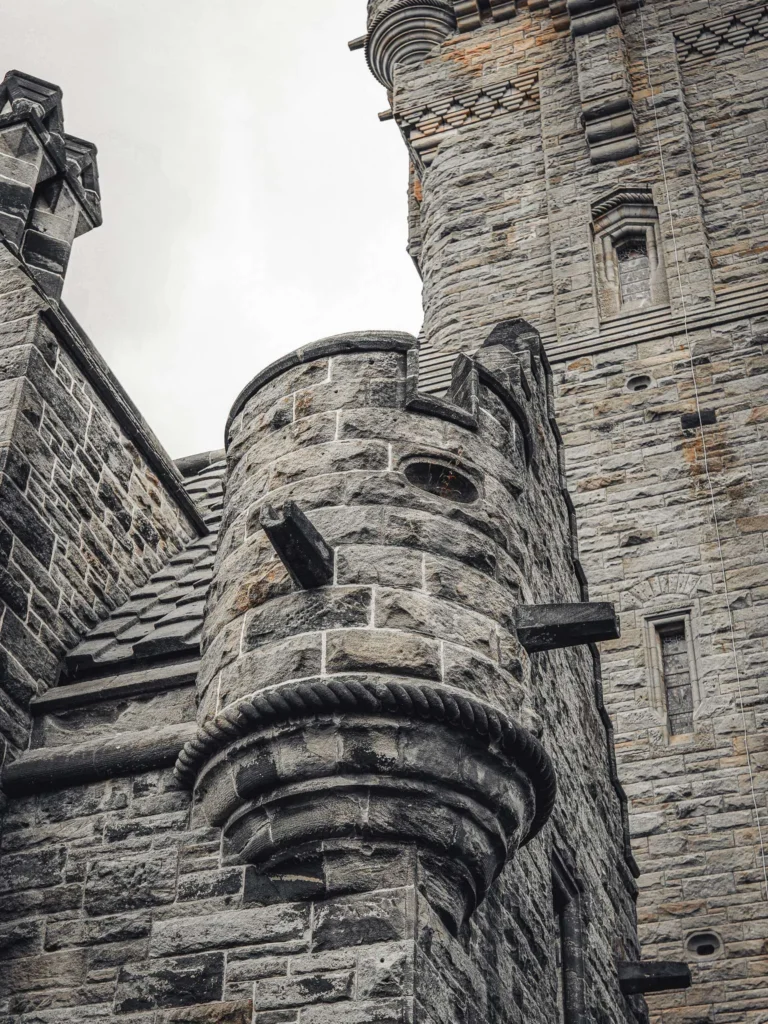
The competition was won in 1858 by John Thomas Rochead, a Glaswegian who specialised in the neo-Gothic, on an anonymous entry submitted under a motto: nothing on earth remains but fame. The foundation stone went down in 1861 and the opening was on 11 September 1869. Eight years of work for 220 feet of sandstone, funded entirely by public subscription, more than £15,000 raised at the time, with donations from abroad including one from Garibaldi. You will have one of these at home, in some form: a committee, a subscription list and something very tall on a hill.
As for the stone, the answer is almost too neat. It was quarried on the spot, in Abbey Craig itself, and the old workings are still visible on the site. The problem was getting it up, so they laid a railway up the three hundred feet of rise, to move materials and men. Which is exactly the story the railway carving tells on the path, the one we walked past without understanding a thing.
And, as so often, there is the other side of it. On 27 June 1864 William Munn, the foreman mason, was riding one of the wagons down when a bolt in the chain gave way. The wagon picked up enough speed to throw him out, and he died of his injuries. We are not going to make a light anecdote of it: the tower is up there thanks to people who did not see it finished.
What impresses Xavier, in the end, is not the bulk of the thing, which is not excessive when you are standing under it. It is that something that vertical is still up there, in stone, put up without a modern crane, more than a hundred and fifty years on.
What the film got wrong
We are not going to be the ones who break it to you that Braveheart takes liberties. You worked that out at the time. What is worth having is the specific version: the Battle of Stirling Bridge as filmed was not shot here, and not in Scotland either. It was shot on the Curragh in Ireland over six weeks, and it happens without a bridge, which is quite something given that in the real battle the bridge over the Forth is Wallace’s entire plan.
The second item happened in the car park where we met our rabbit. For about ten years a twelve-ton sandstone statue by Tom Church stood there, carrying Mel Gibson’s face and the word Freedom. You may well remember the fuss. Visitors disliked it enough to cover it in paint and damage the face, it ended up inside a cage, and it was taken away in 2008.
And the last one, which is the one that actually changes how you look at the tower: do not stand in front of it thinking it has weathered the centuries. It is Victorian. Wallace died in 1305, the monument dates from the 1860s, so there are more than five hundred years between the man and his tower. That is the genuinely interesting angle here. What deserves the astonishment is not its age, it is that people in the nineteenth century felt the need to build this.
The inside will keep for another time
So, is the inside worth it? Honestly, we do not know, and we are not going to pretend otherwise. We did not go up. The 246 spiral steps, the Hall of Arms, the Hall of Heroes, the viewing gallery at the top: we left the lot.
The reason is money, plainly. On this visit to Stirling we had to choose between two paid entries, and we put ours towards the castle, which is bigger and dearer. That is not a verdict on the monument, it is a travel decision, the one everybody makes when admission charges start stacking up over a trip.
The good news is that the site is thoroughly enjoyable without going in. The climb, the woodland, the Wallace Way, the esplanade and the view are all open, and they already take up a decent part of an afternoon. And if we set foot in Stirling again, which we do not rule out at all, we have a reason ready made to come back.

What is certain is that the Wallace Monument is the right place to finish Stirling on. We packed the drone away, went back down the same path reading the carvings the other way round, and carried on north. That same evening, after two kitchens had turned us away, we ended up eating in the rain at Roam West, near Glencoe. But that is another story.
Roam West, Inchree: the kitchen shuts at half eight, so we rang ahead
It has been raining since Fort William, it is dark on the A82, and we are at the point where the only question that matters is whether anyone, anywhere, is...
Read morePractical information
The Wallace Monument: your questions before climbing
Is the Wallace Monument in Stirling, Glasgow, or Edinburgh?
The National Wallace Monument is in Causewayhead, just north of Stirling, on Abbey Craig hill. If you come across a "Wallace monument" elsewhere, it is not necessarily a mistake: there are more than twenty monuments and statues dedicated to William Wallace in Scotland. The two that create the most confusion are the one in Robroyston, on the outskirts of Glasgow, erected in 1900 at the spot where Wallace was captured, and the red sandstone statue of Bemersyde, near Melrose in the Borders, erected in 1814. Only one holds the title "National", and that is the one in Stirling.
How much time should you allow on site?
The monument indicates one to two hours, counting from the car park. This is consistent with what we experienced: ten minutes of walking uphill, and just as much on the way back while stopping at the sculptures along the path. We spent a good part of an afternoon there without going inside, but we were filming. If you go up the tower, plan for a full two hours.
Is entry free, and do I need to book?
Both at the same time, in fact. The wooded path of the Wallace Way, the sculptures, and the esplanade under the tower are accessible without a ticket, and that's exactly the visit we made. On the other hand, going up the tower and touring the rooms is ticketed. The monument itself recommends booking online in advance, with tickets also available on site.
Does my Explorer Pass from Historic Environment Scotland work here?
No, and it catches people out. The Wallace Monument is managed and operated by Stirling Council, the local authority, and not by Historic Environment Scotland. It is therefore not part of the sites covered by the Explorer Pass, unlike Stirling Castle which is indeed an HES site. Budget for two separate tickets for the two monuments.
Can you visit the Wallace Monument and Stirling Castle on the same day?
Yes, and it's quite natural since the two look at each other across the valley: from one, you can see the other. Just budget for two tickets, two different operators, and two climbs, because the castle is also perched on its rock. We did both on the same visit to Stirling, saving the monument for last.
Does the free shuttle save you the 246 steps?
No, and this is the most common confusion. The shuttle only replaces the climb up the hill, from the car park to the foot of the tower. The 246 steps are inside the monument, in a narrow spiral staircase, without a lift and without a handrail. Those who cannot climb them still have access to the Keeper's Lodge, which is at ground level at the entrance.
Can you bring your dog?
On the hill, yes: dogs are allowed on the wooded trails of Abbey Craig, and water bowls are provided. Inside the building and on the shuttle, however, only assistance dogs are accepted.
Does the bridge from the Battle of Stirling Bridge still exist?
Not that one, no. The wooden bridge of 1297, the one that is central to Wallace's strategy, was destroyed just after the battle by the English to prevent the Scots from pursuing them. The stone bridge we see today, the Old Stirling Bridge, was built around 1500, about 185 yards downstream from the old one. It still stands and is reserved for pedestrians and cyclists. A small detail worth noting: the battle took place on 11 September 1297, and the monument was inaugurated on 11 September 1869. Exactly 572 years later.
Who owns the monument?
It is managed and operated by Stirling Council. This fits quite well with its origin: it was funded neither by a patron nor by the Crown, but through public subscription in the 1860s, with donations coming from all over Scotland and even abroad.
How did William Wallace die, and where is he buried?
He was betrayed and captured in August 1305 by Sir John de Menteith, at Robroyston near Glasgow, then taken to London and tried for treason. He was executed at Smithfield on 23 August 1305. As for the burial, there is none: Wallace has no known grave. This is undoubtedly one of the reasons why Scotland has built so many monuments to him.
Is there a café and a shop on site?
Yes to both. The shop, The Tower Shop, is located in the monument itself. And downstairs, at car park level, there is Legends, the site's café. Convenient if you're waiting for the shuttle, or if you're coming down with tired legs.