


Video of our visit to St Andrews
We filmed a video dedicated to this stop, with the ruined cathedral, the historic university and the fishing harbour. You will see our campsite facing the sea (seagull alarm clock included), the castle walls, and golf shops on practically every corner.
Plan your trip: United Kingdom
Tours, tickets and day trips in London.
5% off with code PLANETEDECAROT
Booked on Trip.com — partner link.
Compare rental companies and book at the best price.
10% off with code PLANETECAROLOC
Booked on Trip.com — partner link.
Provided by Holafly, our partner.
5% off with code LAPLANETEDECARO
Booked on Holafly — partner link.
St Andrews, a perfect transition before the wild Scotland
Well, here it is, let’s be honest: St Andrews is our favourite heritage stop in Fife. Not the scale of Edinburgh, not the dramatic punch of Dunnottar, but a human-sized town where every street has some story tucked into it. A compact medieval centre, a polished student atmosphere (students make up around a third of the population), and a coastal setting that changes everything.
It was also a key stop for us on this road trip: the point where we shifted from the more “civilised” south (Edinburgh + Stirling + the urban east coast) towards the wilder north (the Highlands + Skye + the remote west coast). Caroline summed it up on the spot: “a perfect and warm transition”.
What stays with you when you leave: the cathedral, once larger than anything in Edinburgh, broken apart after the Reformation, the university where William and Kate met in 2001, the Old Course created here in the 15th century, and West Sands beach, used as the backdrop for the film “Chariots of Fire” in 1981. Plenty of reasons to stop, very few to drive straight past.
How to get to St Andrews on a road trip
St Andrews sits on the Fife peninsula, on Scotland’s east coast. There is no train station in town (Leuchars is the nearest, 5 miles away), so in practice most people arrive by car, campervan or bus.
When to visit St Andrews by van
Fife : a glimpse of the weather
5-day forecast
For those who love last-minute adventures, here's what the weather has in store.
Monthly climate
Personally, we always choose warm and dry periods. But everyone has their ideal weather! Here's the info to make your choice.
| Month | Min temp | Max temp | Rain | Weather | Rating |
|---|---|---|---|---|---|
| October | 8°C | 13°C | 108 mm | 🌧️ | |
| November | 5°C | 10°C | 129 mm | 🌧️ | |
| December | 4°C | 9°C | 105 mm | 🌦️ | |
| January | 2°C | 5°C | 116 mm | 🌧️ | |
| February | 4°C | 8°C | 92 mm | 🌧️ | |
| March | 3°C | 11°C | 40 mm | ☀️ | |
| April | 4°C | 12°C | 51 mm | 🌦️ | |
| May | 8°C | 15°C | 53 mm | 🌦️ | |
| June | 11°C | 18°C | 79 mm | 🌧️ | |
| July | 12°C | 20°C | 67 mm | 🌦️ | |
| August | 12°C | 19°C | 57 mm | 🌦️ | |
| September | 11°C | 18°C | 67 mm | 🌦️ |
The climate is temperate and oceanic, with North Sea wind as a constant companion (St Andrews is one of the windiest towns in Scotland, which explains a lot about the golf). Average temperatures sit around 5°C in January and 16°C in July.
May to September is still the best window for a van trip. Peak season is July and August, with golfers, day-trippers and students off for summer. Avoid the first week of July if golf is not your thing: when the Open is here, hotel prices go a bit mad and the town gets saturated.
Where to sleep in a van and camper in St Andrews
The right overnight spot changes everything in St Andrews. Here are our recommendations.
Every spot, the cathedral, the castle, the Old Course and the places we ate are pinned on the map below. Tap a marker for the address and the details.
Fife : Places we can tell you about
Here's our selection of places in Fife: spots we've visited that might be useful to you. Use the list view to discover each address in detail, and export everything to add to Google Maps or your favorite GPS app.
| Place | Address | Download |
|---|---|---|
| The Shore Parking | The Shore, St Andrews, Scotland | |
| Grange Road Parking | Grange Road, St Andrews, Scotland | |
| The Pends Parking | The Pends, St Andrews, Scotland | |
| Pines Street Parking | Pines Street, St Andrews, Scotland | |
| Old Station Road | Old Station Road, St Andrews, Scotland |
| Place | Address | Download |
|---|---|---|
| The Forgan's | 110 Market St, St Andrews, Scotland | |
| The Glass House | 80 North St, St Andrews, Scotland | |
| Dunvegan Hotel | 7 Pilmour Pl, St Andrews, Scotland | |
| The Cottage Kitchen | 5 Logies Ln, St Andrews, Scotland |
| Place | Address | Download |
|---|---|---|
| St Andrews Cathedral | The Pends, St Andrews, Scotland | |
| St Andrews Castle | The Scores, St Andrews, Scotland | |
| British Golf Museum | Bruce Embankment, St Andrews, Scotland |
| Place | Address | Download |
|---|---|---|
| Old Course | Old Station Rd, St Andrews, Scotland | |
| St Andrews Botanic Garden | Canongate, St Andrews, Scotland |
| Place | Address | Download |
|---|---|---|
| West Sands Beach | West Sands, St Andrews, Scotland |

We're Caroline and Xavier
We drive to a place, stay long enough to get it wrong a few times, then write the guide we wish we'd had: parking, timing, what's worth the detour.
Ce que vous souhaitez recevoir :
Mobile coverage in and around St Andrews
For UK visitors, there is nothing complicated here: coverage in St Andrews itself is very good, with 4G and generally 5G in town on the main networks. It only starts to get patchier once you push further into rural Fife or continue north into more remote parts of Scotland. If St Andrews is just one stop on a bigger Highlands or islands loop, it is worth checking your operator’s coverage map before you go. If you’re visiting from outside the UK or EU, see our guide below.

Best UK SIM for a Scotland Road Trip: Highlands, Skye and NC500 Coverage
What internet connection to use during a stay in Scotland? Often questioned by travelers, we explored the various options available in Scotland in this comprehensive article. As always, each solution...
Read moreWhat to do in St Andrews in 1 to 2 days
One thing to sort before you park up: the cathedral and the castle are both Historic Environment Scotland sites. If you already hold Historic Scotland membership you walk into both for nothing. If you are an English Heritage or Cadw member, the reciprocal deal gives you half price in your first year and free entry once you have renewed at least once, which is the sort of detail nobody tells you at the gate. And if you are doing a fortnight up the east coast, the 14 day Explorer Pass covers more than fifty sites for £48 an adult or £100 for a family, so it pays for itself somewhere around the third castle. It does not cover National Trust for Scotland properties, and it does not cover anything privately owned, Dunnottar up the coast being the obvious one.
The town is compact and easy to cover on foot. Here are the 8 must-sees we tested or spotted.
1. The ruins of St Andrews Cathedral
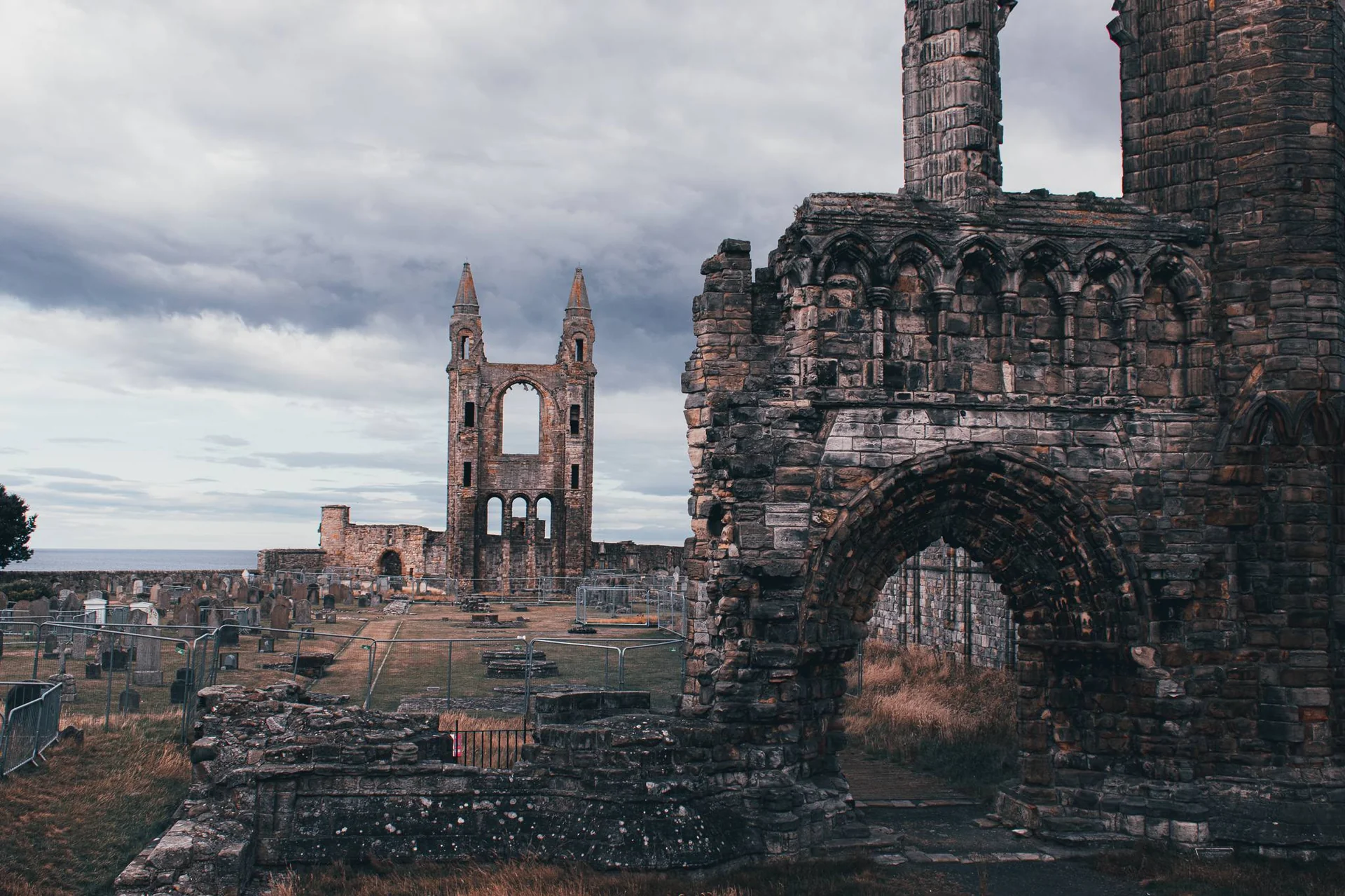
Mandatory first stop. The ruins of the cathedral are genuinely striking: you walk between arches still standing, try to picture the scale of the original building, and it does hit quite hard. Founded in 1158, the cathedral was the largest religious building in Scotland for 400 years. Construction took 150 years, it was consecrated in 1318 in the presence of Robert the Bruce, and it became the seat of religious power in the country.
It was gradually wrecked after the Protestant Reformation of 1559 (John Knox preached against the Catholic Church here, which helped trigger iconoclasm), then fell into ruin during the 17th century as its stones were reused for buildings around town. Today, the site includes the ruins, the large historic graveyard, and St Rule’s Tower (an 11th-century bell tower, older than the cathedral itself).
Combined ticket for the cathedral, tower and small museum: £7.50 for adults (the outer ruins and graveyard are free). Climbing St Rule’s Tower (156 spiral steps) gives you the best panoramic view in St Andrews: the town, the North Sea, and the Old Course in the distance. Well worth it if heights do not bother you.
2. St Andrews Castle (and its underground prisons)
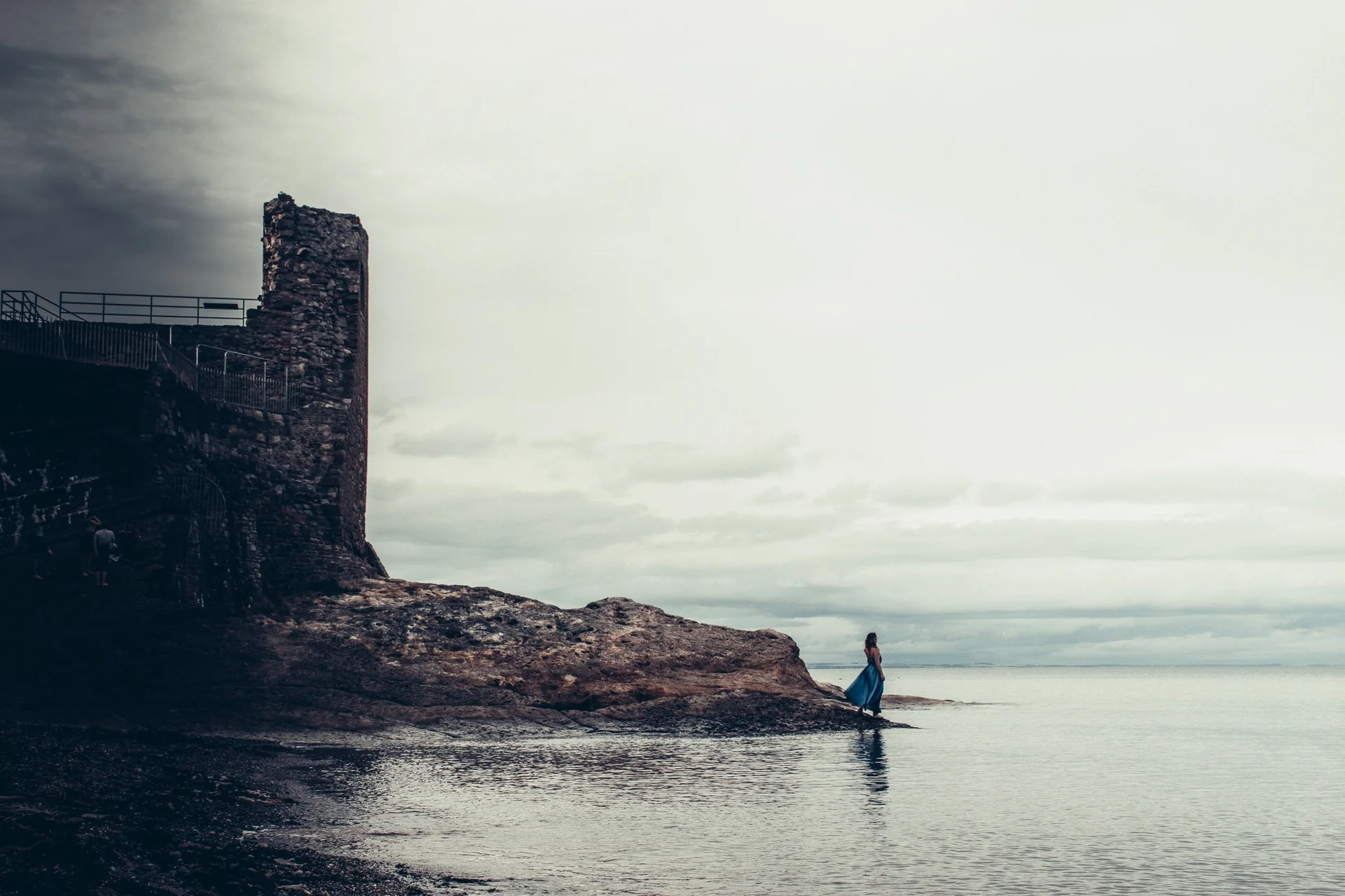
Just a 5-minute walk from the cathedral, St Andrews Castle is a 13th-century ruin perched above the North Sea. The site has been closed to the public for a few years on safety grounds (check the latest status before visiting), but you can still walk beside the ramparts from outside and head down to the rocky shore for photos.
The history here is properly dark: the castle contains the famous “bottle dungeons”, underground prisons carved directly into the rock in the shape of a bottle, narrow at the top, wide at the bottom, where prisoners were thrown in with no way back out. Cardinal David Beaton was murdered here in 1546 by Protestants, and his body was hung from the ramparts. Very gothic, even by Scottish standards.



3. The University of St Andrews, the oldest in Scotland

Founded in 1413 by Pope Benedict XIII, it is the third oldest university in the UK after Oxford and Cambridge, and the oldest in Scotland. It now has around 10,000 students, many of them international (with plenty of Americans paying serious money for the full St Andrews experience).
The campus is not grouped in one neat block: departments are threaded through the town itself, which is part of the charm. You walk down a perfectly ordinary street, look up, and realise you are passing the School of Economics and Finance, or standing in front of a university chapel dating from 1450. St Salvator’s Chapel and its quadrangle are the key sights.
The detail that excites visitors most: Prince William and Kate Middleton met here in 2001, shared a flat in their fourth year, and the rest is now tabloid history. If you enjoy that sort of thing, a few cafés and shops still proudly display photos from the period. St Salvator’s Hall, where they lived, can be seen from outside.
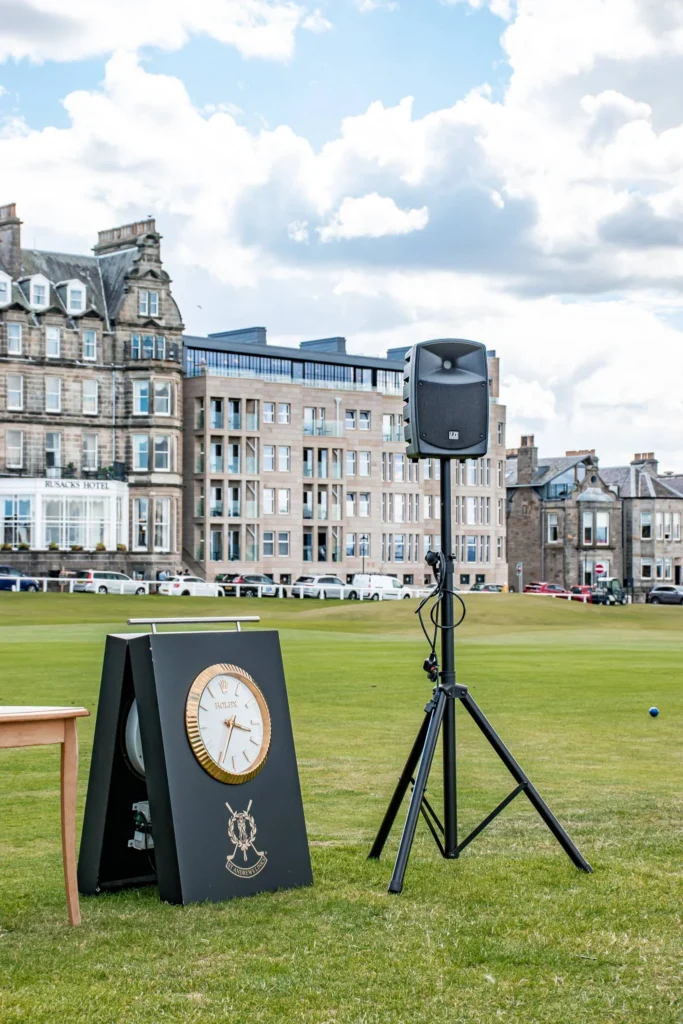
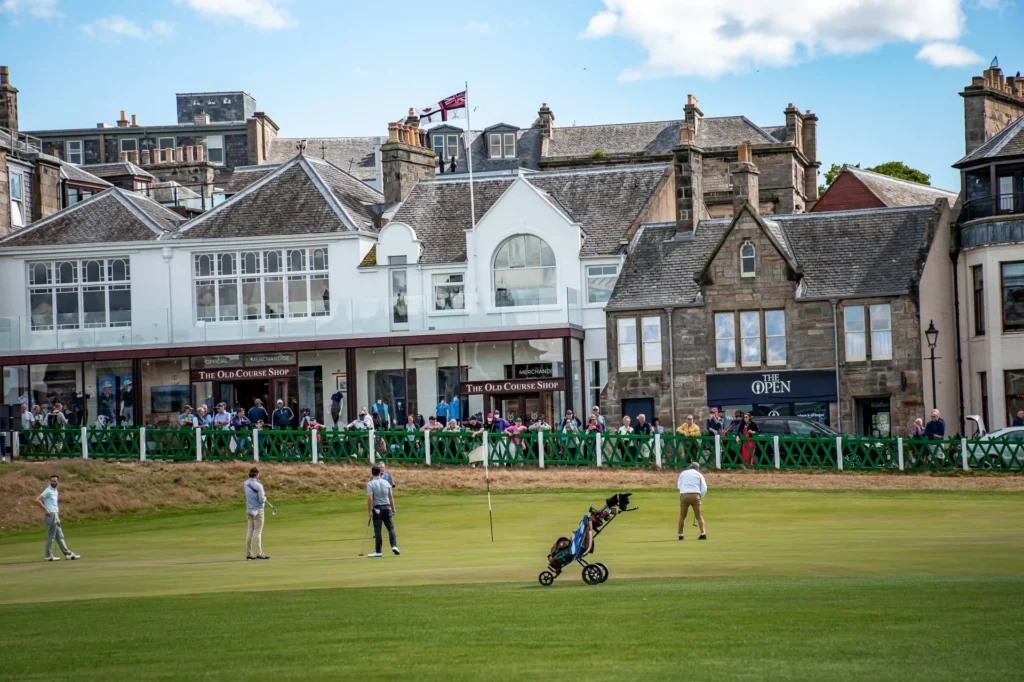
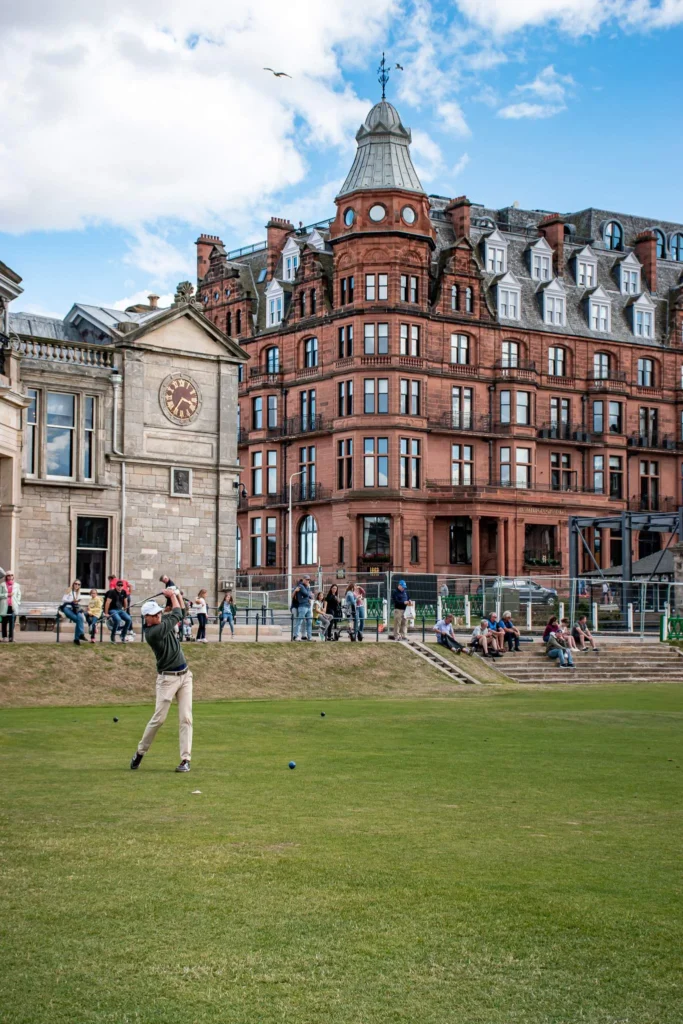
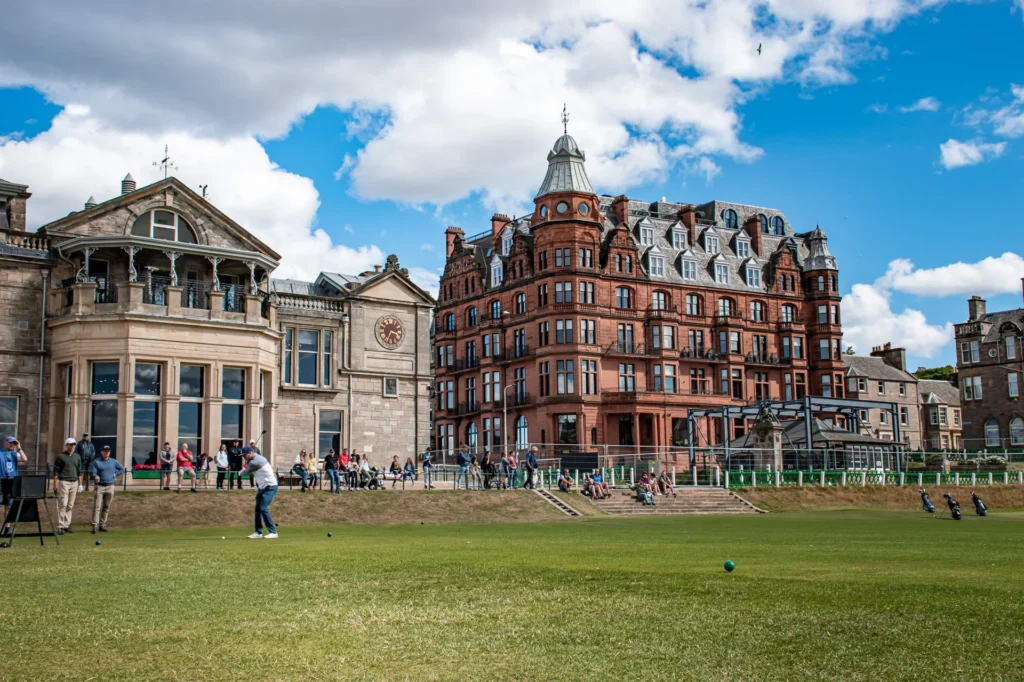
4. The Old Course of St Andrews: the world cradle of golf
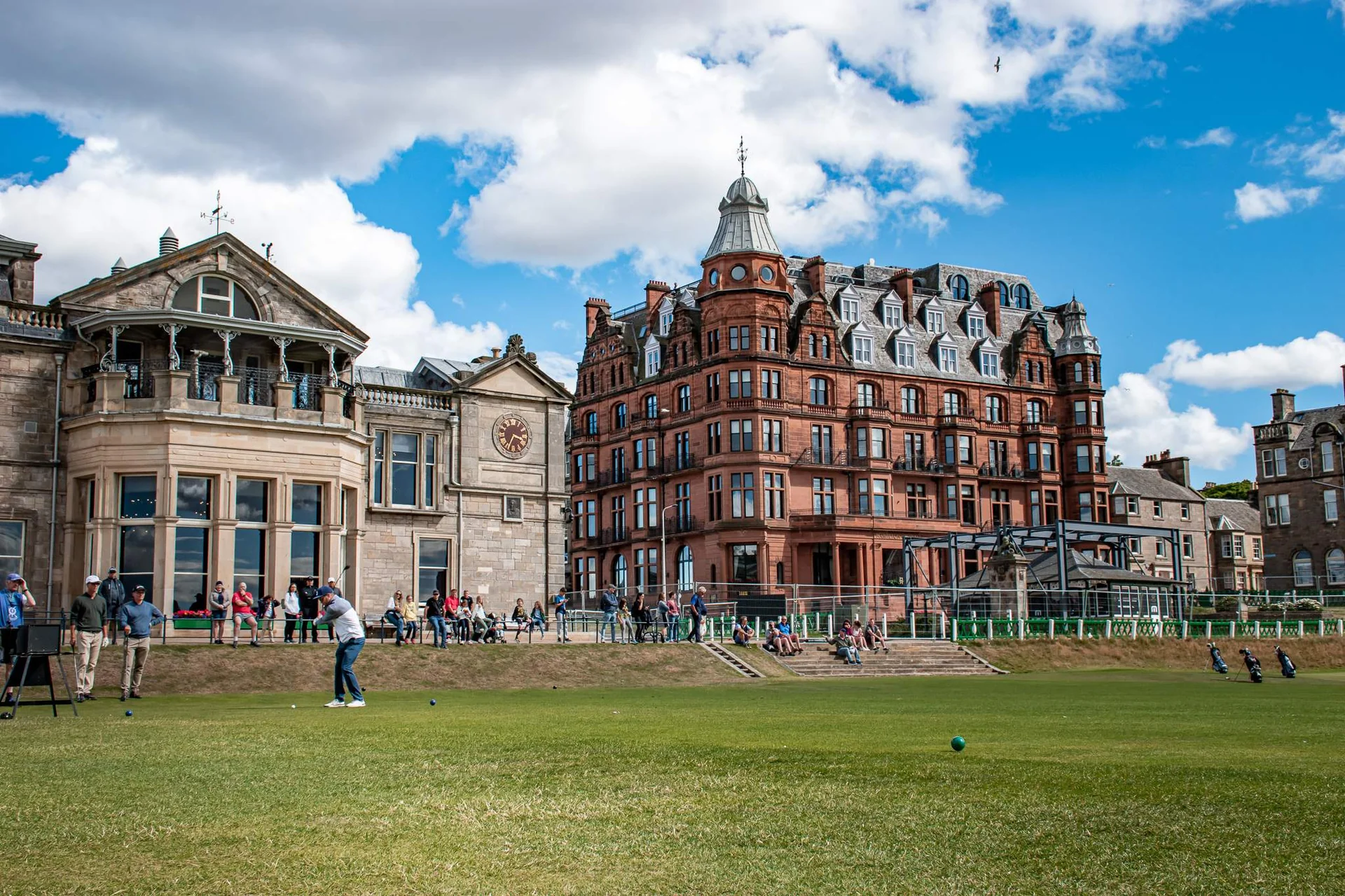
It is the most famous golf course in the world. The game has been played here since the 15th century (the first official rules date from 1754 and were written here), and the Old Course regularly hosts the Open Championship, one of golf’s four Majors. The course is public and managed by the St Andrews Links Trust.
For non-golfers (us, clearly), there is still plenty to see: you can walk on the course when no tournament is on, Sundays in particular are good for that, take the classic photo on the Swilcan Bridge at the 18th hole, and see the outside of the R&A Clubhouse, the building tied to the global rules of golf.
For golfers who want to play: book very far in advance (from 1 September the previous year), handicap required (maximum 24 for men, 36 for women), green fee around £295 in high season. If you have not booked a year ahead, frankly, do not count on it.
5. West Sands beach and Chariots of Fire
The large beach stretching west of the Old Course, West Sands, gives you 1.5 miles of fine sand. It is famous for serving as the backdrop to the opening scene of “Chariots of Fire” in 1981, runners in white on the beach, slow motion, Vangelis, all of it. The film won 4 Oscars, including Best Picture.
Free access, free parking at the far end of the beach. Swimming is technically possible in summer if you are brave enough (water around 12 to 14°C), and a windy walk is basically guaranteed in every season. A good place to decompress after the more historic part of the visit.
6. The ramparts path and the rocky coast
The path along the castle ramparts and down to the rocky coastline is free, open all year, and gives you views you do not quite expect on first arrival. North Sea waves crashing into the rocks, hidden coves, fragments of old fortifications, it is a very good end-of-day walk when the light starts turning golden.
7. Chatting in a student pub at night
St Andrews runs on its students, and the pubs show it. For a good atmosphere: The Central Bar on Market Street (classic student pub, local ales, pub grub), The Whey Pat Tavern (more old-school, very popular), or Aikman’s (bohemian cellar bar). Expect a pint at around £4-5.
8. The antique bookshop and local shopping

The historic centre is full of small shops you do not really get on a standard high street: antiquarian bookshops (the “BOOKS” sign in the photo, which we loved), proper Scottish cashmere shops, cheesemongers, whisky merchants. Caroline completely fell for a lovely Nutcracker-style shop selling handmade decorations. Ideal for the late afternoon, before settling into a pub.
Where and what to eat in St Andrews
Student food dominates overall, but there are still a few stronger addresses.
– The Seafood Ristorante: fresh fish with views over the bay, £35-50 per dish, proper special-occasion option.
– The Adamson: modern bistro, Scottish meat and local fish, £25-35 per dish.
– Forgan’s: brasserie feel, traditional Scottish dishes (haggis, neeps and tatties), £20-25 per dish.
– For cheaper eats: fish and chips from Cromars or Tailend (£8-12).
Budget for a road trip in St Andrews
Quota RapidAPI dépassé (limite par minute/mois). Réessayez plus tard.
St Andrews is a little pricier than other towns in Fife because of the golf crowd. Useful benchmarks (summer 2022):
– Restaurant meal in the centre (starter + main + drink): £30-40 per person.
– Takeaway fish and chips: £8-12 per person.
– Pint in a pub: £4-5.
– Cathedral + tower + museum: £7.50 adult.
– Paid campsite (Craigtoun Meadows): £25-30 per night.
– Green fee Old Course (if you play): £295 in high season.
– Diesel (summer 2022): £1.80-1.90/litre.
Our experience: pivot of the road trip

We arrived late the previous evening from Stirling and parked straight at The Shore near the harbour. Quiet night, right up until 6 AM when the seagulls decided the concert above Édouard should begin. A proper coastal welcome.
Morning: coffee in the van facing the sea, a bit of exercise on the beach (stretching + short run facing the North Sea, very Chariots of Fire, minus the soundtrack). Bakery breakfast in the centre, then straight to the cathedral ruins. We climbed St Rule’s Tower, and yes, the 156 steps wake you up properly. Huge panoramic view over town and the Old Course in the distance. Photo, photo, photo.
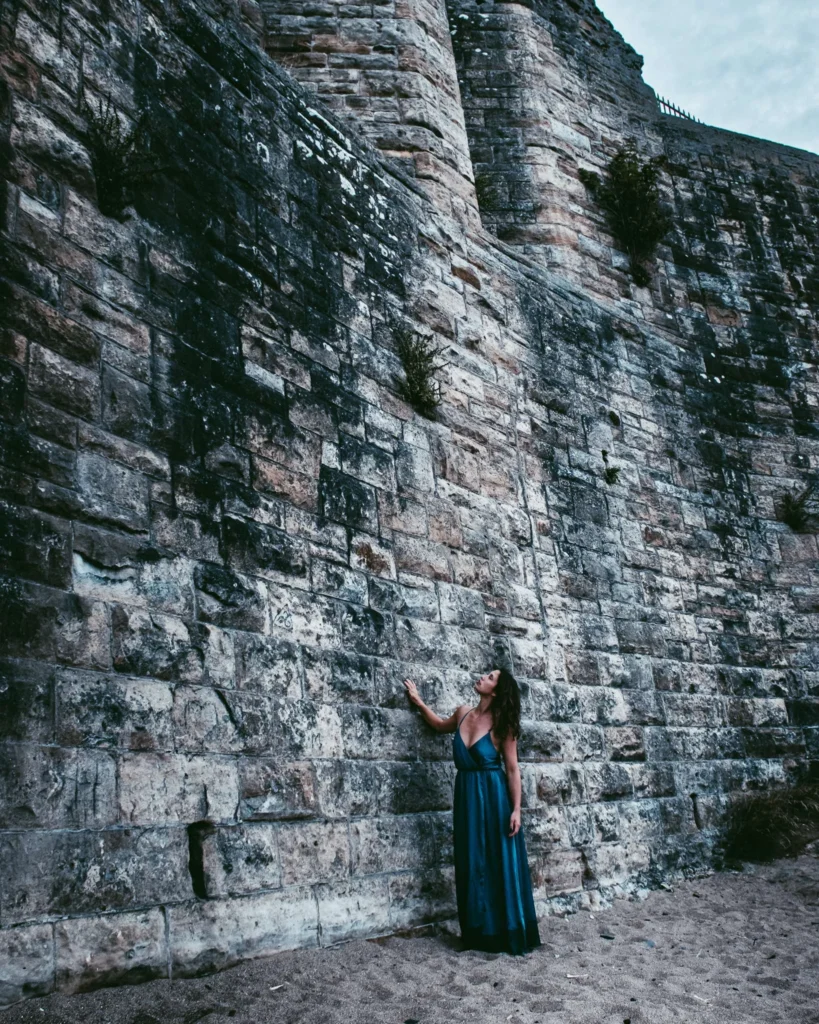
Afternoon: over to the castle, walk along the ramparts (inside closed, outside more than enough for us), then down to the rocky coast. Caroline posed in several dresses against the stone walls (fully in her “Vogue shooting vanlife moment”), while I got the drone out for aerial shots. Coffee break in the historic centre, then a wander through the university buildings (we tried to find William and Kate’s old flat, and naturally ended up at St Salvator’s Chapel instead).
Evening: dinner in a student pub and a pint, then back to the van before 10 PM because we were absolutely finished.
Next morning: one last stop at West Sands, then departure. Northbound for the Highlands and the rest of the trip. St Andrews really was the pivot stage between the urban east coast and the wilder north and west. Caroline said as we left: “we’ll be back”. That says it all.
To go further on the Scottish east coast
St Andrews is an ideal stop between Edinburgh or Stirling and the north-east coast (Arbroath, Stonehaven, Aberdeen). Here are our guides to the stops immediately before and after.

Discovering Edinburgh by road trip and van: Complete Guide
Discover Edinburgh in this travel guide for everyone, perfect for van road trip enthusiasts. Explore the history, budget, where to sleep, where to park, where to eat, and what to...
Read more
Discovering Stirling on a Campervan Road Trip: Complete UK Guide
This guide takes you to Stirling, the perfect destination for a Van Road Trip. Discover the history, budget, where to sleep, where to park, where to eat, and what to...
Read more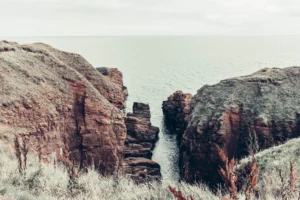
Discovering Arbroath on a Campervan Road Trip: Complete UK Guide
Red sandstone cliffs, the famous Smokie, Arbroath Abbey and a working harbour. Our UK guide to Arbroath by campervan, with overnight spots, Smokie tasting and Angus coast walks.
Read more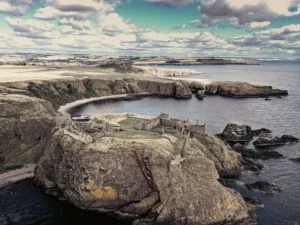
Discovering Stonehaven and Dunnottar by Campervan: Complete UK Guide
Dunnottar Castle on its sea cliff, a working fishing harbour, the seals and the most photogenic ruin in Scotland. Our UK guide to Stonehaven and Dunnottar by campervan.
Read moreFAQ St Andrews on a road trip
How many days to visit St Andrews?
How much does the entrance to St Andrews Cathedral cost?
Can you play on the Old Course at St Andrews when you are not a member?
Where to sleep in a van and camper in St Andrews?
What are the ghost legends in St Andrews?
Is St Andrews Castle accessible and is it worth a visit?
What to do in St Andrews without playing golf?
What is West Sands beach in St Andrews?
PS: we still spent 10 minutes on the main street wondering whether Kate Middleton might appear for a coffee in full “back to my uni days” mode. She did not (or we missed her, sorry British elite). If you go and spot Prince William in a checked shirt at the pub, give him a wave from us.
The next route, straight to your inbox
Two years of full-time van life, and the Algarve as our base ever since. We still hit the road, by van or otherwise, and we write up what we find along the way. An email when we have something to say, no more.
Ce que vous souhaitez recevoir :