



A few years ago, to me, a solar generator was necessarily a bulky thing you dragged around a campsite, with a motor roaring while neighbors looked at you sideways. Then we equipped our campervan, tested a good dozen different stations, and I ended up understanding a simple thing that no one really says: the best station is the one that serves in both your lives, the one that goes on adventures in summer and comes home in winter to handle a power cut.
Because here’s the thing, at home in Portugal, power cuts are almost a season in their own right. The electrical panels are old, we turn on two air conditioners and the oven at the same time, and boom, everything goes out. My entire workstation, computer plus external hard drives, is permanently plugged into a station that takes over without me noticing. So when I’m asked which solar generator to choose, I never respond with a brand. I respond with a question: is it for going away, staying, or both?
What exactly is a solar generator (and why it’s not a generator)

Let’s be clear for a moment, because the name can be confusing. A solar generator is not a machine that produces electricity continuously. It’s a large battery in a box, with outlets (220 V like at home, USB, 12 V car charger), that you recharge from the mains, from the car charger, or with a solar panel placed in the sun. Nothing to install, nothing to drill: you plug it in and it works. That’s the whole point.
The big difference with a thermal generator, the gas one that roars, is that there’s no gas, no engine, no smoke. No lawnmower noise, no carbon monoxide, so usable indoors without danger, in the van as well as in the living room. When you see the term “solar generator,” it’s exactly the same object, just another name for SEO purposes. Don’t look for the difference; there isn’t one.
And in terms of power, it delivers more than you think. In the campervan, we made fruit juice in a blender with a small station without it flinching. At home, we plugged in a heat gun at full power plus a hairdryer on our Delta Pro, we reached 1950 W, and it didn’t even blink. A modern solar generator can run a fridge, an internet box, lights, a computer, a coffee maker. What it doesn’t like are resistors that heat continuously, but we’ll come back to that later.
How it works: the battery, the inverter, and the little regulator that changes everything
Under the hood, three components really matter. First, the LiFePO4 lithium battery, which has become the standard, handling 2500 to 4000 charge cycles before wearing out, which is a good ten years, and remains stable even when working hard. We notice this daily with our EcoFlow: they stay cool under heavy load, which is so rare that we’ve never had heating issues.
Next is the inverter, the component that transforms the battery current into usable 220 V. Always aim for “pure sine wave”: it’s clean current, identical to that from the wall socket, essential for sensitive electronic devices, a computer, hard drives, an electronic coffee machine. An approximate current, and your devices will grind their teeth or even refuse to start.
Finally, when solar is involved, an MPPT regulator optimizes what the panel sends throughout the day. It’s what allows us to fill a large battery in a few hours of good sunlight rather than an eternity. A quick aside, because it cost me time: most of these stations connect to the app via 2.4 GHz Wi-Fi, not 5 GHz. If your phone can’t find the battery, that’s often the issue.
The three families (and which one is right for you)
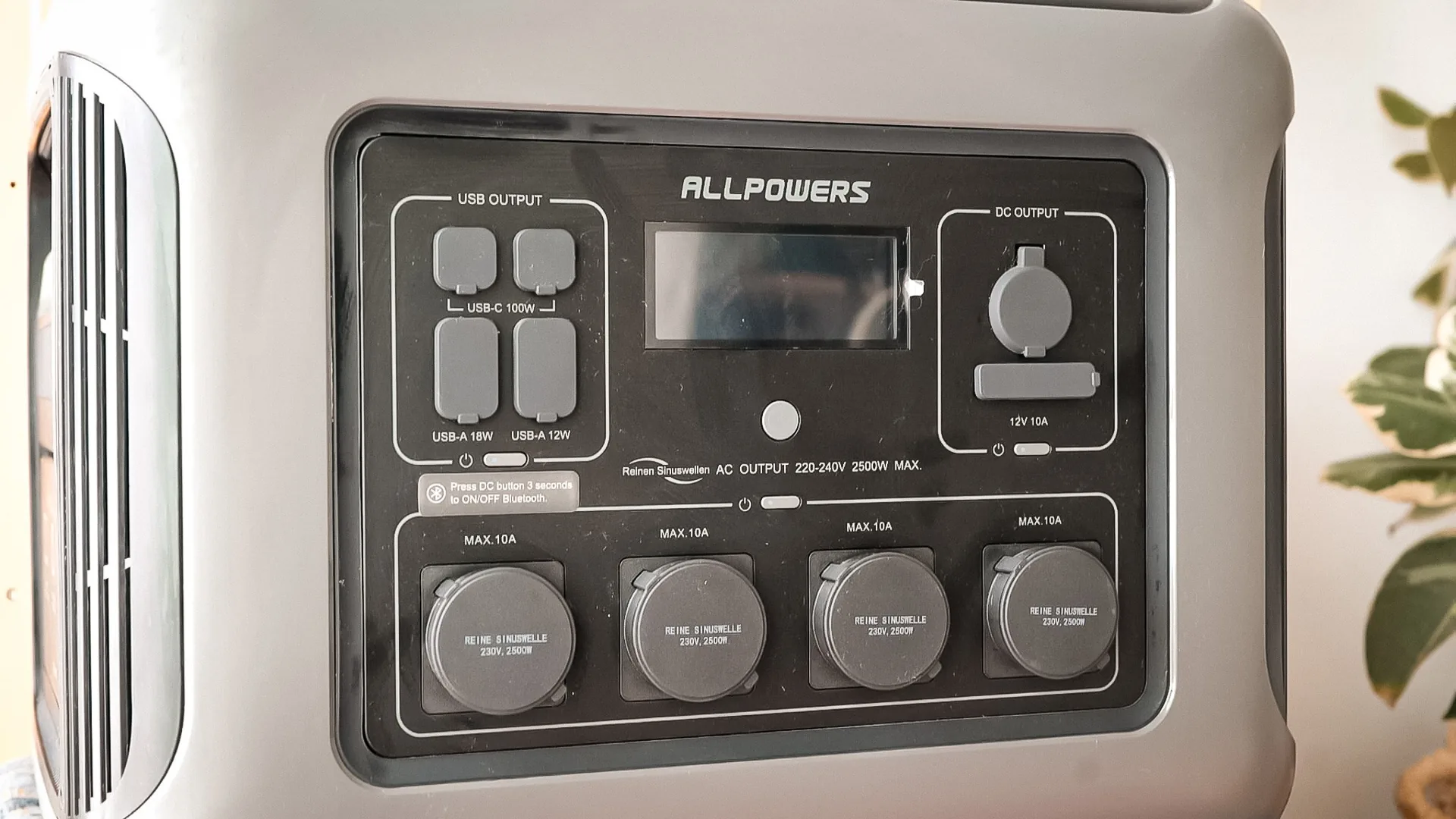
Once you understand the principle, everything comes down to size. And there aren’t thirty-six categories; there are three. The power bank or mini-station, between 100 and 300 Wh, fits in a bag and charges phones and laptops. The versatile expandable station, around 1 to 2 kWh, sturdy enough for 220 V but light enough for travel. And the large home station, 3 kWh and more, an energy cabinet that doesn’t move.
Three families, three logics. The question is not which one is the best, but which one fits your life.
| Family | Capacity | Weight | Ideal use | Indicative budget |
|---|---|---|---|---|
| Powerbank and mini-station | 100 to 300 Wh | 0.3 to 3 kg | Phone, laptop, a hike, a cabin flight | 80 to 300 € |
| Our versatile choice Expandable versatile station |
1 to 2 kWh, expandable | 11 to 15 kg | The van AND home backup: the same station that lives two lives | 400 to 1500 € |
| Large home station | 3 to 7 kWh and more | 30 to 45 kg | Heavy home backup, almost immovable | 1500 to 4000 € |
Real portability
Weight is the real arbiter. A large home station is perfect as long as it never moves. As soon as you want to take it, every kilo counts, and that's where the expandable wins: you keep the capacity via the modules, you eliminate the weight to carry.
The table says it better than I do, but the real judge is the weight. Take our Delta Pro at home: it’s fantastic, it handles everything, but it weighs around 40 kilos. Let’s just say it doesn’t move, unless you roll it like a suitcase on a bus. It’s perfect for stationary use and totally immovable in daily life. It’s the ideal pedagogical counter-example: the bigger a station is, the more capable it is, and the less portable it becomes. Hence the interest in the middle family, the one we’ll detail just after.
What power for what use: the table that no one crosses
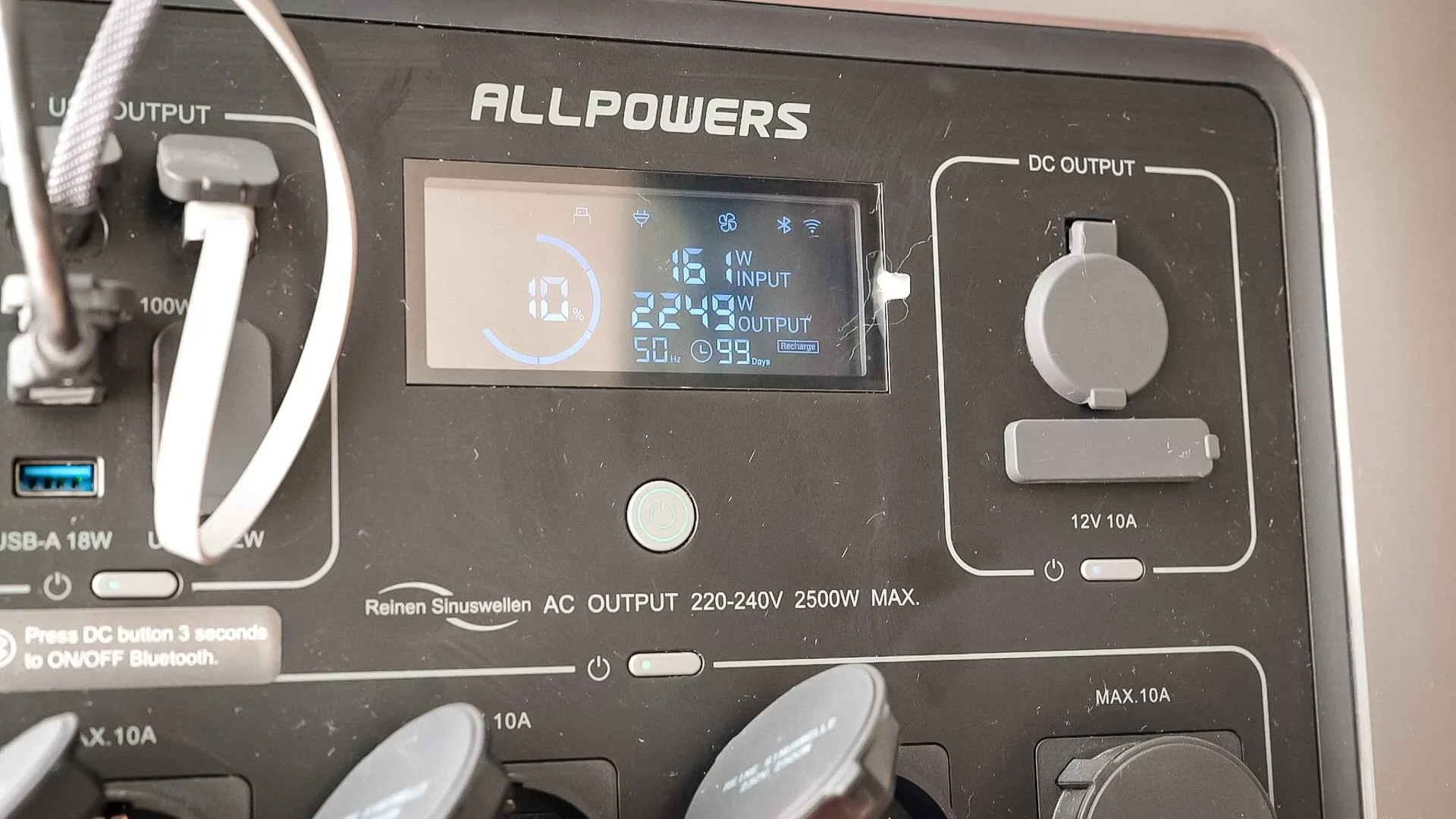
Two numbers not to be confused. The watts are the power, what the station can supply at a given moment: a kettle of 1500 W needs at least 1500 W output, otherwise the station goes into safety mode. Watt-hours, Wh, is the reserve, the autonomy: how long it will last. One formula is enough to navigate: autonomy in hours equals capacity in Wh multiplied by 0.85, divided by the device’s consumption in watts. The 0.85 is because we never recover 100% of what is advertised.
And this is where we need to be honest, because product sheets aren’t always: a station that claims 1024 Wh will give you around 800 usable in cold weather; a battery hates extreme cold. In terms of power, here are the ranges that matter. Below 500 W, we charge small devices, we provide light. From 500 to 1000 W, we add a box, a small fridge, the TV. From 1000 to 2000 W, we can handle a coffee maker, a microwave, tools. Above 2000 W, we’re into heavy appliances in bursts.
A concrete example, because watt-hours remain abstract until we translate them. A van fridge, over a complete cycle, draws on average 40 to 50 W once smoothed over the day. An internet box, about fifteen watts. A laptop on charge, 30 to 60 W. Add all that up, and you’ll see that a 1 kWh station can keep this little world running for a good part of the day, while the same station would give out in twenty minutes on a simple kettle. The lesson is always the same: we don’t size based on the peak, but on what we run for a long time.
Now, cross that with your usage, which almost no guide does. In a van, we look for the best capacity-to-weight ratio and an efficient solar recharge. At home as a backup, we seek output power and automatic switching. And for both, we look for compromise, a lightweight base that we extend as needed. To help you without overthinking, we created this little questionnaire; it won’t sell you the biggest model on the shelf.
Nomad, home or both? Find your solar generator
One station, two lives: the versatility from van to home

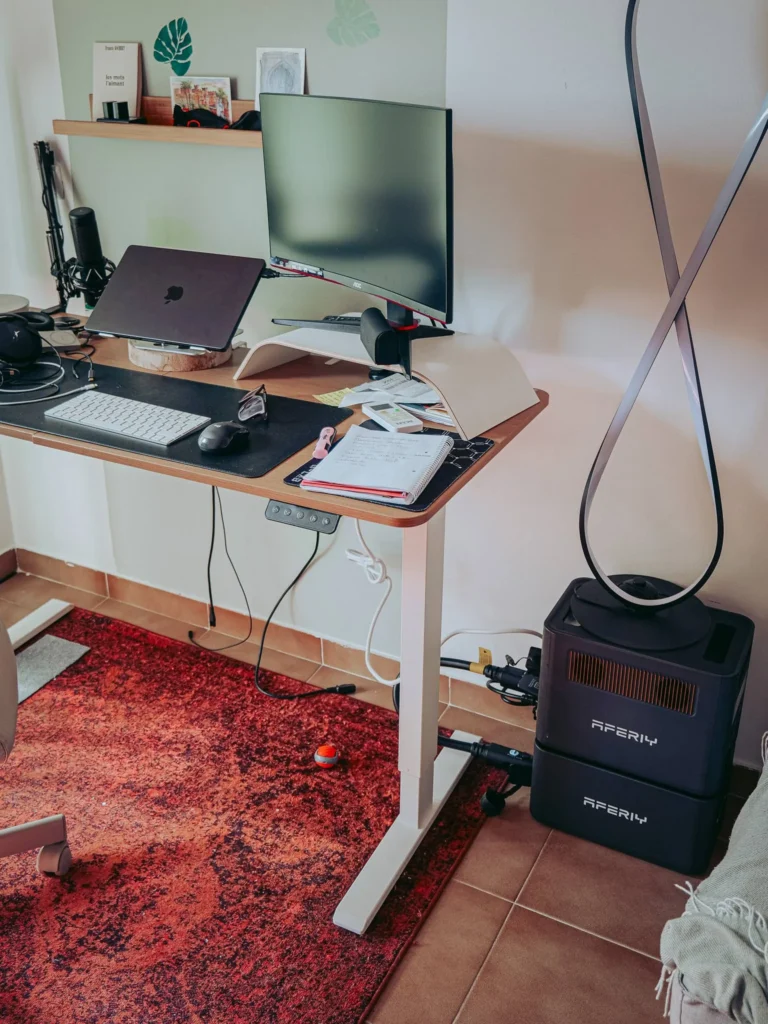
We arrive at the heart of what changed my perspective. Most people reason in two purchases: one battery for the van, another for the home. Except that one station transitions very well from one world to the other, and it’s the same object that migrates. Six months of road trips in summer, then we plug it back at home in winter as a backup. One device, two uses, and we don’t buy twice.
The catch is the weight, again. A large home battery is perfect at home but impossible to take along. The real versatile solution, for a profile like ours, both sedentary and in a camper van, is a lightweight station with extensions. We maintain capacity through stacked modules, eliminating the weight to carry the rest of the time. Specifically, at home, I keep my Delta Pro for the heavy lifting. And the lightweight setup, an Aferiy Nomad 1800 Pro with its extension battery, acts as an inverter and goes in the van. Eleven and a half kilos for the station alone, we can carry it with one hand.
And it’s important to understand what an extension really changes, because it’s often poorly explained. An extension battery adds autonomy, watt-hours in reserve, but it doesn’t increase the power: the station remains at its maximum output, let’s say 1800 W, extension or not. Per watt-hour, buying a larger station directly is even a bit cheaper. If we choose the extensible option, it’s for the flexibility and modular transport, not to save three euros: we travel light and reinforce at home.
Aferiy Nomad 1800 & 1800 Pro: the battery test that saved our night in Bordeira
Field test of the Aferiy Nomad 1800 power station (1024 Wh, 1800 W) in the Algarve: compact format, 1000/500 W input switch, charges in under an hour, 7-year warranty. My...
Read moreA word of technical honesty, because it matters: an extensible station delivers a bit less in pure output than a large dedicated home pro battery. But for grid reinjection, we are anyway limited on the watts we send back into the socket, so this limit does not penalize that usage. If you want to dig into the exact model that embodies this double life, we grilled it in our complete test of the Nomad 1800; it had already saved us one night in Bordeira.

I'm Xavier
I test gear over months, in the van and day to day, and I say what doesn't work. If that saves you one bad purchase, leave me your address.
Ce que vous souhaitez recevoir :
The solar generator as a home backup: handling a power outage
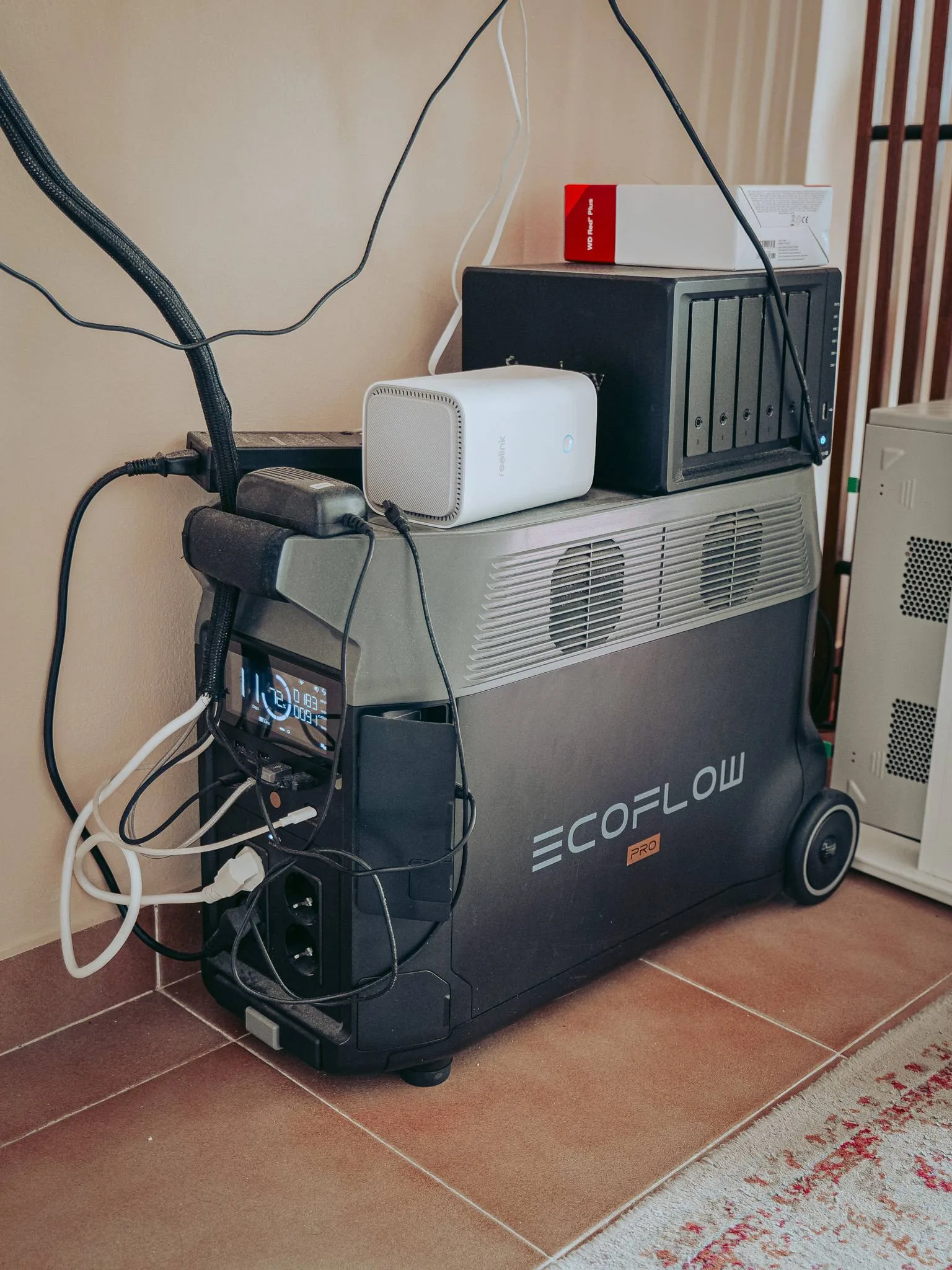
This is the aspect that no one associates with the van, and it’s a shame because this is where these stations become valuable. The number one criterion for backup isn’t capacity; it’s the automatic switch to inverter. A true UPS function switches to battery in a fraction of a second when the power goes out, without your devices shutting down. Beware of the nuance: some stations have a so-called EPS switch, a bit slower, sufficient for a fridge but not always for a computer in full work mode.
For us, this isn’t theory. The day the power went out while I was working, my station took over and saved me from losing my work and from frying my external hard drives while writing. Since then, my entire workstation has lived on it permanently. What a station can hold without issue during an outage: the fridge, the internet box, LED lighting, a computer, a medical machine like a CPAP. What it won’t hold for long, or at all: the oven, the cooktops, the water heater, anything that heats by resistance. We aim to keep the essentials running for a few hours, not to power the entire house.
To give you a sense of scale, consider a twelve-hour outage on a winter evening. The fridge, the box, a few LEDs, and a computer run around 80 to 120 W on average once smoothed out. A station of 1 to 2 kWh will get you through the evening and a good part of the night without even thinking about it. Add an extension, and you can handle the entire outage. That’s the whole point of an extensible base: we don’t oversize just in case; we add kilowatt-hours the day the need truly arises.
The solar panel, the other half of the story
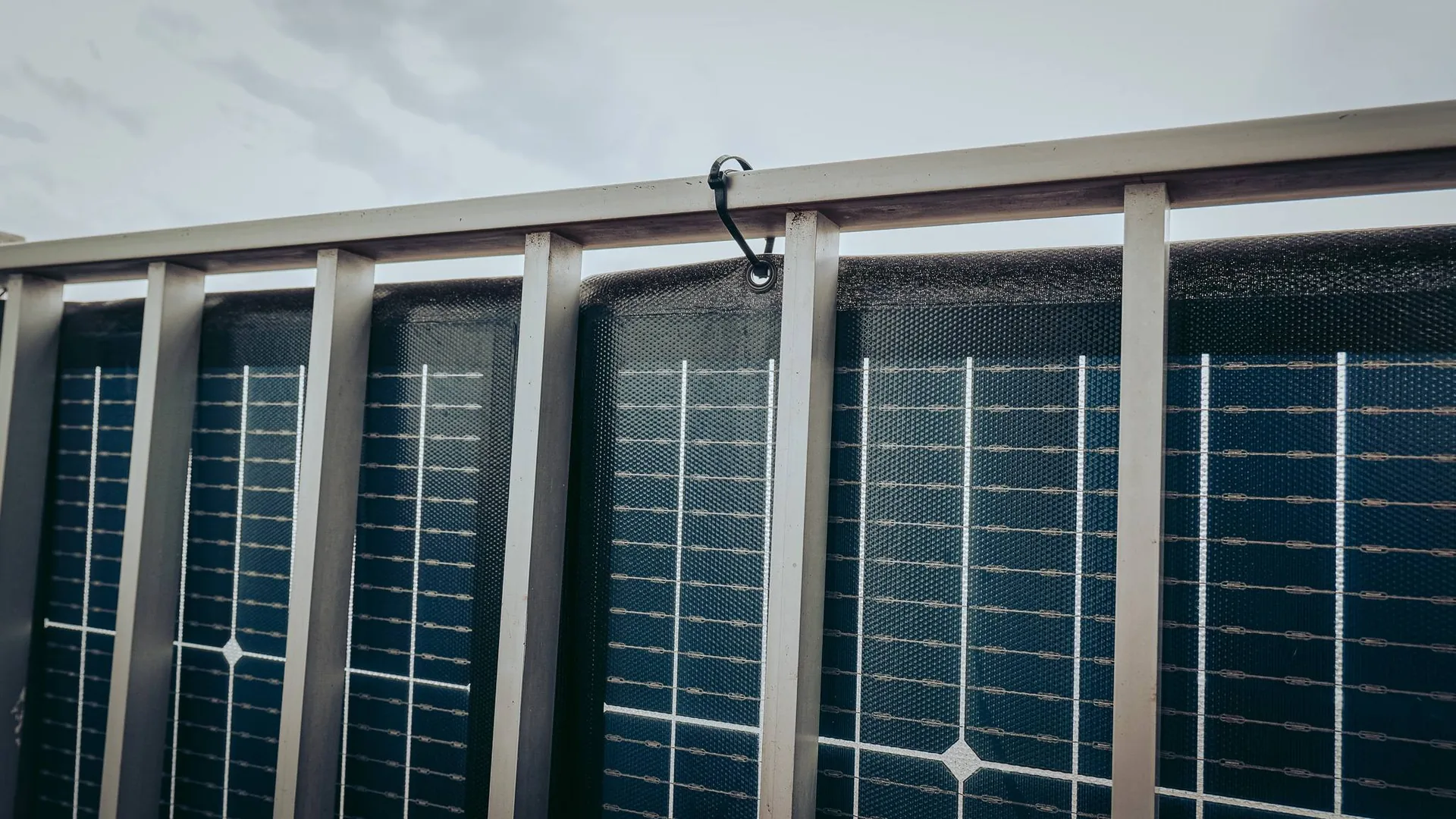
We talk a lot about the battery and never about the panel, even though it’s the one that makes everything truly autonomous. A portable panel unfolds, sits in the sun, plugs into the station, and recharges without a socket. But again, you have to be wary of the advertised figures. With our 110 W panel, we’ve never seen the peak of 110 W: we typically operated between 60 and 70 W under real conditions, more than enough to power two MacBooks, but far from the advertised figure. It’s normal; always plan for a margin.
Weight, again, plays the troublemaker. Our 400 W panel weighs almost 16 kilos, and handling it alone is a workout. However, a good panel well-oriented changes everything: on our setup, an adjustable mount gained 30% more production in winter, just by following the sun. And solar sometimes works real miracles. In Alsace, ten days of travel including three of storms, we never needed to plug into the 230 V external, the panels were enough for two computers and the modem. Still, the portable panel and the fixed installation on the roof don’t play the same role, and many vanlifers combine both; we’ll discuss that further on.
How much does it cost, and which brand to choose
Prices range roughly from £300 for a small station to over £3000 for a large home cabinet, extensions included. What determines the price is capacity, output power, and battery quality. One piece of advice: don’t pay for kilowatt-hours you’ll never use. The right station is the smallest that comfortably covers your actual need, not the biggest in the catalog.
On the brand side, the must-haves hold the top spots: Jackery, EcoFlow, and Bluetti, which are found everywhere, reliable, with real support. Alongside, we’ve tested many slightly lesser-known and often more affordable brands, like Aferiy and AllPowers, which offer excellent value for money when you know what you’re buying. To avoid choosing the wrong model, we detailed the method in our guide to choosing your portable power station, and if your initial question was more about the vehicle’s built-in battery, take a look at our overview on types of camper batteries; it’s another topic that’s often confused.

EcoFlow, Aferiy, or AllPowers: the three we’ve really paid for, and which one we recommend
Well, I have to confess something a bit ridiculous, when we open the cupboard under the van bench, we have three power stations staring at each other like cats and...
Read more
How to Choose Your Portable Electric Station: Buying Guide
The market for portable batteries has exploded in recent years, offering solutions for autonomy ranging from simply recharging a smartphone to fully powering a household in distress. But between pocket-sized...
Coming soonWhat a solar generator won’t do (and the little flaws they’re hiding from you)
Because we’re not going to sell you a dream, here’s the other side of the coin, drawn from our own struggles. First, the weight, we’ve repeated it enough. Then the noise: a big station working is not silent, and we sometimes hear the fan of the Delta Pro from the next room when it runs at night. On an Aferiy P280, the fan even gave me a little panic at startup because it revved up so much before calming down.
A few other downsides experienced, in no particular order, because they matter. On an entry-level station like the River 3 Plus, the protection cuts off as soon as we exceed the power, a greedy vacuum cleaner and everything stops, frustrating but reassuring. On the Aferiy P210, the hatches open upwards and you have to lift the battery to access the sockets. And the little detail that already annoys me about the P180-B extension battery: the cable connecting it to the station is really bulky, it increases the overall footprint and you can’t stack the two just anywhere. Oh, and beware of the announced charging times: we were promised 1.6 hours, it took us 4 on our setup. Nothing dramatic, but it’s good to know in advance.
Frequently asked questions about the solar generator
How many years does a solar generator last?
It's not the autonomy of one evening that matters here, but the battery life. The LiFePO4 lithium models, the standard today, last between 2500 and 4000 full charge cycles before losing their strength, which is about 10 years at a rate of one charge per day. The old classic lithium chemistries topped out around 500 to 800 cycles.
Can it be left permanently connected to the inverter without damaging it?
Yes, it's even one of its best uses. Plugged upstream of your workstation, it allows current to pass through and takes over in a fraction of a second if the power goes out. The LiFePO4 handles staying charged very well. The only point of caution is heat: give it air, don't enclose it in a closed cabinet.
Can it be used while it is charging?
Most stations accept simultaneous charging, what is called pass-through: they power your devices while recharging from the mains or solar. Very convenient to never cut off. However, check the technical specifications, some small entry-level power banks do not allow it.
Solar generator or fixed roof panels on the van: which one to choose?
The two do not play the same role. The solar generator is a mobile, plug-and-play station that goes with you and returns home. The fixed panels on the roof continuously power the vehicle's installation but remain on board. Many vanlifers combine both. We detail the fixed installation in our solar installation guide for motorhomes.
Can you take a solar generator on a plane?
Only the very small ones. The airline rule limits lithium batteries to 100 Wh in the cabin, which is a power bank or a mini-station. Beyond that, 500 Wh, 1 kWh or larger stations are prohibited in both the hold and the cabin. For a flight, we therefore stick to the equivalent power bank format.
Is shade and ventilation needed around the station in summer?
Yes. The paradox of solar energy is that it likes the sun on the panel but not on the station. In full heat, a working battery heats up, its fan speeds up, and the electronics sometimes protect themselves by limiting the power. Place the station in the shade and in the air, only the panel stays in the sun.
PS: since we figured out the trick of the station living two lives, we’ve stopped chasing the perfect model. Ours spends the summer charging our laptops facing the ocean, and the winter standing guard in a corner of the office waiting for the next power cut. Two lives, one battery, and a Portuguese who sleeps soundly despite his old fuses.
Our gear tests, in real conditions
Batteries, solar, conversion, security. What we found after months of real use, and what we would not buy again. An email when we have actually tested something, not before.
Ce que vous souhaitez recevoir :