


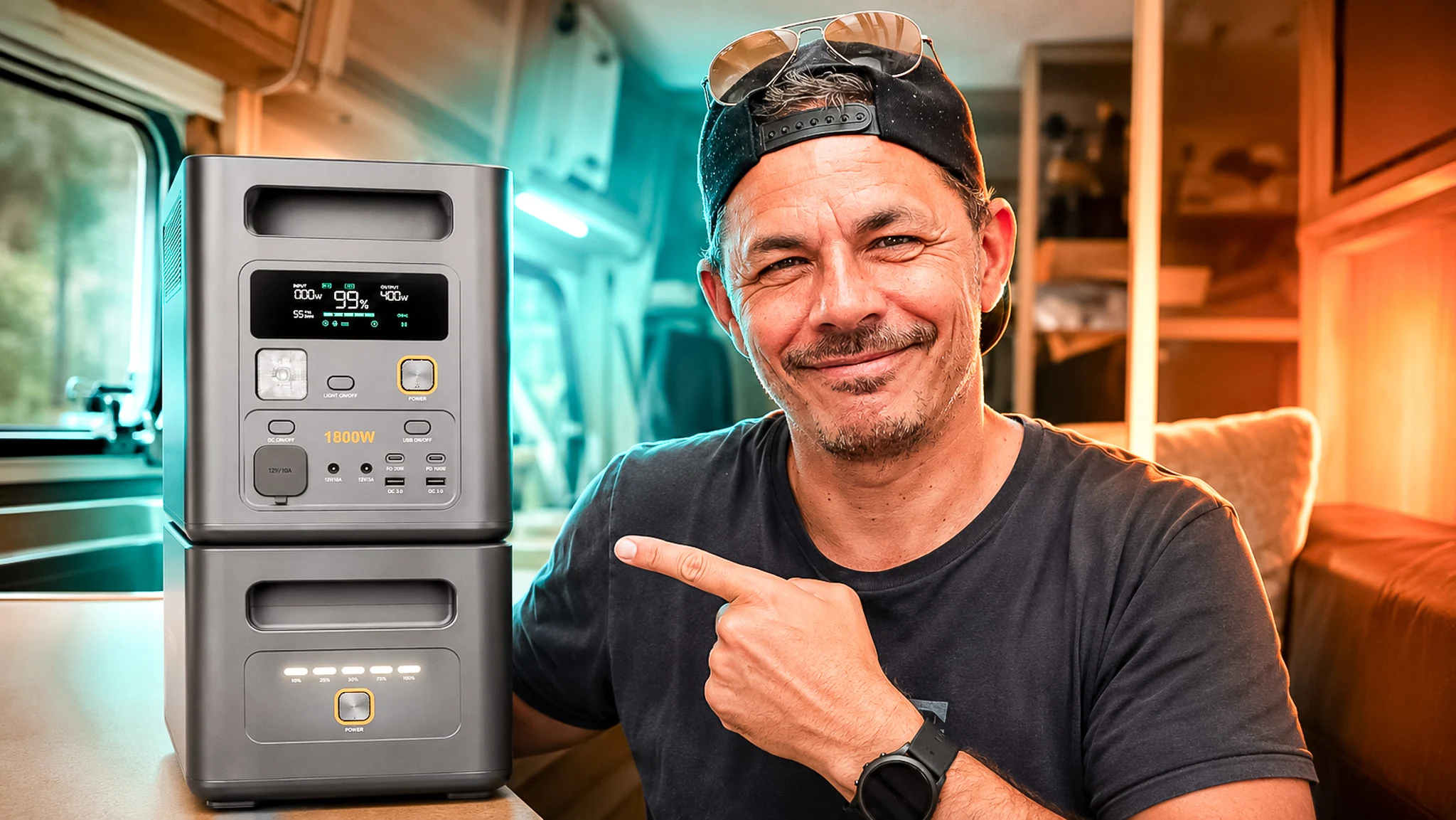
The first time I really understood the purpose of a backup battery that can be expanded was one night at Bordeira beach in the Algarve. Our secondary network battery in the campervan had just given up, corroded terminals, nothing working as soon as the sun went down. And there, calmly, our little Aferiy station plugged outside took over… the modem plugged into the cigarette lighter, enough to last the evening, work continuing as if nothing had happened.
What I took away from that night is that I didn’t even have to drain it. An hour and a half of use, barely 30% consumed, and the next day the full spring sunshine refilled it on its own. I had reserves, I barely touched them, and most importantly, I could take it anywhere. This is exactly the starting point of this article, because this logic of portable reserves can be pushed even further: instead of buying a bigger battery, we add modules to the one we already have. And since then, at home, that’s what I’ve been doing with an extension connected to my Nomad 1800 Pro.
What exactly is an expansion battery
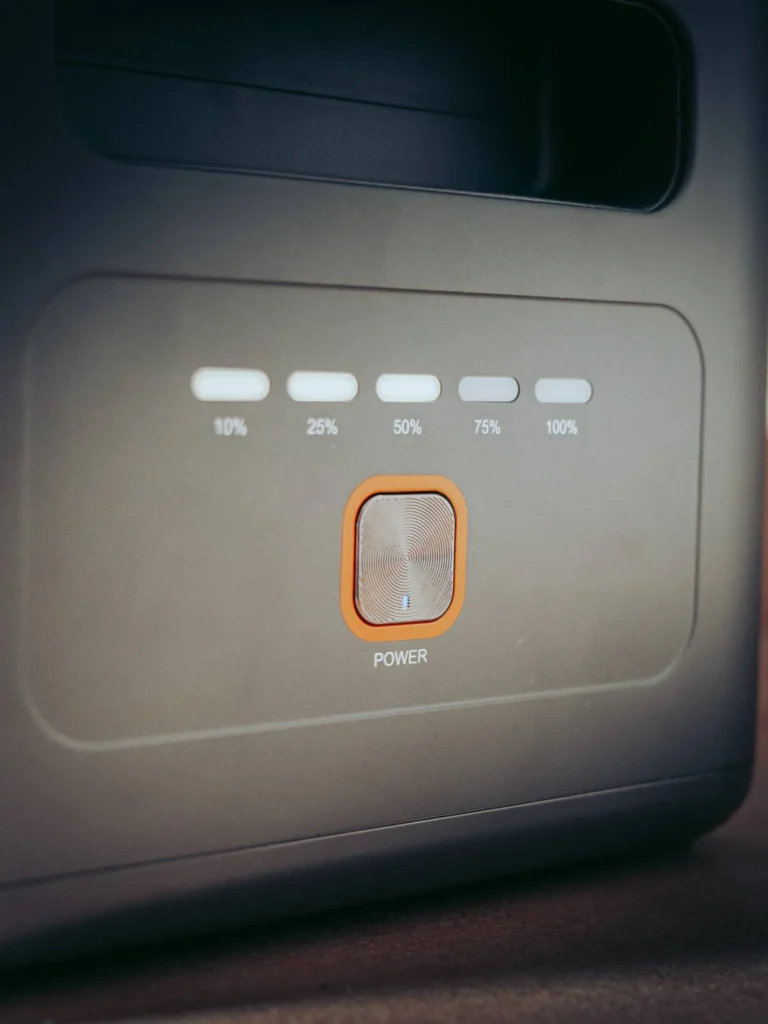
Let’s start from the beginning, because the term can be intimidating while the concept is quite simple. An expansion battery is an additional storage block, lithium cells, and a small brain that manages them (the famous BMS), all housed in a case with a handle. But be careful, and this is the point that no one clearly states: this block does not have its own inverter. No 220 volts outlet, no screen, no output brain. It’s a reservoir, not a station.
In practical terms, the extension connects to your main station via a dedicated thick cable, and it’s the station that does all the work: it’s the one that converts the current, manages the charge, and powers your devices. The extension simply adds fuel to the reservoir. You plug your fridge into the station as usual, except instead of lasting ten hours, it lasts twenty or thirty. We’re stacking capacity, not changing anything else.
This format exists with almost all serious brands today: EcoFlow does it with its Delta, Bluetti with its large stations, Jackery with its recent Explorers, and Aferiy with the Nomad 1800 Pro using the module we’re interested in here, the P180-B. Each time, the promise is the same: a lightweight base station that can be expanded later, without starting from scratch.
Why does it exist, what is it really for
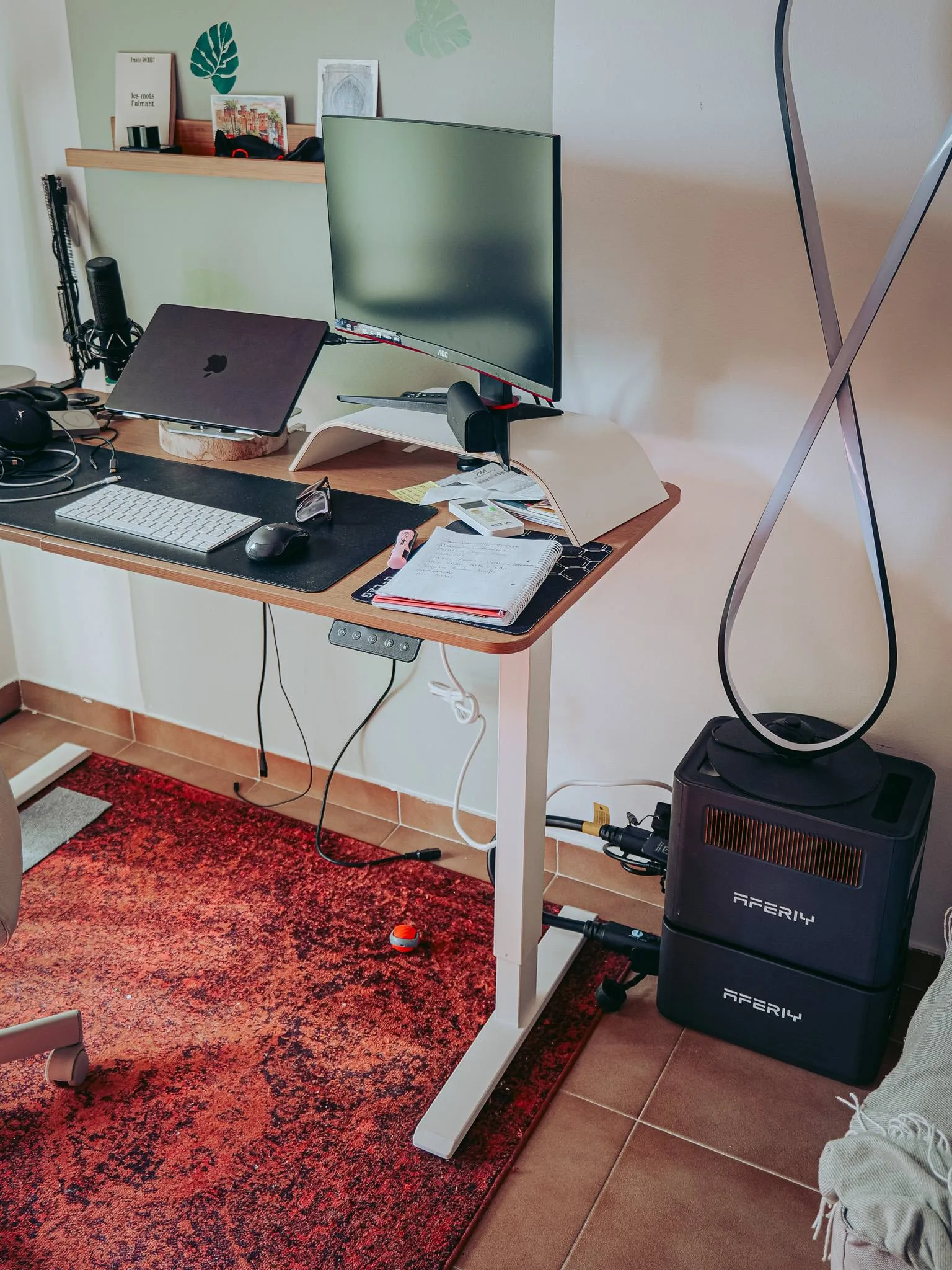
The real purpose of expansion batteries is to solve a dilemma that plagues anyone wanting electrical autonomy: either you go small and light, and you lack capacity, or you go big and heavy, and you end up with a device that you never move again. I know this well; I have a large EcoFlow Delta Pro at home that weighs about 40 kilos. It’s great for stationary use, but moving it is like relocating a washing machine, so let’s just say never.
The extension breaks this dilemma by decoupling two things that we thought were linked: capacity and weight. We keep a lightweight base station, the one we can easily take on weekends or in the van, and we add modules when we’re at home and need to last longer. On departure day, we leave the modules in the garage and set off light. It’s the ideal solution for a profile like ours, both stationary part of the year and on the road the rest of the time.
The second reason, more down-to-earth: the budget. An expandable station allows you to buy capacity in increments. You first equip yourself with just the station, live with it, and if you realize you’re a bit short, you add an extension six months later, without having to buy the whole system again. You spread the expense instead of shelling out £2000 all at once for a large battery.
And there’s a third benefit, more subtle but clever, which is to size without making mistakes. When you start with electrical autonomy, you have no idea what you really need, and you tend to either underestimate and regret it or overestimate and carry around unused capacity. The expandable formula allows for error: you start reasonably, observe your actual consumption for a few weeks, and adjust. It’s much less stressful than betting a large sum on a hunch. If you want the big picture on these all-in-one stations, we’ve created a complete guide on solar generators.

Solar generator: the station that lives two lives, in a van and at home
A few years ago, to me, a solar generator was necessarily a bulky thing you dragged around a campsite, with a motor roaring while neighbors looked at you sideways. Then...
Read moreWhat the extension changes, and what it doesn’t change
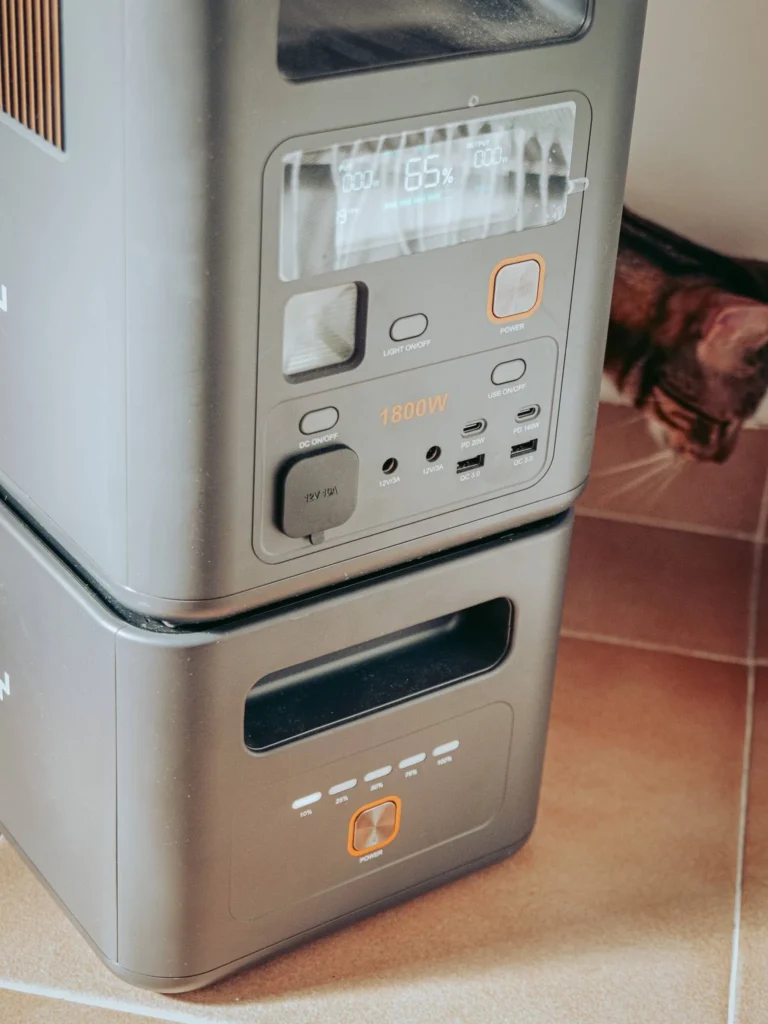
Here’s the number one misunderstanding that needs to be cleared up immediately, because this is where people go wrong when buying. Adding an extension increases capacity, thus autonomy, but it does not change the output power. On the Nomad 1800 Pro, it remains at 1800 watts continuously, whether you have one extension or four. The extension gives you more hours, never more watts.
It may seem like a detail, but it has a huge consequence. If a device wouldn’t work on the station alone because it draws too much power (an oven, an induction cooktop, a powerful hairdryer), it won’t work any better with the extension. You’ll be able to run it longer on the day it works, but if it exceeds 1800 watts, it’s a no-go, extension or not. Capacity is the size of the tank. Power is the size of the pipe. The extension enlarges the tank; it doesn’t touch the pipe.
And this is even the real honest downside of versatile stations like this, which comparison sites often forget to mention. A lightweight and expandable station is smaller at its core, so it delivers less power at output than a large battery dedicated solely to stationary use, which will be capable of sending much more watts. You trade raw power for lightness and modularity. For nomadic work, emergency use, or small devices, it’s the right compromise. To power an entire house, including heating, no, and you need to know this before buying. Here’s what it looks like in terms of autonomy, alone and then expanded.
What the Nomad 1800 Pro holds on a charge, alone and then with one, two, or four stacked P180-B extension batteries. We stack autonomy, never power.
| Device | Alone 1024 Wh | +1 extension 2048 Wh | +2 extensions 3072 Wh | Max +4 5120 Wh |
|---|---|---|---|---|
| Refrigerator / freezer ~60 W | 14 h | 29 h | 44 h | 73 h |
| Internet box + wifi ~15 W | 58 h | 116 h | 174 h | 290 h |
| Laptop ~55 W | 16 h | 32 h | 47 h | 79 h |
| LED Television ~80 W | 11 h | 22 h | 33 h | 54 h |
| Van cooler ~45 W | 19 h | 39 h | 58 h | 97 h |
| LED lighting (home) ~25 W | 35 h | 70 h | 104 h | 174 h |
| Charging phones / tablet ~18 W | 48 h | 97 h | 145 h | 242 h |
Estimates include inverter losses (usable capacity ≈ 85 %). A fridge cycles instead of running continuously, so in practice it often lasts longer than the table indicates. And above all: whatever the configuration, the output remains capped at 1800 W. The extension adds hours, not watts.
Compatibility, the real trap to avoid
If you were to remember only one thing from this article, it would be this, because it’s the most expensive mistake you can make. An expansion battery will only work with its station, and often even with only one specific model. It’s not a universal plug; it’s a closed ecosystem: the connector, the cable, and the electronic dialogue are specific to the brand, sometimes to a single reference.
The case of the P180-B is the perfect example of a trap. It is compatible only with the Nomad 1800 Pro, and not with the standard Nomad 1800, despite a nearly identical name. Two stations that look alike, but only one accepts the extension. If you buy the standard version thinking you can extend it later, you’re stuck. The same goes for other brands: an EcoFlow extension does not connect to a Bluetti, a Bluetti extension does not fit a Jackery, and so on.
The practical lesson is that you need to choose the station with the extension in mind, even if you are not buying it right away. Make sure that the exact model you are targeting is the extendable model, not just that the range offers extensibility somewhere. We detailed the host station, its ports, and its behavior in real conditions in our complete test; it’s the best place to see if it fits your usage before committing.
Aferiy Nomad 1800 & 1800 Pro: the battery test that saved our night in Bordeira
Field test of the Aferiy Nomad 1800 power station (1024 Wh, 1800 W) in the Algarve: compact format, 1000/500 W input switch, charges in under an hour, 7-year warranty. My...
Read moreExtend or buy a larger station
This is THE question that annoys, and the answer is not what you think. We often believe that extension is always the best plan, but when it comes to watt-hours, that is rarely the case: directly buying a larger station often costs a bit less per kilowatt-hour stored. An extension is paid for the flexibility and portability, not for the price per kilo.
So, it all depends on your starting situation. If you are starting from scratch, calculating coldly per watt-hour makes sense, and a large station may be smarter. But if you already have the compatible station, the question doesn’t even arise: the extension is obviously more cost-effective than buying and reselling the old one. And if you move around, the combination of a lightweight station plus an extension left at home beats any large battery that you will never move. I summarized the decision in this little comparison.
- You already own the compatible station (here the Nomad 1800 Pro)
- You want to add capacity in increments, when the budget allows
- You move: you take the station alone (light) and leave the extension at home
- Your need is more autonomy, not more power
- You want to stay on a single device, a single app, a single cable
- You start from scratch, without a compatible station already in hand
- You need more output power, not just autonomy
- You are hunting for the lowest price per watt-hour (direct purchase of a large station is often a bit cheaper per Wh)
- The device will mostly remain stationary, weight is not a concern
- You want a robust inverter switch to cover an entire house
The simple rule: the extension buys autonomy on a basis that remains light and versatile, around €0.35 to €0.5 per watt-hour. Buying bigger buys power and often a better price per Wh, but you end up with a heavy device and a potential duplicate to sell. Two logics, not a single winner.
My concrete case: the P180-B on my Nomad 1800 Pro
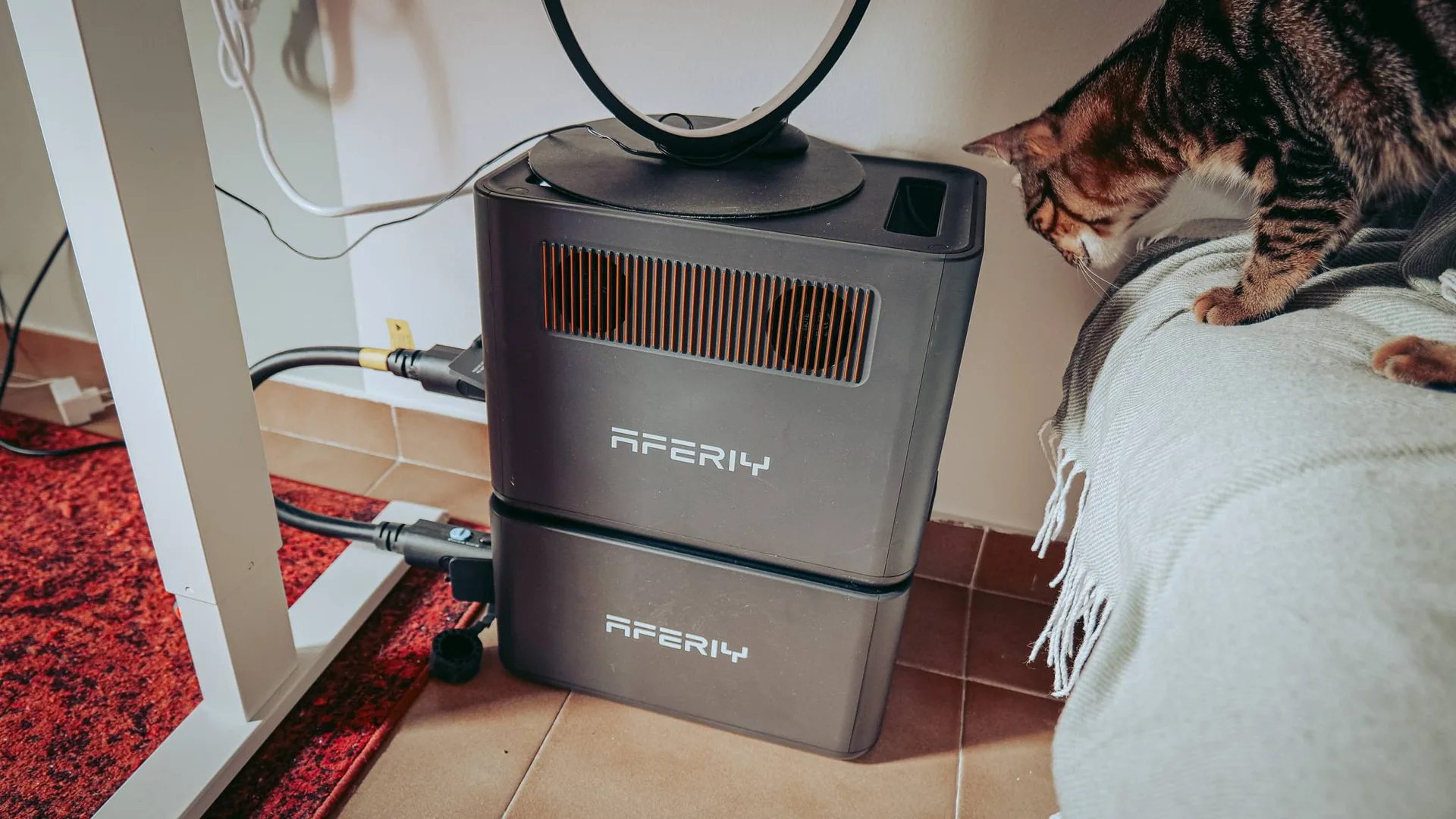
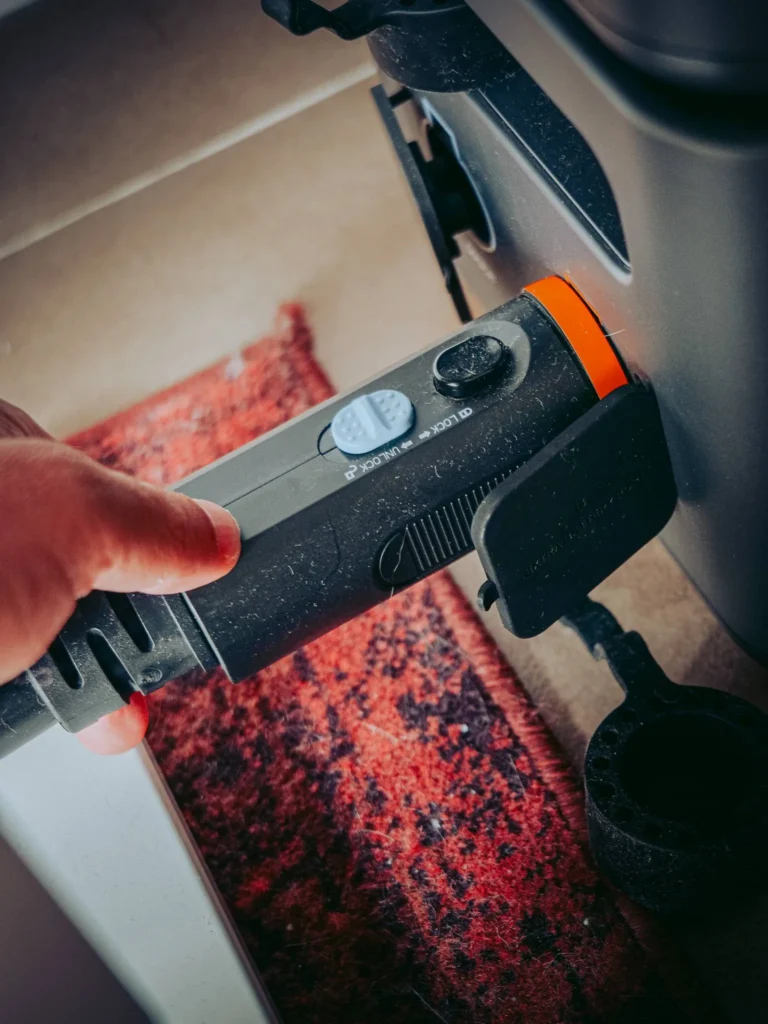
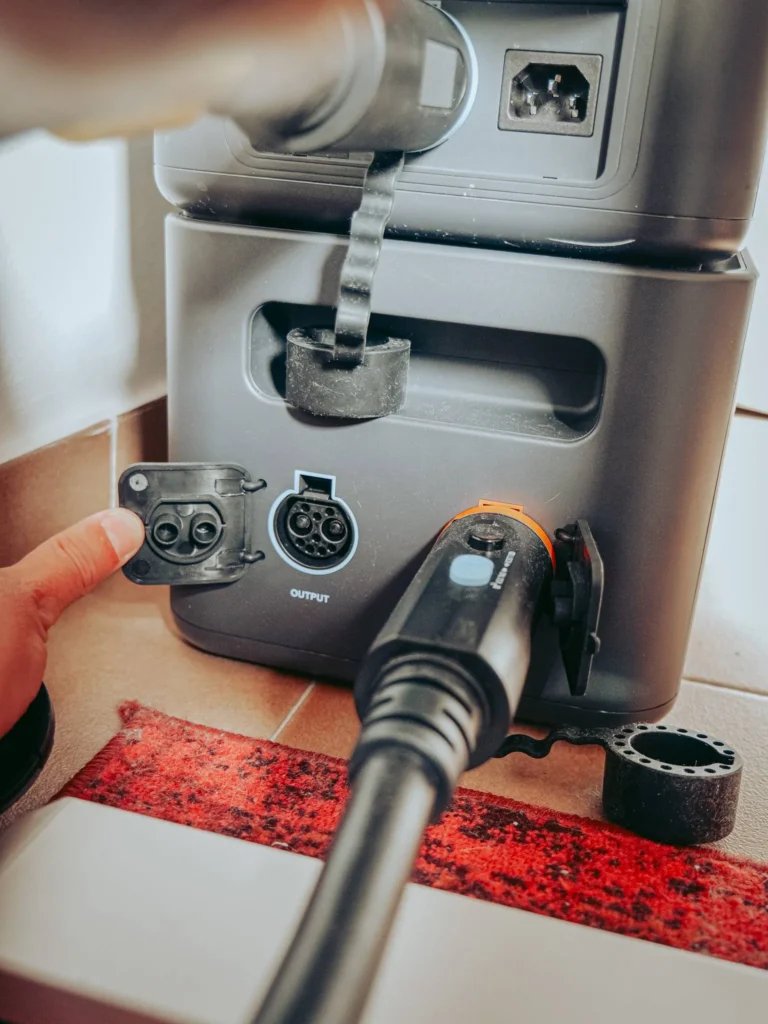
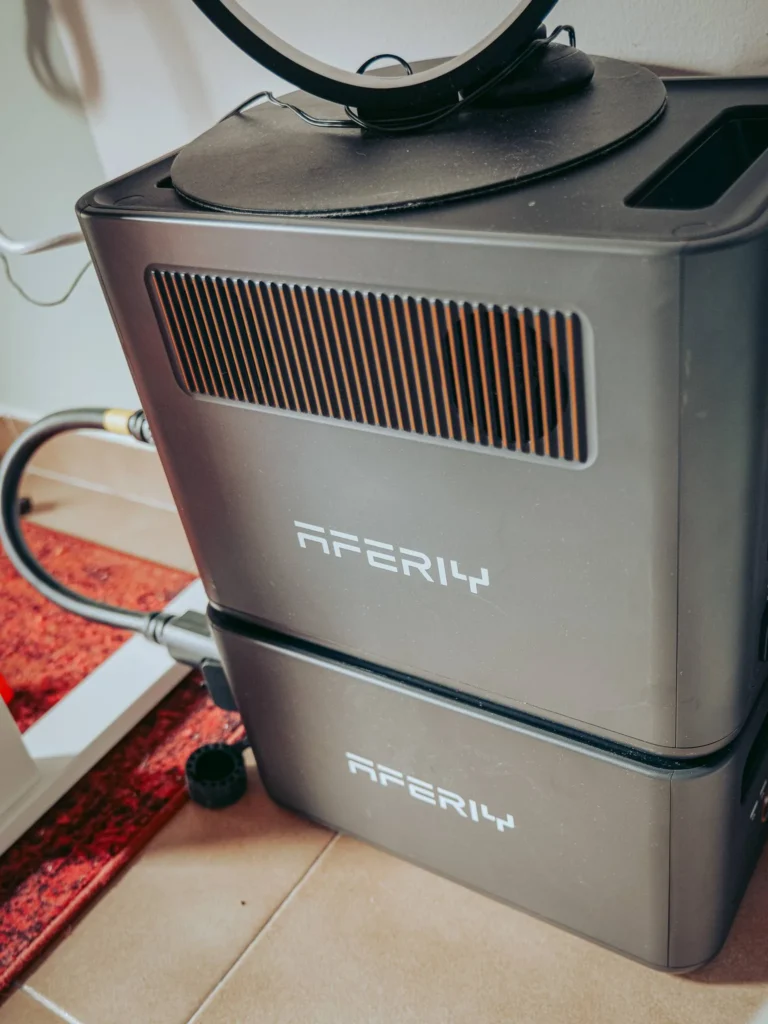
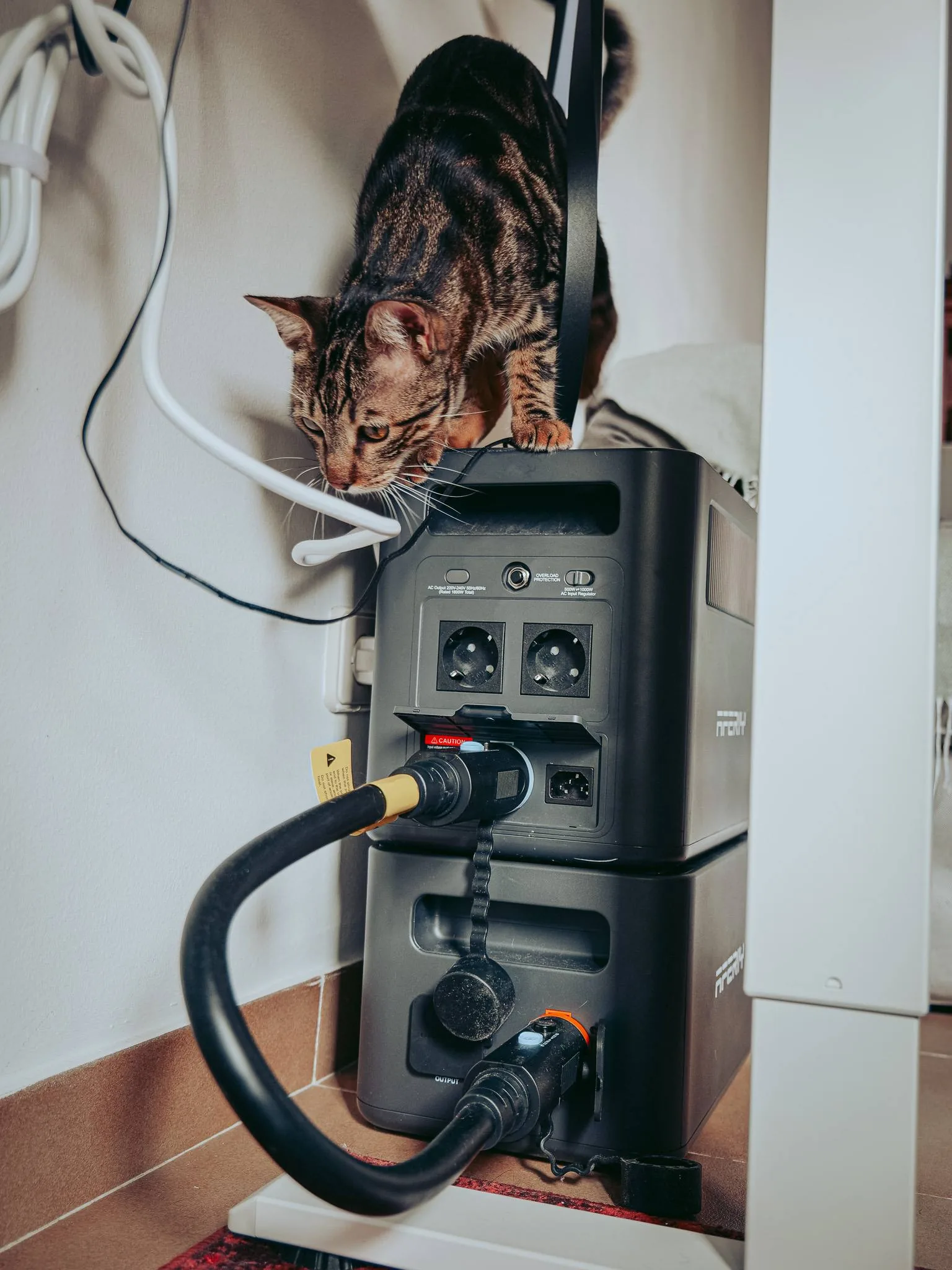
Enough theory, here’s how it works for real at my place. The Nomad 1800 Pro plus its P180-B extension battery is the combo I use as a backup inverter at home. This type of station is very well suited for this role: it switches to battery in less than ten milliseconds when the power goes out, so connected upstream, a workstation or a fridge feels nothing. For the large stationary setup, I keep my old Delta Pro, but the Aferiy set has two lives: inverter at home, and it goes in the camper when we hit the road.
In terms of numbers, the station alone has 1024 watt-hours, and each extension adds the same, up to a maximum of four modules to reach 5120 watt-hours. We always stay at 1800 watts output, 3600 peak, with LiFePO4 cells rated for 4000 cycles and a 7-year warranty when purchased directly. The recharge is quick too, around 80% in just half an hour on mains, which is perfect between two close power cuts.
What I like about this operation is the always-on aspect it allows. The station remains constantly plugged into the socket, it acts as a continuous buffer, and on the day the grid goes down, there’s nothing to catch up on since it was already the source. This is exactly what makes the switch imperceptible, much more than the milliseconds stated on the spec sheet. And with the extension behind it, this always-ready reserve becomes quite comfortable; you no longer worry about whether you will last. The price and the current promo code are here; I don’t fix them in the article because they change all the time.
Technical specifications
| Capacity | 1,024.00 Wh |
|---|---|
| Battery Chemistry | LiFePO₄ |
| Warranty | 7.00 an |
| Battery Protection | Intelligent BMS, 6-layer protection |
| Life Cycles | > 4000 |
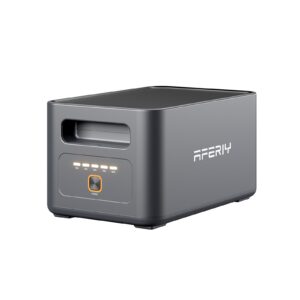
AFERIY P180 Pro-B Expansion Battery | 1024Wh promo code
 In stock
AFERIY P180 Pro-B Expansion Battery | 1024Wh
VANTOURUK*
*Verified price on 21 September 2026. The final price may vary.
And because we wouldn’t be honest otherwise, there is a real ick that I noticed right away: the cable connecting the extension to the station is particularly bulky. Thick, rigid, it increases the overall bulk and imposes an orientation; you can’t place the two units just anywhere. Nothing prohibitive, but on an object meant to be compact and practical, it’s surprising, and I prefer to warn you. By the way, all this backup usage at home has been explored in our dedicated article on home backup batteries.

The home backup battery that also goes on weekends
The last real power cut we had here in Portugal lasted about twenty minutes. And the craziest part is that I didn't even notice it.. I was sitting in front...
Read more
I'm Xavier
I test gear over months, in the van and day to day, and I say what doesn't work. If that saves you one bad purchase, leave me your address.
Ce que vous souhaitez recevoir :
How other brands do it
Aferiy didn’t invent anything; extensibility has become a standard among the big players. At EcoFlow, the Delta 2 accepts an additional battery that brings it up to around 3000 watt-hours, and the Delta 2 Max goes even higher; it’s a bit of a textbook case. Bluetti plays in the higher league with the AC200L, which can be pushed very far in capacity by stacking B300 modules. And Jackery has also joined in with the Explorer 2000 Plus, which is also extendable.
And if we look at the extension modules themselves, those we have in our shop, we can see right away that the sizes and prices vary greatly from one brand to another. A little side-by-side comparison to situate the orders of magnitude.
Extension batteries from several brands
£599,00
See the product
|
£99,00
See the product
|
£2199,00
See the product
|
|
|---|---|---|---|
| Capacity | 2,048.00 Wh | 572.00 Wh | 6,000.00 Wh |
| Net Weight | 16.40 kg (36.16 lb) | 5.80 kg (12.79 lb) | - |
| Dimensions | 396.00 mm (15.59 in) | 234.00 mm (9.21 in) | 204.00 mm (8.03 in) |
| Life Cycles | > 4000 | - | - |
| Operating Temperature | -10°C ~ 40°C | - | - |
The reasoning to follow is always the same regardless of the brand: first look at the base station, its output power, and its weight, then check how far it extends and at what price for the module. A brand that sells an overpriced extension undermines the whole point of the setup. To compare the stations with each other without getting lost, our comparison of portable batteries pits the brands against each other, and our guide to choosing your station starts from your actual usage rather than technical specs.
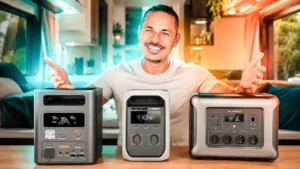
EcoFlow, Aferiy, or AllPowers: the three we’ve really paid for, and which one we recommend
Well, I have to confess something a bit ridiculous, when we open the cupboard under the van bench, we have three power stations staring at each other like cats and...
Read more
How to Choose Your Portable Electric Station: Buying Guide
The market for portable batteries has exploded in recent years, offering solutions for autonomy ranging from simply recharging a smartphone to fully powering a household in distress. But between pocket-sized...
Coming soonThe limits they hide from you
To finish, a bit of honesty, because an article that only talks about happiness smells like a sales pitch. The extension logic has its blind spots. The first, as mentioned, is this often bulky and rigid connecting cable that undermines compactness. The second is that you remain tied to a brand: the day you change ecosystems, your extensions are worth nothing; they cannot be resold anywhere.
There’s also the issue of the price per watt-hour, which is a bit less favorable than a direct purchase, which we’ve already mentioned, and the fact that some still-young brands have a frankly mediocre mobile app, Aferiy being the first, whose software remains basic compared to an EcoFlow. This is not dramatic when you just want reliable and cheap storage, but if you dream of finely controlling your energy from your phone, look closely at this point before buying. There you go, now you know what you are really buying, with the good and the bad sides.
Frequently asked questions about extension batteries
Can you use a power bank on its own, without the station?
No. An extension like the P180-B is just a storage block: cells and a BMS, but no inverter or 220 volts outlets. It needs the host station to convert its current and power your devices. Alone, it does nothing.
Does the extension recharge itself or through the station?
Through the station. You plug the power supply, the car, or the solar panels into the station, and it distributes the charge to itself and then to the extension. The same goes for discharging: everything goes through the station, the extension follows.
Should you buy the extensions at the same time as the station?
No, and that's precisely the point. You can start with just the station and add an extension six months or two years later, when the need or budget arises. The capacity is built in stages.
Does a brand extension walk on the station of another brand?
Never. Each ecosystem is closed: the connector, the cable, and the protocol are brand-specific, often even model-specific. The P180-B only works with the Nomad 1800 Pro, not with the standard Nomad 1800 or with a station from another brand.
Does plugging in an extension change the available power?
No. The output remains that of the station, 1800 watts continuously on the Nomad 1800 Pro, extension or not. What the extension changes is the duration: more watt-hours, so more hours of autonomy, but not more watts to run a large device.
Does the long warranty also cover the extension battery?
At Aferiy, the 7-year warranty also covers the extension, provided you purchase directly from the brand's website using the partner code. In third-party stores, the long warranty is not always honored, which is a real argument for using the official link.
PS: since last night in Bordeira, where my little station saved the day without me really noticing, I have a relaxed relationship with fluctuating electricity. At home, the Nomad 1800 Pro and its extension stand guard under the desk, and come the weekend, the station packs up and goes with us while the extension stays quietly in the garage. A lightweight base, modules that we add, and a Portuguese who no longer worries about his old electrical panels.
Our gear tests, in real conditions
Batteries, solar, conversion, security. What we found after months of real use, and what we would not buy again. An email when we have actually tested something, not before.
Ce que vous souhaitez recevoir :