



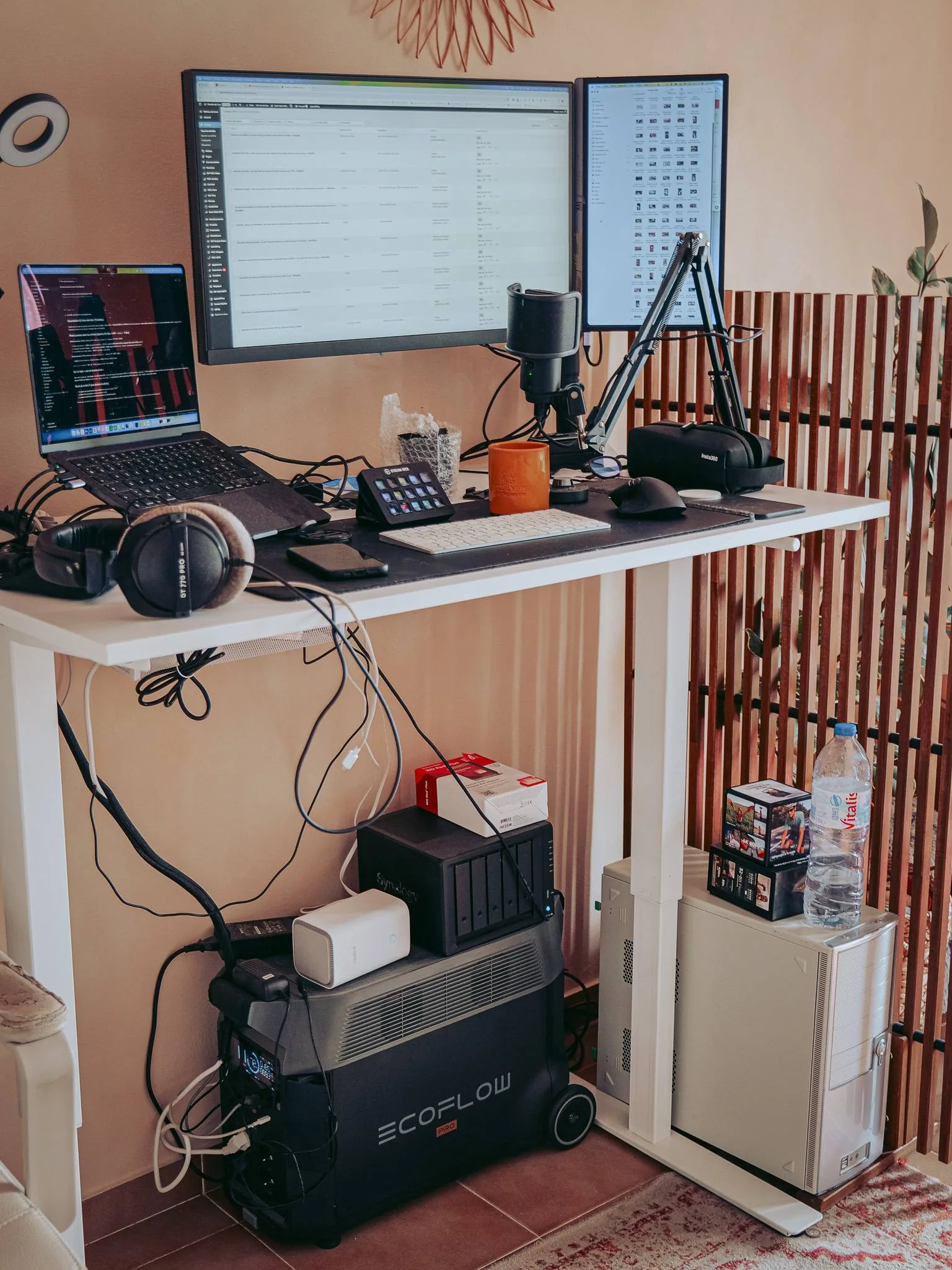
The last real power cut we had here in Portugal lasted about twenty minutes. And the craziest part is that I didn’t even notice it.. I was sitting in front of my computer, deep in work, and I didn’t see anything, no screen flickering, no hard drive restarting. I just realized something was happening because everything around me went dark in the rest of the house. My workstation, however, kept running smoothly, powered by my old EcoFlow Delta Pro plugged in permanently under the desk.
So naturally, when someone asks me what a backup battery is for, I think back to that moment. No panic, no lost work, no hard drive crashing at the wrong moment (and believe me, when you’re working on something, that’s the nightmare). Just silence, and the work continues. What we’re going to see here is how to choose a station that does this for you, without any installation, and most importantly, why the same battery that saves you from a power cut can also go camping with you on the weekend.
What exactly is a home backup battery (and what it is not)
When you search for “home backup battery,” you come across three worlds that have nothing in common, and that’s where people get lost. The first is fixed residential storage, a large block of batteries mounted on the wall like a Powerwall or Beem, installed by a professional, connected to your electrical panel, costing the price of a small car. The second is DIY home solutions, a lead battery, an inverter, wiring, and a lot of faith. The third, which interests us, is the all-in-one portable station, a box with outlets that you plug in without any installation.
This station is a lithium battery, an integrated inverter, and 220-volt outlets, all in a case with a handle. You set it down, plug it in, and it’s ready. No electrician, no holes in the wall, no paperwork. And that’s exactly what makes it interesting for backup: the number one criterion is not capacity, it’s not the brand, it’s the automatic switch without installation. When the power goes out, it takes over automatically, and you don’t have to do anything.
What matters in this choice is that everything happens without the slightest construction work. No need to turn off the meter, call a tradesperson, or fill out a form: you bring the box, plug your devices into it, plug the box into an outlet, and it’s done. This simplicity has a downside that we accept: a portable station protects a corner of the house, not the entire house like a wired installation would. But to keep a fridge, a workstation, and the lights on during a power cut, it’s exactly the right tool, and by far the most flexible.
The rest of this article starts from there: a portable station, plugged into an outlet, that protects the essentials of the house during a power cut. If you were looking to equip your home for year-round self-consumption, that’s another topic (and another budget), which we’ll get back to later.
UPS or EPS: the milliseconds that save your hard drives
Here’s the thing that no one explains to you, and that makes all the difference. When the power goes out, the station must take over, but not instantaneously in the magical sense: there is a tiny switch-over delay, measured in milliseconds. And depending on this delay, we are talking about two different things.
On one side, there is the online inverter, the true UPS, where your devices are continuously powered by the battery, with the mains only serving to recharge it. Here, there isn’t even a switch-over; the delay is close to zero. On the other side, there is the EPS, the backup switch-over, where the mains normally powers and the battery takes over in about twenty to thirty milliseconds when it cuts out. For a computer, a box, a TV, a fridge, this EPS switch-over is completely painless; the devices don’t even notice it.
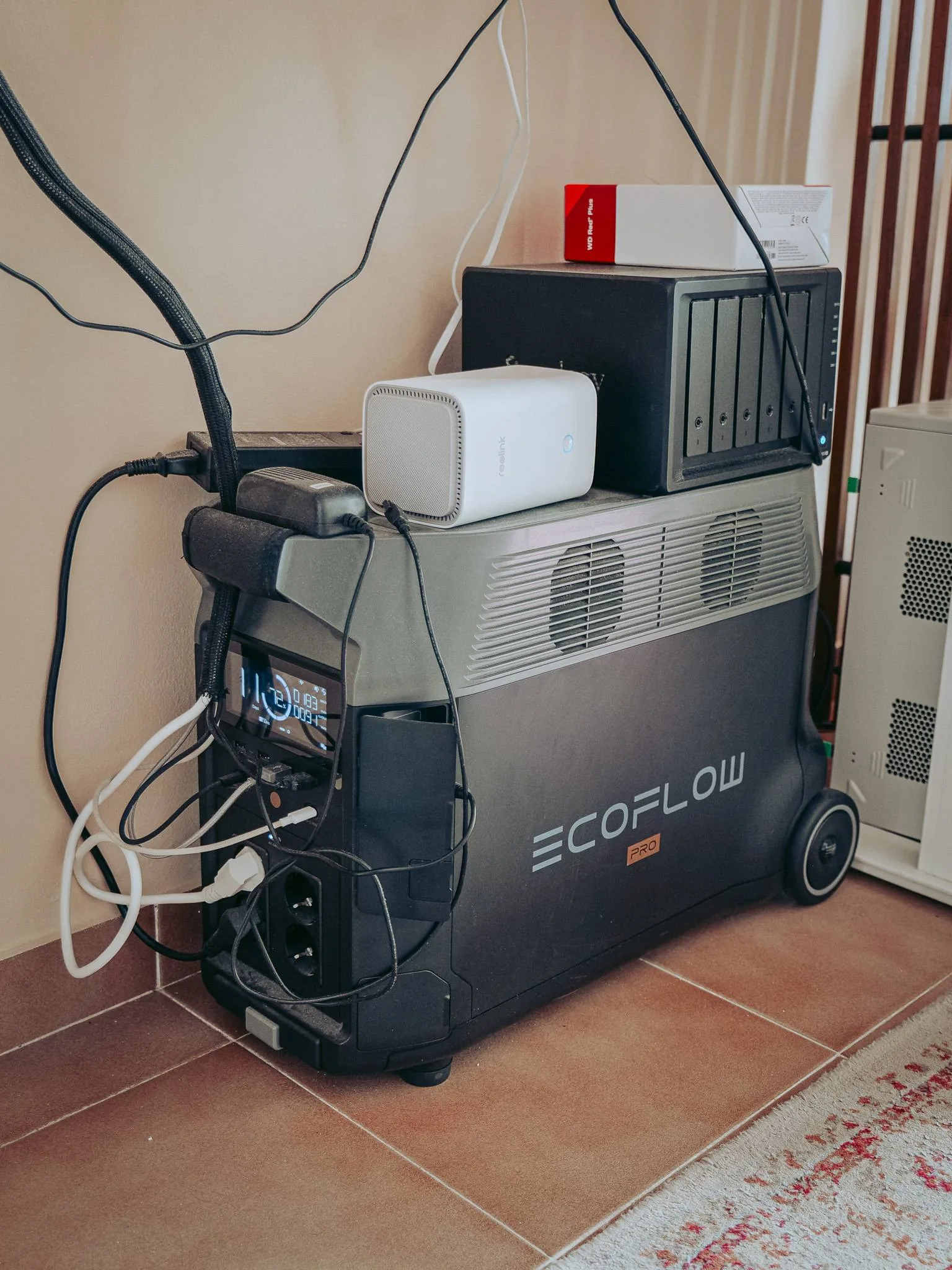
Let’s be honest, because it’s my experience: my first-generation Delta Pro does EPS, not true online UPS. And yet, at home, I never feel a switch-over, ever. Why? Because my entire workstation is permanently plugged into it: it is already the source that powers me, it continuously buffers, so the day the grid goes down, there’s nothing to catch up on. I have seen the true switch-over almost instantaneously, under 20 milliseconds, but that was on the Delta Pro Ultra we tested separately, a step up. For 95% of a home’s needs, EPS is more than sufficient; don’t pay a fortune to gain 15 milliseconds that your fridge doesn’t care about.
What it can handle, what it can’t
The first disillusionment to swallow right away: a portable station does not power the entire house as if nothing happened. It protects the essentials, and there is a clear dividing line between what it can handle without flinching and what will drain it in a few minutes.
- The fridge and freezer
- The internet box and wifi router
- The LED lights in the house
- Computers, phones, tablets charging
- The TV and a console
- A medical device like CPAP
- A fan, a small pump
- The electric oven and induction cooktops
- The electric water heater
- The kettle and resistance coffee maker
- The hairdryer at full power
- The electric fan heater
- The reversible air conditioning in heating mode
- Most large appliances that generate heat
The dividing line is heat. Anything that heats by resistance (oven, cooktops, water heater, kettle) consumes 1500 to 3000 W and drains a station in a few minutes. Electronics and small motors are fine. In between, watch for the startup spike: a fridge or pump draws a brief peak of 3 to 5 times their normal power at startup, and that's what makes a small station cough, not their cruising consumption.
The rule, I learned it in the van before applying it at home: anything that heats by resistance is a black hole. An oven, induction cooktops, a kettle, a water heater, they draw between 1500 and 3000 watts continuously, and they can bring a station to its knees in no time. In contrast, electronics and small motors run smoothly. The middle trap is the starting surge of the compressor: a fridge that restarts calls for a brief spike of three to five times its normal power, and it’s that, not its cruising consumption, that can make a small station cough. We had exactly this issue in the camper when the cooler and the vacuum cleaner wanted to start at the same time.
How long it lasts: the simple calculation
The question that always comes up is “how long does it last?”, and the answer lies in a formula you can do in your head. Duration in hours is roughly the capacity in watt-hours multiplied by 0.85 (for inverter losses), divided by the average power you draw. A 2000 watt-hour station on a setup that consumes 200 watts gives you roughly eight hours. Here’s what it looks like based on the size of the station and your lifestyle.
One formula is enough: Duration ≈ (capacity in Wh × 0.85) ÷ average power drawn in W. The 0.85 accounts for inverter losses.
| Usable capacity | Essential (~120 W) | Comfort (~300 W) | Speed burst (~700 W) |
|---|---|---|---|
| 1 kWh small station | ~7 h | ~2 h 50 | ~1 h 15 |
| 2 kWh the right compromise | ~14 h | ~5 h 40 | ~2 h 25 |
| 3.6 kWh large station | ~25 h | ~10 h | ~4 h 20 |
"Essential" means a fridge humming, the internet box, two LED bulbs, and something to charge phones and laptops. It's the realistic backup mode: to last 6 to 12 hours of essentials, not to power the whole house.
Indicative values. The fridge does not consume continuously, it cycles, so in reality, it often lasts longer. The real trap is the compressor's startup spike, which rises well above normal consumption for a second.
What you need to remember is that in realistic backup mode, we aim to keep the essentials for 6 to 12 hours, not to power the entire house for two days. A station of 1 to 2 kWh already covers the vast majority of power cuts, which rarely last more than a few hours. And the good news is that the fridge doesn’t consume continuously; it cycles, so in practice, we often last longer than the calculation suggests. The quality of the battery also matters: lithium LiFePO4, the standard today, withstands 2500 to 4000 cycles, while older chemistries topped out much lower, a topic we explored in our overview of types of camper batteries.
Which camper van battery to choose for autonomy?
Discover the complete guide to choosing the ideal battery for your motorhome - tailored to your lifestyle and budget!
Read moreA 12-hour power cut on a winter evening: the numbers scenario
Let’s take the worst reasonable case, the one that scares you: the power goes out on a winter evening and doesn’t come back until the early morning, twelve hours later. What do we really want to keep on? The fridge and freezer to avoid throwing away groceries, the internet box and Wi-Fi (because when working from home, losing internet means losing income), a few LEDs to avoid living by candlelight, and a way to charge phones and a laptop.
Put all that together and you’re looking at around 100 to 150 watts on average, including the fridge since it doesn’t run continuously. At this rate, a 2 kWh station will comfortably take you through the night, with some margin. And if the outage drags on, you still have the recharge option, which we’ll discuss next. In our case, the reality is a bit different: often, it’s not even the grid that fails, it’s our own circuit breaker that trips because we turned on the air conditioning in addition to everything else, on an older Portuguese installation. Whether it’s the grid or the breaker, the result is the same, everything shuts off suddenly, and the workstation remains unaffected.

I'm Xavier
I test gear over months, in the van and day to day, and I say what doesn't work. If that saves you one bad purchase, leave me your address.
Ce que vous souhaitez recevoir :
Recharging the battery: mains, solar, and the bridge with the van
A backup battery can be recharged, and this is where it gets clever. On mains power, good stations charge from 0 to 80% in thirty to fifty minutes, so between two close outages, you have time to top up. But the real backup advantage is the solar panel as a supplement: if the outage lasts for hours during the day, you recharge while it discharges, and you could potentially hold out indefinitely.
At my place, I’ve pushed the setup a step further thanks to the EcoFlow app. My Delta Pro is permanently plugged in, capped at 80% charge to preserve the battery in the long term, and I’ve programmed a reserve: the low range, from 0 to 40%, is prioritized for charging by the solar panels, with the rest from the mains. As a result, I always have reserve power on hand without thinking about it, and part of it comes from the sun. This is exactly the kind of logic we’ve refined in our camper van, where managing recharging between mains, solar, and car charger is second nature. Moreover, a station that manages 220 volts at home also manages 220 volts in the van; it’s the same device, and that’s the whole point: we’ve detailed our field readings in our test of the Aferiy Nomad 1800.
And if everything is really flat, there’s the desperate solution we love in the van: recharging from the car’s cigarette lighter. It’s slow, but a running engine for an hour gives you enough juice to restart the fridge and charge the phones. Three sources of recharge—mains, solar, and 12 volts—mean that a well-designed station is never really stuck, even when the outage sets in.

Aferiy Nomad 1800 & 1800 Pro: the battery test that saved our night in Bordeira
Field test of the Aferiy Nomad 1800 power station (1024 Wh, 1800 W) in the Algarve: compact format, 1000/500 W input switch, charges in under an hour, 7-year warranty. My...
Read moreThe backup battery that also goes on weekends
And this is where I want to change your perspective because this is our true conviction after years of living with these stations. A fixed battery mounted on the wall, no matter how great, only does one thing: it waits for a power cut. It sleeps 364 days a year, magnificent and useless, hoping for the big night. A portable station, on the other hand, never sleeps: it saves you from a power cut three times a year, and the rest of the time, it goes camping, DIYing, picnicking, powering the sound system for a birthday, or the garage fridge.
This is what I call the cost per use. Paying the same price, one of the two devices serves you 350 days a year, the other three. For a profile like ours, sedentary part of the year and on the road the rest, it’s not even a compromise; it’s two devices for the price of one. We, of course, keep a large Delta Pro at home for heavy-duty use, but the one that truly lives, the one that has two lives, is the lightweight station that migrates from the office to the camper van and back. The entire concept is detailed in our guide on solar generators if you want the big picture.

Solar generator: the station that lives two lives, in a van and at home
A few years ago, to me, a solar generator was necessarily a bulky thing you dragged around a campsite, with a motor roaring while neighbors looked at you sideways. Then...
Read moreHow much does it cost, and which brand to choose
Let’s talk money, no beating around the bush. A portable backup station that holds up ranges roughly from £600 for a 1 kWh model to £3300 for a large station of 3 to 5 kWh, including extensions. In comparison, fixed residential storage starts around £5000 and quickly climbs beyond £10000 once installation is counted. For pure backup, the gap isn’t justified: the portable provides the same service in terms of outages, and it goes on weekends. The advice I repeat all the time: the right station is the smallest that comfortably covers your actual need, not the biggest in the catalog.
On the brand side, the must-haves for home backup hold the top spot: EcoFlow, Bluetti, and Jackery, which we see everywhere, reliable, with good support and well-thought-out inverter functions. Alongside, we’ve tested many more affordable brands that are often excellent when you know what you’re buying, like Aferiy and AllPowers, which cut prices per watt-hour. To avoid choosing the wrong model based on your usage, we’ve detailed the method in our guide to choosing a portable power station, and our comparison pits the brands against each other.

EcoFlow, Aferiy, or AllPowers: the three we’ve really paid for, and which one we recommend
Well, I have to confess something a bit ridiculous, when we open the cupboard under the van bench, we have three power stations staring at each other like cats and...
Read more
How to Choose Your Portable Electric Station: Buying Guide
The market for portable batteries has exploded in recent years, offering solutions for autonomy ranging from simply recharging a smartphone to fully powering a household in distress. But between pocket-sized...
Coming soonWhat a backup battery won’t do (the flaws they hide from you)
To finish, a bit of honesty, because articles that only talk about happiness smell like sales. A backup station will never replace a system that powers the entire house, including heating and cooking; that’s not its role, and trying to make it run an electric oven will drain it in ten minutes and leave you disappointed. It won’t make you self-sufficient year-round; it’s for backup, not self-consumption.
And then there’s the little detail that gets forgotten in product sheets: the fan noise. When a large station is working hard at night, whether charging or discharging continuously, you can hear it. At our place, we sometimes hear the fan of the Delta Pro from the next room. Nothing dramatic, but avoid placing it right next to the bed if it’s working continuously. Cold also doesn’t like charging below zero, and the charging times advertised are often optimistic; plan for longer than the specs suggest. There you go, now you know what you’re really buying.
Frequently asked questions about home backup batteries
Is 5000 Wh really necessary for an entire house as we read everywhere?
It's the number we see to power an entire house, including heating and cooking. But in an emergency, no one runs their house the same way during a power outage. We protect the essentials: fridge, router, lights, and something to charge devices. For that, a station of 1 to 3 kWh lasts already 6 to 12 hours and costs three to five times less than a wall of batteries.
Which battery to choose if I'm going for a 12V to 220V inverter?
This is the DIY option: a lead or lithium battery connected to an inverter. Count on a 100 Ah LiFePO4 battery (about 1280 Wh) for a small backup, with a pure sine inverter at least as powerful as your largest device. Honestly, an all-in-one station already does all this in one box, with integrated charging, protection, and switching, without any wiring to improvise.
Can we store electricity without a battery?
On an industrial scale, yes: dams that pump water, flywheels, hydrogen. On a household scale, no, there is no serious alternative to batteries to handle a power outage. Balcony kits that feed back into the grid do not store anything: as soon as the power goes out, they stop too. For backup, you need batteries.
How much does a real fixed photovoltaic storage system at home cost?
A fixed system mounted on the wall like Powerwall or Beem starts around £5000 and quickly rises above £10000 with installation. It's relevant if you aim for year-round self-consumption. For pure backup, a portable station costing £1000 to £3300 provides the same service during outages, and you can take it with you on weekends the rest of the time.
Can a backup station start a well pump or a boiler?
It depends on the startup peak, not the displayed power. A pump motor or boiler burner draws a brief spike of 3 to 5 times its normal power at startup. An 800 W pump may demand 2500 W for a second. Aim for a station whose output power covers this peak, or a model with an overload reserve, otherwise it will go into safety mode.
Does the battery hold its charge if I never use it?
Yes, LiFePO4 discharges very slowly, on the order of a few percent per month. A fully charged station left in a cupboard will last several months before weakening. The ideal is to keep it plugged in maintenance charge mode, or to check its level once a quarter to ensure it's ready the day the power goes out.
Does the cold of a garage in winter damage the battery?
LiFePO4 discharges without worry in cold weather, but it doesn't like to be charged below 0°C, it wears out the cells. Most good stations automatically stop charging when it freezes. In practice, keep it frost-free if you can: a heated cupboard rather than a garage at 2°C, and it will age better.
Should it be unplugged during a storm?
A power station plugged upstream of your devices already protects them from micro-variations, but it is not a surge protector. In case of a big storm, the safest option is to unplug it from the mains: it continues to power your devices on its own battery, disconnected from the grid, thus protected from a surge that could come through the socket.
PS: since that twenty-minute outage where I didn’t feel a thing, I have a calm relationship with storms and the old electrical panels of Portugal. My station stands guard under the desk, half charged by the sun, and when the weekend comes, it packs up with us. Two lives, one battery, and a Portuguese who sleeps soundly despite his capricious fuses.
Our gear tests, in real conditions
Batteries, solar, conversion, security. What we found after months of real use, and what we would not buy again. An email when we have actually tested something, not before.
Ce que vous souhaitez recevoir :