



You turn up on site, your tools are in the van, but there’s no power. Great start to the day. Hunting for a socket, running an extension lead from the far end of the building or making do with a less suitable tool all takes time. And when you’re a tradesperson, that time costs money.
That’s why the EcoFlow PowerRock 4000 for professionals caught my interest. EcoFlow is going straight for the building trades with a power station designed to run tools right next to where you’re working. The DELTA Pro name already had a professional ring to it; here, it’s the build and the on-site uses that come first.
My video above is in French. To see the product in use, here is the testimonial of Frédéric Goyard, an electrician at EFG, featured on EcoFlow’s official page. The video is published by EcoFlow: it gives you a real-world example, through the eyes of a customer the brand chose to showcase.
A battery to keep working when the site has no power
A site with no supply, a power cut or a socket that’s too far away: those are the situations where I can see the point of the PowerRock. You take the energy to your tools, instead of planning your whole job around where the socket happens to be.
When the socket is at the other end of the site, honestly, having your power supply right next to you must be a real weight off your mind. The expected benefit is very concrete: being able to use the right tool and keep the job moving. I can’t put a figure on the time saved, but it’s a question that deserves the same attention as the purchase price.

The station still has to suit your machines and the length of the job. A power source you can carry doesn’t guarantee, on its own, that you’ll get through the whole day without recharging.
4,000 W of power, but an energy reserve to keep an eye on
EcoFlow quotes 4,000 W continuous and 3,072 Wh of capacity. Watts tell you the power available; watt-hours tell you the energy in the tank. Plug in a demanding machine and that reserve can go quickly.
Take a tool that genuinely draws 1,600 W continuously. The theoretical calculation gives roughly 1 hour 55 minutes from 3,072 Wh, before conversion losses and the station’s own consumption. That’s not a measured runtime. A tool used in short bursts can last much longer in elapsed time, because it doesn’t draw its rated power during the pauses.
To choose, I’d start with your tools: how much they draw, their inrush current at start-up, and how long they actually run. Our article on choosing between a generator and a solar power station goes into the differences between these two ways of bringing power on site.
38 kg: easier to move, but still a heavy lift
The weight made me wince when I saw people carrying the PowerRock in the promo images. EcoFlow quotes up to 38 kg. It’s portable, yes, but picture the stairs with that in your hand. A promotional shot doesn’t tell you what it’s like to handle it several times a day.
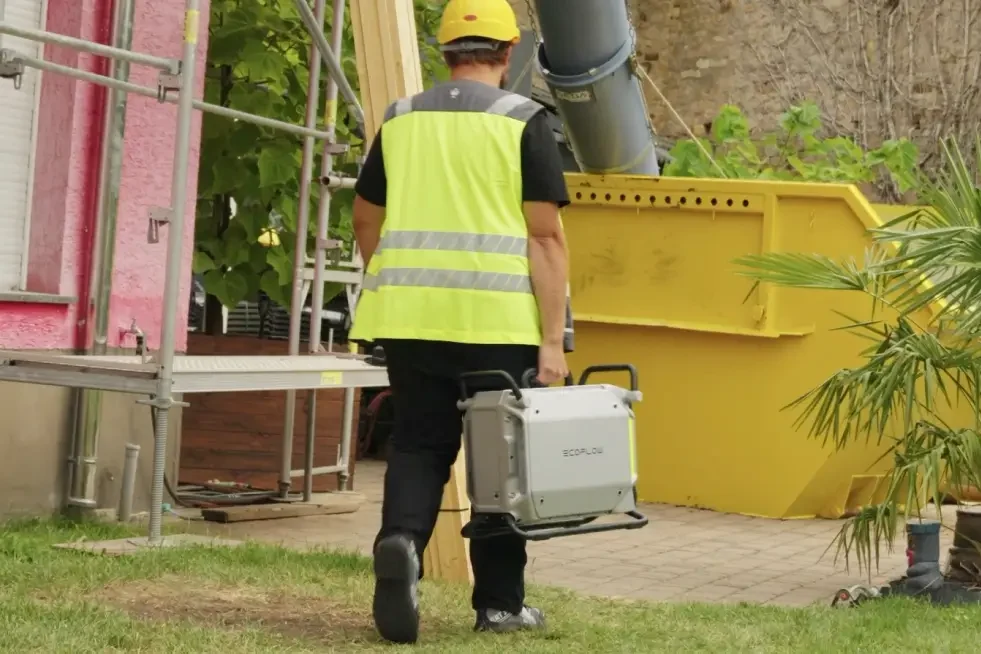
For comparison, the original DELTA Pro is quoted at around 45 kg for 3,600 Wh and 3,600 W continuous. So the PowerRock is lighter and more powerful, but it also carries less energy.
Its quoted dimensions are 264 × 515 × 462 mm, against 635 × 285 × 416 mm for the first DELTA Pro. Multiplying those out, I get roughly 17% less boxed footprint. That’s an indicator of the space it takes up, not a measurement of the casing’s actual volume; the PowerRock is also taller.
The most interesting figure is power per kilo: about 105 W/kg for the PowerRock at 38 kg, against 80 W/kg for the DELTA Pro at 45 kg. Roughly 32% better. In stored energy per kilo, the two are very close, around 80 Wh/kg. The gain is mainly in available power, not a revolution in energy stored per kilo.
Compared with a generator, working indoors changes everything
There’s no single weight for generators. The Pramac PMi 4500 is quoted at 42.5 kg for 3.8 kW rated output. A Honda EC5000 site generator is listed at 75 kg dry for 4.5 kW continuous in Honda’s 2020 catalogue. At the other end of the scale, a Honda EU32i weighs 26.5 kg dry but delivers 2.6 kW rated output.
So the PowerRock can be much lighter than a typical site generator. It isn’t lighter than every generator. And a generator’s weight has to be read in context: the fuel you carry or top up with is part of the handling too.
For a job inside a flat, the practical difference matters more than a few kilos. A petrol or diesel generator has to run outdoors, away from doors, windows and vents, because of exhaust fumes and carbon monoxide. The same goes for a house: it can’t run inside the home, the garage or the cellar.
A battery station can power tools directly indoors, with no combustion, as long as you follow its operating and ventilation conditions. You skip the hassle of setting up an engine outside and then running the power back to where you’re working.
A fuel generator does keep one advantage for long stretches: you can keep it running with more fuel. With the PowerRock, you need to plan for when the reserve runs out and how you’ll recharge it.

I'm Xavier
I test gear over months, in the van and day to day, and I say what doesn't work. If that saves you one bad purchase, leave me your address.
Ce que vous souhaitez recevoir :
Charging in the van: the add-on I’d consider essential
For a tradesperson going from job to job in a van, an alternator charger strikes me as essential with this kind of station. You work on site, then use the next drive to put energy back in. Charging becomes part of the day, instead of waiting until you’re back at the yard.
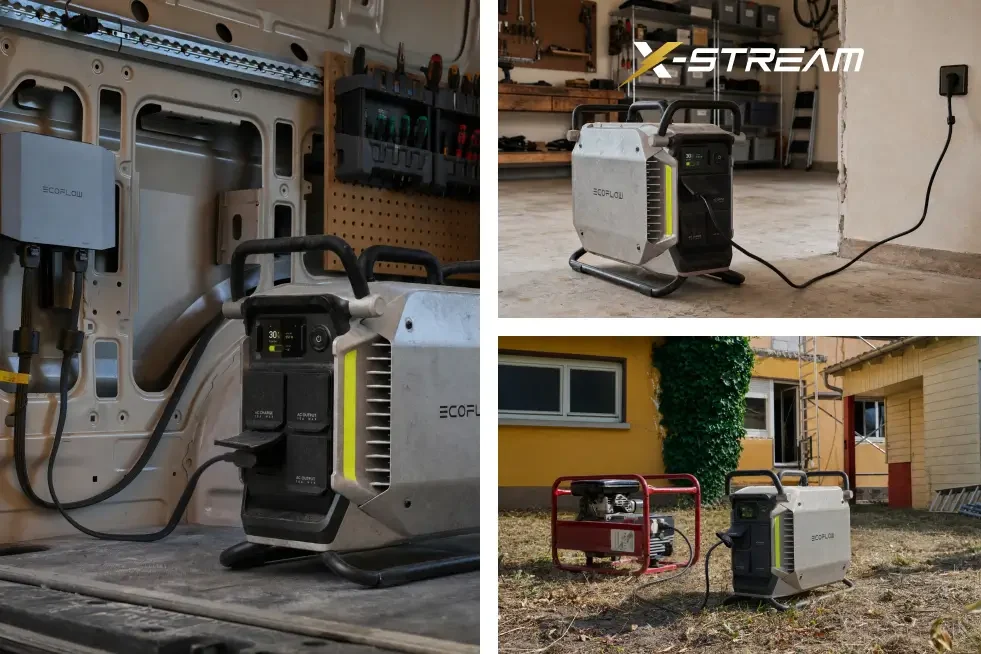
EcoFlow plans for the PowerRock to be charged via an alternator charger. That’s equipment to install in the vehicle. Not a simple cigarette lighter cable: the quoted input is 42–60 V, which doesn’t match a 12 or 24 V vehicle socket directly.
I’m keeping a reservation here: the exact compatible charger model, its cable, its price and the power actually delivered still need confirming. So nobody can promise that an hour’s drive will top the station back up to full. An electric car charger isn’t a confirmed charging option for the PowerRock either.
On mains power, EcoFlow quotes a full recharge in one hour under certain conditions. You can charge it at the yard or on a site that has power, not just at home. The brand also provides for charging from a generator.
The lack of solar bothers me less for this use
The PowerRock doesn’t support solar charging. On a travel power station, that would weigh more heavily in my choice. Here, with demanding tools and drives between jobs, I can better understand why mains and alternator charging come first.
In a hypothetical scenario, a tool drawing 1,600 W against a panel actually delivering 400 W would still leave 1,200 W for the battery to supply, before losses. The panel would slow the drain; it wouldn’t hold the level. You’d also have to set it up and find a sunny enough spot on site.
Solar would still make sense with low loads or during breaks, on a station that accepts it. And portable panels aren’t all limited to 400 W. But adding more power means bringing more kit and finding more space. Our article on portable solar panels looks at what they produce and how to set them up.
Built for the site, with limits to read before you buy
The reinforced casing, the built-in RCD and the quoted drop resistance are all part of the professional positioning. They’re worth checking on a unit that will go back and forth between the van and the work area.
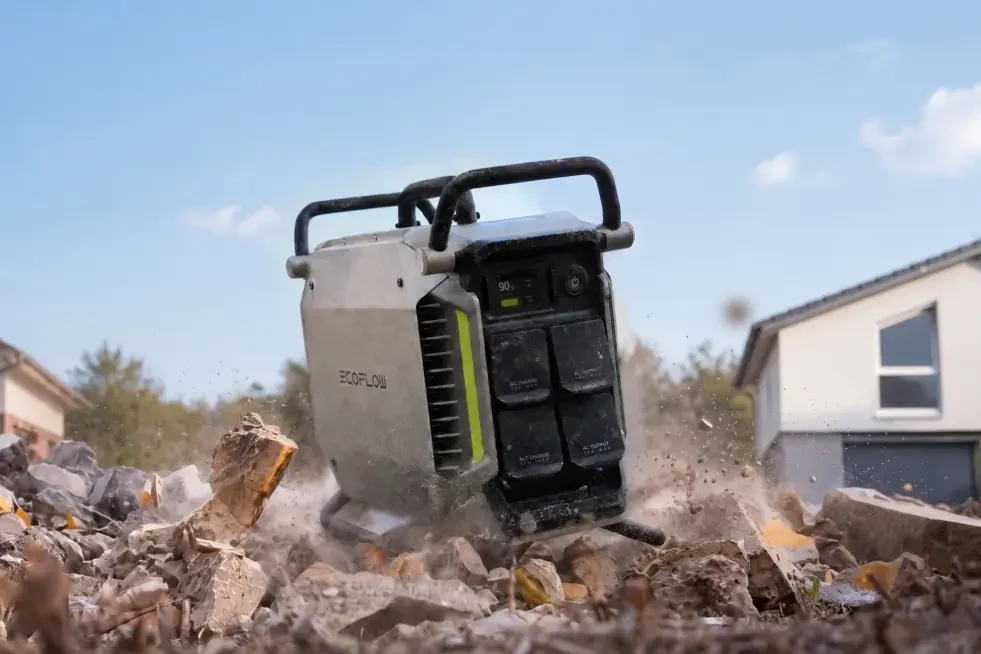
The built-in RCD also needs to be understood in context: its detection is disabled in floating mode. The choice of mode and the connection must follow the manufacturer’s instructions and the requirements of the installation.

My take: look at what it lets you do, then at the cost of the whole setup
What interests me is seeing EcoFlow build a product around the needs of building professionals. When you arrive with no power, when the socket is too far away or a power cut stops you, the right power supply can let you carry on with the right tools.
To judge the purchase, I’d look at the cost of the station, the compatible alternator charger and its installation, then the jobs where that setup would actually help. Lost time and postponed work have a cost too. That doesn’t mean it will pay for itself in every trade, but it’s an essential part of the comparison.
As I write this, the UK isn’t on the list of the 26 European markets where EcoFlow is launching the PowerRock 4000, and EcoFlow’s UK site has no page for it, so there is no UK price. EcoFlow says it won’t sell it on its official online store: from November 2026 it is being rolled out gradually through professional distributors, with enquiries going through its sales team. I’ll need the full price before taking my opinion any further.
So the PowerRock interests me for mobile jobs where its capacity covers the planned work. For long, continuous loads, a battery this size needs a charging plan. And for home backup, the criteria can be different; we cover them in our article on home backup batteries.
EcoFlow PowerRock 4000: frequently asked questions
Is this article a test of the PowerRock 4000?
No. I'm not planning to receive this product to test it. My opinion is based on the official specs and the uses I can see for it. The video testimonial is published by EcoFlow.
Can the PowerRock run every tool on a building site?
You need to check each tool's power draw, its start-up demand, the limits of the sockets and the combined load of everything plugged in. The quoted continuous output is 4,000 W; temporary surges don't guarantee it will run everything.
Can you extend its runtime?
EcoFlow recommends daisy-chaining up to three PowerRock units through their AC inputs and outputs. They discharge one after another. That extends the runtime without increasing the total output power.
Can you charge it straight from the cigarette lighter socket?
No direct charging from a cigarette lighter socket is documented in the sources I checked. The quoted alternator input accepts 42–60 V DC. EcoFlow plans an alternator charger; the exact model and compatible cable are still to be confirmed.
Can you charge it at an electric car charger?
That compatibility isn't confirmed for the PowerRock in the official pages I checked. A suitable 230 V mains socket, on the other hand, lets you charge it on AC.
Does the PowerRock accept solar panels?
No. EcoFlow documents mains charging, charging via an alternator charger and charging from a generator, but not solar.
Can you use the PowerRock in the rain?
No: EcoFlow's FAQ asks you not to operate it in the rain, despite its IP rating. After exposure to water, the unit and its ports must be completely dry before you switch it back on.
How much does it cost in the UK?
There's no UK price: the UK isn't among the 26 European markets announced for the launch, and EcoFlow's UK site doesn't list it. EcoFlow doesn't sell it on its online store and is rolling it out gradually through professional distributors from November 2026. The cost of the compatible charger and its installation should also go into the comparison.
Our gear tests, in real conditions
Batteries, solar, conversion, security. What we found after months of real use, and what we would not buy again. An email when we have actually tested something, not before.
Ce que vous souhaitez recevoir :