


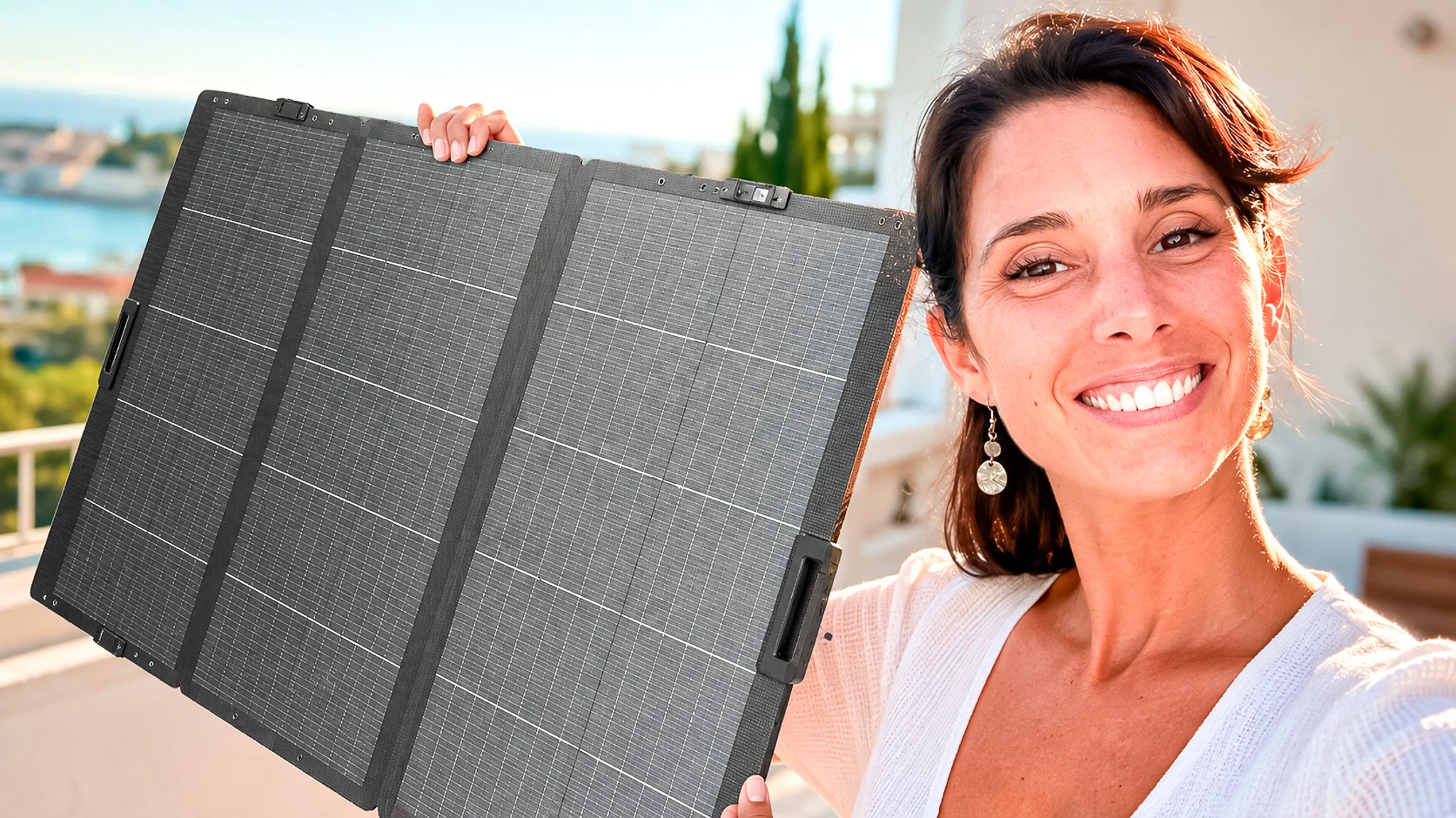
The first time I plugged in our 110 W panel, I looked at the app with a smile, ready to see the watts roll in. And the screen showed me 62. Sixty-two, not one hundred ten. It was a beautiful day, the panel was unfolded right in front of the van, and yet I was far, very far from the number printed on the box. That day, I understood that a portable solar panel needs to be chosen and understood; otherwise, you end up disappointed and complaining about the brand.
Since then, we’ve handled a bunch, from the small 110 W to the big 400 W weighing 16 kg, both in the van and attached to the balcony of the apartment. Here’s what we’ve learned on the ground, without beating around the bush, so you can choose the right one the first time.
What is a portable solar panel (and why it’s not a roof installation)
A portable panel is one that you take out, place, orient towards the sun, and store away in the evening. No screws, no drilling. This contrasts with a fixed installation, which is glued or bolted onto the roof of the camper once and for all.
The two do not play in the same league. The fixed one produces on its own while you drive, zero handling, but it suffers from everything: the shadow of the van, poor tilt, the scorching roof that reduces efficiency. The portable one, however, allows you to do the crucial action: park the van in the shade and place the panel in full sun, at the end of a cable. This freedom of orientation is the whole point, and it’s also something the roof can never offer you.
Where the portable really shines is when stationary: during multi-day bivouacs in the same spot, weekends without hookups, wild parking where you need to rely on your reserves. When driving every day, the alternator and fixed panel are often enough. As soon as you stop, it’s the portable that recharges you. Think of it as a supplement you control, not as a source of energy that falls from the sky on its own.
Many people end up with both: a fixed panel for the base of autonomy while driving, and a portable one for high needs or static days. If you’re particularly hesitant about the roof, we have a dedicated guide for fixed installations that perfectly complements this one.
Rigid, foldable, or flexible: the three families
Before even discussing power, you need to choose your family, as it determines how you’ll live with the panel on a daily basis. There are three, all with monocrystalline cells (the most efficient), some dressed in an ETFE surface, this textured plastic that’s lighter and more durable than glass, but a bit less long-lasting over time.
The rigid panel lasts a very long time but is heavy (often 10 to 15 kg), the foldable one is the Swiss army knife weighing 3 to 7 kg that you can take anywhere, and the flexible one weighs only 2 to 4 kg and can fit where nothing else can, but it heats up and ages faster. Here’s a quick comparison to give you an overview at a glance.
- Best performance and longest lifespan (aluminum frame, tempered glass)
- Heaviest of the three, often 10 to 15 kg for 400 to 600 W
- Can be placed on the ground, on a support, or hung on a balcony
- Puncture-proof but bulky, not something you move ten times a day
- Ideal for a semi-permanent setup: house, balcony, base camp
- Best compromise of weight, performance, and price
- Folds into a suitcase, from 3 to 7 kg depending on power
- Integrated stands to orient it towards the sun
- Perfect for the van, hiking, outings, or barbecues with friends
- The most versatile, the one you take everywhere
- Ultra light and thin, 2 to 4 kg, it rolls or sticks
- Conforms to a curved roof, a backpack, a guardrail
- Performance slightly lower, and it tends to heat up
- More fragile to repeated folds, shorter lifespan
- For supplementary use and surfaces where nothing else fits
No family is better in absolute terms: the rigid lasts long, the flexible travels everywhere, the soft sneaks in. The right choice mainly depends on where and how you place the panel.
Announced watts, real watts: the truth about efficiency
We come back to this because it’s THE point that no one tells you frankly. A panel almost never delivers its nominal power. Our 110 W peaked between 60 and 70 W in real use, especially in spring, and this was not a defect: it’s the norm. Between temperature, angle, dust on the surface, and a sky that’s never perfect, we usually get at best 70 to 80 % of the peak announced.
Why this gap? Because the watts on the box are measured in a lab, at 25 degrees, with calibrated sunlight that you will almost never see. In reality, a cell that heats up loses efficiency (count a small loss for each degree above 25), a slight veil of clouds already cuts a third of the harvest, and dust does the rest. It’s mechanical; no brand escapes this, not even the best ones.
The 400 W is the same at the next level: magnificent on paper, but I’ve never seen it deliver its full 400 W. In the middle of summer, in full sun, perfectly oriented, we get close. On a cloudy day, we’re down to a third. Our big AllPowers 400 W really needs to be in full sun to hope to charge a station in 8 hours. So when you read a power rating, mentally, subtract a good quarter. You will rarely be disappointed, and sometimes pleasantly surprised.
This little 110 W I’m talking about, we’ve measured, weighed, and carried it for months. It’s a good example of a lightweight supplemental panel, honest about what it does, perfect for keeping two laptops and a modem alive without breaking the bank.
Technical specifications
| Solar Panel Power | 110.00 W |
|---|---|
| Panel Type | Foldable |
Our verdict
Benefits
- 110 W solar output
- Foldable build
- Standard connectors, works with most stations
Disadvantages
- Output depends on sun and angle
A solid 110 W foldable panel to keep a power station topped up off-grid. Match it to your station's solar input.
EcoFlow 110W Lightweight Portable Solar Panel promo code
 Out of stock
EcoFlow 110W Lightweight Portable Solar Panel
CARO5*
*Verified price on 19 September 2026. The final price may vary.
Voc, Vmp, connectivity: the numbers to avoid frying your station
Two acronyms to know before buying, and I swear it prevents mistakes. The Voc is the open-circuit voltage of the panel, the maximum voltage it can send. The Vmp is its operating voltage. Why is this crucial? Because each station has a maximum input voltage, and if the Voc of your panel (or your panels in series) exceeds this limit, the station cuts off the input at best, or gets damaged at worst.
Good news: if you’re charging a portable power station, you don’t have to worry about the regulator. The famous MPPT, which optimizes power continuously and is much better than an old PWM, is already integrated into the station. You plug the panel directly. An external regulator is only needed if you connect a panel to a bare 12 V battery, the old-fashioned way.
For connections, the queen connector is called MC4, it’s the universal standard. Depending on your station, you may need an adapter to XT60, Anderson, or an 8 mm connector. Nothing complicated, but check compatibility beforehand, not in the parking lot at noon with the cooler warming up.
And if you want to combine two panels: in series, the voltages add up (watch out for the total Voc that rises quickly), in parallel, the amps add up while the voltage stays safe. To charge a station, the parallel connection is often safer. In any case, you add up the Voc and check that you stay below the station’s input limit.
Which panel for which station: the real charging time
The question we get asked the most: how many watts of panel for my station, and how long will it take. The honest answer is summed up in one rule: take the capacity of the station in Wh, divide by the real power of the panel (not the peak, the actual), and you have an estimate of hours.
Our concrete readings, to set the tone: with two 200 W panels, we maintained 80 W stable under average conditions, enough to fill 572 Wh in 7 hours. Our Delta 2 Max charged in 3 to 6 hours depending on the morning sun. The Delta Pro connected to 800 W of solar filled up in 6 hours under good summer sun. A well-oriented 400 W charges a large station in about 8 hours. You get the idea: it’s slow, it’s solar, but set up in the morning, it gives you a reserve for the day.
A very common case is the fridge. A compressor fridge draws 40 to 60 W when running. A well-oriented 100 to 200 W panel compensates for its consumption on a sunny day and even adds a bit of reserve. And since most stations manage direct passage, you can charge the station while using it, without ever unplugging everything.
To match your panel and your station, we’ve put together a little calculator for you. Enter your panel power, the capacity of your station, and the type of day, and it will give you a realistic estimate.
Never the advertised peak: a panel rarely delivers more than 70 to 80% of its nominal power in full sun, and much less in overcast conditions. This calculation remains a realistic estimate, not a guarantee.
And if you’re looking for the station to charge, we’ve detailed our current favorite in our review of the Aferiy Nomad 1800, the one we most often connect to our panels.
Orientation and tilt: the gesture that changes everything
If you only remember one thing, it’s this. A panel laid flat on the ground is the best way to waste half of its potential. We installed a manual tiltable support and found about 30% more production in winter, just by adjusting the angle towards the low sun. Thirty percent, for free, with two props.
Alignment is crucial, to a point that we always underestimate. One day, we covered a corner of the panel to test, and the amperage dropped suddenly, much more than the hidden surface would suggest. A shadow from a branch, an angle of the van, a pole, and your beautiful production collapses. So we follow the sun throughout the day, repositioning two or three times, and especially we park smart: the van in the shade to sleep cool, the panel in the sun at the end of its extension.
It really pays off. During a ten-day trip in Alsace, we never needed to plug in the 230 V external, even after three days of storms, just with our tiltable panels that sought out the little available light. It’s simple, but that’s what makes the difference between a panel that works and a panel that decorates.
A panel we bring everywhere: from the van to the balcony (and to the barbecue)
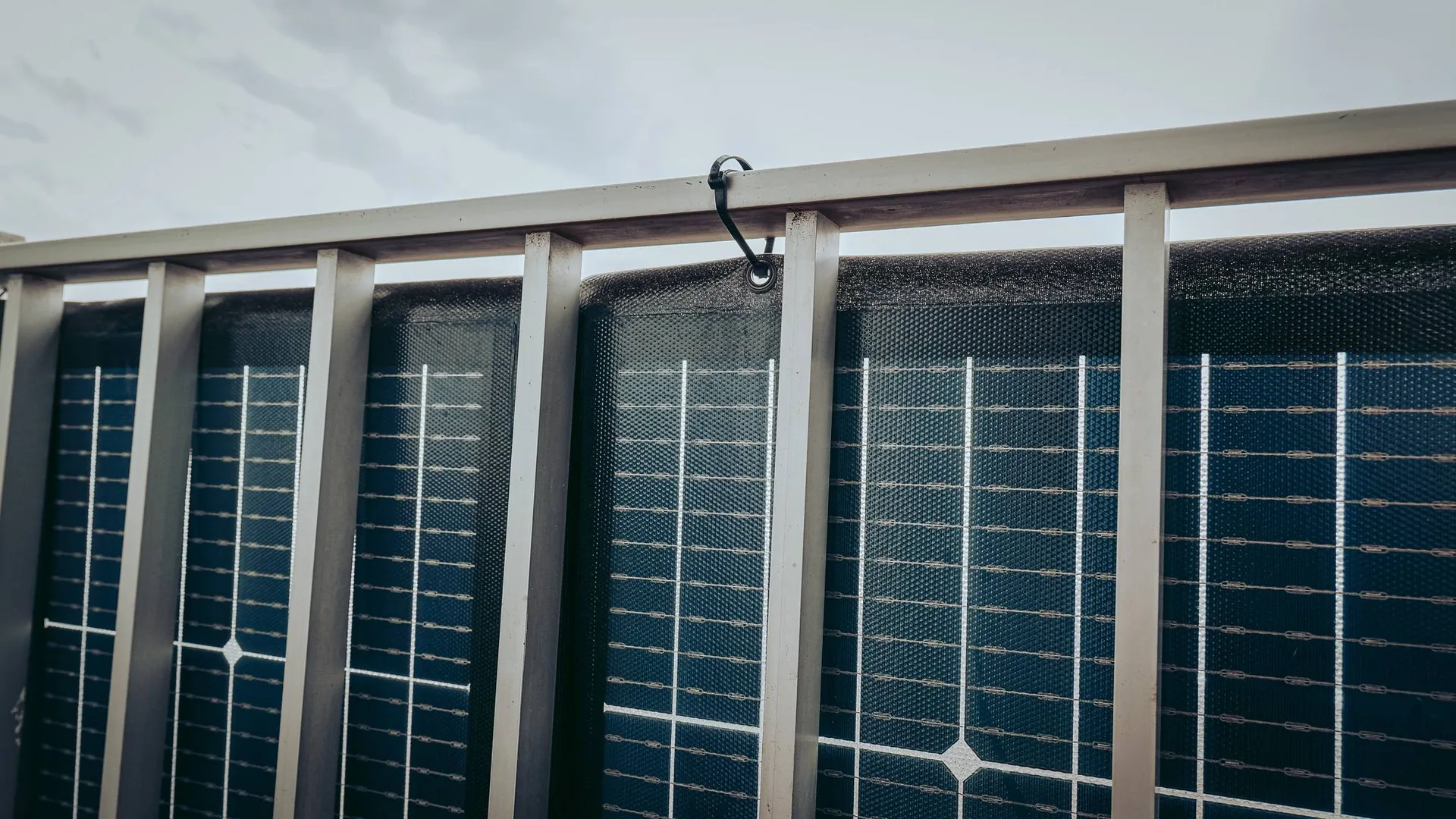
Here’s the thing we don’t say enough about the foldable: it’s so portable that we don’t just store it in the van, we take it everywhere. It’s not just for vanlifers. You arrive at friends’ houses, you have a barbecue, a day trip, and boom, the panel goes with you to power the station and the cooler. A panel fixed on a roof will never do that.
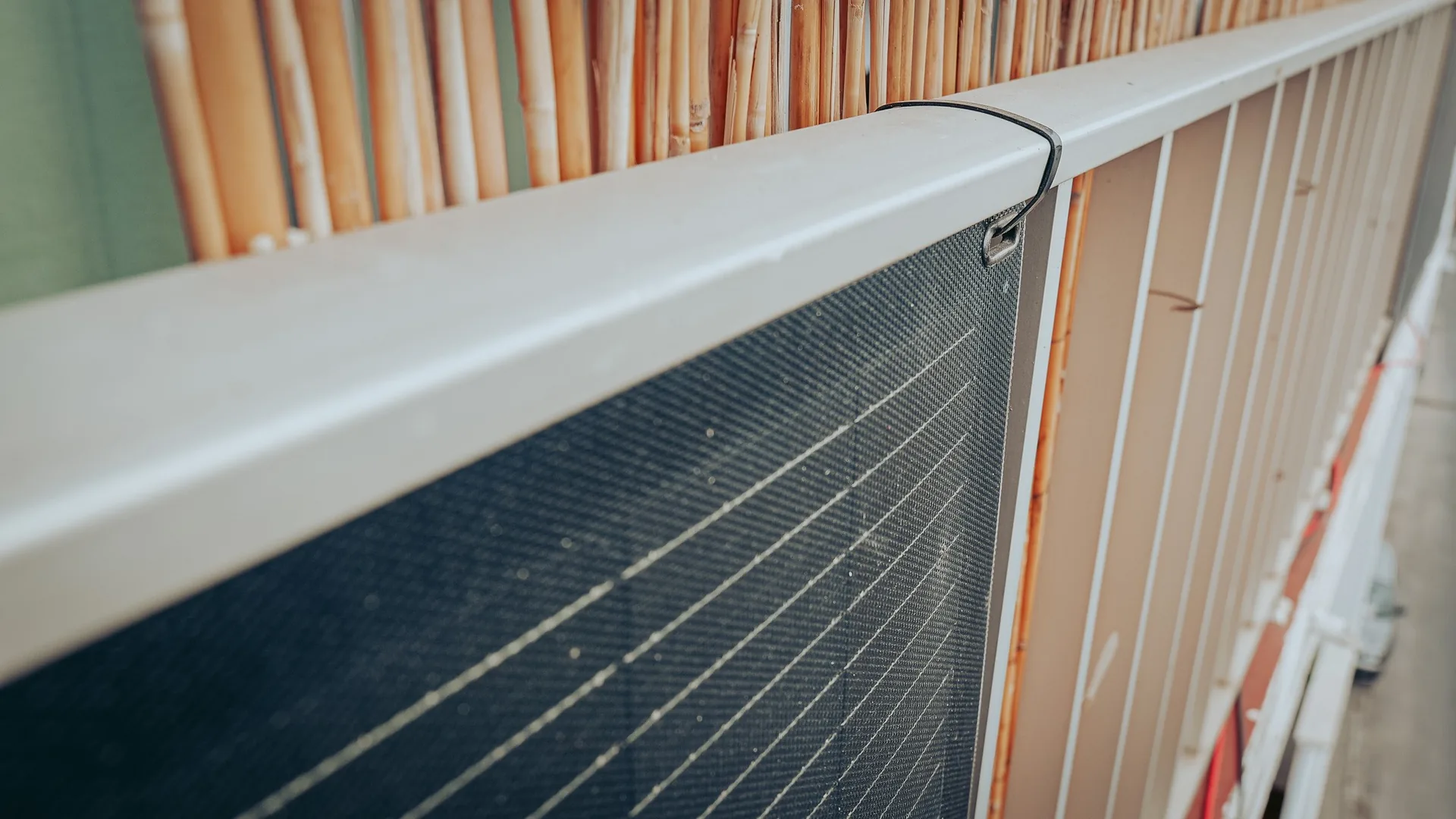
For us, it goes even further. At the apartment, we hang our panels on the balcony with rilsan, those simple tie wraps, and they stay there, facing the sun, without bothering anyone. Connected to the station or the small micro-inverter we use at home, they provide a nice supplement that nibbles a bit at the bill. This is exactly the logic we defend throughout our file: one panel, two lives, the same object that goes in the van in summer and works on the balcony the rest of the year.

Solar generator: the station that lives two lives, in a van and at home
A few years ago, to me, a solar generator was necessarily a bulky thing you dragged around a campsite, with a motor roaring while neighbors looked at you sideways. Then...
Read moreHow much does it cost, and which brand to choose
In terms of budget, expect a wide range depending on the power: around £130 to £180 for a small 100 W, £250 to £400 for a serious 200 W, and £400 to £700 for a 400 W or a large model. Quality flexible panels also rise quickly, ETFE comes at a price. These are just benchmarks, prices change all the time and promotions can alter the situation, so always check the current price before pulling out your card.
For brands, we mainly focus on EcoFlow, Jackery, AllPowers, and Aferiy, with Bluetti lurking. The premium ranges (EcoFlow, Jackery) pay attention to finish and compatibility with their own stations. Brands like AllPowers or Aferiy often offer more watts per pound, sometimes with a less developed app. One piece of advice: if you already have a station from a brand, getting the matching panel saves you from adapter issues. Here are three concrete models, one from each family, to compare weight, power, and connectivity.

I'm Xavier
I test gear over months, in the van and day to day, and I say what doesn't work. If that saves you one bad purchase, leave me your address.
Ce que vous souhaitez recevoir :
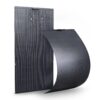
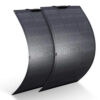
A portable panel for every setup: foldable or flexible
£179,99
See the product
|
£599,99
See the product
|
£113,99
See the product
|
|
|---|---|---|---|
| Net Weight | 4.10 kg (9.04 lb) | - | - |
| Dimensions | 1,375.00 mm (54.13 in) | - | - |
| Total Output Power | 200.00 W | - | - |
| Warranty | 5.00 an | 2.00 an | - |
| Cell Efficiency | 23.00 % | 23.00 % | - |
| Waterproof Rating | 68.00 % | 68.00 % | - |
| Voltage at Maximum Power | 32.00 V | - | - |
| Current at Maximum Power | 6.25 A | - | - |
| Open-Circuit Voltage | 38.40 V | - | - |
| Short-Circuit Current | 6.87 A | - | - |
| Solar Panel Power | 200.00 W | 400.00 W | 100.00 W |
| Panel Type | Flexible | Flexible | Flexible |
And if you don’t have your station yet, our two guides help you frame the overall budget before you dive in.
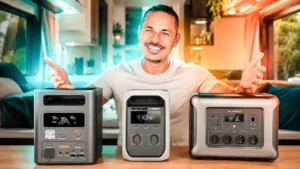
EcoFlow, Aferiy, or AllPowers: the three we’ve really paid for, and which one we recommend
Well, I have to confess something a bit ridiculous, when we open the cupboard under the van bench, we have three power stations staring at each other like cats and...
Read more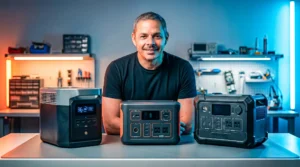
How to Choose Your Portable Electric Station: Buying Guide
The market for portable batteries has exploded in recent years, offering solutions for autonomy ranging from simply recharging a smartphone to fully powering a household in distress. But between pocket-sized...
Coming soonWhat a portable panel won’t do (the limits we hide from you)
Let’s be clear to finish, because honesty is also part of it. A portable panel does not replace the grid. It depends on the weather, and a gray sky nearly brings it to a halt. The slightest shadow cuts its legs. It will never deliver its promised peak. And the more powerful it is, the heavier and bulkier it becomes: our 400 W is nearly 16 kg, it’s a suitcase to unfold, the cover tears quickly, and it’s safer with two.
There’s also maintenance and lifespan, which we always forget. A panel lives outside, so it gets dirty, and a dusty surface produces less: a damp cloth every now and then, and we always store the foldable in its cover to protect the hinges. The flexible one wears out faster if we keep folding it in the same spot. And a panel placed on the ground in a public area needs to be watched, it can quickly disappear into a malicious hand.
Finally, in winter, with short days and a low sun, the harvest is meager, you have to deal with it. Portable solar is free and silent energy when it’s there, but it remains a supplement that we plan for, not a source we take for granted. Here are the last questions we often get asked.
Frequently asked questions about portable solar panels
What solar panel to recharge a 1000 Wh station?
Count broadly. A 200 W panel unfolded and properly oriented takes about 6 to 8 actual hours to fill a 1000 Wh station in full sun, a 400 W does it in 3 to 4 hours. Always reason on 70 to 80% of the advertised power, never on the peak of the box.
Does a portable panel charge on cloudy days?
A little, but really little. A cloudy sky reduces output to 10 or 30% of nominal: a 200 W panel may only deliver 30 to 50 W. Portable solar remains a supplement, not a guaranteed source. On a gray day, we supplement with the grid or while driving.
Do you need a separate regulator or MPPT?
No, if you recharge a portable electric station: the MPPT regulator is already integrated inside, you plug the panel directly. The external MPPT is only used to connect a panel to a bare 12 V battery, without a station.
Can you mix two panels of different power or brands?
It is not recommended. By connecting them together, the weaker one limits the stronger one and you lose efficiency, especially in series. If you want to combine, use two identical panels. Otherwise, it is better to connect each one to a separate input of the station.
What power of panel is needed to run a camper fridge?
A compression fridge draws 40 to 60 W when it runs. A well-oriented 100 to 200 W panel compensates for its consumption on a sunny day and recharges the station a bit as well. Below 100 W, you slow down the discharge without ever catching up to the level.
Can you leave a sign hanging on the balcony permanently, in the rain?
Yes, if the panel is rated for IP67 or IP68: it withstands rain without worry. Here, we attach ours to the balcony railing with cable ties and they stay there. We just bring the equipment inside in case of hail or a big storm, and we monitor the shading that kills the output.
PS: since that famous 62 instead of 110, I never look at the watts of a box the same way again. Our foldable panel has slept in the van, found itself hung on the balcony with rilsan, followed a barbecue with friends, and it continues its little quiet supplement. A panel is not a miracle, it’s just free energy that we go to get where it is, by understanding it a bit.
Our gear tests, in real conditions
Batteries, solar, conversion, security. What we found after months of real use, and what we would not buy again. An email when we have actually tested something, not before.
Ce que vous souhaitez recevoir :