



It’s a bit like mushrooms: when you find a really good one, you keep quiet about it. It took us a while to admit it, but our best spots stay secret, and we’re far from the only ones. It’s the kind of thing you never read in a Park4night review, so let’s start there.
For the rest, the verdict fits in one word: essential. No reservations. We installed it the week we left, subscribed a few weeks later, and it’s now the second app we open most after Google Maps. What follows is what it does really well, what it misses for a vehicle our size, what changes when you use it in Britain rather than on the continent, and above all what our experience doesn’t prove.
What we really ask of it, and it isn’t the sunset photo
In our use it does three jobs that have nothing to do with each other. Finding a spot off the beaten track, yes, that’s the one everybody puts on the poster. But also finding a plain, charmless overnight stop, with no view and no story. And above all, finding somewhere to do services: refill fresh water, empty the waste.
That third job is the least glamorous and by a distance the most useful. When there isn’t a drop left in the tap or the cassette is full, you could not care less about the view. You want a water point and a dump station, now, within fifteen miles. The app that saves your day is never the one with the dream spots.
We also use it in two opposite ways, and most articles only describe the first. There’s the calm planning the night before, where we browse, compare and read comments. And there’s the last-minute call, when the light is going, we’re still driving, and we have three minutes to decide. Two different uses, and the app handles both.
One thing worth saying early, because it’s the single biggest difference for a British reader: Park4night is a continental app first. In France its community is dense and the map is thick with aires, water points and dump stations, because France has thousands of them. In Britain that network barely exists, so the map thins out and the listings lean towards car parks, laybys and pub stopovers rather than proper service points. We reach for Caramaps in France for the same reason — a mostly French community, denser on that territory — and in the UK plenty of people pair Park4night with Searchforsites, which is better stocked on British stopovers and CL sites. It isn’t a question of technical superiority. It’s a question of territory.
Emptying the wastewater from a camper van: where to really empty it
For a peaceful vanlife, discover why and how to empty your camper van. From the distinctions between grey and black water to tips for finding service areas, this article provides...
Read moreThe trap the app doesn’t show you: it speaks van, not motorhome
That’s its real flaw, and nobody mentions it because almost all the Park4night content online is written by people in converted vans. We drive a 1999 Hymer B544. Just under eighteen feet, an overcab bed, and a height that doesn’t forgive.
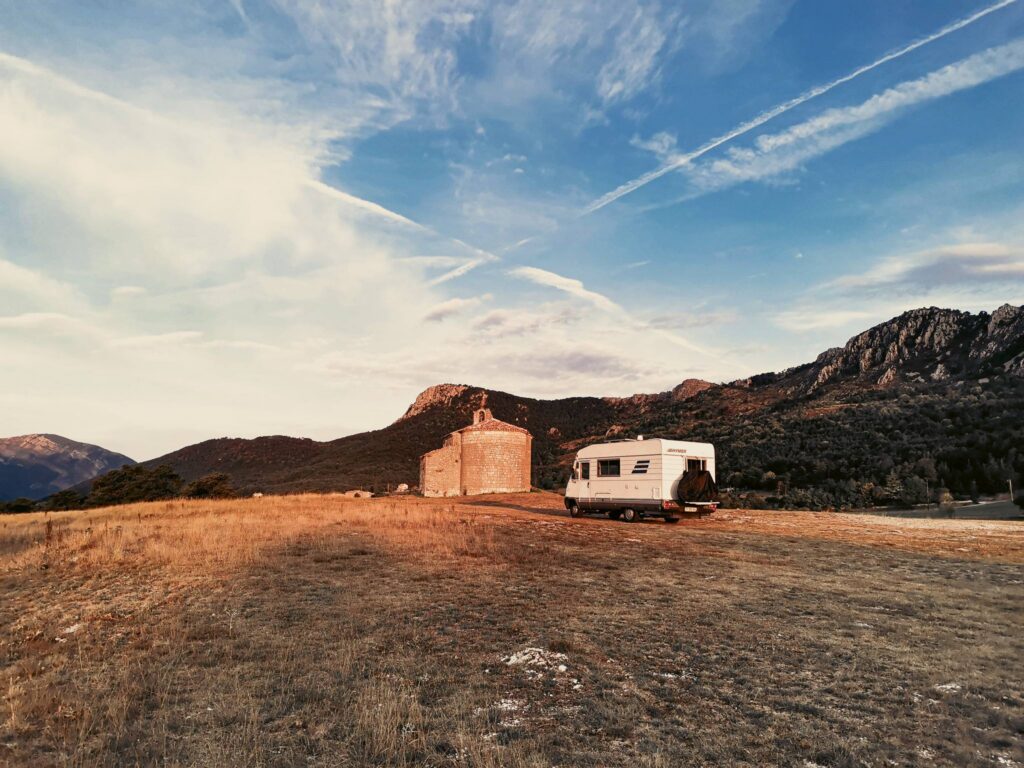
Honestly, gaps between the listing and reality stay rare. We once turned up at a spot that simply didn’t exist any more. But the painful case is the other one: a track far too tight for us, with perfect photos, enthusiastic comments, and not a word about the fact that only vans were getting down it. The one piece of information that would have changed everything was nowhere on the page.
In Britain that trap has a particular flavour, and it has a name: the single-track road with passing places. It is drawn on the map exactly like any other road. A listing at the end of one, in the Highlands or on a Welsh headland, can be perfectly genuine and perfectly impossible for a twenty-seven-year-old overcab that needs somewhere to turn round.
Which is why size comes before every other question for us. We’ve learned to read a listing by first asking whether we can get in, and above all whether we can get out again. Turning a twenty-seven-year-old overcab round on a narrow track isn’t a manoeuvre, it’s an evening.
Our very first reflex on a listing: check the date
Before reading a single comment, we check when it was written. It’s simple, and it’s the most useful thing we can tell you about this app.
Because a Park4night review is almost never wrong. It is out of date, not wrong, and that isn’t remotely the same thing. The spot was free three years ago, it’s been charged for since. The height barrier wasn’t there, now it is. The dump station worked, it’s closed. Nobody lied: the world moved and the comment stayed.
That gap matters more in Britain than anywhere else we’ve driven, because council car parks change their rules from one season to the next, and the height barrier is the national sport. A two-year-old comment saying “free overnight, no barrier” is not a lie. It’s an archive.
How to read a review before committing
Four things we look at in this order, and the signal that makes us back off.
| What we look at | What it really says | The signal that makes us back off |
|---|---|---|
| The date of the comment | The review describes a place at a given moment, not today. | Nothing recent, and the last review mentions access that has changed. |
| The layout and access | What the people who posted drive, visible in the photos. | Only compact vans on a narrow path. |
| The advertised services | Water and waste disposal, the only parameter whose absence poses a real problem. | Advertised services but denied in recent comments. |
| The photos, even bad ones | A failed shot sometimes provides better information than a beautiful image. | A photographed waste disposal full, a dumpster, a damaged ground. |
On the rest of the information, our trust is variable and we own it. Prices are an order of magnitude, nothing more: we look at the range, decide whether we’re willing to pay it, and check on site. The services listed, water and waste, are the one parameter we genuinely filter on, because it’s the only one whose absence actually puts us in trouble.
As for the photos, let’s just say some people cannot take a photograph. Except there’s one glorious exception: when someone posts a picture of a dump station filled to the brim, the information is perfectly reliable and perfectly off-putting. The worst photo on the listing is sometimes the only honest one.
Free or paid: we subscribed after a few weeks
We didn’t agonise over it. A few weeks after leaving we’d already worked out this was the app we had to subscribe to, it had saved us that much time and money.
What the paid version unlocks, in our use, fits on one line: far more points on the map. That’s the only difference I’ll cite, and it’s plenty. On the free map you see part of the area. On the paid map you see the area.
And that’s where the argument turns. This isn’t a subscription you take for comfort, it’s one that pays for itself with the first night it saves you — and in Britain, where a single night on a campsite can cost more than the annual fee, it pays for itself faster than anywhere on the continent. Set against the number of free nights and good places it found us afterwards, the price becomes noise. It’s one of the few subscriptions I’ve never bothered working out the payback on, because the answer is obvious.

I'm Xavier
I write up what we learn on the road, from the gear we wear out to the paperwork that lets us live off it. Without dressing it up.
Ce que vous souhaitez recevoir :
Overcrowding: why our experience may not apply to you
I need to be straight here, because this is where a review can mislead without meaning to.
Overcrowding, we barely lived it. Turning up at a spot already packed has happened to us rarely. Except the reason has nothing to do with the app: we travelled through the lockdowns. In other words we used Park4night under the most favourable conditions in its history, on empty roads and deserted spots.
What we have seen change is the quality. Spots have deteriorated. The reliability of the information has slipped too, and let’s just say the comments aren’t always great. The app itself, oddly, has barely moved, and that’s my only real complaint: it could have evolved a bit, graphically, in terms of ergonomics. Though I’ll qualify that straight away, because redesigning the interface of an app this widely used is a thankless exercise and plenty of users would have taken it very badly.
The spots we keep to ourselves, and why it isn’t selfish
Let’s come back to that. Yes, we deliberately keep some places to ourselves. It’s a secret, and it’s a well-kept one.
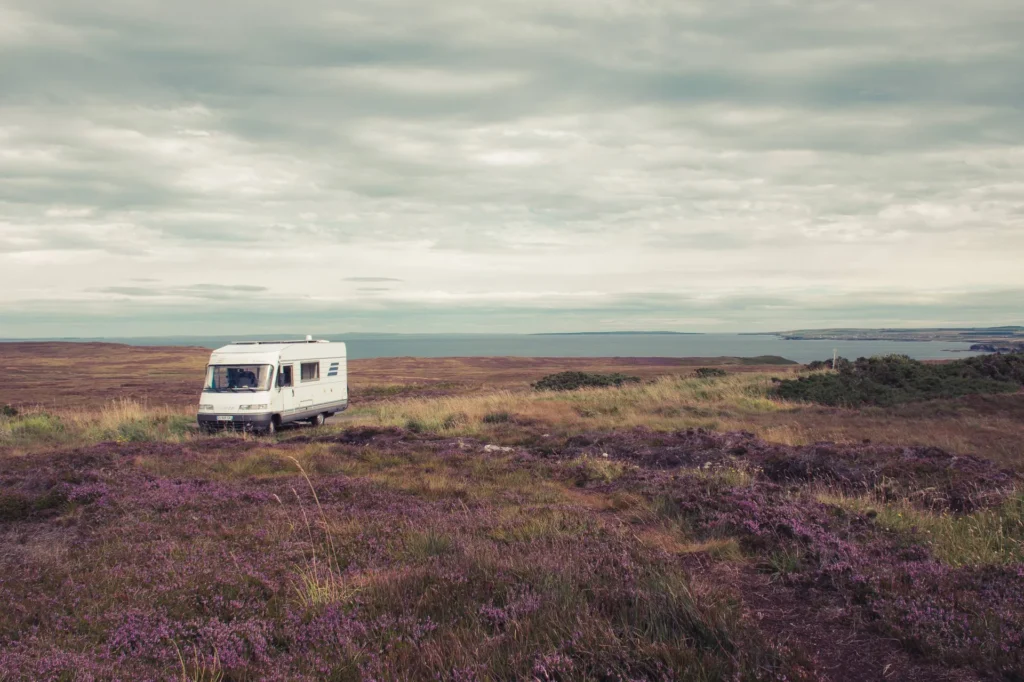
The reason isn’t jealousy, and it’s been in front of us for three years: we’ve watched spots get closed or banned because locals had had enough of seeing them on Park4night. That much is certain. The paradox of this app sits right there, and it’s dizzying: the tool that helps you find places is also the one that makes them disappear. Every post is a small act of endangerment against the place it celebrates.
Britain makes that paradox sharper, not softer. Overnight parking here lives on tolerance rather than on rights — and if you’re about to bring up the Scottish Outdoor Access Code, be careful with it: it gives you the right to wild camp in a tent, on foot, and it has never covered sleeping in a vehicle. A motorhome parked overnight in Scotland is parked on goodwill, exactly like one parked overnight in Cornwall. Goodwill is precisely what a viral listing burns through.
The cycle we all feed, and the only way to get out of it
The tool that discovers places is also the one that makes them close. Each publication accelerates the loop.
So I may as well name the contradiction myself before somebody does it in the comments: I run a travel blog, part of our living depends on the audience it brings, and I keep my best spots to myself. I own that. Publishing a fragile place often condemns it inside three years, and I’ve come to prefer a living spot to another article. It’s the same instinct as the way we park, which I go into in our piece on where to sleep on a road trip: discretion protects the place as much as it protects us.
On contributing, I’ll be honest rather than flattering. We’ve left the odd comment, but we have never once added a spot. We’ve used the app far more than we’ve fed it. It isn’t glorious, it’s the truth, and it makes us passengers of that community rather than contributors to it.
Where to Sleep on a Road Trip
Ready to find the best places to park your van for the night? From wild nature spots to service areas, this article explores the top spots for a peaceful night's...
Read more
Van safety: what scares us, and what really happens
Discover how to live in a van safely. Tips on choosing spots, using security gadgets, and preparing for any eventuality to travel peacefully.
Read moreWho Park4night is a bad tool for
There’s one kind of traveller I wouldn’t recommend it to, and it isn’t a dig at the app. The one who wants to live without planning, the genuine adventurer, who sets off in the morning with no idea where they’ll sleep and finds that this is precisely the point: they don’t need it. It would take something away from them.
For everyone else, and especially for anyone driving something bulky, carrying limited water and feeling a little tight-chested about finding a spot at dusk, it’s the tool that changes everything. We still open it several times a day in September 2026.
The real advice, if I had to keep one, isn’t about which app is best. It’s to check the date before the comment, the size before the view, and to keep the best ones to yourself.
Park4night: the questions we are still asked
Is a spot indicated on Park4night allowed for overnight stay?
No, and that's the most common misunderstanding. The app is a community-based platform, not an authority. A place can be listed for years and be subject to a municipal order for six months. On-site, it's the sign that rules, never the listing.
What to do if you arrive and the place is full or inaccessible?
You never arrive somewhere with just one plan. Before turning off the engine, you always have two backup solutions saved, including at least one traditional service area. It's less romantic, but it avoids having to look for a plan B at night, tired, in a village you don't know.
Should you leave a review after every night?
Ideally yes, and we are in a poor position to give lessons since we contribute little. The most useful thing is not the rating but the date and a verifiable fact: access, noise, state of the dump, barrier. A comment dated from last week is worth a hundred stars given four years ago.
Does Park4night suffice when traveling only in France?
It works, but the French coverage of a competing application like Caramaps is denser, simply because its community is mostly French. Many motorhome users keep both and switch depending on the country, which costs little and avoids blind spots.
Does a high rating guarantee a good night?
No, because the rating mainly measures the charm of the place. It says nothing about the noise from the road, the street lighting, the nighttime crowd, or the slope of the land. A place rated five stars for its view can be unlivable as soon as it gets dark.
Is it risky to sleep in a location marked by the app?
Not more than elsewhere, and often less than an urban parking lot. The fact that a place is known and frequented by other vehicles works in your favor. Our own fears did not occur where we expected them, and we share which ones in our article on van safety.
What to do if a place has become prohibited since the listing?
We move on, without discussing and without taking a chance. A recent sign almost always means that the locals had a problem with vehicles before us. The only useful gesture afterwards is to report it in the comments, so that the next person doesn't make the trip for nothing.
Is the app useful outside of Europe?
Its density drops significantly as soon as you leave the continent. Outside of Europe, iOverlander takes the lead because its community is more active there, especially on long crossings. This is typically the case where you keep a second app as a backup rather than stubbornly insisting.
Is it better to subscribe right away or test the free version?
Nothing compels you to pay on the first day. We used the free version for a few weeks before switching, and it was this real usage that made the decision obvious. One trip is more than enough to know if the tool fits your way of traveling.
Our road notes, by email
Two years of full-time van life, and the Algarve as our base ever since. We still hit the road, by van or otherwise, and we write up what we find along the way. An email when we have something to say, no more.
Ce que vous souhaitez recevoir :