



Our fridge spends a good part of the year turned off. And no, it’s not a malfunction, it’s the method.
Let me clarify right away, because the statement might shock those coming from the world of houses: in a camper van, a fridge that runs continuously is the best way to empty a gas bottle for nothing. Ours is an original trimix, installed in Édouard, our 1998 Hymer B544. So it has twenty-seven years of service, it still cools, and it took us a while to understand how it really works.
So what you’re going to read here is not a fridge comparison (you have sellers for that, and they do it very well). It’s a user feedback. What makes it stop, what makes it start again, the homemade setup I crafted to send it solar power, and what I found behind the exterior grills the day I got curious enough to unclip them.

A trimix doesn’t work like the fridge in your kitchen
Trimix, trimixte, 3-way: it’s the same device, and the travel term is misleading (if you search “trimix” on Google, you’ll find scuba diving, hypoxic mixtures, and so on). In a camper van, it means a absorption refrigerator that accepts three energy sources: gas, 230 V, and 12 V.
The important point is absorption. There’s no compressor that kicks in, no motor that hums at night. There’s a closed circuit, a liquid, and a heat source that sets everything in motion. A flame or an electric resistance. Yes, you read that right: we heat to make cold. It’s counterintuitive, yet that’s the principle.
What this changes for you on a daily basis is huge. An absorption fridge is silent, it doesn’t care about short cycles, but it is slow to cool down and especially it hates two things: heat around it and lack of ventilation. A compression fridge, on the other hand, handles better, doesn’t care about the vehicle’s level, and consumes electricity continuously. I won’t redo the match here; we’ve already refereed it elsewhere.
How an absorption fridge makes cold
No compressor, no motor. A heat source moves a closed circuit, and it is this movement that cools the box.

Living without gas in your van: we have everything except that (and here’s why we’re still considering it)
Gas has always existed in vanlife as it essentially allows for "Heating," but it's not impossible that in the coming years, electricity will replace it. Can we currently completely do...
Read moreThe three buttons, and the rule we never break
On ours, there are three distinct buttons: gas, 220, and battery. And there’s one rule, just one, but it’s non-negotiable.
You must be very careful with trimix fridges, especially the older ones: you must never select multiple sources at the same time. Otherwise, it doesn’t like that too much. It’s either gas, or 220, or battery. Never two, never all three.
It sounds silly put like that, except in real life you’re tired, you arrive at a rest area at 9 PM, you plug in the cable and you don’t think for a second that the gas has been left on “on” since this morning. On a recent model with AES (automatic energy selection), the electronics decide on their own and switch according to what’s available. On a 1998 model, the electronics are you. No one switches for you, no one warns you.
My trick is simple: I consider that changing sources is complete, never an addition. We turn off the old one, we turn on the new one, in that order. It avoids thinking when we’re exhausted.
The 12 V doesn’t make cold, it preserves
Here’s the number one misunderstanding about trimix, and it costs dearly in lost food.
On 12 V, the fridge draws from the battery, and it only works with the engine running, when the camper van’s alternator is on. On this source, it’s not really a fridge; it maintains a bit like a cooler. It preserves the cold that’s already there. It doesn’t produce it, or so little that you won’t see it on a day of driving.
The practical consequence can be summed up in one sentence: cold is made when stationary, before leaving. If you load your warm groceries into a warm fridge and expect three hours of highway driving to fix it, you’re going to be disappointed. We turn on the fridge on gas or 230 V the night before or in the morning, we load cold, and driving just has to maintain the temperature.
And if you drive little, which is our case most of the time (we move in small steps, we stay), the 12 V is hardly ever used. It’s a transport source, not a life source. This is actually the big difference with a compression cooler on battery, which produces cold as long as it has power, whether driving or stationary.
The three sources, without illusion
A trimix accepts three energies, but they do not provide the same service. And never two at the same time.
| Source | What it really does | When to use it | The trap |
|---|---|---|---|
| Gas | Produces cold, completely autonomously, without electricity | When stationary, without sunlight and without a power source. This is the default mode | Mandatory shutdown in tunnels, on ferries, and at gas stations |
| 230 V | Produces cold just as well as gas, without consuming anything from your bottle | Plugged in while camping, or powered by sufficient solar production | Requires real available power, not a low battery |
| 12 V | Produces almost no cold. It maintains, like a cooler | Only while driving, engine running and alternator charging | Believing that a day of driving will cool down a warm loaded fridge |
Our method: make cold, then turn off
This is where it gets interesting, because it’s what we took two years to refine and I’ve never read it anywhere.
In the trimix, there’s a kind of block at the top that acts as a freezer. A small compartment, not enough to store frozen goods for the week, let’s be clear. For a long time, I looked at it as a decorative item. Then I understood that it wasn’t meant for preservation; it was meant to create a reserve of cold.
The protocol, in order
When the fridge is running, we put our blocks at the top, in the freezer, and let them freeze. They become hard. Once we have enough and they are well frozen, we can turn off the fridge and move the blocks down to the fridge section. This helps keep the cold without putting strain on the machine.
The protocol of frozen blocks
Make cold when energy is available, consume it when it is no longer there.
It’s not deprivation, it’s timing. You run the fridge when energy is available (the sun is shining, you’re plugged in, or you have gas to burn anyway), you store that cold in blocks, and you consume it later, with the device turned off. An absorption fridge that restarts cold in a box that’s already cool works infinitely less than an absorption fridge that has to fight against a box at 25 degrees.
The shopping cart is part of the fridge
The other technique to keep food items often enough is to avoid animal products. It’s better to choose products that can be preserved without needing a very cold temperature.
I’m not being moralistic here; we’re not vegetarians, and if you want your steak, you take your steak. I just observe that autonomy is determined at the supermarket. Vegetables, canned goods, eggs, hard cheeses, and fruits don’t require you to maintain 4 degrees at all costs. Fresh meat and fish do. And the day the fridge acts up, you’ll be glad you shopped with that in mind.
In summer, the problem isn’t the fridge, it’s what’s behind it
An absorption fridge, the hotter it is outside, the less effective it is. It’s not a defect of your device; it’s physics. Beyond about thirty degrees, it starts to struggle, and if the air doesn’t circulate behind it, it completely gives up.
Behind the fridge, on the side of the camper van, you have two vents: one at the bottom, one at the top. This is not just decoration, it’s the chimney of your refrigerator. Cold air enters from the bottom, absorbs the heat from the unit, and exits from the top. If this airflow is blocked, slowed down, or overheated, you can set the thermostat to maximum, and nothing will happen.
A small clarification to avoid frequent confusion: we are talking here about the fridge ventilation, not the ventilation of the converted van. These are two different systems, two different subjects, and the cabin has its own article.

Van and motorhome ventilation: how to breathe without ending up with mould
Humidity, condensation, mold, stuffy nights: poor ventilation ruins life in a van. We explain how to ventilate your van or motorhome, summer and winter, without electricity or drilling into the...
Read moreOrientation, our real lever
My trick costs nothing. At each stop, I always try to orient myself so that the fridge side is not exposed to the sun. You arrive, you look at where the sun will move in the afternoon, and you position your vehicle accordingly. It’s a thirty-second reflex that makes more of a difference than a fifty-quid accessory.
Except that (there’s always an except) this conflicts directly with the orientation of the solar panels, which require full sun. Two constraints, one parking space. It’s a trade-off we make at each stop, and there is no universal right answer: it depends on whether you need to recharge or keep things cool.
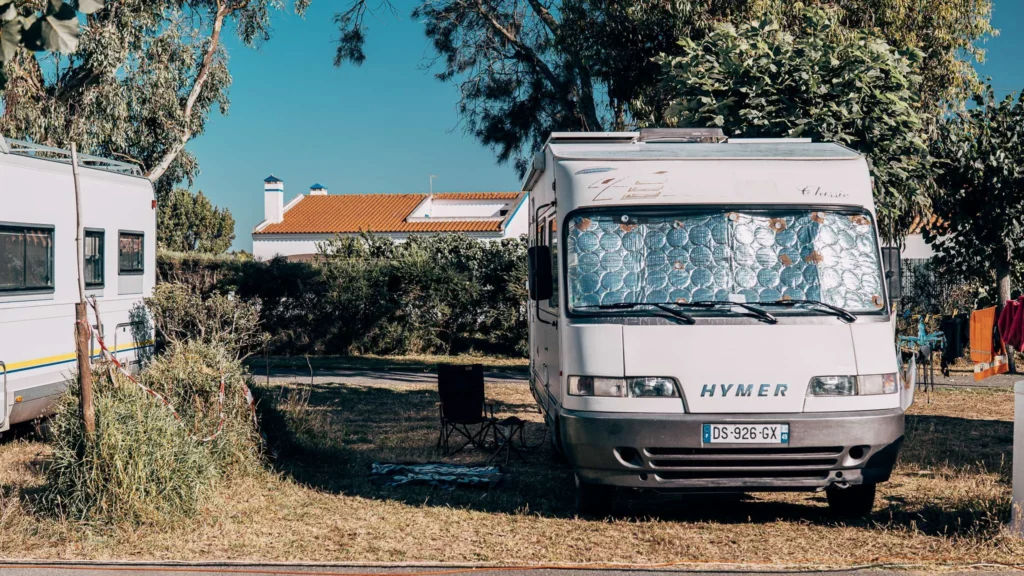
And then there’s the lever we didn’t have to activate because we bypassed it through geography. In summer, we go where it’s cool, in winter we go where it’s warmer, so we always have a temperature that remains acceptable, and we normally don’t need to run the fridge 24/7. Our best tip to avoid heat in vanlife is the steering wheel.

Refreshing your van or camper, how to avoid heat in Vanlife?
Heat can quickly turn your vanlife adventure into a nightmare. But with the right insulation techniques, thoughtful layout, and a few clever tips, you can keep your van pleasantly cool,...
Read moreIf you can’t move your climate, the other classic option is to add a fan behind the vent: two small 12V PC fans placed at the condenser level, with a switch to turn them off when it’s mild. It’s common DIY, well-documented on forums, and it resolves a good part of the efficiency loss in summer.

I'm Xavier
I write up what we learn on the road, from the gear we wear out to the paperwork that lets us live off it. Without dressing it up.
Ce que vous souhaitez recevoir :
What it consumes in gas (the honest answer)
Everywhere you will read that a 13 kg bottle, a Calor propane in UK terms, lasts a fridge two to three weeks. This may be true. I don’t know, and I’m not going to copy a figure that I haven’t measured.
For us, measuring is impossible, and for a very simple reason: the same bottle powers everything. The fridge, the stove, the water heater (the small 10-liter reserve), and the heating. It’s impossible to say how long it runs with just the fridge because at no point does it run with just the fridge. And this single bottle also needs to be refilled, which becomes an adventure as soon as you cross a border: we detailed the fittings and instructions by country.

Gas across borders: what really stops a motorhome, and it is not butane
Butane or propane, that's not the issue. What holds up a motorhome abroad is the connection: our hassle in Portugal, the bottle priced at 400 euros declared prohibited, the switch...
Available on 24 September 2026What I can tell you, however, is the sense of things. The fridge is the only appliance that runs for a long time continuously, while the stove runs for twenty minutes and the water heater for fifteen. Over a month in summer, the fridge’s share in your bottle is probably the largest of all. That’s exactly why the tips in this article exist: it’s the area where there’s the most to save.
Since we had LPG installed (with an approved external outlet, after a significant hassle with bottles and adapters), the LPG also powers the fridge. For someone traveling year-round in Europe, this is a huge comfort: we fill up at the pump instead of chasing after a bottle with the right national standard. If you are coming from the UK, that is the same logic as swapping exchange cylinders for a refillable tank filled at an Autogas pump, except that the UK bayonet nozzle stops at the Channel. The downside is that you have to carry a set of adapters, because each country has its own, and it took us a while to realize this while trying to do without gas in a converted vehicle.
The setup that relieves gas: reinjecting solar power through the external socket
This is the DIY project I’m most proud of, by far.
On board, I have two separate electrical systems. The main system, the original one from the camper van with its battery and everything that goes with it. And a secondary system, completely independent, powered by 450 W of solar panels.

Here’s the technique. Sometimes, when we’re at a stop, and I know I’m not moving and have plenty of sunlight, I use the energy from my secondary system’s panels to reinject it into the camper van’s external power socket. The one we plug in while camping, the one that brings in alternating current. In other words: I plug myself into my own outlet. And with this peak power, I supply the fridge with 230 V. This has saved me a lot of gas.
Three conditions must be met, and they are not met every day: being stopped, with no departure planned, and having real sunshine. This is not a permanent lifestyle, it’s a window we open when it presents itself. Typically in summer, in the middle of the day, when the sun is shining hard and you’re doing nothing else but reading in the shade.
And I refer you to the paragraph about the three buttons: when I switch to 230 V, I manually turn off the gas. The fridge doesn’t switch over by itself; nothing switches over by itself on a model of this age.
A word of honesty to finish on this point: I’m telling you about a setup, I’m not giving you a wiring tutorial. Reinserting current into a socket designed to receive it requires thought, safety measures, and is not just a simple string light connection. If you want to delve into the production side, that is a subject of its own, and it belongs to the solar side of the van rather than to the fridge.

EcoFlow, Aferiy, or AllPowers: the three we’ve really paid for, and which one we recommend
Well, I have to confess something a bit ridiculous, when we open the cupboard under the van bench, we have three power stations staring at each other like cats and...
Read moreTwenty-seven years later: rust and fickle restarting
We arrive at the part I had read nowhere before experiencing it, and it’s probably the most useful if your camper van has some age.
What’s behind the vents
After 27 years of lifespan, when I remove the plastic vents from the camper van, the external grills, I find myself facing a lot of rust. So I will have to either change the fridge or remove all this rust.
The sneaky thing is that it’s not visible. As long as you haven’t unclipped the grill, you have no idea of the condition of the unit behind. Your fridge is cooling, everything seems fine, and meanwhile, humidity, salt, and road splashes are quietly working out of sight. If you’ve never done it, go take a look. It’s five minutes, and it might save you from discovering the problem one summer, in Spain, on a Sunday.
The decision, for us, has not yet been made. To treat or to replace. I’ll let you know.
The fridge that won’t turn on is not necessarily dead
This is the only real issue we’ve encountered in 27 years, and the most counterintuitive: it never happens in daily use. These machines like being used often. When we use it less, the first restart is always the difficult one.
The piezo, the little thing that ignites the gas, refuses to do its job. You can feel that the humidity makes it very difficult to start again. Sometimes you can only get it to work again after a day, when the ventilation has managed to chase away all the humidity, so that it can ignite more easily.
Translation for your spring: the fridge that refuses to start after three months of inactivity is not necessarily broken. It is humid. The answer is not to dismantle the burner while swearing, but to leave it open, let it ventilate, and try again later. It just requires not planning to do the shopping on the same day as departure.
The verdict, nonetheless
These are fridges that, in my eyes, age quite well, at least for models like ours, on a Hymer B544 which is already quite an old model. Back then, it really felt like there was no planned obsolescence. Now, for the more recent ones, I don’t know if their lifespan is longer or not, and I’m not going to pretend to know.
If I had to do it again
I wouldn’t change the fridge for a compression one, at least not as long as this one keeps things cold. A factory absorption fridge, silent, that uses gas when there is no sun and 230 V when there is, is a rather logical companion for a vehicle that isn’t plugged in every night.
What I would change is the moment I understood how it works. We accumulated these tips over two years, one by one, by feeling our way. Today we turn it off a good part of the time, we send it solar power when the sun is out, we park the right side in the shade, and it has never let us down on the road.
And if one day rust takes over, well, we will see. At September 2026, it still keeps things cold.
Camper van fridge: the questions we are asked
Which gas bottle for a tri-mixed fridge?
Propane rather than butane if you plan to go out in winter: butane stops vaporizing around zero degrees, and a fridge that no longer has gas pressure does nothing. A standard 13 kg bottle is suitable. If you travel year-round in Europe, the LPG installation with approved external outlet avoids having to chase the right national standard at every border.
How to turn on a trimix fridge on gas?
Bottle open, ramp tap open, selector on gas, thermostat at maximum, then press the ignition button and hold the pressure for a few seconds after the flame appears, until the thermocouple heats up. If you release too early, the safety cuts off the gas supply and it goes out. This is the number one cause of false ignition failures.
What temperature should a camper van fridge be?
Between 0 and 5 degrees in the fridge section, just like at home. The real difference is the cooling time: it takes several hours to reach temperature, even longer on 12 V. That's why we always turn on the fridge the night before or in the morning, and load already cold groceries instead of hoping it catches up.
Does the motorhome need to be level for the fridge to work?
Yes, and it is a specificity of absorption refrigerators that many ignore. The circuit works by gravity: too tilted, the liquid no longer circulates properly and the cold disappears, sometimes permanently if it lasts. A slight slope is not a problem, a seriously tilted parking is. The wedges are not just for your sleeping comfort.
How to clean the burner of a camper fridge?
It's the classic annual maintenance: you access the burner through the external hatch, dust off the chimney, and clean the burner and its injector, which are clogged with cobwebs and combustion residues. A dirty burner gives a weak flame: the fridge seems to be working but cools very little. If you don't feel comfortable doing it, a workshop can do it at the same time as the gas check.
How does an AES fridge work?
AES stands for automatic energy selection. The fridge chooses its source on its own depending on what is available: 230 V when plugged in, 12 V when the engine is running, gas the rest of the time. It's convenient and avoids user error. On older models like ours, this arbitration does not exist; the user has to switch manually.
Where is the fridge fuse located in a motorhome?
Rarely where one looks for it. The 12 V from the fridge generally goes through the cell's control unit, not through the fuse board of the vehicle, and it is often paired with a fuse on the relay that cuts off the power when the engine is off. The diagram of the cell (Hymer, Rapido, Chausson depending on the brands) is more useful than the Ducato manual to find it.
What power does a camper van fridge consume at 12 V?
A trimix at 12 V generally draws about ten amps continuously, which is over 100 W, which is huge for a cell battery. That's precisely why the manufacturer cuts this source when the engine is off: in one night, the fridge would drain the battery without ever reaching the right temperature. A compression cooler, on the other hand, consumes several times less.
Can you drive with the gas fridge on?
Technically it works, and many do it, but it is not recommended and prohibited in certain contexts: tunnels, ferries, and gas stations require the gas to be turned off. An open flame on board a moving vehicle, with a full tank of gas next to it, is not a good idea. That's where the 12 V takes over, precisely because it only works while driving.
Which fridge to choose for a van or a converted truck?
On a a recent van, the question is almost no longer relevant: the compressor fridge has won, because it does not require a gas circuit, no flue in the side, and it can handle heat and slopes. The trimix still has its appeal on vehicles already equipped with gas and that remain without electricity for long periods. We have detailed this match elsewhere on the site.
Should you empty and leave the fridge open during winter storage?
Yes, door ajar. A closed and turned off absorption for months accumulates moisture, and that's exactly what makes the spring restart so painful. Most models have a ventilation latch that keeps the door slightly open. It won't always spare you a day of patience at restart, but it seriously shortens it.
PS: I still find it absurd that we heat to make cold. This machine has been running on this principle since 1998, and I still find it a bit mind-boggling.
Van life day to day, unfiltered
Two years of full-time van life, and the Algarve as our base ever since. We still hit the road, by van or otherwise, and we write up what we find along the way. An email when we have something to say, no more.
Ce que vous souhaitez recevoir :