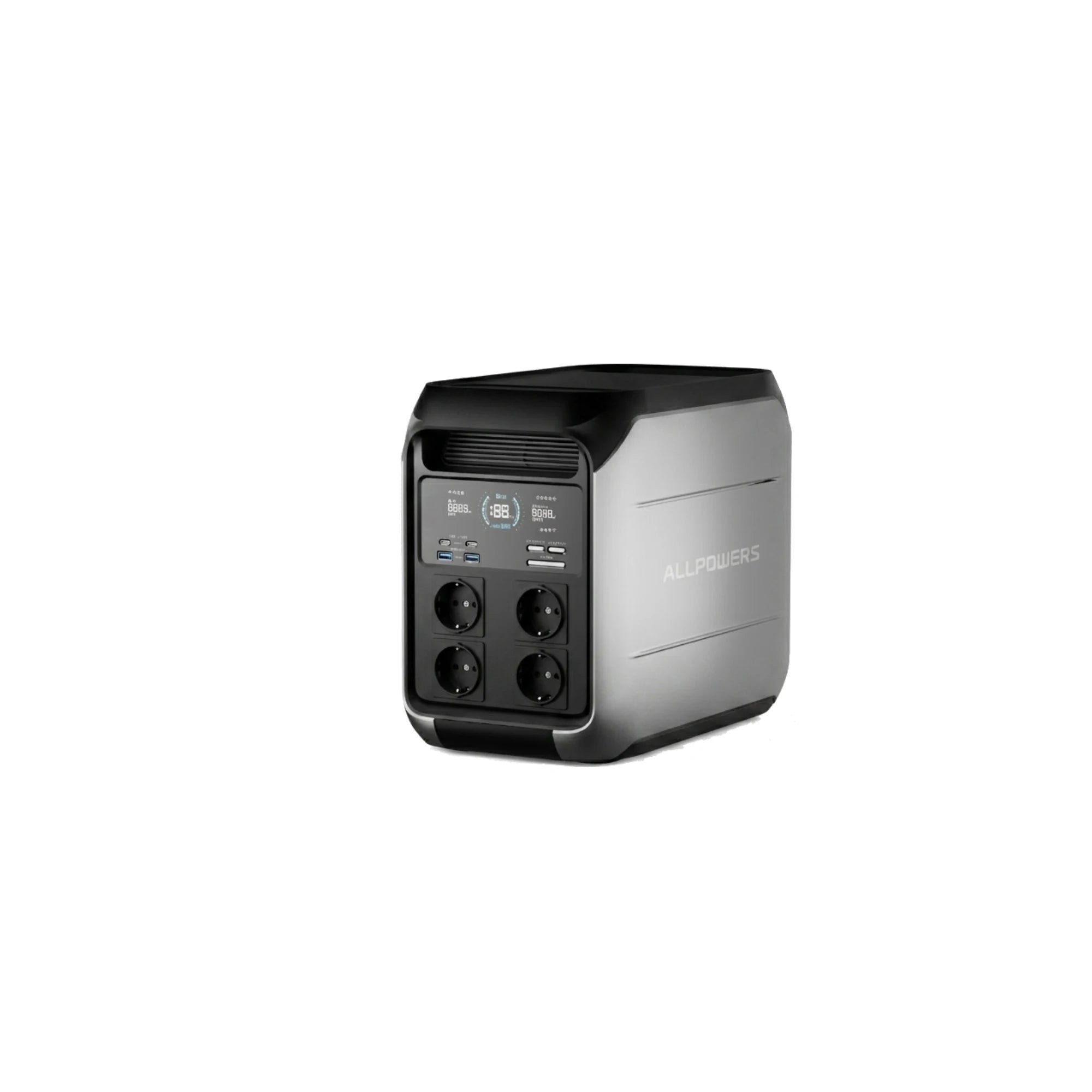
ALLPOWERS P1800 Portable Power Station 1800W 1024Wh
VANTOUR**Verified price on 5 August 2026. The final price may vary.
Portable power station 1024 Wh and 1800 W, first of the new P range from ALLPOWERS. Compact vertical format of 13 kg, four AC outlets, full recharge in 54 minutes, UPS under 10 ms and LiFePO4 cells rated for 4000 cycles. No capacity extension found so far.
Why use our link and our code?
Description
The P1800 is the first station of the new P range from ALLPOWERS, and it arrives with a slightly different profile from the rest of the catalog. 1024 Wh of capacity, 1800 W output, four AC outlets, and above all a format that stands upright instead of spreading out.
In our classification, it is versatile in the strict sense: enough energy to enjoy a weekend in a van or to endure a power outage at home without thinking about it, compact enough not to become a piece of furniture. With an important nuance, which we will return to later: unlike its cousins in the R range, no extension battery appears to connect to it.
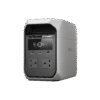
A note from our side: visually, it can bring to mind other stations in this segment, the upright black-fronted format having become a standard. What sets it apart is a more extensive block of AC outlets than average, a noticeably narrower case, and a well-designed screen where the readings are far easier to take in at a glance than on previous generations.
Who is this station for?
It targets three uses, and it covers them well.
The converted van or weekend camper first. 1024 Wh is the format that powers a fridge, a water pump, laptop charging, and an evening of lights without having to calculate every watt. Its 13 kg and 20 cm width make it easier to fit than a square station of the same energy size.
The home backup next. The UPS function switches in less than 10 milliseconds, so the computer, the box, and the freezer do not notice the outage. If you work remotely in an area where the network falters, this machine is exactly what you need.
And a less obvious use that we rarely think about: the trunk of an electric car. A station of this size can power a camping fridge, run equipment on a construction site or a shoot, and it recharges via the cigarette lighter during the journey.
Key features to know
The cell is LiFePO4 rated for 4000 cycles, which is 500 more than the R1500 from the same manufacturer. Under normal use, one cycle per day places the end of useful life well beyond ten years, with more than 80% of capacity retained.
On the output side, you have four 220-240 V outlets sharing 1800 W, with a peak of 3600 W for devices that draw heavily on startup. There are also two USB-C at 140 W, two USB-A, and a 12 V cigarette lighter output. Nine ports in total, which is generous for this category.
Control is done through the ALLPOWERS app, via Wi-Fi or Bluetooth, allowing you to monitor the charge without getting up to read the screen.
What is the daily autonomy?
1024 Wh usable at about 85% once conversion losses are accounted for gives concrete benchmarks. A van fridge that consumes 45 W runs for about 18 hours. A laptop can be charged about a dozen times. A phone, about fifty times.
For heavy consumers, it's shorter, of course. A 1500 W kettle can run without issue, but it drains a quarter of the battery in a few minutes. This is the normal compromise of this capacity range, not a defect of this particular machine.
Charging: AC, solar, or car
This is probably the most interesting point of the technical sheet. On a standard wall outlet, ALLPOWERS claims a full charge in 54 minutes, with an input that goes up to 1200 W. In practice, you plug it in when you go shopping and it's full when you return.
In solar, the input accepts up to 650 W. In full sun and with a properly oriented panel, we are theoretically around one and a half hours to fill the 1024 Wh, and more like two hours in real conditions. This is real comfort for camping: a morning of good weather is enough to leave fully charged.
Charging while driving through the cigarette lighter is possible in 12 V as well as in 24 V, but be careful, the car cable is not included in the box.
The extension question
This is the point that could change opinions, so let us put it exactly as we observe it. We cannot find any extension battery port on the P1800. Its technical specifications do not mention one, and it does not appear anywhere in the combinations offered by the manufacturer, unlike the R1500 and R2500 which accept one or two B1000. We note this as an observation, not a verdict, and we will update this page as soon as we have the unit in hand.
As things stand, what you are buying is therefore 1024 Wh. If your plan is to start small and expand later, look instead at the R range from the same manufacturer, or competitors of similar capacity that accept modules. The comparator just below puts them side by side with their current prices. If you know that 1 kWh covers your need definitively, the lack of modularity costs you nothing and you gain in bulk.
Why buy from Vantour?
Because we send you directly to the manufacturer, not to an intermediary retailer.
- Direct purchase from the brand, thus the best possible value for money on this product.
- 100% authentic and official product, shipped from Germany in 3 to 5 days.
- Stocks managed by ALLPOWERS, the displayed availability is real.
- Customer service guaranteed by the brand, with 5 years warranty and 30 days to change your mind.
On the pricing side, to give you a concrete idea: £481,58 at the brand, and £433,42 with our code VANTOUR (-10% off).
We have it on order
Let's be transparent: at the time of writing this sheet, we do not yet have the P1800 in hand. ALLPOWERS is sending it to us, and everything you read here comes from the manufacturer's technical sheet and our familiarity with this range, not from a field test. As soon as we have used it in real life, we will complete it with our own measurements and photos.
In the meantime, if you are hesitating between several brands in this format, we have written a comparison of the portable batteries we have actually paid for. And if the sticking point is the fixed capacity, the AllPowers R range and several competitors of the same size do accept add-on batteries. The comparison block further down this page lists them side by side.
Technical specifications
| Capacity | 1,024.00 Wh |
|---|---|
| Net Weight | 13.00 kg (28.66 lb) |
| Dimensions | 371 x 208 x 296 |
| Total Number of Output Ports | 9.00 |
| Total Output Power | 1,800.00 W |
| Number of AC Outputs | 4.00 |
| Max AC Output | 1,800.00 W |
| Output Voltage | 220-240V |
| USB-A | 2x 5V⎓3A, 9V⎓2A, 12V⎓1,5A, 18W maximum |
| USB-C | 2x 5/9/12/15V⎓3A, 20/28V⎓5A, 140W x2 maximum |
| DC 12V Output | 12V⎓10A, 120W maximum |
| AC Charging | 1,200.00 W |
| Solar Charging | 650.00 W |
| Car Charging | 12V / 24V DC |
| Battery Chemistry | LiFePO4 |
| Number of Extra Battery Ports | 0.00 |
| Wi-Fi | ✓ |
| Bluetooth | ✓ |
| Application | ✓ |
| Warranty | 5.00 an |
| Noise | 30.00 dB |
| Money-Back Guarantee | - |
| Life Cycles | 3000+ (70%) |
| UPS Function | ✓ |
Compare with similar products
£481,58
This product
|

£878,00
See the product
|
£429,00
See the product
|
£399,00
See the product
|
|
|---|---|---|---|---|
| Capacity | 1,024.00 Wh | 1,024.00 Wh | 1,024.00 Wh | 1,024.00 Wh |
| Net Weight | 13.00 kg (28.66 lb) | 12.50 kg (27.56 lb) | 11.64 kg (25.66 lb) | 12.10 kg (26.68 lb) |
| Dimensions | 371 x 208 x 296 | 398,200,284.00 mm (15,677,185.00 in) | 350.00 mm (13.78 in) | 398,200,283.00 mm (15,677,184.96 in) |
| Total Number of Output Ports | 9.00 | 11.00 | - | 5.00 |
| Total Output Power | 1,800.00 W | - | - | - |
| Number of AC Outputs | 4.00 | 4.00 | 2.00 | 2.00 |
| USB-A | 2x 5V⎓3A, 9V⎓2A, 12V⎓1,5A, 18W maximum | 2 × 18W Max | 2 ports, QC 3.0 18W | 1*12W |
| Application | ✓ | - | - | ✓ |
| Warranty | 5.00 an | 5.00 an | 7.00 an | 5.00 an |
| Noise | 30.00 dB | 30.00 dB | - | 50.00 dB |
| Life Cycles | 3000+ (70%) | 4000 Cycles to 80% Capacity | 4000+ Charge/Discharge cycles to 80% | 10 years |
| UPS Function | ✓ | ✓ | ✓ | - |
Our verdict
Benefits
- Four AC outlets, two more than most stations of comparable capacity
- 1800 W output, at the top of the range for this format
- Full AC recharge claimed in 54 minutes
- Narrow format of 20.8 cm wide, easier to fit than a square equivalent station
- LiFePO4 cells rated for 3000 cycles at 70% remaining capacity and a 5-year warranty
- UPS under 10 ms, power cuts go unnoticed
- Solar input of 650 W, above the segment average
Disadvantages
- No extension battery found, the capacity appears to be fixed at 1024 Wh
- 13 kg, which puts it among the heaviest in its category
- AC input limited to 1200 W, other stations of this format go higher
- Solar input surpassed by part of the segment
- Car charging cable not included
On paper, the P1800 isn't the sleekest in its category: heavier than the segment average, and with no capacity extension found so far. It makes up for this with its four AC outlets, charging in under an hour, and a 5-year warranty. It's a good choice if you want to plug in several devices at once and 1 kWh is enough for you. Avoid it if you plan to expand later or if every kilogram counts.
Frequently Asked Questions
Can you add an expansion battery to the P1800?
How long does it take to recharge?
How long will it run a van fridge?
Does the UPS function really protect a computer?
Is the car charging cable included?
Customer reviews
Review
There are no reviews for this product yet.
Additional information
| Option | Price | Availability |
|---|---|---|
| Standard | £481,58 £433,42 | In stock |