


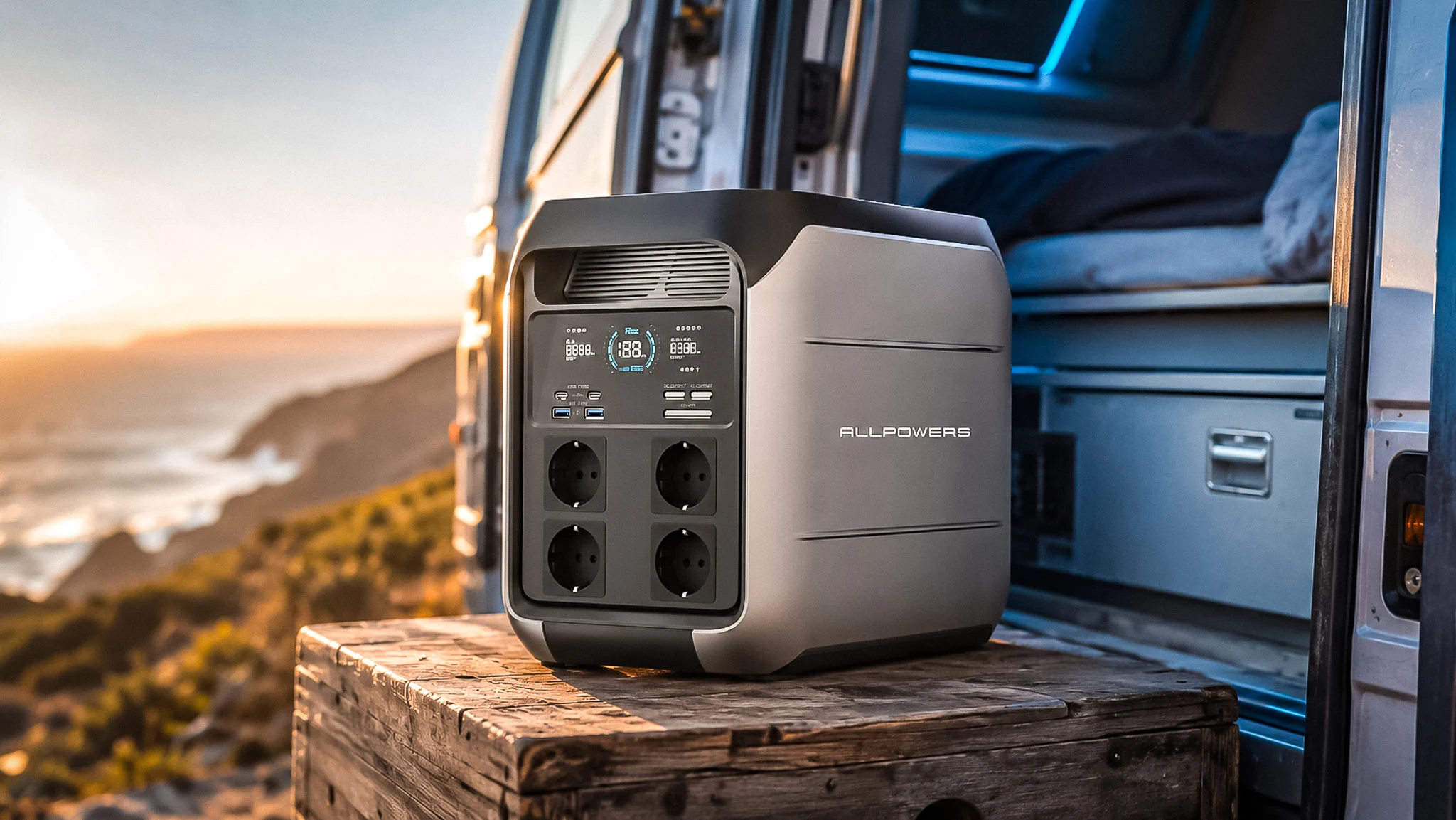
She arrived, spent two weeks in the camper van, then I placed her under Caroline’s desk and connected her to her workstation. That’s where I conducted the tests that really interested me: cutting the power for good, asking for over a thousand watts, and sticking a microphone against her ventilation to see if you can work next to it.
What follows replaces the pre-notice I had written based on her technical sheet. The photos are mine, the numbers are what I read on her screen, and I will also tell you what I did not measure.
Our verdict on ALLPOWERS P1800 Portable Power Station 1800W 1024Wh
Benefits
- Four AC outlets, two more than most stations of comparable capacity
- 1800 W output, at the top of the range for this format
- Full AC recharge claimed in 54 minutes
- Narrow format of 20.8 cm wide, easier to fit than a square equivalent station
- LiFePO4 cells rated for 3000 cycles at 70% remaining capacity and a 5-year warranty
- UPS under 10 ms, power cuts go unnoticed
- Solar input of 650 W, above the segment average
Disadvantages
- No extension battery found, the capacity appears to be fixed at 1024 Wh
- 13 kg, which puts it among the heaviest in its category
- AC input limited to 1200 W, other stations of this format go higher
- Solar input surpassed by part of the segment
- Car charging cable not included
On paper, the P1800 isn't the sleekest in its category: heavier than the segment average, and with no capacity extension found so far. It makes up for this with its four AC outlets, charging in under an hour, and a 5-year warranty. It's a good choice if you want to plug in several devices at once and 1 kWh is enough for you. Avoid it if you plan to expand later or if every kilogram counts.
The cut under the desk, the test I was waiting for
The principle of the inverter is simple: the station remains plugged in at all times, your devices are connected to it, and the day the power goes out, it continues to supply them without anything turning off. On paper, ALLPOWERS claims a switch over in under 10 milliseconds. For us, the real question was whether Caroline’s workstation would hold up.
I then unplugged the wall socket, rotating camera. Nothing flickered. The external screen stayed on, the MacBook didn’t notice anything, and the station took over without the slightest hiccup.
Once on battery, the station’s screen displayed 51 W output for the MacBook Pro and its monitor. That’s low, and that’s the whole logic of this setup.
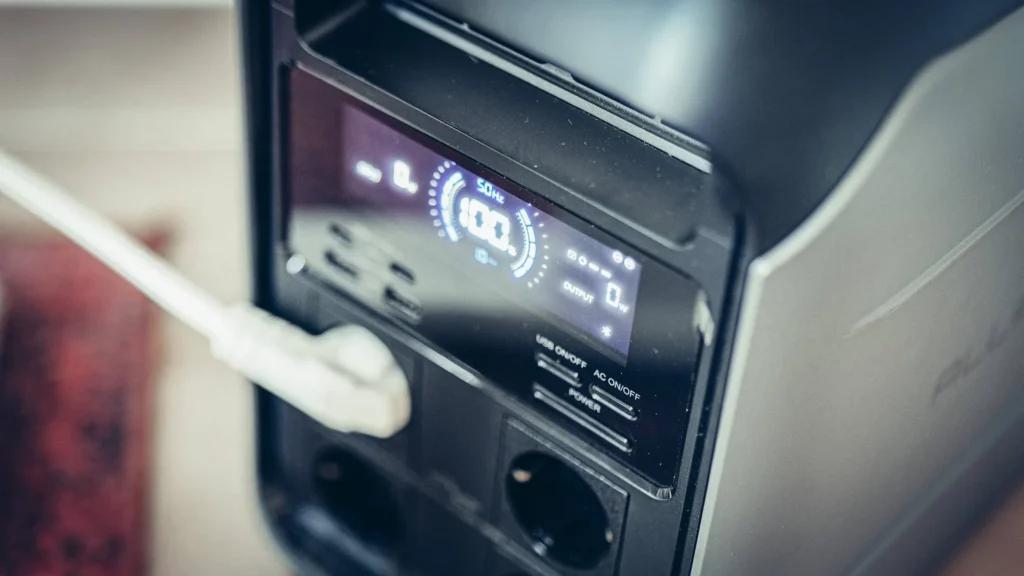
At 50 W consumption for 1,024 Wh capacity, the calculation gives a little over twenty hours. I say it as it should be said: it’s an order of magnitude on paper, before conversion losses and what the station consumes for itself. I did not perform a complete timed discharge, so I am not selling you twenty measured hours. What I can affirm is that a power cut does not cost Caroline a day of work.
Going over 1,000 watts with a hairdryer
Second test, and this one was more brutal. A station rated at 1800 W, I wanted to see if it could really handle a large resistive load. So I kept Caroline’s workstation plugged in, added an iPad and USB headphones, and brought out the weapon of choice: a hairdryer.
A hairdryer is a straightforward resistance, it’s the kind of device that doesn’t negotiate. I first set it to half power, 600 W, then to full power, 1,000 W. With the rest of what was plugged in, the station went above 1,000 W output for about a minute.
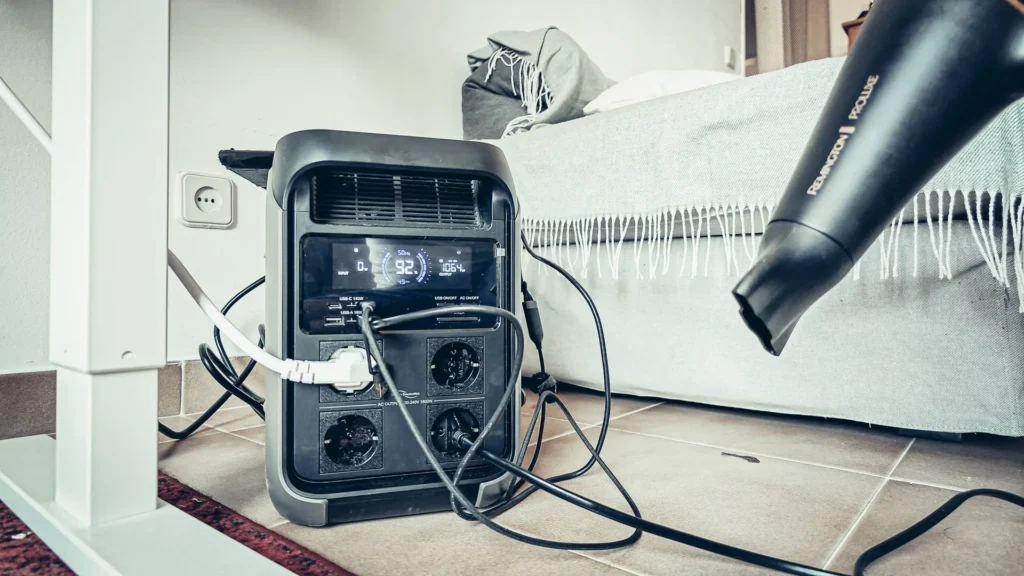
It held up without flinching. The hairdryer was definitely louder than the battery, which sums up the matter quite well.
I did not plug in a drill, and that was intentional: this is not a construction battery, it’s a home battery. A vacuum cleaner, a hairdryer, an induction plate for the time of a coffee, yes. A professional tool that draws continuously is not its job, and there were still two free sockets to plug in something else.
The noise, now that I’ve listened closely
This is a point I rarely overlook, because a station blowing in a six-square-meter camper van, or next to you while you work, quickly becomes unbearable. I have our DELTA Pro in mind, which is frankly noisy.
I therefore placed the microphone against the ventilation grille, once while it was powering the desk and charging at around 550 W, and a second time right after the hairdryer test.
The verdict is clear: at 50 cm, it’s not noisy. It’s a ventilation blow, not a turbine that goes high-pitched. I should clarify that I do not have a sound level meter: this is an observation, not a measurement in decibels.
The app, once you find the right one
I was waiting for ALLPOWERS on this front, because their previous app was not very useful: it duplicated the buttons on the front, it just saved you from getting up.
The beginning was laborious. While searching for the brand on the App Store, I came across several apps not knowing which one to choose. The first, ALLPOWERS AI, told me a trial session had expired. The second was in Chinese. The right one was actually an app I had already installed and then uninstalled, which I had to redownload.
Once connected, the judgment completely reverses. This app no longer just duplicates the front buttons, and that’s exactly what I was expecting.
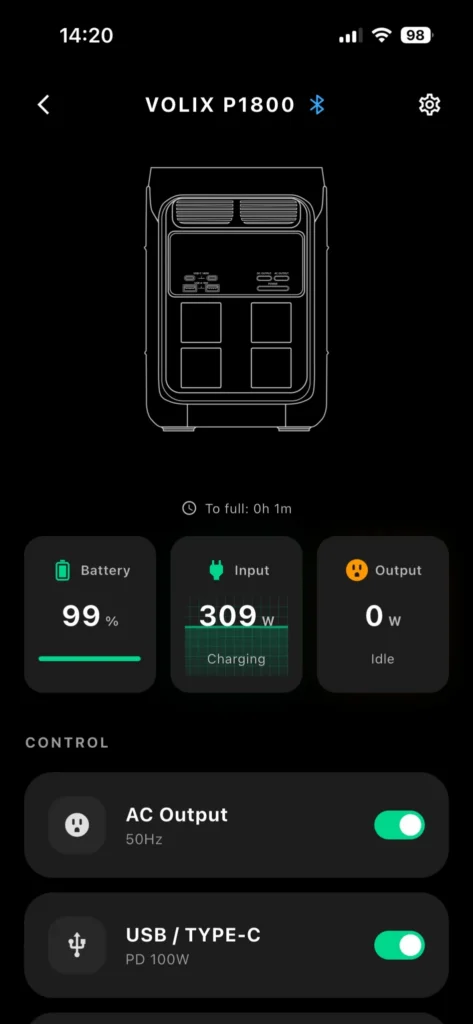
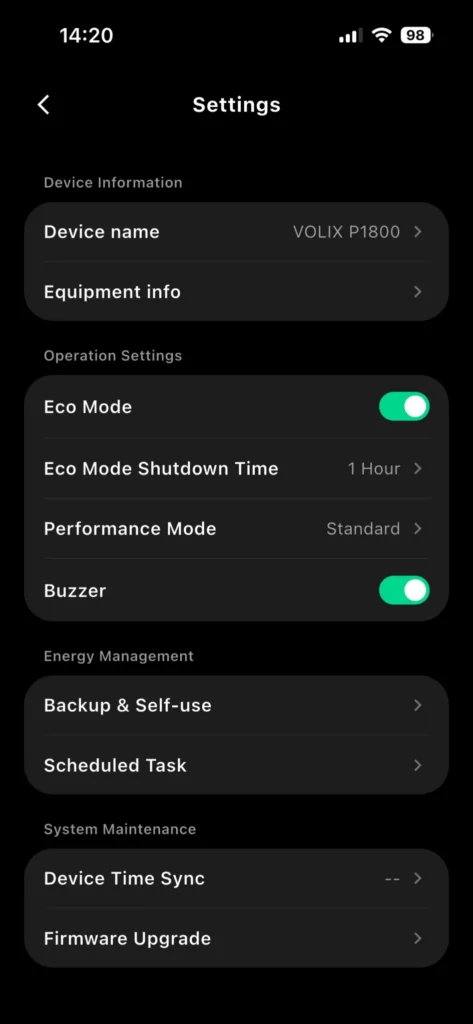
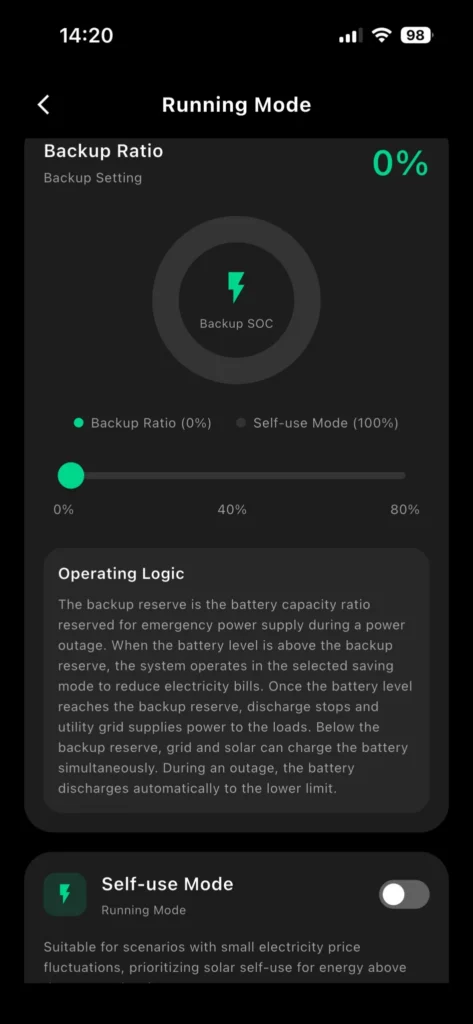
You can set the eco mode and the delay after which the station turns off, displayed here as one hour. You can turn off the buzzer, which seems trivial until the day the beeps annoy you. You can rename the device, control the outputs, and find the firmware update. And above all, there’s a setting for backup reserve, the Backup Ratio, which can be set from 0 to 80%: it’s the portion of capacity that the station keeps aside for a power cut, instead of using it for regular use. On my unit, it was set to 0%.
I did not test the actual behavior of this reserve, nor the scheduled tasks, nor the Performance mode: the screens exist, I show them to you, but I will not recount tests I did not perform. What I can say is that the app is significantly better than the versions I had known, and I can recommend it this time.
The extension: it’s a no, and that remains its true flaw
In the pre-notice, I couldn’t decide from my desk: no visible extension port in the official photos, no P1800 in the manufacturer’s additional battery combinations, but no confirmation.
With the case in hand, it’s confirmed: you can’t connect an additional battery to increase its capacity. And that’s the only real downside I can find after these tests.

AllPowers R2500: my opinion after a year of carrying it everywhere (van, balcony, hairdryer included)
Well, I need to tell you about a battery that I really like and that, curiously, almost no one talks about in Britain. The AllPowers R2500. I've had it for...
Read moreThis code name VOLIX, still so mysterious
I keep this part of the pre-notice because nothing has changed since, and it’s the kind of detail you only see when entering the references one by one into a product database. The SKU for this machine is VOLIX-P1800-EU. Not ALLPOWERS something, VOLIX. And the app actually displays VOLIX P1800 as the device name, which you can verify in my screenshots above.
VOLIX, when you pull the thread, leads nowhere: no website, no brand page, nothing public under this name. The small P300 in the catalog carries the same root, and that’s about it. The known families from the manufacturer remain the S, R, and BS, and this P doesn’t fit into any of the three. The simplest hypothesis is an internal range nomenclature that goes back to the commercial reference.
Does this change anything for you? Regarding warranty and after-sales service, no, it’s the same manufacturer and the same five years announced. Regarding catalog reading, yes: no need to search where the P1800 fits between an R1500 and an R2500, it opens its own family.
The front, the screen, and the format
The screen is what caught my eye during unboxing, and I confirm it in use: color display, readable at a glance, with significantly more information than previous generations. Input, output, percentage, estimated end of charge, status of outputs. On a station you look at ten times a day, that’s not a detail.
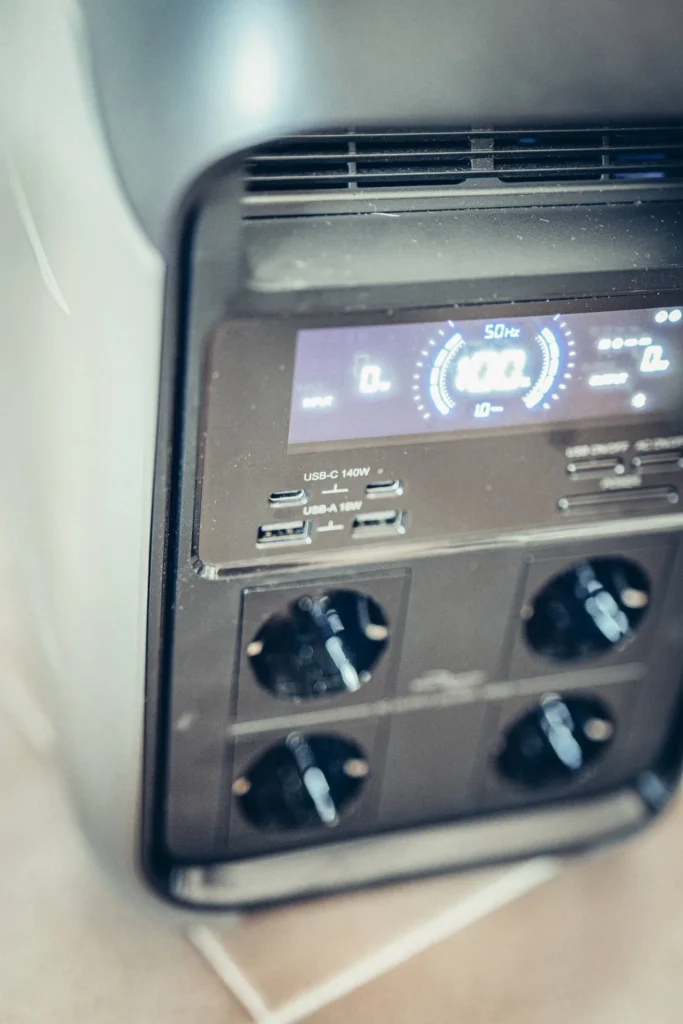
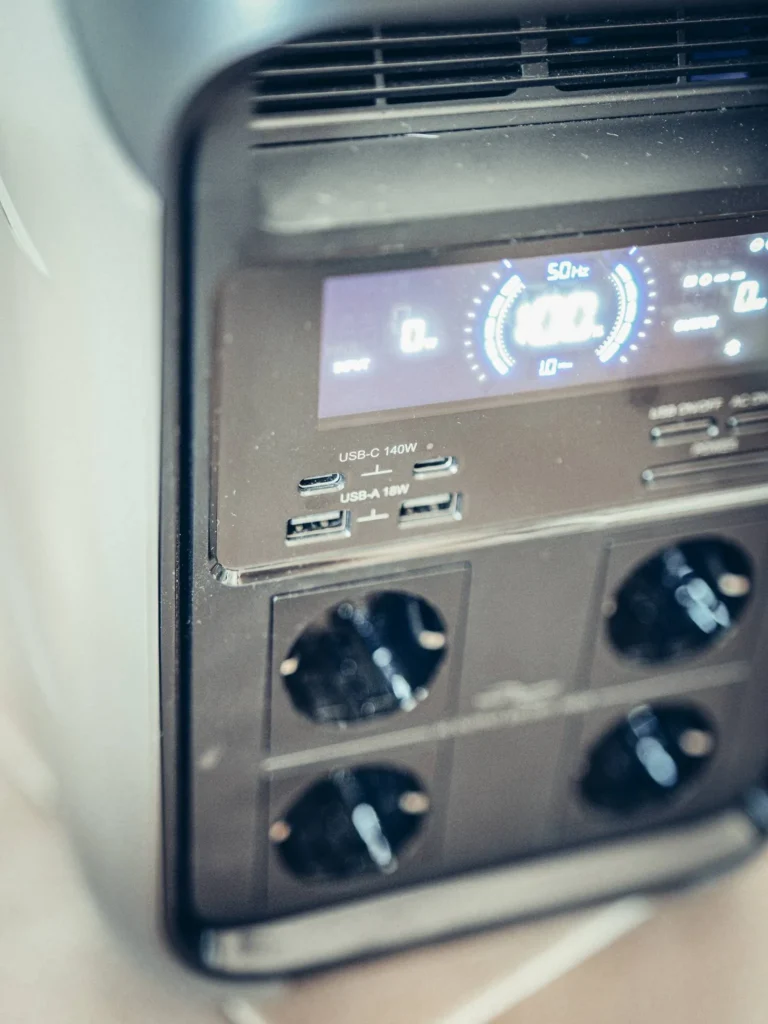
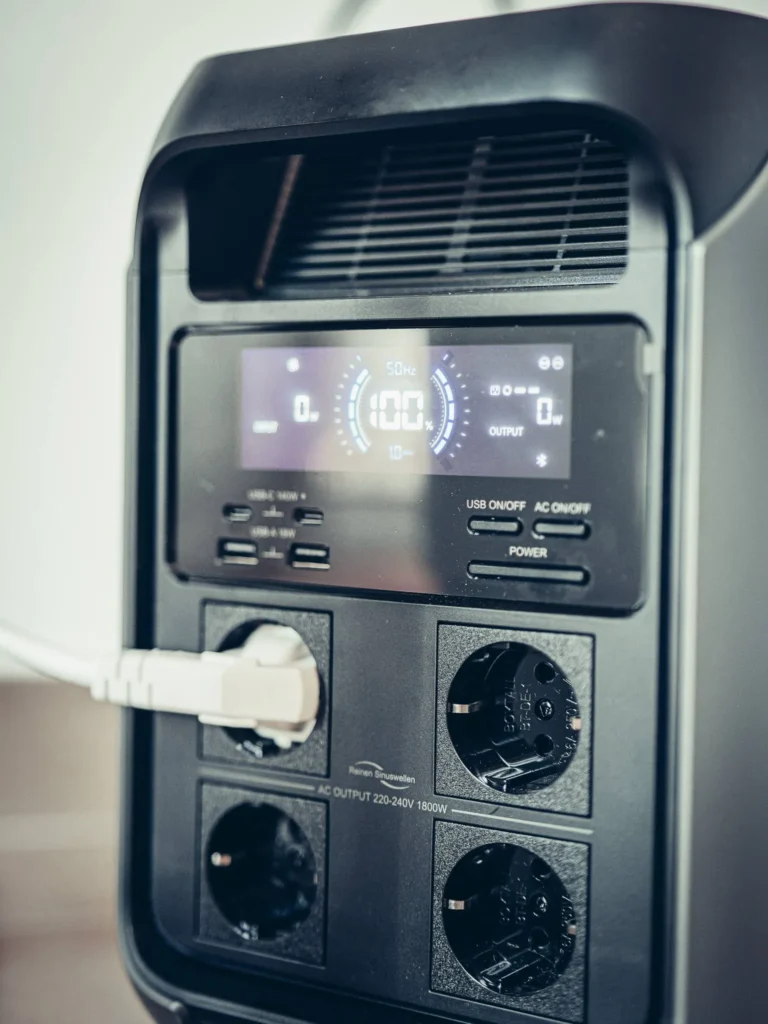
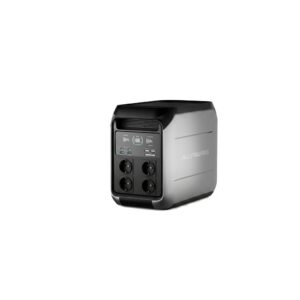
On the front, we have four AC outlets, two USB-C, two USB-A, and a 12V car socket. Nine ports in total, and that’s a lot for this size. One display detail to note: the screen announces the USB-C as PD 100W while the manufacturer’s sheet lists them at 140W. I haven’t decided which of the two is correct, just bringing it to your attention.
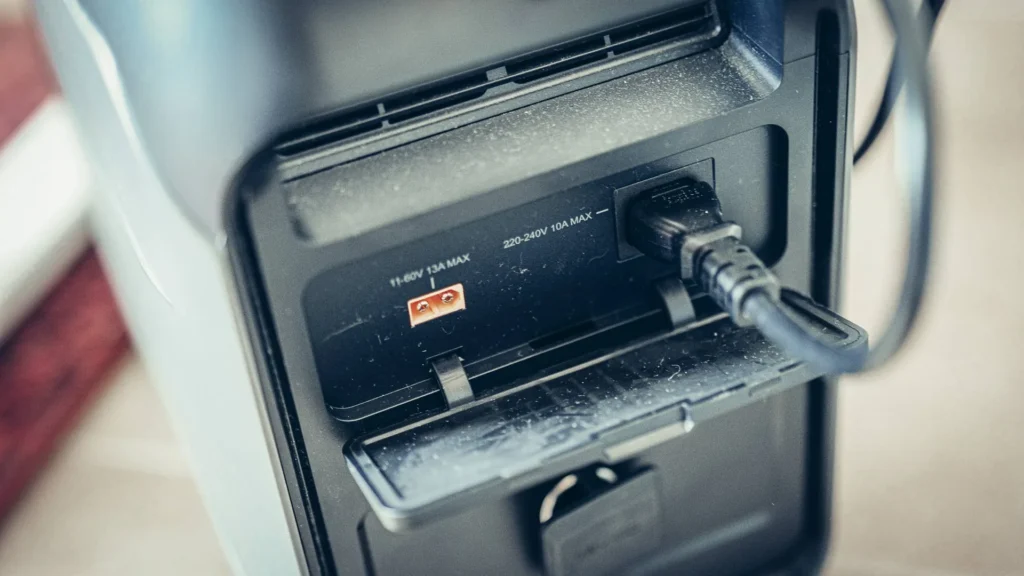
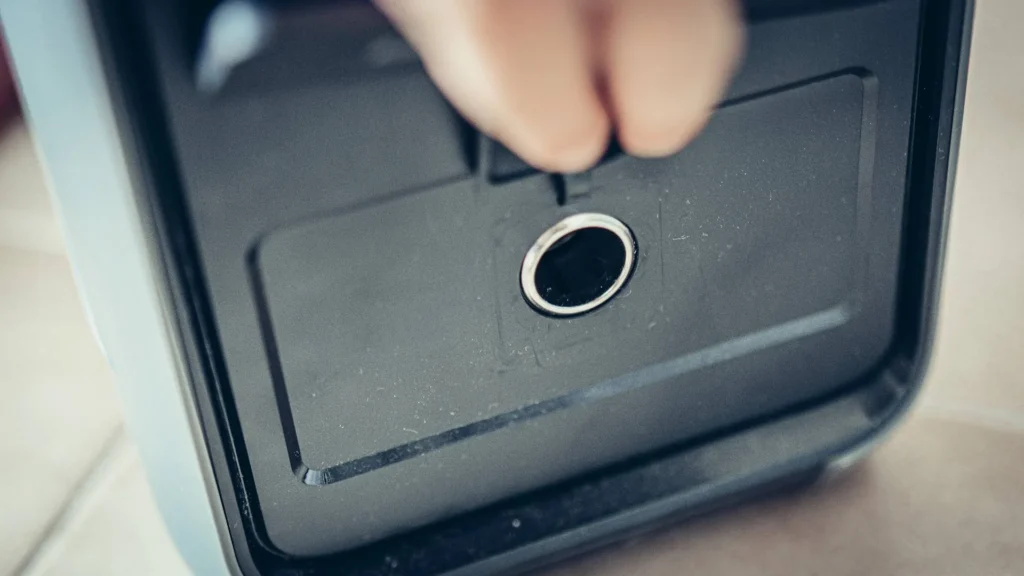
At the back, we find the 220-240V AC input and the DC input for solar or car. One last point of form, which matters more than you think in a van: the P1800 is built taller rather than wider, with a footprint of 20.8 cm compared to 31.2 for an R1500. Low and wide, a station slips under a bench; tall and narrow, it fits in a cupboard or against a wall. It’s neither better nor worse, it’s a different storage solution, and it’s decided meter by meter.
Seven 1 kWh stations in our shop, we need to make a choice
This segment is saturated, to say the least. Just with us, seven models revolve around the kilowatt-hour, all in LiFePO4, all at competitive prices. I’ve selected three that approach the P1800 from three different angles, and you can scroll through the columns to compare them line by line, including today’s price.

I'm Xavier
I write up what we learn on the road, from the gear we wear out to the paperwork that lets us live off it. Without dressing it up.
Ce que vous souhaitez recevoir :
The P1800 against three 1 kWh rivals

£481,58
See the product
|
£481,58
See the product
|
£459,00
See the product
|
£429,00
See the product
|
|
|---|---|---|---|---|
| Capacity | 1,024.00 Wh | 1,024.00 Wh | 1,024.00 Wh | 1,070.00 Wh |
| Net Weight | 13.00 kg (28.66 lb) | 11.50 kg (25.35 lb) | 11.64 kg (25.66 lb) | 10.80 kg (23.81 lb) |
| Dimensions | 371 x 208 x 296 | 320 x 215 x 250 | 350.00 mm (13.78 in) | - |
| Total Number of Output Ports | 9.00 | 9.00 | 9.00 | 6.00 |
| Total Output Power | 1,800.00 W | 1,800.00 W | 1,800.00 W | 1,500.00 W |
| Number of AC Outputs | 4.00 | 2.00 | 2.00 | 2.00 |
| USB-A | 2x 5V⎓3A, 9V⎓2A, 12V⎓1,5A, 18W maximum | 2 × 15 W max. | 2 ports, QC 3.0 18W | 1x 18W (QC 3.0) |
| Application | ✓ | ✓ | ✓ | ✓ |
| Warranty | 5.00 an | 5.00 an | 7.00 an | 5.00 an |
| Noise | 30.00 dB | 30.00 dB | - | 22.00 dB |
| Life Cycles | 3000+ (70%) | 4000+ (80%) | 4000+ cycles (to 80% capacity) | 4000 |
| UPS Function | ✓ | ✓ | ✓ | ✓ |
| Number of DC Outputs | - | - | 2.00 | - |
| Number of MPPT Inputs | - | - | 1.00 | - |
What I read there, honestly: the P1800 is the heaviest of the four at 13 kg, and it is with the BLUETTI one of the two that will never expand. However, it wins on the number of outlets, four where the other three only have two, and it clearly outperforms the Jackery Explorer 1000 v2, which remains the lightest but delivers 1500W instead of 1800 and 400W of solar instead of 650.
The one I would keep a close eye on in its place is the AFERIY Nomad1800 Pro: lighter by a kilo and a half and expandable four times, it checks the box that the P1800 leaves empty. However, it charges slower via AC, 1000W versus 1200, so the match isn’t one-sided. If you want the details on how we classify all this little world, we’ve written this:

EcoFlow, Aferiy, or AllPowers: the three we’ve really paid for, and which one we recommend
Well, I have to confess something a bit ridiculous, when we open the cupboard under the van bench, we have three power stations staring at each other like cats and...
Read more54 minutes announced, and what the manufacturer’s page really says
Two figures had raised an eyebrow before receipt, and they still hold.
The first is the AC charging time announced at 54 minutes, with 1200W input. Less than an hour to recharge a full kilowatt-hour is the kind of thing that changes a day at a service area. The second is the 650W solar input, generous at this level where a good part of the segment caps at 500. In real conditions, this places us around two hours for a full charge, and in the Algarve, that weighs heavily in the balance.
The rest of the technical file is clean: LiFePO4 cells, five years warranty, nine ports, and this inverter function that I showed you earlier works well. The complete detail, line by line, if you like to dig through:
Technical specifications: ALLPOWERS P1800 Portable Power Station 1800W 1024Wh
| Capacity | 1,024.00 Wh |
|---|---|
| Net Weight | 13.00 kg (28.66 lb) |
| Dimensions | 371 x 208 x 296 |
| Total Number of Output Ports | 9.00 |
| Total Output Power | 1,800.00 W |
| Number of AC Outputs | 4.00 |
| Max AC Output | 1,800.00 W |
| Output Voltage | 220-240V |
| USB-A | 2x 5V⎓3A, 9V⎓2A, 12V⎓1,5A, 18W maximum |
| USB-C | 2x 5/9/12/15V⎓3A, 20/28V⎓5A, 140W x2 maximum |
| DC 12V Output | 12V⎓10A, 120W maximum |
| AC Charging | 1,200.00 W |
| Solar Charging | 650.00 W |
| Car Charging | 12V / 24V DC |
| Battery Chemistry | LiFePO4 |
| Number of Extra Battery Ports | 0.00 |
| Wi-Fi | ✓ |
| Bluetooth | ✓ |
| Application | ✓ |
| Warranty | 5.00 an |
| Noise | 30.00 dB |
| Money-Back Guarantee | - |
| Life Cycles | 3000+ (70%) |
| UPS Function | ✓ |
The price, our code, and who it’s for
On the pricing side, we go through our partner link and our code VANTOUR, which gives -10% discount at ALLPOWERS. If the code gets stuck, we’ve detailed the tips on our dedicated ALLPOWERS promo code page. And for the P1800 itself, with today’s price, it’s here:
ALLPOWERS P1800 Portable Power Station 1800W 1024Wh promo code
 In stock
ALLPOWERS P1800 Portable Power Station 1800W 1024Wh
VANTOUR*
*Verified price on 5 August 2026. The final price may vary.
After these tests, I see it fitting for three profiles. The home backup for remote work, first, because that’s where it convinced me the most: four outlets, a switch that works, and enough to last a workday on a low-consumption setup. The converted van or weekend van next, where 1024Wh is enough to run a fridge, a water pump, and charge laptops. And a use that is rarely considered, the trunk of an electric car, as backup for a camping fridge or filming equipment.
Four outlets at home is perfect. In a camper van, it’s almost too much, but no one has ever complained about having a free outlet.
I do not recommend it to those who buy a station as a first step, for the reason explained above, and to those who move their battery every day, because 13 kg remains 13 kg. For the rest, it’s pretty, well-finished, and on everything I’ve asked of it, it has delivered.
Your questions about the ALLPOWERS P1800
Can the P1800 be left plugged in permanently under a desk?
This is exactly how we use it at home, and that's why the inverter function exists. The station remains connected to the mains, your devices are plugged into it, and it only discharges on the day the power goes out. The application also allows you to set a backup reserve, the Backup Ratio, between 0 and 80%: this is the portion of capacity that the station keeps aside instead of using it for regular use. We haven't yet measured the actual behavior of this reserve over a long period, we'll let you know when that's done.
Do you need the app to use the battery?
No, absolutely not. Everything essential is controlled from the front: turning on the mains outputs, USB ports, the 12 V, and reading the charge status on the color screen. The app provides settings that are not found on the buttons, such as eco mode, shutdown delay, the buzzer, or the backup reserve. It's a convenience, not a requirement, and that's a good thing considering the time we spent finding the right one in the App Store.
Can you charge the P1800 while driving, using the cigarette lighter?
Yes, it accepts a DC input from a 12 V or 24 V vehicle socket, in addition to mains and solar power. It's slower than a wall socket, of course, but it's the classic reflex in camper vans: we collect energy during trips without plugging anything else in. The same input is used for solar panels, which can go up to 650 W.
Can you take the P1800 on a plane?
No, and it's not a matter of the company but of regulation. Lithium batteries in the cabin are limited to 100 Wh, with a tolerance up to 160 Wh with the company's agreement. The P1800 carries 1024 Wh, which is ten times the limit: no station of this size is allowed, neither in the cabin nor in the hold. It's a product for cars, motorhomes, or homes, not for air travel.
How long will a camper fridge last on this battery?
It entirely depends on the fridge, and beware of those who give you a single figure. A compressor fridge consumes in cycles, not continuously: its actual average over twenty-four hours counts much more than the power displayed on its label. The calculation is always done the same way, capacity divided by average consumption, as we did in the article with Caroline's workstation. We didn't run a fridge on this station, so we won't give you a figure that we haven't measured.
Our road notes, by email
Two years of full-time van life, and the Algarve as our base ever since. We still hit the road, by van or otherwise, and we write up what we find along the way. An email when we have something to say, no more.
Ce que vous souhaitez recevoir :