


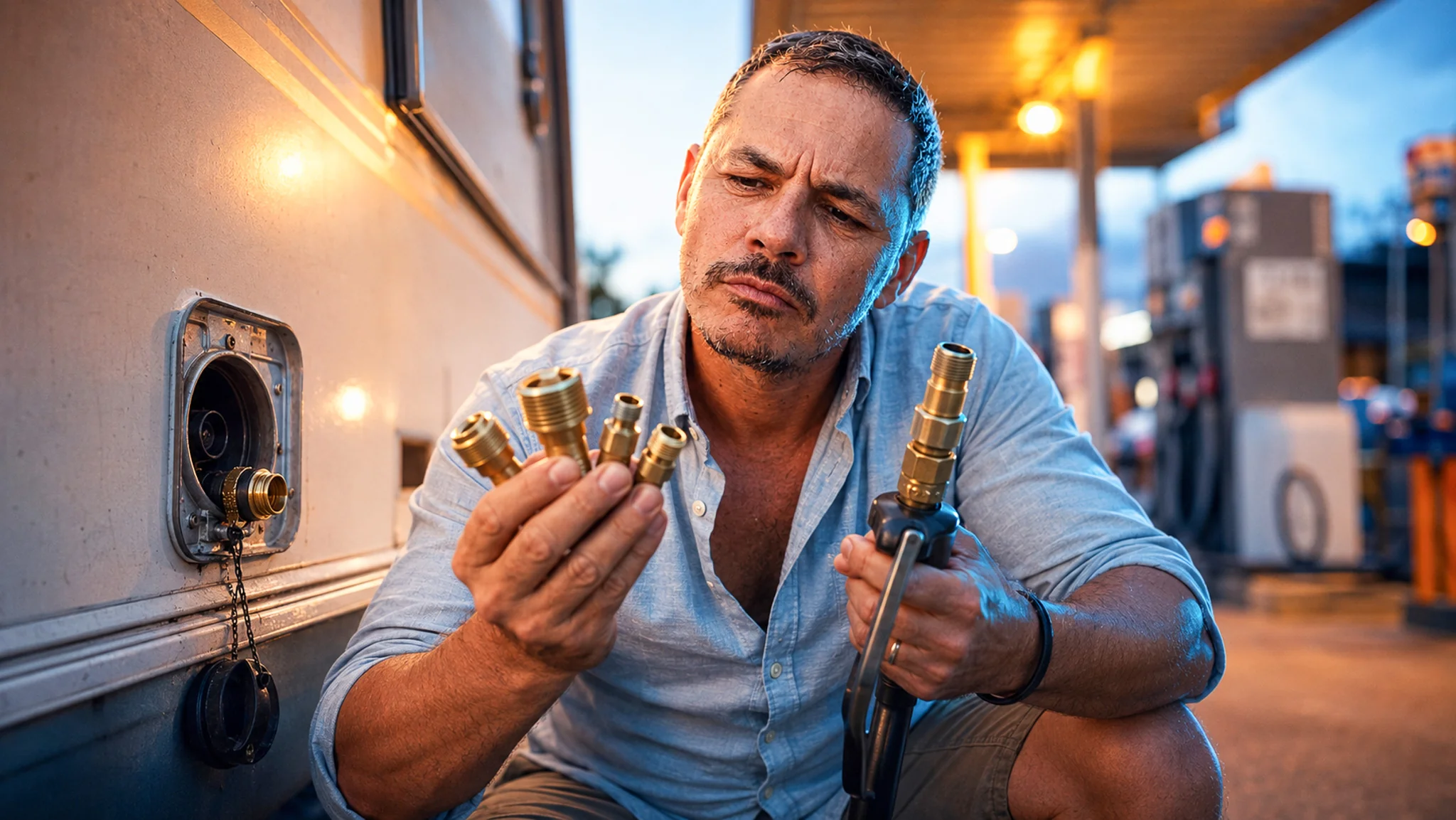
“I have a bottle that’s compatible everywhere.” That’s what the seller said. Three weeks later, a Portuguese gas station explained to me that it wasn’t true.
In between, there were 400 euros, two attempts that made me sweat, and that very particular feeling of having bought a solution to a problem that had just been created for me. Gas in a camper van is not a technical subject. It’s a border issue. And no one tells you this until you’re stuck somewhere with a stove that won’t light.
The real problem is not butane or propane
Okay. Type “camper gas bottle” and you’ll find fifteen pages explaining the difference between butane and propane. So let’s settle this in two lines, because this is really not the question that will ruin your trip.
Butane stops vaporizing properly when you get close to zero degrees. Propane, on the other hand, holds up well below that. So if you’re sleeping outside in winter, even in the South, it’s propane, period. On the equipment side, the nozzles are the same and it’s the regulator that makes the difference: a 30 mbar regulator handles butane, propane, and LPG without flinching. That figure is not a French quirk: EN 1949 fixed the supply pressure at 30 mbar across Europe in 2003, so every UK-built van since then runs at 30 mbar too, marked on a label in the gas locker. And the device that really empties a bottle is not the kitchen, it’s the heating, followed by our absorption fridge when it runs on gas.

Truma gas heating: an original combined unit, twenty-seven years on
Do you know at what temperature you turn on your heating? For us, it's 10 degrees, and it's measured inside, not outside. Our heating works very well, by the way....
Available on 29 October 2026
Three-way fridge: what 27 years of absorption cooling taught us
Our trimix fridge is 27 years old and spends a good part of the year turned off. Our usage method, the three-button rule, the trick with frozen blocks, and the...
Read moreThere you go. It’s done. Now the real issue, the one I learned at my own expense: your bottle has a nationality. It belongs to a national deposit network, and that network stops right at the border. Our French bottle, no one would take it back from us in Portugal.
If you are reading this from the UK, read “French bottle” as “Calor bottle” and the story is the same, only tighter. Calor and Flogas run a closed exchange system: you never own the cylinder, you swap it at a UK stockist, and there is no continental dealer who will take it off your hands. Nor can you have it filled: an exchange cylinder has no 80 % filling stop, which is exactly the problem we are about to walk into. And it works the other way round too, so a Spanish or Portuguese bottle is just as dead once you are back in Dover.
And the worst part is not even that… the worst part is what happens when you try to buy a local bottle.
Porto, first winter: the day we couldn’t plug anything in anymore
First winter of vanlife, we head down to Portugal all happy. We had our two French bottles, we had the Truma, we had the three-burner stove, we felt very organized (spoiler: we weren’t).
The problem arrives quietly, like real problems do. The bottles empty. So we go to buy a Portuguese bottle, which makes perfect sense, except that a Portuguese bottle doesn’t connect to a French regulator. We were missing the piece, that little bit of pipe, that adapter, that local format regulator that we searched for days without ever finding.
And then, you understand something humiliating. It’s not your bottle that’s blocking you. It’s not the deposit, it’s not the country, it’s not even the language. It’s a part worth a few quid that immobilises your heating and your cooking, and you can’t get your hands on it. We detailed this realization more in our article on the dream of living without gas, because yes, that’s exactly when the idea was born.

Living without gas in your van: we have everything except that (and here’s why we’re still considering it)
Gas has always existed in vanlife as it essentially allows for "Heating," but it's not impossible that in the coming years, electricity will replace it. Can we currently completely do...
Read moreThe feeling, if you want to know everything: we weren’t in danger, we weren’t cold enough to shiver, we were eating cold stuff while half-laughing. But there was this little shame of feeling that we had missed something obvious, and that our beautiful autonomy depended on a fitting.
“Compatible everywhere”: the 400 euros we left in Portugal
So we searched. And we ended up in a Portuguese camper store, where a very confident seller told us the phrase of the century: “I have a bottle that’s compatible everywhere.” Classic bottle format, but with an inlet to fill it directly at the LPG pump of the station. Great. We paid. Around 400 euros, if I remember correctly.
We tested it once. Then twice. And I’m going to be honest with you: the process freaked me out. There you are, LPG nozzle in hand, filling something that doesn’t look like it’s meant for that, in a station where everyone is watching you. The kind of moment when your brain whispers that it might not be normal for it to be so makeshift.
My brain was right. At the third station, a Portuguese employee stopped us: “No, anyway it’s forbidden, you’re not allowed to use this kind of bottle.” Bought in this country, refused in that country. We parted ways with it.
And in fact, he was perfectly right, which makes the story even more vexing. A classic deposit bottle doesn’t have a filling limiter at 80%, so if you fill it at the pump you’re playing with overpressure. What’s allowed are bottles designed to be refilled, with a certified safety valve (EN 14792 standard), or a fixed installation connected to an external filling point (EN 1949 standard). Everything else is makeshift sold with a smile.
Switching to LPG, and the right time to do it
We made the decision at the end of our first year of camper living, while we were on standby in southern Portugal, in winter, settled in an Airbnb. And that detail matters more than it seems: no work while driving, it doesn’t happen while driving. You need a workshop, an appointment, a few days, and a place to sleep while your vehicle is open.
The idea was simple: to make the second year of the trip less troublesome than the first. So we had LPG installed, with the external filling outlet, the one that makes it legal and, incidentally, very practical. You stop at the pump like for fuel, you fill up, you leave.
And for those who will ask the question: no, it doesn’t change the engine. We’re talking about the gas for the living area, the one that provides cooking, hot water, and heating. The engine continues its 1998 diesel without questioning (it already has enough questions, cf. its passion for not starting).
The trap that no one tells you: your installation has a nationality too
And here’s the joke. We had our LPG installed in Portugal… and it came out with a French filling outlet. Because the workshop installs the connector it’s used to, not the one from the country you’re in. No one talks about it, and especially no one warns you that this commits you for years.
Because in Europe, there are four filling systems sharing the map: DISH, Euronozzle, ACME, and bayonet. France uses DISH. Portugal uses Euronozzle. Spain mixes Euronozzle and bayonet. Italy uses DISH like us, which at least makes one border where you don’t have to think about it. And the UK fills on the bayonet nozzle, which is why a British filling point crosses to the Netherlands, Denmark and Norway with nothing in the bag, and needs an adapter absolutely everywhere else. ACME, the one people assume is British, is actually the German, Belgian, Irish and Luxembourgish standard.
Which LPG filling nozzle, country by country
Four systems share Europe. Your filling point speaks only one of them: everywhere else, you need the matching adapter.
| Country | Nozzle at the pump | If your filling point is a UK bayonet |
|---|---|---|
| United Kingdom | Bayonet | Nothing to carry |
| Netherlands | Bayonet | Nothing to carry |
| Denmark, Norway | Bayonet | Nothing to carry |
| Ireland | ACME | ACME adapter |
| Belgium, Luxembourg | ACME | ACME adapter |
| Germany | ACME, DISH at some stations | ACME adapter, DISH as backup |
| France | DISH | DISH adapter |
| Italy | DISH | DISH adapter |
| Austria, Switzerland, Poland | DISH | DISH adapter |
| Spain | Euronozzle, bayonet in places | Euronozzle adapter |
| Portugal | Euronozzle | Euronozzle adapter |
The set sold as complete carries all four nozzles and costs less than a tank of fuel. It is the cheapest part of your whole installation, and the one that decides whether you eat hot.
The solution lies in a bag. We bought a set of adapters on Amazon, brass, M10 thread, a model that covers the four European connectors (ours is a Gomet SET008, but there are equivalents). I have five or six in total, including one for Portugal and Spain and one for the UK, and I carry them around like others carry phone chargers.
A little tasty detail I noticed while rereading the product sheet: it’s sold with a mention “professional use only.” There you go. Everyone buys it, no one is a professional, and these fittings are the condition to legally fill up in the neighboring country. Welcome to European gas.

I'm Xavier
I write up what we learn on the road, from the gear we wear out to the paperwork that lets us live off it. Without dressing it up.
Ce que vous souhaitez recevoir :
Two bottles and a switch: the setup we recommend to everyone
In Édouard, our Hymer B544, there are two bottles side by side. The refillable LPG bottle, and a French bottle as a backup. A switch at the top of the compartment allows you to choose which one powers the circuit, and that’s it.
This is the advice I always give to people switching to LPG: keep a standard bottle nearby. Not out of nostalgia, but out of organized cowardice. The day the main one runs out while you’re cooking, you flip the switch, grumble for three seconds, and dinner continues. Without a backup, what do you do? You eat raw. I’ve tried it, it fills you up but it’s not a party.
And for those wondering if it’s legal to have two: yes, absolutely. The French rules we live under allow up to three bottles on board, 47 kg in total, in a compartment vented to the outside. So our two bottles are quietly sleeping within the rules.
The British frame is written differently but lands in the same place. There is no magic number in law; what matters is BS EN 1949, which is the standard your habitation gas system is built and checked against: cylinders live in a sealed, purpose-built locker with a drop-out vent to the outside, never loose in the living space. In practice the club sites police it harder than the law does, and two cylinders is the number nobody argues with. Private owners are not legally obliged to have an annual gas check, but if you ever hire the van out you are into Gas Safe certificate territory, and that is a different conversation.
Finding an LPG station abroad (and why I do it the day before)
LPG isn’t found on every street corner. We use MyLPG.eu, a dedicated app that lists stations in Europe with prices and types of connectors. It has saved us several times, and it’s been on our phones for years.
But you need to know its limits, and they are significant: these are imperfect community data, rarely updated. A station may have closed, changed ownership, or stopped offering LPG without anyone correcting the listing. So our rule is to locate the station the day before and have two in mind, not to go with an empty bottle and faith in your gut.
We detailed our entire stack of apps, those we actually use and those that sit idle, in a dedicated article.

The apps we really have on the phone (and those that are dormant)
In this article, we will present the mobile applications that we use on a daily basis. Apps to find places to sleep, to navigate, for your gear, and even to...
Read moreWhat it costs, and when it becomes profitable
The price of LPG varies by country, and I feel it closely follows local purchasing power: more expensive where life is costly, cheaper where it isn’t. What doesn’t change, however, is the power dynamic with deposit bottles: filling up at the pump remains significantly cheaper than buying bottles, in all the countries we’ve passed through.
The figure that matters to us is this: after a year of living full-time in the motorhome, the installation was paid off. One year. After that, it’s all profit. I won’t give you a price per liter or an installation invoice, because it will depend on your workshop, your country, and the year, and the figures you read everywhere on this topic often have the age of their author.
If you want to see where gas fits into the overall budget of a converted vehicle, we’ve done the math elsewhere, honestly, line by line: the real cost of maintenance.
Running out of gas: our two times, and why it’s not a big deal
The first time, right at the beginning, and the reason will make you smile. Since the first refill impressed me, I didn’t dare fill it all the way. Result: the bottle was half full, it emptied much faster than expected, and we found ourselves dry wondering if the installation had a problem. It didn’t. I was the problem, or rather my beginner’s fear.
The second time, on a Sunday, near Arcachon. Empty bottle, everything closed, no one to refill anything for us. We got a bit colder, ate salads, and one evening we went to a restaurant deciding it was a lifestyle choice. Honestly? It’s much less worse than a flat tire. And it’s very much less worse than a full toilet cassette with nowhere to empty it.
Cassette toilet: our 1999 unit, and what we actually put in it
In our toilets, there has never been the slightest camper product. Not a blue pod, not a green jug, nothing. What we've been pouring into the cassette from the beginning...
Available on 8 October 2026That’s why I downplay this issue: running out of gas is the most comfortable hassle of vanlife. It costs you a cold meal and a slightly chilly evening, not your day or your budget.
One last point for those going further: in Morocco, we didn’t stay long enough to run out of gas, and we heat very little there, so I won’t tell you that I master sourcing outside the European Union. What I’ve seen is that in these countries people are extremely resourceful, and according to feedback, it generally goes well. But that’s not firsthand experience, it’s campfire conversation.
Gas while traveling: what we're still being asked
Can you fill a standard gas bottle at a GPL pump?
No, it is prohibited. A standard returnable bottle does not have a filling limiter at 80%, and without this safety measure, there is a risk of overpressure. Only bottles designed to be refilled (OPD valve or certified multi-valve, EN 14792 standard) are accepted, and only at stations that allow it. The attendant has the right to refuse, and they are right to do so.
What is the difference between a refillable bottle and a fixed LPG tank?
The refillable bottle fits into the existing gas trunk and is filled at the pump, it's the intermediate solution. The fixed tank, on the other hand, is installed under the vehicle or in the trunk and connects to an external filling point, in accordance with standard EN 1949. The fixed option is more expensive and requires a workshop, but it provides true long-term peace of mind.
How many gas cylinders can you carry in a motorhome?
There is no single number in UK law. What governs it is BS EN 1949: the cylinders live in a purpose-built, sealed locker vented to the outside through a drop-out hole, never loose in the living space, and the system is checked against that standard at a habitation service. In practice the club sites set the real limit, and two cylinders is the number nobody argues with. For reference, the French rule we travel under is explicit: three cylinders, 47 kg total, cooking, heating and lighting only.
Should you change the injectors when switching from butane to propane?
On a a modern motorhome installation, no: the regulators are the same and it's the pressure reducer that makes the difference. A 30 mbar pressure reducer accepts butane, propane, and LPG. The older dedicated models (28 mbar butane, 37 mbar propane) are not interchangeable: here, you need the right pressure reducer, no new burners.
Does butane work in winter?
Bad. Butane stops vaporizing properly when the temperature approaches zero, so your stove weakens exactly on the morning when you want hot coffee. Propane, on the other hand, holds up well below that. For those spending winter outdoors, even in the South, propane or LPG is the only serious choice.
Can you exchange a Calor bottle abroad?
No. Exchange systems are national: the cylinder belongs to the network that put it into circulation, and Calor or Flogas have no continental counterpart who will take it back. Nor can you have it filled, since it has no 80 % filling stop. The two real options are to buy a local cylinder with the matching regulator, or to move to a refillable bottle or fixed tank and stop depending on any network at all.
What does a composite bottle change while traveling?
It is significantly lighter than a steel bottle and you can see the gas level through it, which avoids the guessing game on Sunday night. But it remains a deposit bottle: it does not solve the border issue, it just makes it more comfortable to carry.
Should you turn off the gas to take a ferry?
Yes. Valve closed before boarding, and no gas at all during the crossing, neither hob nor heating. Most operators on the Channel and the Irish Sea also ask you to declare the cylinders at check-in, and some cap how many you may carry. We read the operator’s conditions before we reach the booth: it is the kind of detail that turns a smooth boarding into a painful discussion.
How long does a 13 kg bottle last?
Impossible to answer honestly, and yet that is the figure everyone copies. It all depends on what the bottle feeds: for us the same one runs the hob, the water heater, the heating and the fridge, so no average means anything. The only reliable method is to weigh the cylinder and write it down. A Calor 13 kg propane has its tare weight stamped on the collar, so the arithmetic is done at the kerb in thirty seconds.
Is gas circuit inspection mandatory?
In the UK, the circuit compliance certificate is mainly requested during approval or sale, and many motorhome owners have never had anything checked, us included. In Germany, however, the gas inspection (Gasprüfung G607) is again required every two years, which is worth knowing before spending several months there.
And if all this has made you want to unplug everything and go fully electric, you’re not the first. We’re thinking about it strongly, we’re not there yet, and we’ve explained why without beating around the bush.
PS: I now collect filling nozzles like others collect fridge magnets. The difference is that my nozzles are useful… and that my fridge, for now, runs on gas.
Van life day to day, unfiltered
Two years of full-time van life, and the Algarve as our base ever since. We still hit the road, by van or otherwise, and we write up what we find along the way. An email when we have something to say, no more.
Ce que vous souhaitez recevoir :