


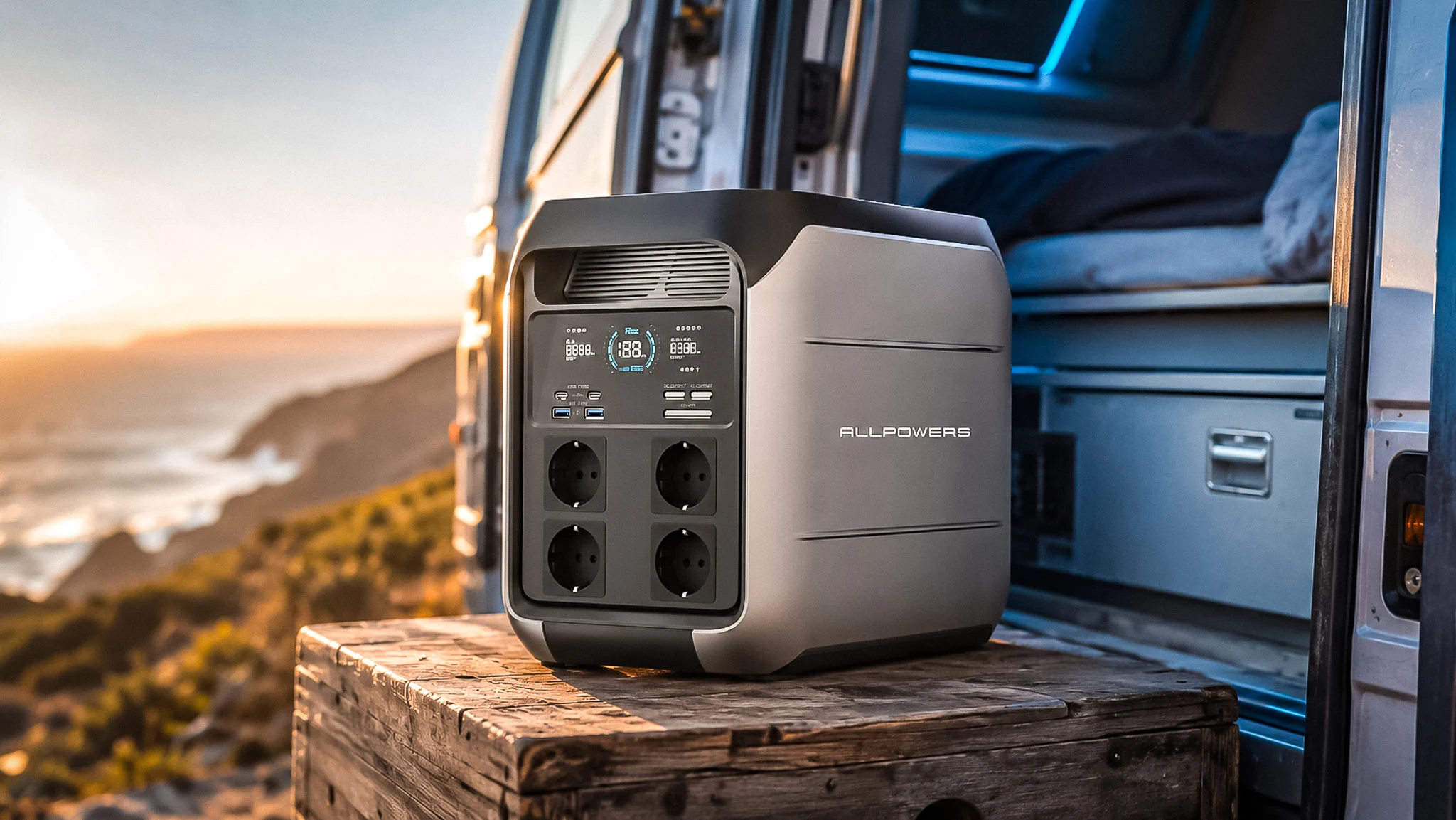
Well, let me tell you right away: I haven’t touched this station yet. ALLPOWERS offered to send it to us for testing, we said yes, and it’s traveling. However, I spent a serious amount of time on its technical sheet to reference it in our shop, and I found a couple of things that I haven’t seen anywhere else. So I’m sharing them now, even if the measurements come later.
What you are about to read is reasoning based on the specifications, plus our experience with the brand (a R2500 has been with us for a year, from the van to the balcony). This is not a field report, and I won’t pretend otherwise.
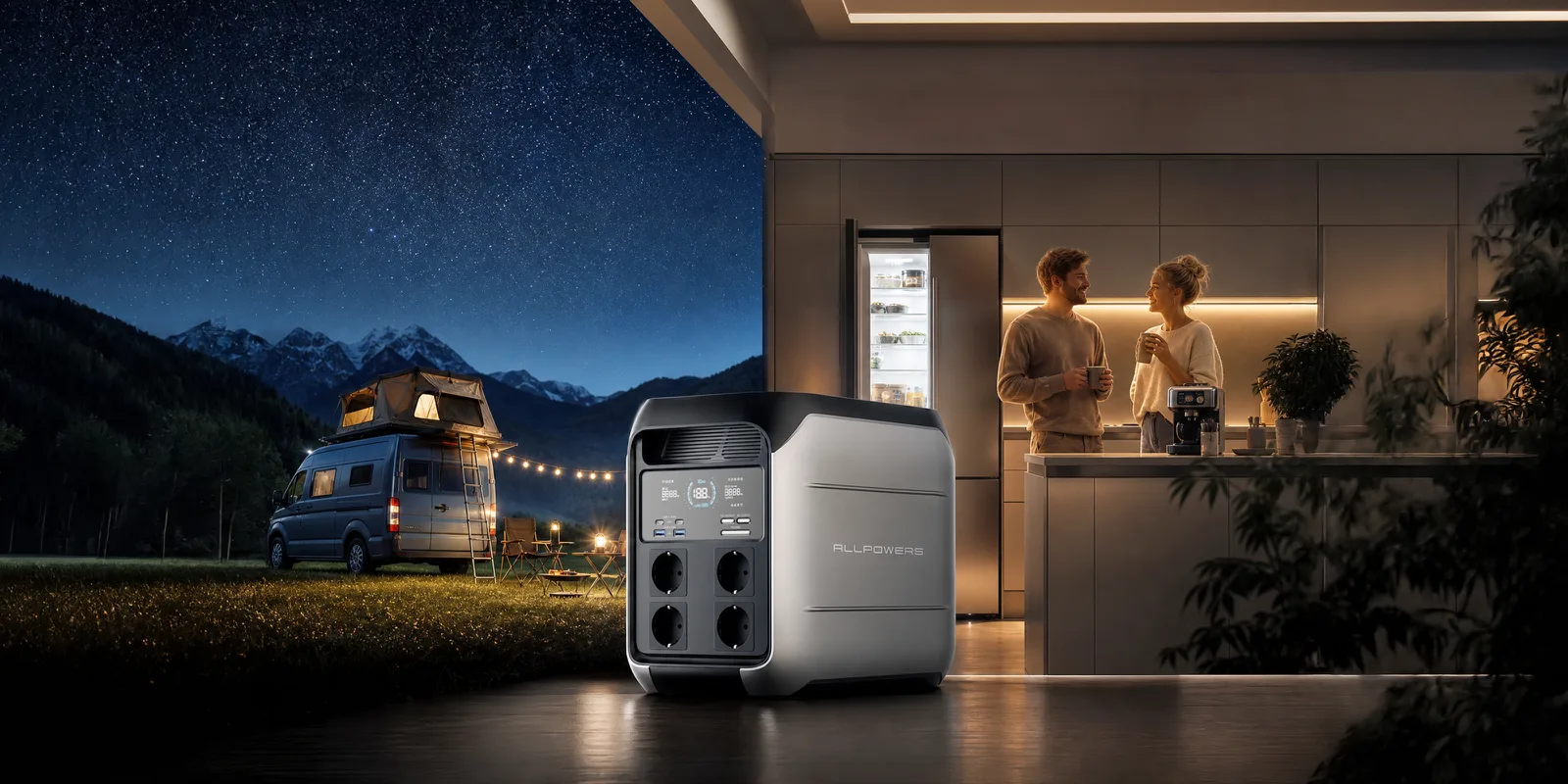
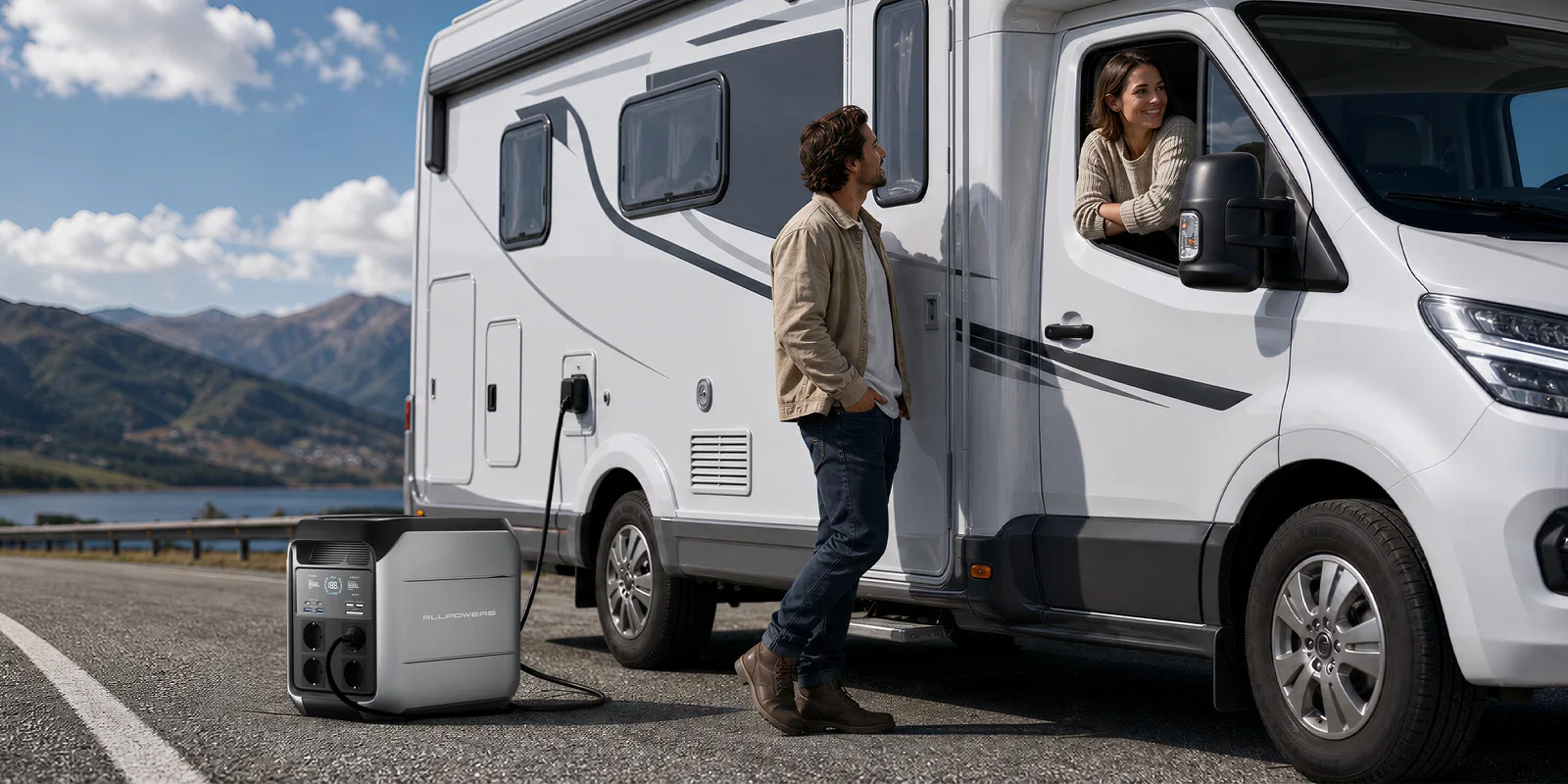
A word about the images in this article: these are currently visuals provided by the manufacturer and renders we generated, not photos of the machine at our place. Our own images, taken in the van and on the kitchen table, will replace these as soon as we have the station.
Our verdict
Benefits
- Four AC outlets, two more than most stations of comparable capacity
- 1800 W output, at the top of the range for this format
- Full AC recharge claimed in 54 minutes
- Narrow format of 20.8 cm wide, easier to fit than a square equivalent station
- LiFePO4 cells rated for 4000 cycles and a 5-year warranty
- UPS under 10 ms, power cuts go unnoticed
- Solar input of 650 W, above the segment average
Disadvantages
- No extension battery found, the capacity appears to be fixed at 1024 Wh
- 13 kg, which puts it among the heaviest in its category
- AC input limited to 1200 W, other stations of this format go higher
- Solar input surpassed by part of the segment
- Car charging cable not included
On paper, the P1800 isn't the sleekest in its category: heavier than the segment average, and with no capacity extension found so far. It makes up for this with its four AC outlets, charging in under an hour, and a 5-year warranty. It's a good choice if you want to plug in several devices at once and 1 kWh is enough for you. Avoid it if you plan to expand later or if every kilogram counts.
First curious thing: this code name VOLIX
Now, this is the kind of detail you only see when you enter the references one by one into a product database. The SKU of this machine is VOLIX-P1800-EU. Not ALLPOWERS something, VOLIX.
And VOLIX, when you pull the thread, leads nowhere: no website, no brand page, nothing public under this name. The small P300 in the catalog has the same root, and that’s about all we can say. The known families from the manufacturer remain the S, the R, and the BS, and this “P” doesn’t fit into any of the three. The simplest hypothesis is an internal nomenclature for the range that goes all the way to the commercial reference. We won’t invent further.
Does this change anything for you? Regarding the warranty and after-sales service, no, it’s the same manufacturer and the same five years announced. Regarding the catalog reading, yes: there’s no need to look for where the P1800 fits between an R1500 and an R2500; it opens its own family.
The point to clarify: it doesn’t seem expandable
Here’s the point I can’t decide on from my desk. I looked for the battery extension port in the official visuals, but I didn’t find it. I searched for the P1800 in the manufacturer’s additional battery combinations B1000, and it’s not listed there either.
So as it stands, everything indicates that it doesn’t connect to anything, and I note this as an observation, not a verdict: I haven’t had the case in my hands yet to turn it around and look behind. It’s a perfectly defensible choice for a product of this size, but it matters because that’s often what people decide between two models. We will ask our contact at the brand, and I will put their response here, as is.
To give you a concrete point of comparison for what a real extension changes: our R2500 goes up to about twenty kilowatt-hours with its modules, and that’s precisely what makes it transition from van to serious home backup.

AllPowers R2500: my opinion after a year of carrying it everywhere (van, balcony, hairdryer included)
Well, I need to tell you about a battery that I really like and that, curiously, almost no one talks about in Britain. The AllPowers R2500. I've had it for...
Read moreThe look, the screen, and the app
First impression upon seeing it, and I give it for what it’s worth: visually, it may remind you of a station from another brand. This is not a criticism; the upright format with a black front has become a standard in the industry, and it says nothing about what’s inside.
What caught my eye, however, is the screen, which is really beautiful. You can tell that ALLPOWERS has worked on the displayed information; there are more things readable at a glance than on previous generations, and on a station you check ten times a day, that’s not a detail.
In the same spirit, I can’t wait to receive it to talk to you about the app. From what I see, the brand has made significant efforts in controlling the batteries from the phone, and the whole seems to have become much more pleasant to use. This is typically the kind of thing that can’t be judged from a technical sheet; you need to have it in hand, and it’s one of the first points I will look at.
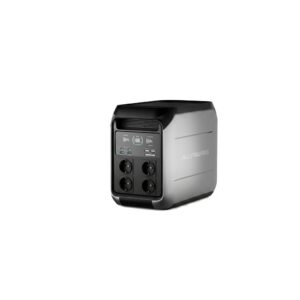
There’s one last point of form that matters more than you think in a van: the P1800 is built taller rather than wider. 20.8 cm of footprint, compared to 31.2 for an R1500 from the same manufacturer. Low and wide, a station can slide under a bench; tall and narrow, it can fit in a cupboard or against a wall. It’s neither better nor worse; it’s a different storage solution, and it needs to be decided before purchase, tape measure in hand.
The 1 kWh segment is crowded, you have to pick one
This segment is crowded, to say the least. A whole cluster of models sits around the kilowatt-hour, all LiFePO4, all in the same price bracket. I have put the P1800 next to three rivals that come at it from three different angles, and you can scroll the columns to compare them line by line, today’s prices included.
The P1800 against three 1 kWh rivals

£481,58
See the product
|
£429,00
See the product
|
£439,00
See the product
|
£429,00
See the product
|
|
|---|---|---|---|---|
| Capacity | 1,024.00 Wh | 1,024.00 Wh | 1,024.00 Wh | 1,070.00 Wh |
| Net Weight | 13.00 kg (28.66 lb) | 11.50 kg (25.35 lb) | 11.64 kg (25.66 lb) | 10.80 kg (23.81 lb) |
| Dimensions | 371 x 208 x 296 | 320 x 215 x 250 | 350.00 mm (13.78 in) | - |
| Total Number of Output Ports | 9.00 | 9.00 | 9.00 | 6.00 |
| Total Output Power | 1,800.00 W | 1,800.00 W | 1,800.00 W | 1,500.00 W |
| Number of AC Outputs | 4.00 | 2.00 | 2.00 | 2.00 |
| USB-A | 2x 5V⎓3A, 9V⎓2A, 12V⎓1,5A, 18W maximum | 2 × 15 W max. | 2 ports, QC 3.0 18W | 1x 18W (QC 3.0) |
| Application | ✗ | ✓ | ✓ | ✓ |
| Warranty | 5.00 an | 5.00 an | 7.00 an | 5.00 an |
| Life Cycles | - | 4000+ (80%) | 4000+ cycles (to 80% capacity) | 4000 |
| UPS Function | ✓ | ✓ | ✓ | ✓ |
| Noise | - | 30.00 dB | - | 22.00 dB |
| Number of DC Outputs | - | - | 2.00 | - |
| Number of MPPT Inputs | - | - | 1.00 | - |
What I read there, honestly: the P1800 is the heaviest of the four at 13 kg, and along with the BLUETTI one of the two that will never grow. It wins on the number of outlets, four where the other three have only two, and it clearly beats the Jackery Explorer 1000 v2, which stays the lightest but delivers 1500 W instead of 1800 and 400 W of solar instead of 650. The BLUETTI answers with a much bigger solar input.
The one I would keep an eye on in its place is the AFERIY Nomad1800 Pro: a kilo and a half lighter and expandable four times over, it ticks the box the P1800 leaves empty. It does charge more slowly from the wall though, 1000 W against 1200, so the match is not one-sided. And if you want the detail of how we rank all this, we wrote it up here:

EcoFlow, Aferiy, or AllPowers: the three we’ve really paid for, and which one we recommend
Well, I have to confess something a bit ridiculous, when we open the cupboard under the van bench, we have three power stations staring at each other like cats and...
Read moreWhat’s still appealing: 54 minutes and 650 W of sun
Well, enough said. There are two numbers in there that made me raise an eyebrow, and in a good way.
The first is the announced charging time of 54 minutes, with 1200 W input. Less than an hour to recharge a full kilowatt-hour is the kind of thing that changes a day at a service area: you plug it in while doing laundry and having a coffee, and you leave fully charged. Manufacturer’s figure, to be confirmed.
The second is the 650 W solar input, generous for this range, where a good part of the segment caps at 500. In real conditions, with panels that never deliver their theoretical power, it puts us around two hours for a full charge. It’s the typical profile that allows you to live off the sun without ever looking for a plug, and for us, in the Algarve, it weighs heavily in the balance.
The rest of the technical file is neat without being spectacular: LiFePO4 cells rated for 4000 cycles (which is well over ten years at one cycle per day), five years warranty, nine ports in total including two USB-C at 140 W, and an inverter function that switches under 10 milliseconds.
The complete detail, line by line, if you like to scrutinize:
Technical specifications
| Capacity | 1,024.00 Wh |
|---|---|
| Net Weight | 13.00 kg (28.66 lb) |
| Dimensions | 371 x 208 x 296 |
| Total Number of Output Ports | 9.00 |
| Total Output Power | 1,800.00 W |
| Number of AC Outputs | 4.00 |
| Max AC Output | 1,800.00 W |
| Output Voltage | 220-240V |
| USB-A | 2x 5V⎓3A, 9V⎓2A, 12V⎓1,5A, 18W maximum |
| USB-C | 2x 5/9/12/15V⎓3A, 20/28V⎓5A, 140W x2 maximum |
| DC 12V Output | 12V⎓10A, 120W maximum |
| AC Charging | 1,200.00 W |
| Solar Charging | 650.00 W |
| Car Charging | 12V / 24V CC |
| Battery Chemistry | LiFePO4 |
| Number of Extra Battery Ports | 0.00 |
| Wi-Fi | ✓ |
| Bluetooth | ✓ |
| Application | ✗ |
| Warranty | 5.00 an |
| Money-Back Guarantee | - |
| Life Cycles | - |
| UPS Function | ✓ |
What we’ll check as soon as it’s here
And we arrive at the honest part of the exercise, the list of what I can’t tell you today and that the test will clarify:
- The 54 minutes of mains charging, stopwatch in hand, and at what noise level (on a fast charge, the fans can be heard).
- The actual capacity delivered from the announced 1024 Wh, once the conversion losses are accounted for.
- The behavior under heavy load, the kettle, the grinder, and the hairdryer, the classic household test.
- The UPS switch, measured, on a real workstation.
- The extension battery port, present or absent, determined with the case in hand.
- The storage in the van, because a dimension chart gives millimeters and not life constraints.
Home photos, video, and measurements will land directly here. Bookmark the page if you’re interested in the topic, we won’t publish a second article, we’ll complete this one.
The price, our code, and who it’s for
On the pricing side, we go through our partner link and our code VANTOUR, which gives -10% off at ALLPOWERS. If the code doesn’t work, we’ve detailed the tips on our dedicated ALLPOWERS promo code page. And for the P1800 itself, with the current price, it’s here:
ALLPOWERS P1800 Portable Power Station 1800W 1024Wh promo code
 In stock
ALLPOWERS P1800 Portable Power Station 1800W 1024Wh
VANTOUR*
*Verified price on 5 August 2026. The final price may vary.
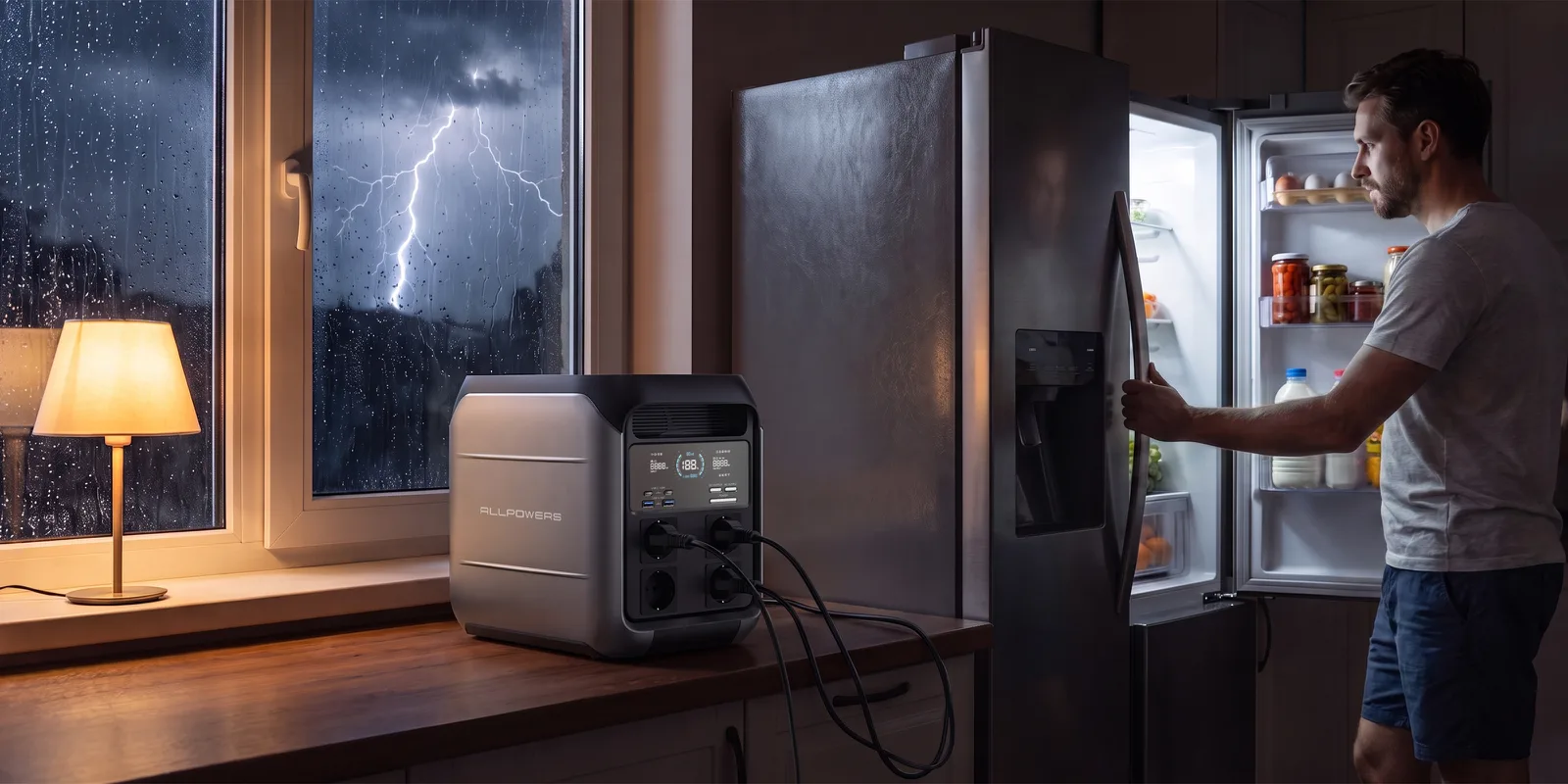
On paper, I see it fitting well for three profiles. The converted van or weekend van, where 1024 Wh is enough to run a fridge, a water pump, and charge laptops without counting every watt. The home backup for remote work, thanks to the inverter and the four sockets. And a use that we rarely think about, the trunk of an electric car, where it serves as a backup for a camping fridge or filming equipment.
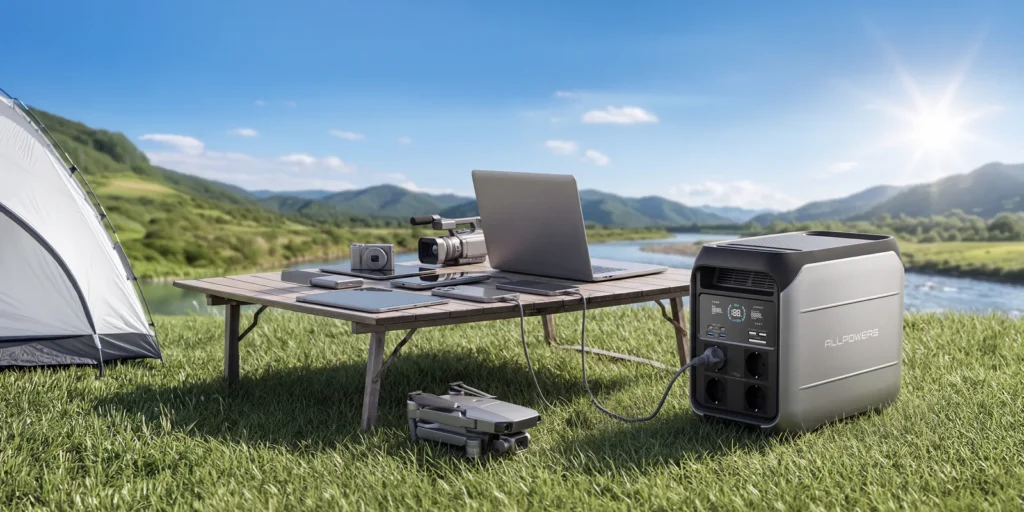


I do not recommend it, however, for those who buy a station as a first step, for the reasons explained above, and for those who move their battery every day, because 13 kg is still 13 kg. The rest, I’ll tell you when I’ve plugged it in.
Your questions about the ALLPOWERS P1800
Is the ALLPOWERS P1800 expandable with an additional battery?
Everything indicates that no, and that is the point we want to have confirmed. We do not find any extension port on the official visuals, and the P1800 does not appear in any of the manufacturer's B1000 combinations, while the R series stations do. We note it as an observation, not as a verdict: the question is posed to our contact at the brand and the answer will land here. If you want to be able to upgrade later, the R series remains the safe choice.
Why does the reference of the P1800 start with VOLIX?
Because the exact reference is VOLIX-P1800-EU. This name does not refer to anything public, no website or brand page, and the small P300 in the catalog has the same root. Since the known families of the manufacturer are the S, the R, and the BS, and this P does not fit into any of the three, the simplest hypothesis is an internal range nomenclature that goes back to the commercial reference. This does not change anything regarding the warranty or after-sales service.
How long does it take to charge the P1800?
The manufacturer announces 54 minutes from zero to one hundred percent on a mains socket, with an input of 1200 W. In solar mode, the input rises to 650 W, which places a full charge at around two hours in good sunlight conditions. These are manufacturer figures, and we will verify them with a stopwatch as soon as we have the station.
Can the P1800 be used as an inverter for a computer?
Yes, it includes a UPS function announced under 10 milliseconds of switching, which is fast enough for a computer, an internet box, or an external hard drive not to notice the interruption. This is one of the uses that interests us the most in remote work, and it is also one of the first points we will measure.
ps: yes, I am publishing a review on a battery that I have not yet received, and no, it doesn’t make me particularly comfortable. But between a fake field test and an assumed specs reading, I chose. The real one is coming.