



Well, I need to set the scene for you, because that’s where it all starts. One evening while camping, somewhere on a quiet spot by the water, the neighbor in their campervan starts their generator. And just like that, the calm is gone: a never-ending lawnmower hum, plus that unpleasant smell of gasoline lingering in the evening air. We’ve never had one ourselves, but we’ve experienced that moment several times, and honestly, it has vaccinated me against them.
The thing is, the question keeps coming up among people who want energy autonomy: should I get a generator, or one of those portable solar stations everyone is talking about? On paper, both promise the same thing: 220 volts where there’s no outlet. Except that in practice, they represent two opposing philosophies, and the comfort of life is not the same. We’re going to compare them for real—noise, fuel, danger, autonomy, cost—without selling you the version that suits a seller.
And I’ll warn you right away, this isn’t a match where solar crushes everything. There are specific situations where the thermal remains unbeatable, and I’m going to tell you about them frankly rather than pretending they don’t exist.
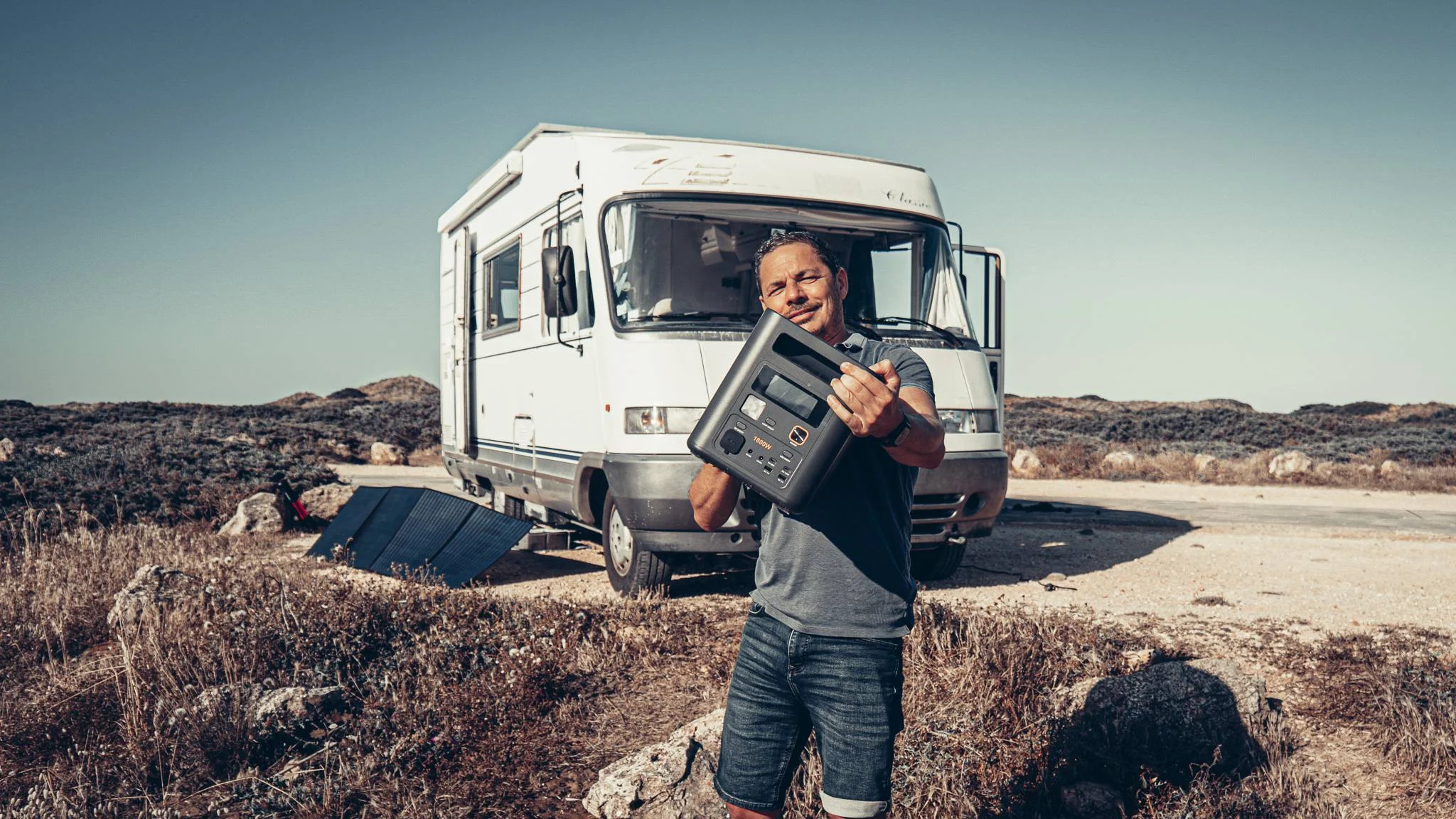
Two ways to generate electricity: the burning engine, the storing battery
Let’s start from the beginning, because under the same need, there are two objects that have nothing in common. The generator is a small thermal engine, usually gasoline, sometimes diesel or gas, that drives an alternator and produces electricity as long as you provide it with fuel. It’s a mechanical generator, the same logic as in a car, with its spark plugs, oil, and fuel tank.
The portable solar station, also known as a solar generator, is the complete opposite: a large battery in a box, with an inverter that outputs clean 220 volts, and outlets on it. It doesn’t produce anything; it stores and then delivers. You charge it from the mains, from the car’s cigarette lighter, or with a solar panel placed on the ground, and then it provides energy silently and without a drop of fuel.
Keep this difference in nature in mind, because everything else follows from it. The thermal generator produces on the spot and without limit as long as there’s gasoline. The station draws from a finite reserve that needs recharging. This is exactly what makes neither of them better in absolute terms: they don’t play the same match; they respond to two different needs.

Solar generator: the station that lives two lives, in a van and at home
A few years ago, to me, a solar generator was necessarily a bulky thing you dragged around a campsite, with a motor roaring while neighbors looked at you sideways. Then...
Read moreNoise, the real issue: the quietest generator is the one without a motor
If you search for silent generators online, it’s because noise already concerns you, and you’re right. A classic generator runs around 70 to 90 decibels, equivalent to a truck passing right next to you continuously. Inverter models labeled as silent go lower, but you still have a motor running, with its vibrations and its breath, placed just a few meters from your head.
A solar station, on the other hand, simply makes no noise when it delivers power. The only possible sound is its small fan that kicks in during a fast charge or heavy demand, and then we’re around 30 to 45 decibels, the level of a quiet library. On our River 3, the charger is almost inaudible, to the point that we forgot it was working under the bench.
So I’ll be honest to the end, because it’s easy to sell dreams on this chapter. A large station working hard at night isn’t completely silent either: our Delta Pro, during charging or sustained discharging, can sometimes be heard from the next room. Nothing compared to a gasoline engine, but avoid placing it against your pillow. The real takeaway is this: the quietest generator that exists is the one that has no motor at all.
Gasoline, oil changes, smell: the hidden cost of thermal
You hear the noise right away. The rest you discover after the purchase, and that’s often where thermal disappoints. For a generator to start the day you need it, it requires fresh gasoline in the tank, but gasoline evaporates in a few months and clogs the carburetor if the device sits in a garage. An engine needs to be run regularly, it needs oil changes, it requires maintenance, otherwise it will fail you at the worst moment.
There’s also the logistics of fuel, which is always underestimated. You have to buy the gasoline, transport it, store it in jerry cans, and not run out in the middle of an isolated spot. It’s a constant constraint, one more thing to manage, when you’re actually going van life to lighten your mind. And I’m not even talking about the smell that permeates the storage and your hands.
The solar station, in this regard, asks for nothing. No oil changes, no spark plugs, no fuel to haul, no smoke. Its maintenance boils down to keeping it reasonably charged and not leaving it flat for months. It’s this total absence of hassle that, on a daily basis, truly changes life, much more than the numbers on a technical sheet.
Carbon monoxide: why thermal stays outside
This one isn’t talked about enough, and yet it’s the most serious. A thermal generator emits carbon monoxide, an invisible, odorless, and deadly gas. It should never be placed in a closed space, never in the van, never in the garage, never under a poorly ventilated awning. Every winter, domestic accidents remind us that this is not a theoretical precaution, it’s a survival rule.
In practical terms, this means that a thermal generator lives outside, at a distance, in all weather, and you have to run an extension cord inside. In the middle of the night, in the rain, it’s not the most pleasant time to go fiddling with a motor in the dark. The constraint of exhaust gas dictates all usage; it keeps the generator outside.
The solar station, however, emits nothing at all. You can place it on the van’s countertop, in a cupboard, next to the bed, in the living area, without any risk. This is what makes it usable indoors, and it’s a vast comfort gap between the two worlds that no product sheet really highlights.
Where thermal still wins: continuous power, for a long time
Now, the honest part, the one that branded articles quickly forget. The thermal still has a real advantage, and it’s simple: as long as you pour gasoline into it, it produces endlessly. Its autonomy is not limited by a battery; it is limited by your jerry cans. For heavy and continuous needs over long hours, it has no equal.
Take an isolated worksite, a concrete mixer, a grinder, and a saw running all day long, far from any network. There, a station would empty, and you would wait for the sun to fill it up. The generator, on the other hand, keeps going without flinching as long as there’s fuel: it’s the king of high demand, prolonged, predictable, at full power. The same goes for a fully covered winter week, with not a single ray of sun, where solar barely recharges.
That said, don’t underestimate what a good station can handle in the moment. On our Delta Pro, we plugged in a thermal gun at full power plus a hairdryer, and we reached 1950 watts without it flinching. On the big AllPowers, I stacked an iPad, a scooter, a drone, and a 2000-watt hairdryer, and it didn’t falter for a second. What the station doesn’t do is peak power; it’s the sustained high power maintained for eight hours straight without sun to recharge.
Technical specifications
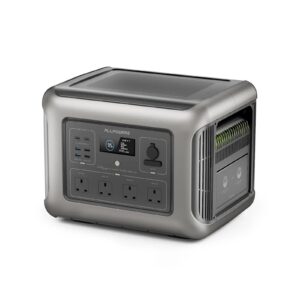
| Capacity | 2,016.00 Wh |
|---|---|
| Net Weight | 29.00 kg (63.93 lb) |
| Dimensions | 456.00 mm (17.95 in) |
| Total Number of Output Ports | 13.00 |
| Total Output Power | 2,500.00 W |
| Number of AC Outputs | 1.00 |
| Max AC Output | 2,500.00 W |
| USB-A | QC 3.0 18W, 5V⎓3A/9V⎓2A/12V⎓1.5A 36W Max. |
| USB-C | 5/9/15V⎓3A, 20V⎓5A, 200W Max. |
| AC Charging | 100.00 W |
| Solar Charging | 1,000.00 W |
| Car Charging | 12V/24V |
| Battery Chemistry | LiFePO4 |
| Operating Temperature | - |
| UPS Function | ✓ |
Our verdict
Benefits
- 2016 Wh usable capacity
- 2500 W AC output
- LiFePO4 chemistry, long cycle life
- Built-in UPS (millisecond switchover)
- Solar charging for real off-grid use
- Brand-direct, app and features with no subscription
Disadvantages
- Heavy, meant to stay in place
- A larger investment
A high-capacity unit for serious home backup and self-consumption, best left in place.
ALLPOWERS R2500 Home Backup Power Station | 2016Wh 2500W promo code
 In stock
ALLPOWERS R2500 Home Backup Power Station | 2016Wh 2500W
VANTOUR*
*Verified price on 23 September 2026. The final price may vary.
As backup at home: the station permanently plugged in against the generator that we will start in the rain
Let’s change the subject because home backup is a whole separate use case, and that’s where comfort makes the difference. Here in Portugal, power cuts happen for real, between old electrical panels and our own devices that sometimes trip the circuit breaker. My entire workstation, the computer and external hard drives, is permanently plugged into my Delta Pro, which acts as an inverter.
Our longest power cut lasted about twenty minutes, and the craziest part is that I didn’t feel anything. No switching, no flickering, nothing restarting. I only realized it because everything around me in the house went dark, while my office continued as if nothing had happened. That’s the true strength of battery backup: devices are already continuously powered by the station, so when the grid goes down, there’s nothing to catch up on.
With a generator, this scenario is impossible to experience so calmly. The power goes out, everything shuts down, and only then do you go outside, in the cold or rain, to start the engine, plug in the extension cord, and turn on your devices one by one, which have already taken the hit. The thermal generator provides backup, yes, but it doesn’t protect gently; it doesn’t act as a buffer. To protect a computer and drives, it makes all the difference.

The home backup battery that also goes on weekends
The last real power cut we had here in Portugal lasted about twenty minutes. And the craziest part is that I didn't even notice it.. I was sitting in front...
Read moreThe real cost: at purchase, but especially per liter of fuel
Let’s talk money because that’s often the argument we hear for thermal: at equal power, it costs less to buy than a big station. That’s true, and it needs to be said. But to stop there is to only look at half of the bill. The real cost of a device that produces energy is the initial price plus everything you put into it over the years.
And here, the ratio slowly shifts. The thermal generator, for every hour of operation, burns fuel that needs to be repurchased, over and over, plus oil changes and wear parts. The solar station, once paid for, recharges from the sun, meaning with free and infinite fuel. Its lithium LiFePO4 battery lasts between 3000 and 6000 cycles, easily eight to fifteen years of use, while a well-maintained thermal engine aims for five to ten years.
Portable solar panel: what it really offers, and which one to take everywhere
The first time I plugged in our 110 W panel, I looked at the app with a smile, ready to see the watts roll in. And the screen showed me...
Read moreTo make this concrete rather than just throwing numbers at you, we’ve prepared a little calculator. You enter your hours of use, the price per liter, and the number of years, and it shows you the fuel bill that thermal will cost you additionally, while solar recharging stays at zero. It’s often this line that sways a decision.
With a solar-powered station, this cost drops to £0 over the same period. The sun is free.
Estimation of fuel only, excluding purchase price, oil, and maintenance. A solar station is paid for at purchase, but its charging energy remains free thereafter.
Who wins for what use, concretely
We’ve compared each criterion, but what you really care about is knowing which one to choose for YOUR life. So we’ve laid things out in a little grid, without beating around the bush. The idea isn’t to designate a universal champion, but to show you the right tool depending on what you really do with it.
- You camp quietly and value silence
- You work or live in the van on a daily basis
- You want to power devices indoors safely
- You are looking for a home backup that gently protects the computer and the router
- You follow the sun or have a panel to recharge for free
- You want neither fuel, nor oil changes, nor the smell of gasoline
- You are pulling heavy loads continuously all day (construction, heavy tools)
- You stay in a fixed location without sunlight for several days in a row
- You want unlimited autonomy as long as there is fuel
- The low purchase price is a priority and noise does not bother you
- The device lives outside, away from ears and any enclosed space
The simple rule: the solar station buys comfort and silence for moderate and predictable needs. The thermal buys endless raw power, at the cost of noise, fuel, and hassle. For many profiles, the real answer is the station for daily use, with a small thermal kept as a backup.
To summarize in one sentence: peaceful camping, remote work in a van, backup for a computer at home, family camping where you want peace, all of that leans heavily towards the silent solar station. The isolated worksite that pulls heavy all day, or the region where the sun disappears for an entire week, remains the domain of thermal. Each to their own kingdom.
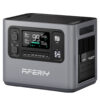
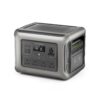
And if you’re convinced by the silent path, you still need to choose the right station. To save you from starting from scratch, here are three models we’ve actually had hands-on experience with, one from each brand, with comparable capacities. You’ll see the specs side by side, prices and promo codes included; it’s more informative than a speech.

I'm Xavier
I test gear over months, in the van and day to day, and I say what doesn't work. If that saves you one bad purchase, leave me your address.
Ce que vous souhaitez recevoir :
Three quiet solar stations we've actually used
£399,00
See the product
|
£829,00
See the product
|
£854,99
See the product
|
|
|---|---|---|---|
| Capacity | 1,024.00 Wh | 2,048.00 Wh | 2,016.00 Wh |
| Net Weight | 12.10 kg (26.68 lb) | 21.60 kg (47.62 lb) | 29.00 kg (63.93 lb) |
| Dimensions | 398,200,283.00 mm (15,677,184.96 in) | 398.00 mm (15.67 in) | 456.00 mm (17.95 in) |
| Total Number of Output Ports | 5.00 | - | 13.00 |
| Number of AC Outputs | 2.00 | 3.00 | 1.00 |
| USB-A | 1*12W | 2 ports, QC 3.0 12W | QC 3.0 18W, 5V⎓3A/9V⎓2A/12V⎓1.5A 36W Max. |
| Application | ✓ | - | - |
| Warranty | 5.00 an | 7.00 an | - |
| Noise | 50.00 dB | - | - |
| Life Cycles | 10 years | 4000+ Charge/Discharge cycles to 80% | - |
| Operating Temperature | -10 to 45°C | - | - |
| Waterproof Rating | 20.00 % | - | - |
| Charging Temperature | 0.00 °C (0.00 °F) | - | - |
| Number of DC Outputs | - | 2.00 | - |
| UPS Function | - | ✓ | ✓ |
| Total Output Power | - | - | 2,500.00 W |

EcoFlow, Aferiy, or AllPowers: the three we’ve really paid for, and which one we recommend
Well, I have to confess something a bit ridiculous, when we open the cupboard under the van bench, we have three power stations staring at each other like cats and...
Read more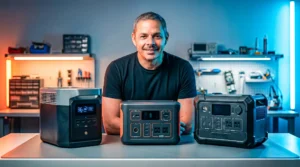
How to Choose Your Portable Electric Station: Buying Guide
The market for portable batteries has exploded in recent years, offering solutions for autonomy ranging from simply recharging a smartphone to fully powering a household in distress. But between pocket-sized...
Coming soonThe real answer is often hybrid, and our honest caveats for both
After all these years, here’s what I really think, and it’s not a choice that’s all black or all white. For the vast majority of people, and clearly for nomadic use, the solar station replaces the generator without regret. We follow the sun; in summer, we go where it’s cool but bright, in winter we head to sunny regions, and we’ve never run out of recharging in years of travel.
But if your situation pins you in a place without sun for days, or if you have a heavy and continuous professional need, the smartest solution isn’t to choose one camp against the other: it’s to make both coexist together. The solar station for all daily needs, silent and clean, and a small thermal generator kept in the back of the garage as a backup for the backup, for the rare times when the sun really abandons you for a long time.
In our case, we already live this coexistence on our scale, without thermal by the way. The big Delta Pro stays at home, planted in a stationary position because it weighs forty kilos and we don’t move it. And it’s a lighter and expandable station, like the Aferiy Nomad 1800 Pro, that plays the versatile role, acting as an inverter at home for part of the year, then taken in the van when we go back out. The same family of devices, two lives, without ever needing to start an engine.
And because I hate articles that only see one side, here are the caveats for both, straightforward. The thermal generator brings noise, odor, maintenance, fuel management, and carbon monoxide that exiles it outside. The station isn’t magic either: it depends on the sun to recharge really for free, it has a finite reserve, a large capacity weighs its weight, and the fan of a large unit can be heard a bit at night. Two tools, two logics, and now you have what you need to decide for yourself.
Generator or solar station: your questions
What fuel do we put in a generator?
The vast majority of portable generators run on unleaded gasoline, the easiest to find. Heavier or professional models switch to diesel, more economical by the hour but noisier and smellier. Some generators also accept gas (LPG), cleaner but requiring the management of bottles. In any case, you have to buy, transport, and store this fuel, whereas a solar station only needs sunlight or a plug.
What is an inverter generator, and is it really quieter?
An inverter generator transforms the current in two stages to deliver more stable electricity, suitable for sensitive devices like a computer. It also adjusts its engine speed to demand, so it is quieter than a traditional generator running at a constant full speed. Quieter, yes, but it remains a thermal engine: we are talking about a subdued purring, not the complete silence of a battery.
How to reduce the noise of a generator that you already own?
We move it as far away as possible and orient the exhaust towards the outside, we place it on an anti-vibration mat rather than on a resonating sheet metal, and we can enclose it in a ventilated soundproof box designed for it. Be careful, a box must always allow air to pass and evacuate gases: we never cover a running unit. These tips reduce the nuisance, they do not eliminate it.
Can you recharge a solar station with a generator?
Yes, a station can be charged from any 220-volt outlet, so from the output of a generator. It's even a combination used by some for long outages without sunlight: the generator runs for a while to fill the station, then it is turned off and we live on the battery, in silence. This way, we concentrate the noise into short windows instead of enduring it continuously.
Is a generator allowed in rest areas and campsites?
It depends on each location, and it is often restricted. Many campsites prohibit or limit groups due to noise and odors, or impose strict schedules. In areas and in bivouac, a rotating group quickly disturbs the neighborhood. A solar station, on the other hand, poses no regulatory or neighborhood issues, as it makes neither noise nor smoke.
What maintenance for a generator that is only used as a backup?
It's the trap of the backup thermal: if it sleeps all year, the fuel evaporates and clogs the carburetor, and on the day it refuses to start. It needs to be run regularly, change the oil according to usage hours, and ideally drain or stabilize the fuel before long storage. A backup station, on the other hand, just needs to stay roughly charged.
Can you run a generator in the rain?
Not directly exposed to the downpour, due to the electrical risk, but especially never in a closed shelter to protect against the rain: that's the deadly reflex, as exhaust gases accumulate. The right solution is an open and ventilated shelter, like a dedicated awning that allows air to circulate. This is yet another constraint that the solar station, usable everywhere including indoors, does not impose.
PS: the evening when the neighbor finally turned off his generator, we turned our little station back on, plugged in the kettle, and listened to the silence return to the spot. It may sound silly, but it’s exactly for that silence that we made our choice a long time ago, and we’ve never looked back.
Our gear tests, in real conditions
Batteries, solar, conversion, security. What we found after months of real use, and what we would not buy again. An email when we have actually tested something, not before.
Ce que vous souhaitez recevoir :